 Skip to content
You may already be in the same spot as many families in The Woodlands. The house is worth more than it was a few years ago. Retirement accounts have grown. Maybe there's a business interest, a second marriage, or kids who are just now becoming adults. Then one question keeps coming up at the kitchen table: “Do we finally need a will or a trust?”
In Montgomery County, that question has practical consequences. Estate planning isn't only about passing property after death. It's also about keeping your family out of unnecessary court problems, reducing confusion, and making sure your instructions work under Texas law.
A good wills and trusts lawyer in The Woodlands should help you make clear decisions, use the right documents, and avoid the common mistakes that create trouble later in probate court. Local details matter. Families in Alden Bridge, Panther Creek, Sterling Ridge, and Creekside often have the same broad goals, but the right plan depends on the assets, the family structure, and how those assets would move through Montgomery County procedures if no plan exists.
Why Estate Planning Is a Priority in The Woodlands Today
A family in Alden Bridge buys a home years ago, names each other on a few accounts, and assumes that is enough for now. Then one spouse's father dies, the family sees how probate works in Montgomery County, and the question changes from “Do we need estate planning?” to “Why did we wait?”
That change is common in The Woodlands because the legal risk is usually not obvious until a health event, death, remarriage, or disabled adult child brings it to the surface. In neighborhoods like Panther Creek, Sterling Ridge, and Creekside, families often have more tied up in a house, retirement accounts, life insurance, and closely held business interests than they realize. The plan that worked ten years ago may no longer match the property they own or the family structure they have now.
Why local families feel the pressure now
Estate planning here is not about preparing for some distant problem. It is about keeping a spouse or child from having to sort out title issues, beneficiary mistakes, and court filings during a hard month.
Texas gives families useful planning tools, but those tools only work if the documents are signed correctly and the assets line up with the plan. A will may still require probate. A trust only helps avoid probate for assets that were transferred into it. Community property rules can help in one situation and create confusion in another, especially in second marriages or blended families. Those are practical issues, not theory.
I often tell clients that the trigger for estate planning is simple. If your family would need instructions, access, or court authority to handle what you own, it is time to put a plan in place.
Why Montgomery County court realities matter
Local court procedure is a large part of the answer. In Montgomery County, probate is often manageable when the paperwork is clear, the original will can be produced, and assets were titled with care. It gets harder when a will was signed improperly, a trust was never funded, or no one can tell whether an account passes by beneficiary designation, survivorship rights, or the estate.
That is why local experience matters in a way generic online forms do not address. Families in The Woodlands are often trying to protect a homestead, keep administration efficient, reduce the chance of disputes among children, and make sure incapacity documents will be accepted when needed. The right lawyer looks at how your plan will hold up with Montgomery County clerks, courts, title companies, and financial institutions, not just whether the document looks finished in a binder.
Good planning also depends on support behind the scenes. Many firms use trusts and estates legal support to help keep document preparation, funding follow-up, and probate filings organized, but the legal judgment still has to come from someone who understands Texas Estates Code and how these cases unfold locally.
The priority is clarity. If something happens tomorrow, your family should have a workable path under Texas law, not a preventable court problem.
Wills Versus Trusts The Texas Rules Explained
A will is a set of instructions. It says who should receive property after you die, who should serve as executor, and who should care for minor children. A trust is more like a legal container. It can hold assets during your lifetime, provide management if you become incapacitated, and continue after death under the terms you chose.
That difference matters in Texas.
The Texas Estates Code allows The Woodlands residents to use revocable living trusts so the grantor keeps control during life while naming beneficiaries to receive assets later without probate, as explained in Texas trust planning guidance for revocable living trusts.
Here is the side-by-side picture many families need:
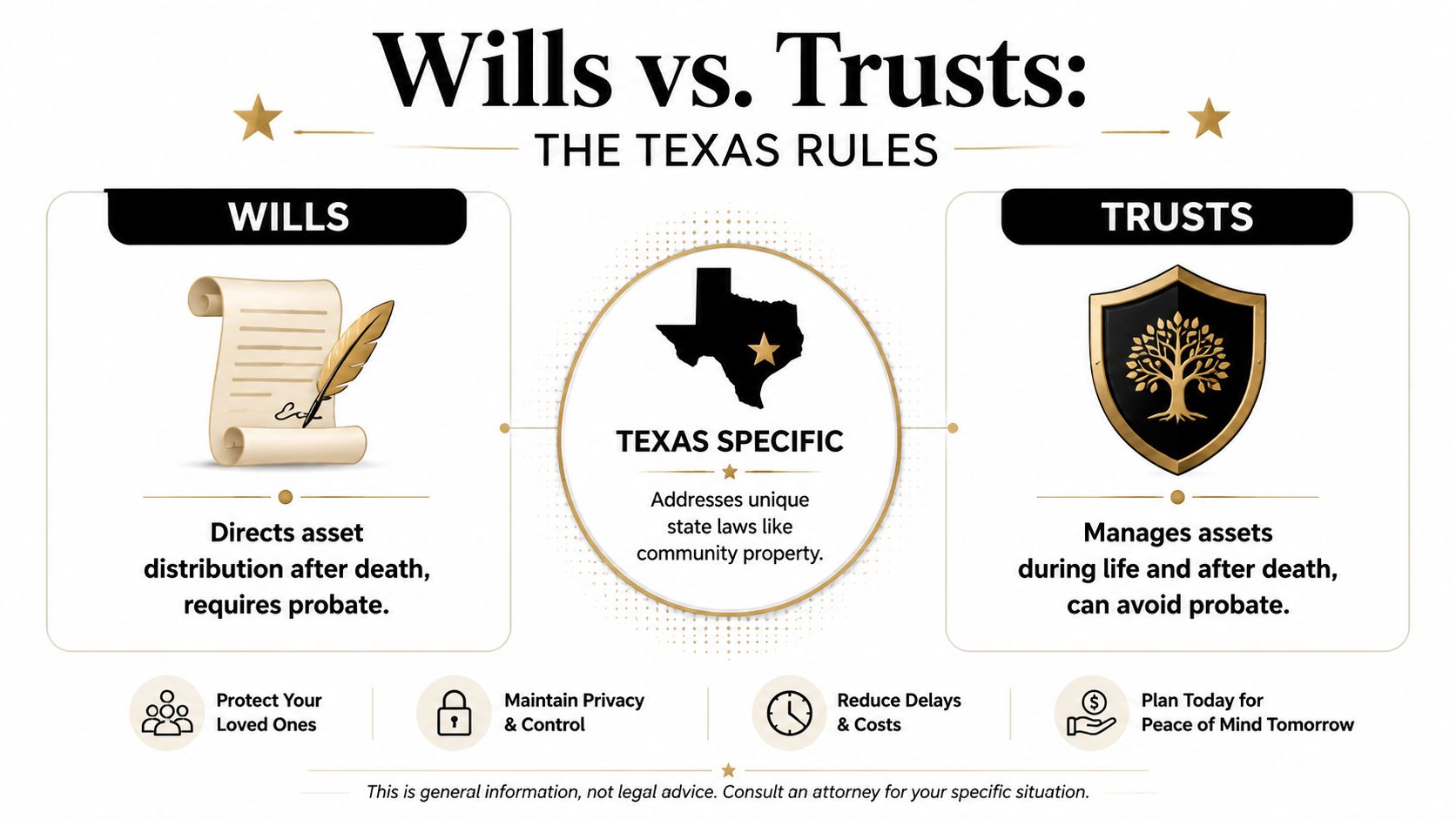
Will vs Revocable Living Trust in Texas at a Glance
| Feature | Last Will and Testament | Revocable Living Trust |
|---|---|---|
| When it takes effect | Operates at death | Can operate during life and after death |
| Probate | Usually goes through probate | Can avoid probate for assets properly placed in the trust |
| Incapacity planning | Doesn't manage assets during incapacity by itself | Can provide ongoing asset management if the grantor becomes incapacitated |
| Privacy | Probate is a court process | Trust administration is generally more private |
| Guardians for minor children | Can nominate guardians | Trust alone doesn't replace the need for a will naming guardians |
| Asset transfer | Distributes through estate administration | Requires assets to be retitled or assigned into the trust |
| Best fit | Simpler estates, straightforward wishes | Families seeking probate avoidance, continuity, and tighter control |
What works well, and what doesn't
A will often works well when the estate is modest, the family structure is straightforward, and the client mainly wants to name guardians and an executor.
A revocable living trust tends to work better when privacy matters, when there are out-of-state assets, when a family wants smoother management during incapacity, or when avoiding probate is a top priority.
What doesn't work is choosing a trust and never funding it. An unfunded trust is a common failure point. The paperwork may look complete, but if major assets never move into the trust, the family may still end up in probate.
The best document is the one that matches how your assets are titled and how your family will actually need them managed.
Texas families also need to think about community property rules and family dynamics, not just asset totals. That's one reason many people ask for both a will and a trust. A pour-over will can catch assets not transferred into the trust, while the trust handles the broader management structure.
For readers comparing document types and workflow support, resources on trusts and estates legal support can help frame the administrative side of planning. Locally, Estate Planning Attorney in The Woodlands addresses wills, trusts, and estate plans for The Woodlands families.
A short video may also help if you want a quick overview before diving into document choices.
Where the Texas Estates Code matters
Under the Texas Estates Code, the legal effect of a will and the administration of an estate depend on formal compliance. Trusts also have technical requirements. If the document language is vague, if execution is sloppy, or if the trust is never funded, the plan can fail in exactly the way families were trying to avoid.
That's why the will-versus-trust choice shouldn't be treated as a generic internet checklist. In The Woodlands, the right answer is often a coordinated plan rather than an either-or answer.
The Role of Your Estate Planning Attorney
A lawyer's job isn't just to draft papers. The essential work begins earlier.
An estate planning attorney helps identify what you own, how it's titled, who should control it if you become incapacitated, and how to reduce the chance of a future dispute. In practice, that means looking at deeds, beneficiary designations, family relationships, business interests, and whether your goals line up with Texas law.
What your attorney is really doing
A strong planning process usually includes several layers:
- Clarifying your goals: Do you want probate avoidance, protection for a surviving spouse, structure for children, or cleaner handling of family conflict?
- Matching tools to the problem: Some families need a will, powers of attorney, and medical directives. Others need a trust because the issue is management, privacy, or complexity.
- Checking legal formalities: The Texas Estates Code requires a valid will to be signed by the testator and witnessed by at least two credible individuals age 14 or older who are present at the same time, as summarized in guidance on valid will requirements in The Woodlands.
- Reducing ambiguity: Clear trustee powers, beneficiary definitions, backup appointments, and distribution terms matter more than generally realized.
Why this matters in family situations
The more tension there is in a family, the more precision matters. That can include blended families, estranged adult children, second marriages, a child with special needs, or overlap with divorce and property division issues under the Texas Family Code.
In those cases, vague language often creates the very conflict the client wanted to avoid. A lawyer helps pressure-test the plan before it becomes a court file.
Local insight: In estate planning, most preventable disputes start with assumptions. “Everyone knows what I mean” is not a legal strategy.
A lawyer also coordinates the pieces that people often miss, including durable powers of attorney, medical powers, HIPAA releases, and trust funding steps. Drafting is only part of the service. Making the plan usable is the part families remember later.
Your Step by Step Guide to Creating an Estate Plan in Montgomery County
A Panther Creek parent dies with a will from an online form, a house in The Woodlands, two retirement accounts, and children from a prior marriage. The family learns, in the middle of grief, that the will does not answer every practical question, the beneficiary designations point in a different direction, and the probate court still needs clean paperwork before anything can move. That is why estate planning here needs more than generic documents. It needs a plan that will hold up under Texas law and in Montgomery County procedure.
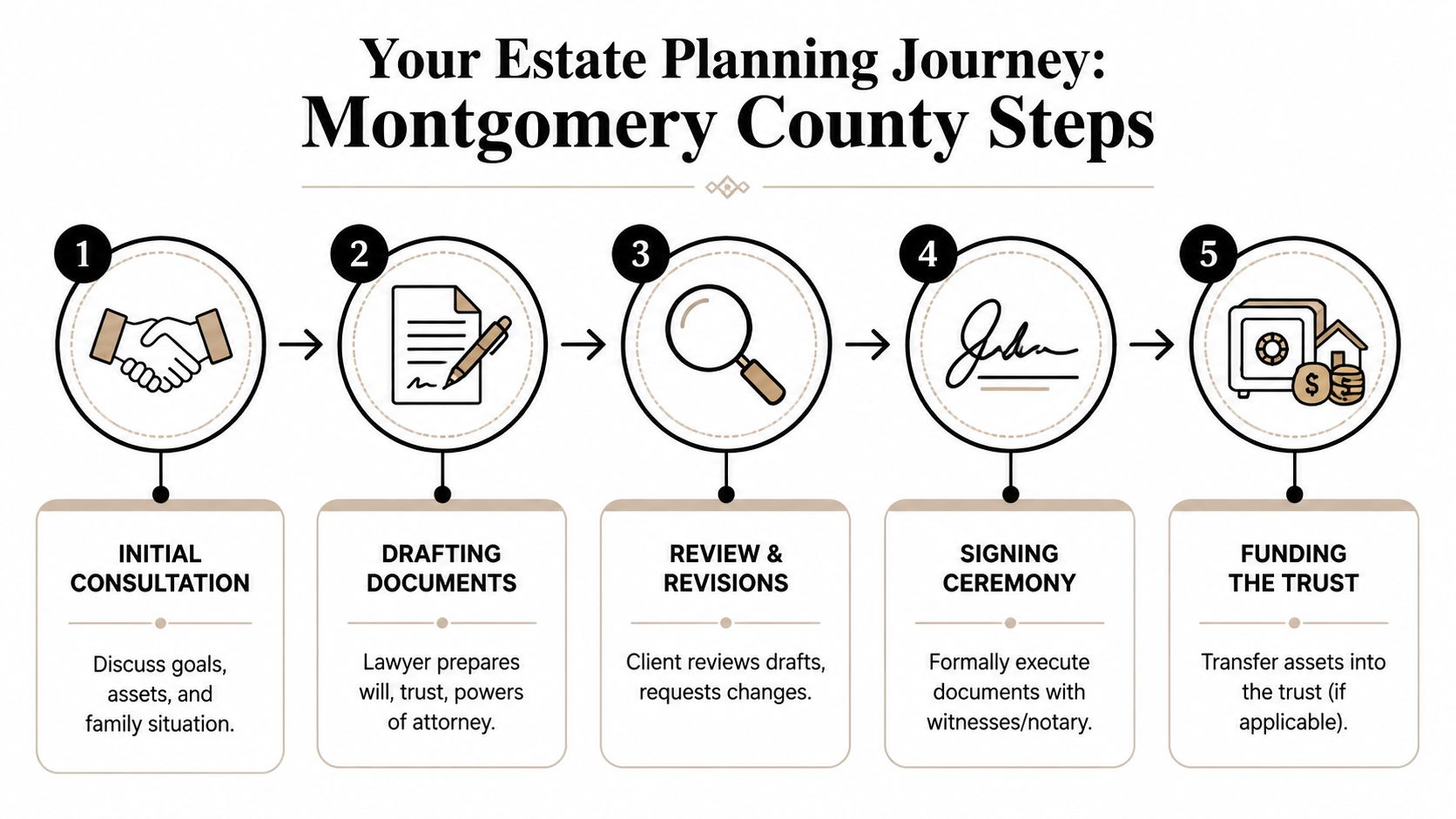
Step 1 Gather the facts before the meeting
Start with the parts of your life that a court or financial institution will care about later. List your real estate, bank accounts, retirement plans, life insurance, business interests, debts, and any asset with a beneficiary designation. Include how title is held. In Texas, that detail often controls the result as much as the will or trust language.
For Woodlands families, I also want to see deeds, prior estate planning documents, divorce decrees, premarital agreements, and company records for closely held businesses. In blended families or second marriages, those records often reveal the issues that cause trouble later, especially where separate and community property have been mixed over time.
Step 2 Choose the right people for the right roles
An estate plan only works if the people named in it can do the job.
That means choosing an executor who can deal with deadlines, an agent under a power of attorney who can handle banks and title companies, a guardian who is realistic for your children, and a trustee who will follow the written terms even when family pressure starts. The oldest child is not always the best choice. The sibling who lives closest is not always the best choice either.
In Montgomery County, these appointments become practical quickly. If probate is needed, the person you name may be the one collecting records, appearing in court, and coordinating with the clerk, appraisers, or financial institutions. Reliability matters more than sentiment.
Step 3 Review the draft like your family will have to live with it
Poorly drafted wills and unfunded or unclear trusts are a common source of estate disputes. The problem is usually not one dramatic mistake. It is a series of smaller ones. A missing backup executor, vague language about children from a prior relationship, outdated beneficiary designations, or a trust that was signed but never funded.
Review should answer real questions. Who inherits if a beneficiary dies first? Who manages money for a minor child at age 18, 25, or 30? Does the plan account for a remarriage, a family business, or a child who should not receive assets outright? If a judge in Montgomery County read these documents during a probate dispute, would the instructions be clear?
That is the standard.
A short real-world scenario
A couple in Alden Bridge came in with a basic online will and the assumption that everything would pass smoothly to their children. One spouse had a child from a prior relationship. The house had increased in value. Several financial accounts still carried old beneficiary designations. Their paperwork did not match their intentions.
The fix was straightforward but detailed. We revised the documents, updated fiduciary appointments, and checked title and beneficiary designations so the plan worked as a system instead of a stack of separate papers.
If your estate plan does not match your beneficiary designations and title records, your family may end up following the wrong document.
Step 4 Sign the documents with the right formalities
Signing day should be controlled and deliberate. For a will, Texas law requires proper execution formalities. For powers of attorney, medical directives, and trust documents, notarization and related requirements need the same level of care.
Local practice matters here. A document can look polished and still create problems if it was signed casually, witnessed incorrectly, or left incomplete. Families often do not discover that kind of defect until a bank refuses the document or a probate court reviews it after death.
Step 5 Finish the funding and keep the plan current
This is the step families skip most often. A revocable trust does not avoid probate for assets that were never transferred into the trust. Deeds may need to be prepared and recorded. Beneficiary forms may need to be updated. Business documents may need to be coordinated with the estate plan.
Life changes matter too. A move within Texas, a marriage, a divorce, a new child, a major increase in assets, or a death in the family should trigger a review. Caregiving issues often push families to act, and a practical outside guide on estate planning for caregivers can help frame those conversations. If your family is already dealing with the court process after a death, estate administration in The Woodlands explains what that process looks like locally.
A good estate plan is not measured by how it reads in your office. It is measured by whether your family can use it without avoidable court fights, delays, or confusion in Montgomery County.
Understanding Costs Timelines and Montgomery County Probate
A family in Alden Bridge can have a signed will, a paid-off home, and clear intentions, then still spend months dealing with court filings, notices, and title problems after a death. That is the part generic estate planning articles miss. In Montgomery County, the real question is not only what your plan costs to prepare. It is what your family will have to do with it later.
The answer usually turns on structure. A will-based plan often costs less upfront because the drafting is narrower and there is less transfer work during life. A trust-based plan usually costs more because it requires drafting, funding, and coordination with deeds and beneficiary designations. In the right case, that added work reduces court involvement, shortens the post-death administration burden, and gives the family more privacy.
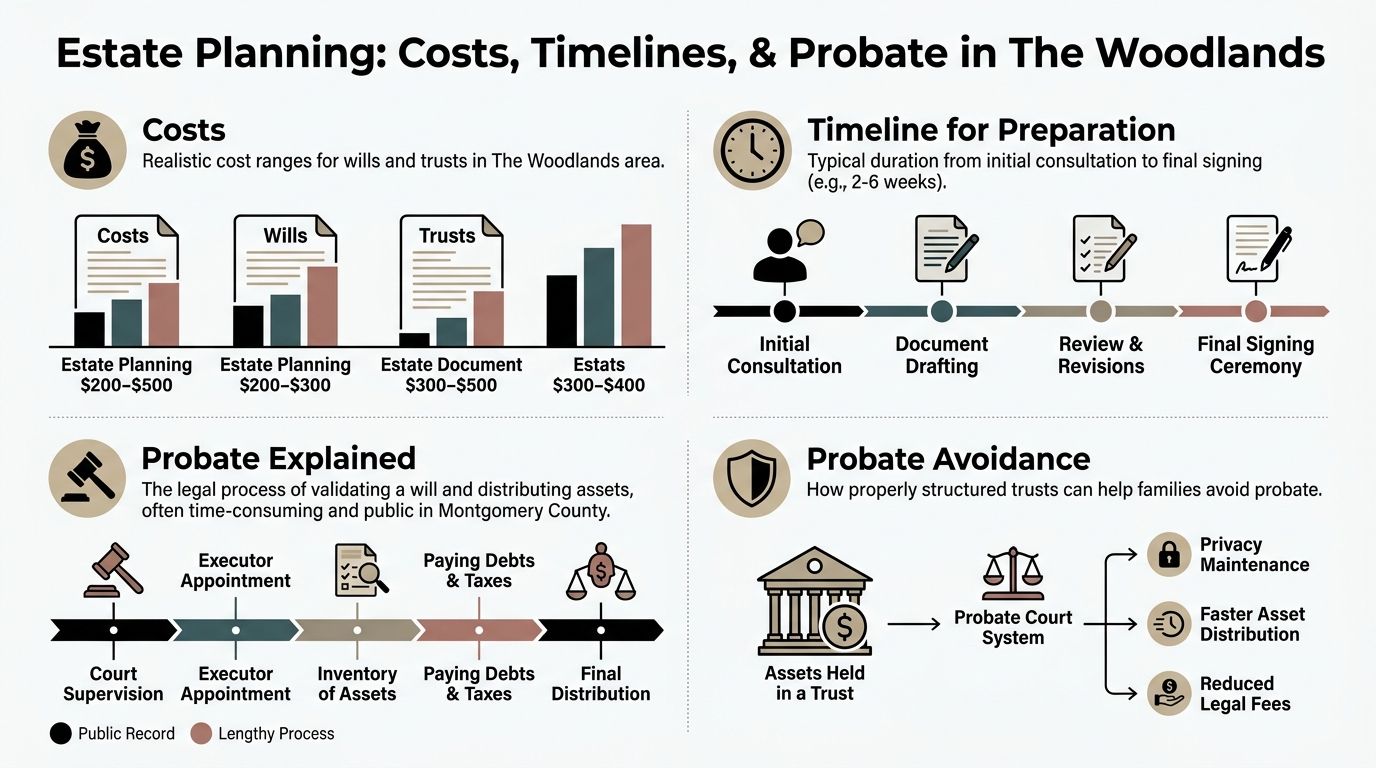
What probate looks like here
Montgomery County probate is a formal court process, not a stack of papers your family drops off at the courthouse. The court may require an application, sworn filings, a hearing, notices, inventory work, and follow-up steps that depend on whether there is a valid will, whether an independent administration is available, and what assets were titled in the decedent's name alone.
That local procedure matters. A house in Panther Creek that was never transferred into a trust may still need probate even if the family assumed everything was "covered." An out-of-state form will can create delays if execution or self-proving requirements do not line up cleanly with Texas practice. A missed beneficiary update can send an account outside the plan entirely.
Families who want a practical overview of the local court sequence can review the Montgomery County probate court process. For a pending estate, Probate Lawyer in The Woodlands, TX covers probate administration and estate settlement in Montgomery County.
What families should weigh
A useful comparison looks like this:
| Consideration | Will-Based Plan | Trust-Based Plan |
|---|---|---|
| Up-front drafting | Usually simpler | Usually more involved |
| Court involvement after death | More likely | Often reduced for funded trust assets |
| Administration timeline | Often tied to court scheduling and probate steps | Often faster for assets already titled in the trust |
| Asset transfer work during life | Less immediate retitling | Requires follow-through to fund the trust |
| Best use case | Simpler family and asset picture | Higher complexity, privacy concerns, probate avoidance goals |
The trade-off is practical, not theoretical. If a family owns one home, has straightforward beneficiaries, and expects little conflict, a well-drafted will plan may be enough. If the family has remarriage issues, minor children, privacy concerns, rental property, or a strong desire to keep the house out of probate, a funded revocable trust often makes more sense.
What works and what backfires
The plans that hold up in Montgomery County are the ones that match the asset list and are finished correctly.
A trust works well only if the home, non-retirement accounts, and other intended assets are transferred to the trust. If that step never happens, the family may still face probate for those assets. I see that problem more often than families expect. They paid for probate avoidance, but title never changed.
A cheap plan can also become an expensive one if it leaves executor authority unclear, ignores Texas homestead issues, or names the wrong people for the wrong jobs. Those are not drafting details. They are administration problems waiting for a court file.
A trust can reduce probate exposure, but only for assets that were properly moved into the trust or coordinated with it.
How long planning and probate usually take
Creating the plan is usually the shorter part. A straightforward matter can move quickly if the client provides asset information, chooses fiduciaries, and signs without delay. A blended-family plan or a plan involving business interests usually takes longer because the drafting needs more precision and the funding work is heavier.
Probate moves on a different clock. Court settings, required notices, creditor periods, title problems, and missing records can all slow the process. That is one reason local experience matters. A lawyer who regularly handles Montgomery County estates can spot avoidable delays before they become expensive ones.
Even law firms that want to attract more law firm clients know that practical local process is what earns trust. Estate planning works the same way. Families in The Woodlands benefit most from plans built for how Montgomery County handles property, probate, and post-death administration.
How to Choose the Right Wills and Trusts Lawyer for Your Family
Choosing a wills and trusts lawyer in The Woodlands isn't only about finding someone who says they handle estate planning. You want someone who understands how these documents hold up when a real family uses them under real Montgomery County conditions.
Questions worth asking in the first meeting
A useful consultation should answer practical questions, not just describe legal products.
Ask things like:
- How often do you handle Montgomery County probate or estate administration matters? A drafting lawyer should understand what happens if the plan is later tested in local court.
- How do you handle blended families or second marriages? This matters in The Woodlands, where family structures are often more complex than the documents suggest at first.
- What is your process for trust funding? If the answer stops at “we draft the trust,” that's incomplete.
- How do you coordinate estate planning with divorce, property division, or custody issues? The Texas Family Code can matter when family court orders and estate documents overlap.
- Will you review beneficiary designations and title issues? Good planning goes beyond the signed packet.
Red flags people overlook
Some warning signs are easy to miss because the meeting feels efficient.
- One-size-fits-all drafting: If every client gets the same package without much discussion, the plan may not fit.
- No discussion of local court realities: A lawyer who never talks about probate procedure may be drafting in a vacuum.
- Unclear fee communication: You should understand what is included, what follow-up work costs, and whether trust funding assistance is part of the engagement.
- No questions about family conflict: Estate plans fail most often where conflict was predictable and ignored.
Why local roots matter
Local experience doesn't mean fancy branding. It means understanding how clients in Panther Creek, Alden Bridge, and nearby Montgomery County communities hold property, structure businesses, and manage family disputes.
That local familiarity is one reason to review estate planning attorney services in The Woodlands when comparing options. The Law Office of Bryan Fagan serves families in this area in probate and family-law-related matters, which can be relevant when an estate plan intersects with divorce, custody, or property division.
A side note. When you research lawyers online, remember that visibility and fit are different things. Articles about how firms attract more law firm clients can explain why some names appear first in search results, but your decision should still come down to experience, clarity, and whether the lawyer addresses your family's actual risks.
Choose the lawyer who asks the harder questions. Those questions are often what prevent later litigation.
Your Estate Planning Checklist and Next Steps
If you've been putting this off, keep the next steps simple.
What to do next
- List your major assets: Include your home, bank accounts, retirement accounts, insurance, and any business interests.
- Review beneficiary designations: Make sure those designations still match your current wishes.
- Think about roles, not just names: Choose the right executor, trustee, guardian, and agents for financial and medical decisions.
- Note any family complications: Prior marriages, stepchildren, a child with special needs, or current divorce issues should be discussed early.
- Gather existing documents: Bring old wills, trusts, deeds, powers of attorney, and relevant court orders.
- Schedule a consultation: A local lawyer can tell you whether you need a will-based plan, a trust-based plan, or a combination.
One final practical point
Under the Texas Estates Code, formalities matter. Under the Texas Family Code, family circumstances can affect the planning choices that make sense. A plan that is clear, current, and correctly signed is far better than a document that sits in a drawer and doesn't fit your life anymore.
This article is for informational purposes only. It is not legal advice, and reading it does not create an attorney-client relationship. Estate planning decisions depend on your specific facts, assets, and family circumstances.
If you're ready to sort through wills, trusts, probate concerns, or family-related planning issues in The Woodlands or Montgomery County, a consultation can help you decide what fits and what doesn't.
If you'd like to talk through your situation in plain English, you can schedule a consultation with The Law Office of Bryan Fagan. That conversation can help you identify whether a will, a trust, or a more complete estate plan makes sense for your family in The Woodlands.
