 Skip to content
You may be sitting at a kitchen table in Panther Creek or Alden Bridge with a stack of account statements, a mortgage, maybe a business interest, and kids who depend on you. You know you need a plan, but the hard part is deciding where to start and who to trust.
That's where an estate planning attorney in The Woodlands, TX can make a real difference. A good plan isn't just about who gets what after death. In Montgomery County, it also needs to account for divorce, custody disputes, remarriage, beneficiary problems, and the practical reality that family situations change faster than most legal documents do.
Why Your Family in The Woodlands Needs an Estate Plan
A lot of families in The Woodlands put this off for understandable reasons. Life is busy. The documents sound technical. And many people assume a simple will is enough until a major life event proves otherwise.

A common local example is a couple in Alden Bridge with a home, retirement accounts, and two children. One spouse says, “We should get a will.” The other says, “We'll do it after school starts” or “after year-end” or “when things calm down.” Then a health scare, a marital problem, or a parent's death puts the issue in front of them all at once.
According to a 2024 survey by Caring.com, nearly 68% of American adults do not have an estate plan in place, a gap that can extend the probate process in Texas by over six months and increase legal costs for families, as discussed in this overview of estate planning in The Woodlands.
Estate planning is more than a will
An estate plan is a set of instructions and legal tools. It usually addresses:
- Who receives assets if you die
- Who manages money if you become incapacitated
- Who makes medical decisions if you can't speak for yourself
- Who would care for minor children
- How to reduce probate delays and family conflict
For many families in Montgomery County, the harder questions aren't about property. They're about people. Who will serve as guardian? Can an ex-spouse still inherit through an outdated beneficiary designation? What happens if you remarry and have children from different relationships?
Practical rule: If your family has changed, your estate plan should probably change too.
The local stakes are higher than people expect
The Woodlands isn't a one-size-fits-all community. A family in Creekside may have young children and a recent adoption. A family in Sterling Ridge may be planning around a second marriage. A business owner in Panther Creek may be balancing company interests, community property concerns, and future guardianship decisions.
That's why estate planning should be treated as a working strategy, not a document packet. A plan that looks complete on paper can still fail in practice if it doesn't match your current life, title work, beneficiary designations, and family court realities.
If you're starting from scratch, this primer on estate planning services for The Woodlands families is a useful first step. The key is starting before a crisis forces the family into court.
What to Look For in a Woodlands Estate Planning Attorney
Not every attorney who drafts wills is equipped to spot problems created by divorce, custody orders, or blended-family conflict. In Montgomery County, that overlap matters more than most marketing pages admit.
Data from the Texas State Bar shows that 22% of divorce decrees in Montgomery County involve contested asset division that directly impacts beneficiary designations, yet 85% of local attorney marketing pages omit this specific intersection of family law and estate planning. That gap is exactly where families get surprised.
Why family law experience matters
A strong estate plan can unravel when family law enters the picture. Divorce filings, custody disputes, and remarriage can affect:
- Beneficiary designations on life insurance and retirement accounts
- Powers of attorney that still name an estranged spouse
- Guardianship choices for children from prior relationships
- Trust administration when a former spouse still has a role
- Inheritance structure for blended families
An attorney who understands both probate and family law sees these collisions earlier. That lawyer is more likely to ask the uncomfortable but necessary questions: Is a divorce pending? Is there a custody fight? Are separate and marital assets clearly identified? Has anyone updated medical directives since remarriage?
A plan that ignores family litigation isn't finished. It's just signed.
Local knowledge matters too
Montgomery County practice has its own rhythm. Families in Sterling Ridge, Creekside, Alden Bridge, and Panther Creek often deal with high-value homes, retirement assets, closely held businesses, and complicated parenting arrangements. A lawyer with local court familiarity is usually better positioned to draft a plan that works in practice, not just in theory.
One practical example is content and service descriptions like Estate Planning Attorney in The Woodlands, which focuses on wills, trusts, and estate plans for The Woodlands families. That kind of work is most effective when it's informed by what happens later in Montgomery County probate and family courts.
Questions that reveal real depth
When you're evaluating an attorney, listen for substance, not slogans.
Ask things like:
- How do you handle estate plan updates during divorce or custody litigation
- What problems do you see with blended families in Montgomery County
- How do you coordinate trusts with beneficiary designations
- What happens if one spouse wants to revise a plan while family litigation is pending
- How do you address guardianship planning when parents disagree
The right lawyer won't answer these with generalities. They'll explain trade-offs. They'll tell you what works, what often fails, and what needs to be reviewed when family relationships shift.
Understanding Wills Trusts and Powers of Attorney
A family in The Woodlands can have a signed will and still leave a mess behind. I see that after divorce, during custody disputes, and after remarriage. The documents exist, but the beneficiary designations still name an ex-spouse, the guardian section does not match the current parenting reality, or the trust was never funded. That family law and estate planning collision is where many plans fail.

What a will does
A will states who should receive your property at death and can nominate a guardian for minor children. In Texas, execution rules matter. A typed will usually needs the testator's signature and two witnesses who meet legal requirements. If the signing ceremony is sloppy, the fight later is often about validity before anyone even reaches your actual wishes.
That risk gets higher in blended families. If you have children from a prior marriage, a simple will may not solve the underlying problem. A surviving spouse can have rights in some property, minor children may need a court-created management structure, and family members may disagree about who should control money for the children. In Montgomery County, those disputes are rarely about one sentence in a document. They are about whether the plan fits the family as it exists now.
What a trust does differently
A revocable living trust can hold assets during your lifetime and pass those assets without probate if the trust is properly funded. Privacy is one reason people use trusts in Montgomery County. Control is another. A trust can also be useful where remarriage, separate property claims, or children from different relationships make an outright distribution risky.
The trade-off is maintenance. A trust only works for the assets titled to it, or otherwise coordinated with it. If the house stays in your individual name, the trust may not control it. If a retirement account names the wrong beneficiary, the trust may not control that either. My Policy Quote explains beneficiary designation in a way many clients find helpful before they review their own accounts.
For a practical local overview, this page on wills and trusts in The Woodlands outlines the basic options.
One point matters here. A trust is not automatically better than a will. For some families, a straightforward will package is enough. For others, especially families dealing with divorce, child support obligations, special needs planning, or a second marriage, a trust can prevent exactly the kind of conflict that spills from family court into probate court.
Powers of attorney matter during life
A durable power of attorney allows someone to handle financial matters if you cannot. A medical power of attorney lets someone make healthcare decisions when you are unable to communicate informed consent.
These documents often become urgent before any will or trust does.
That is why I tell Woodlands families to treat powers of attorney as part of incapacity planning, not as paperwork to sign at the end. If a spouse is disabled during a pending divorce, or if parents in a custody dispute disagree about medical authority for a child, old documents can create more confusion instead of less. The right agent on paper is not always the right agent after a major family change.
Guardianship decisions are often the real issue
Parents with young children usually start by asking who gets the house or retirement account. The harder question is who will raise the children and who will manage money for them.
A will can nominate a guardian, but that choice should be made with the family court history in mind. If there has been prior litigation, supervised possession, substance abuse concerns, or conflict between a surviving parent and extended family, your estate plan needs to reflect those facts clearly and lawfully. This is a critical nuance that most guides ignore but is a core specialty of The Law Office of Bryan Fagan.
Good planning here is specific. It accounts for who should serve, who should not, how money should be managed for minors, and whether the people raising the child should be the same people controlling the child's inheritance. For many Montgomery County families, those should be different roles.
Preparing for Your Initial Consultation
The first meeting is easier when you treat it like preparation for a financial and family strategy session, not a test. You don't need perfect records. You do need enough information for the attorney to see the full picture.
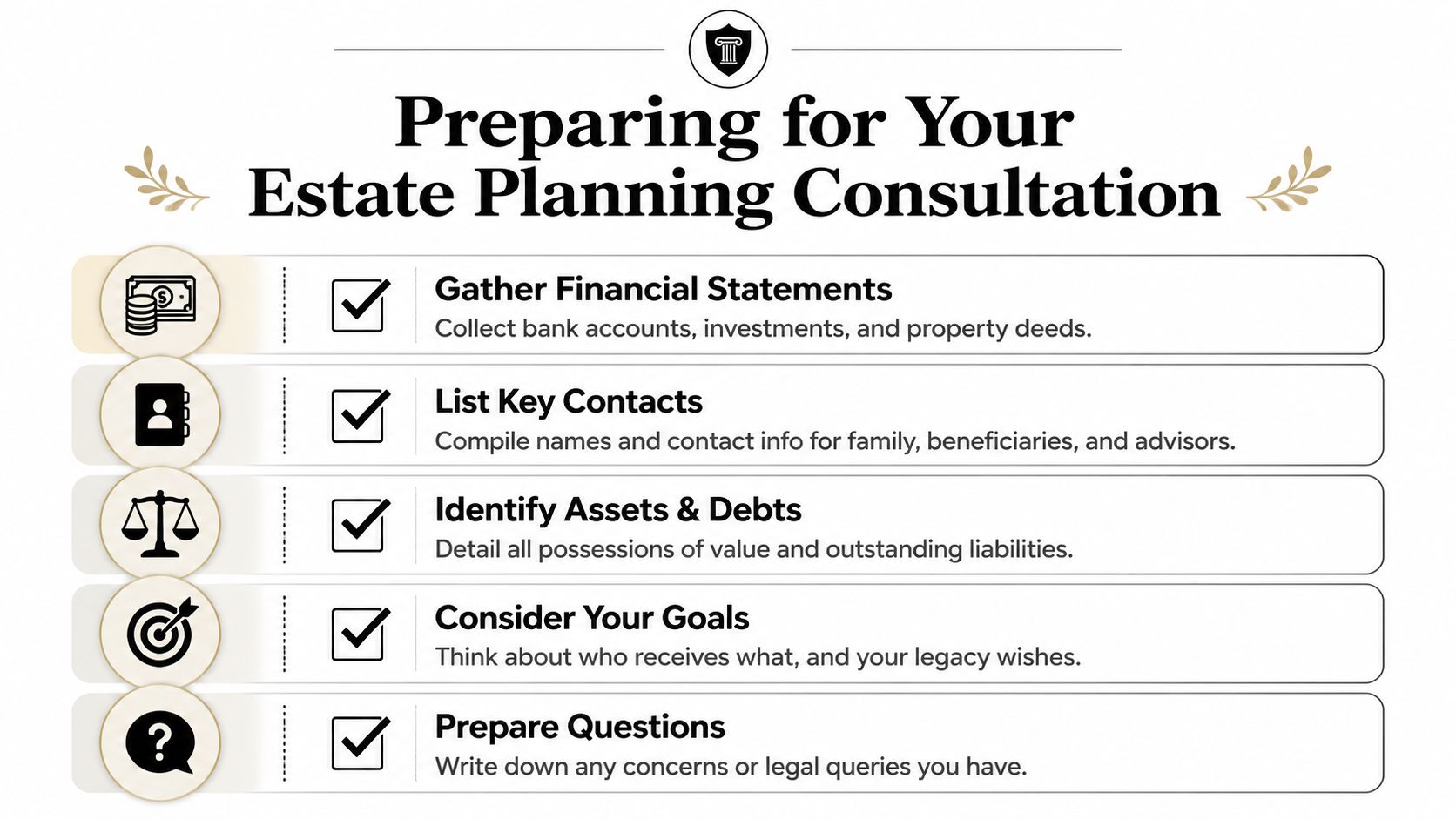
A short scenario shows how this works. A married couple in Creekside came in with retirement account statements, their deed, a list of life insurance policies, and one handwritten page about their goals. They also identified the core issue early: one spouse had children from a prior marriage and didn't want an accidental disinheritance after remarriage. That made the consultation productive because the family dynamic was clear from the start.
What to bring
The most useful preparation is practical, not fancy.
- Asset records: Bring account summaries, deeds, business ownership records, and a rough list of major personal property.
- Debt information: Include mortgages, lines of credit, and other significant obligations.
- Family details: Write down full names for spouse, children, former spouses, and anyone you may name in a fiduciary role.
- Existing documents: Bring old wills, trusts, powers of attorney, divorce decrees, and custody orders if they exist.
- Decision list: Note who you trust for executor, trustee, guardian, and agent roles.
Here's a quick visual many clients find helpful before they walk in:
What to ask in the meeting
The best questions are the ones that expose future problems, not just drafting mechanics.
Consider asking:
- How should my plan change if divorce is filed or already pending
- Do my beneficiary designations match the estate plan
- Should my children inherit outright or through a trust
- Who should control money for a minor child
- What documents need review after remarriage or adoption
- Are there title or deed issues that could defeat the plan
What to decide before you arrive
You don't need every answer, but think through these topics first:
| Topic | Why it matters |
|---|---|
| Guardian choices | Courts can end up deciding if parents don't |
| Trustee or executor | The wrong person can create conflict or delay |
| Blended family goals | Equal isn't always fair in second-marriage planning |
| Medical authority | Hospitals need clear documents and clear decision-makers |
Bring the awkward facts to the first meeting. Prior marriages, estranged children, business disputes, and custody orders usually matter more than the account balance.
What to Expect for Fees and Timelines in Montgomery County
A common Montgomery County scenario looks like this. A parent remarries, keeps the old beneficiary designations in place, puts off updating the will, and assumes the new spouse will be able to sort things out later. Then a health crisis, death, or divorce filing forces everyone to deal with the paperwork at the worst possible time.
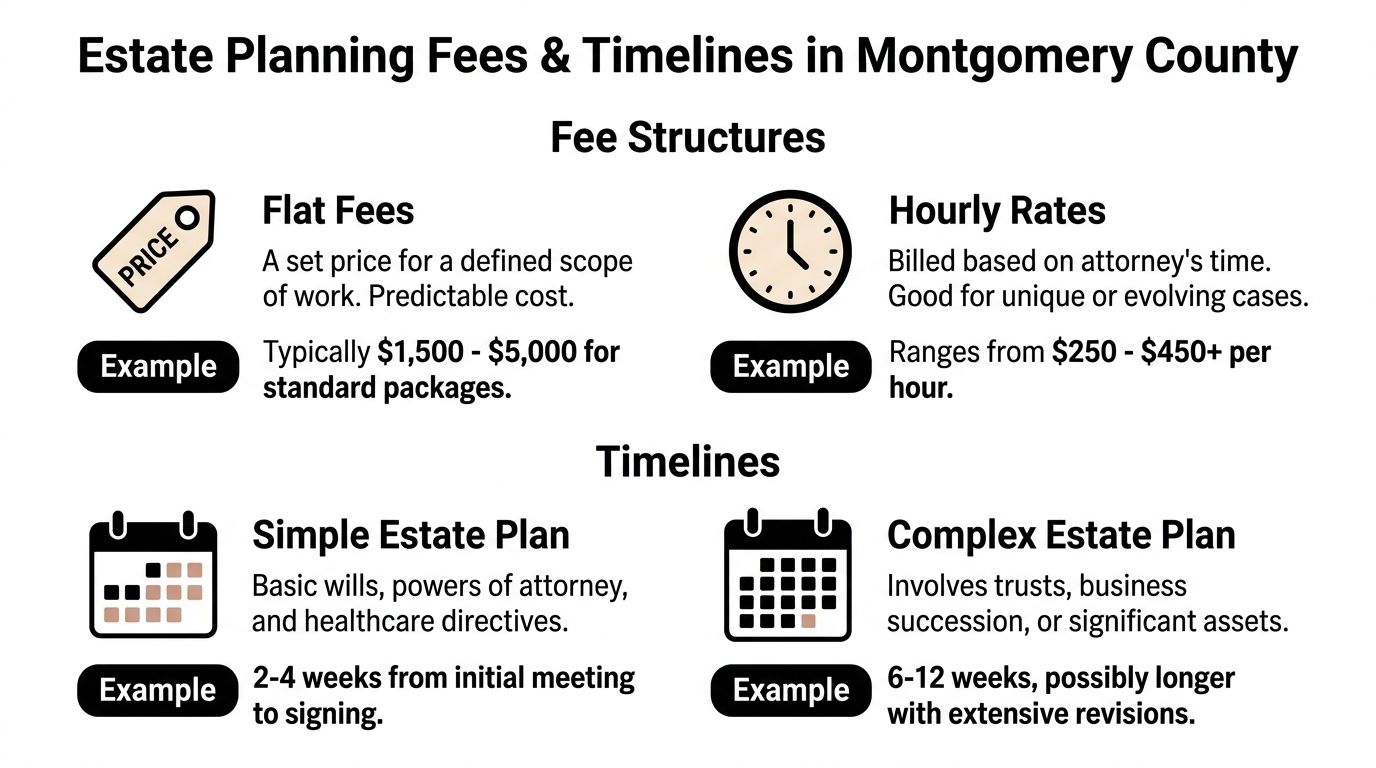
That is why fees and timing vary so much in estate planning. A basic plan for a couple with clear goals and simple assets usually moves quickly. A plan involving remarriage, children from different relationships, separate property claims, prior divorce decrees, or custody restrictions takes more work because those family law issues can change who should inherit, who should manage money, and who should make decisions if someone becomes incapacitated.
How fees are usually structured
In this area, attorneys usually charge either a flat fee for a defined set of documents or hourly rates for planning that requires extra drafting, deed work, trust funding advice, or coordination with a divorce or custody matter. Ask what is included. Some quotes cover only the documents. Others include deed review, beneficiary coordination, signing meetings, and follow-up revisions.
That difference matters.
A lower fee can become expensive if the plan ignores a retirement account, an ex-spouse still listed on life insurance, or a homestead that was never retitled after divorce. I often tell families to focus less on the sticker price and more on whether the plan fits their household. In blended-family planning, equal shares on paper can create very unequal results in real life.
For homeowners in The Woodlands, the house is often the asset that creates the most confusion. Title, homestead status, and tax consequences all affect the planning discussion. If you want background before the meeting, this guide to understanding Montgomery County property tax helps frame part of that conversation.
Why the timeline can stretch
Many estate plans are finished in a matter of weeks, but the timeline usually depends on decisions, not drafting speed. Delays tend to come from missing deeds, uncertain beneficiary choices, old family court orders, or disagreement about who should serve as trustee, executor, or guardian.
Family law collisions slow things down more than clients expect. If support obligations exist, if a divorce is pending, or if one parent should not control a child's inheritance, the estate plan has to be written with those facts in mind. This is a critical nuance that most guides ignore but is a core specialty of The Law Office of Bryan Fagan.
Planning now usually costs less than fixing a mess later
The actual comparison is current planning costs versus later court costs, delay, and conflict.
Some families need a will and powers of attorney. Others need trusts because they are trying to protect children from a prior marriage, control when a young adult receives money, or prevent an unintended result after remarriage. The right answer depends on the family structure and the risk of conflict, not on a one-size-fits-all package.
If you want a practical look at what happens after death when the plan is missing or poorly coordinated, read this overview of how long probate can take in Texas. In Montgomery County, probate delays often trace back to the same problems I see during planning: unclear authority, title issues, outdated documents, and family members who were never put on the same page.
Clients are usually paying for clarity, control, and fewer problems for the people they leave behind.
Your Action Plan for Securing Your Familys Future
The hardest part is usually starting. Once families decide to act, the process becomes much more manageable.
What to do next
Use this checklist if you're ready to move forward:
- List your people: Identify who should serve as executor, trustee, guardian, and medical or financial agent.
- Gather your documents: Pull deeds, account statements, insurance information, prior estate documents, and any divorce or custody orders.
- Review your life changes: Note births, adoptions, remarriages, separations, business changes, and beneficiary updates that may affect the plan.
- Write down your goals: Be clear about who should receive assets, who should manage them, and how you want minor children protected.
- Schedule a consultation: Bring the practical facts, including uncomfortable ones. That's how a workable plan gets built.
The issue many families miss
The biggest blind spot in Montgomery County isn't just failing to sign documents. It's failing to coordinate estate planning with family law realities.
If divorce is pending, if custody is contested, if you're entering a second marriage, or if children from different relationships are involved, your estate plan needs more than boilerplate. It needs coordination. In my experience, that's where families either protect themselves well or leave behind a mess no one intended.
A final note before you act
This article is for informational purposes only and is not legal advice. Reading it does not create an attorney-client relationship. Estate planning depends on your specific facts, your family structure, your assets, and any current or pending issues under the Texas Estates Code or Texas Family Code.
If you live in The Woodlands, Sterling Ridge, Creekside, Alden Bridge, Panther Creek, or elsewhere in Montgomery County, the right next step is a focused conversation with a lawyer who understands both estate planning and the family law issues that can disrupt it.
If you're ready to talk through wills, trusts, powers of attorney, divorce-related updates, or blended-family planning, you can schedule a consultation with The Law Office of Bryan Fagan.
