
Montgomery County has no single family court; family cases are heard by designated district courts under countywide assignment rules, and the courtroom depends on the case type and status, not on whether your family lives in The Woodlands.
Why, then, can a court named on an older divorce decree be the wrong place to submit a new request? The answer requires separating a court's legal authority from its current filing assignments. That distinction matters whether you're starting a divorce, changing a custody schedule, or asking a judge to enforce an existing order.
Several Designated District Courts Hear Family Cases
Several Montgomery County district courts share family-case work under countywide rules. The Texas judiciary's record of Montgomery County family rules names the 9th, 221st, 284th, 359th, 418th, 435th, and 457th District Courts. That designation identifies a court's connection to family practice; assignment orders address which court handles particular filings.
Designated Montgomery County district courts and published status
| Court | Named in county family-rules record | Status noted in published materials | What to confirm |
|---|---|---|---|
| 9th District Court | Yes | County order says it no longer receives new family cases | Current new-case assignment |
| 221st District Court | Yes | Included in the county order's no-new-family-cases list | Current new-case assignment |
| 284th District Court | Yes, with family-rules designation | Listed as no longer receiving new family cases; separate assignment orders address new, pending, and post-judgment cases | Which assignment order applies |
| 359th District Court | Yes | Listed as no longer receiving new family cases | Where a post-judgment filing goes |
| 418th District Court | Yes, with family-rules designation | Receives specified post-judgment filings in rotation with County Court at Law No. 3 | Rotation status for the filing |
| 435th District Court | Yes, with family-rules designation | Listed as no longer receiving new family cases | Post-judgment routing |
| 457th District Court | Yes | The family-rules listing does not establish its current intake status | Whether a current order assigns the case category there |
The table summarizes published assignments, not a live docket. Treat it as a guide to what to verify, rather than a list of courts you can choose from.
Why official listings can look inconsistent
A family-rules listing describes a court's role, while an assignment order explains where certain filings go. Read the two together: the court name helps identify the court's family-law connection, and the order addresses the filing route.
A family case is assigned to a court, not to a neighborhood.
For residents of Panther Creek, Alden Bridge, Sterling Ridge, or Creekside, a familiar court name alone does not settle the filing question. Check the court number on the case paperwork against the assignment order that applies to the type and status of the matter.
Why Your Address Does Not Pick Your Judge
A hospital directs a patient to a unit based on the patient's condition, not the street where the patient lives. Court routing works in a similar way: staff must identify the kind of proceeding and whether it belongs with an existing case.
That comparison helps separate two questions people often combine: Can this court hear this kind of dispute? And has this particular case been assigned to that court?

Legal authority is different from assignment
Legal authority is often called jurisdiction. Texas family district courts have district-court authority that overlaps with the authority of other district courts in the same county, so the existence of jurisdiction doesn't necessarily identify the receiving courtroom.
For parent-child proceedings, Texas Family Code Chapter 101 defines a court to include a district court, a juvenile court with equivalent jurisdiction, or another court expressly given jurisdiction over the proceeding. A custody or support dispute therefore doesn't automatically belong in a building labeled “family courthouse.”
Assignment is the administrative layer. County orders determine which authorized court receives a particular category of case, and an existing judgment can change the route.
An important technical term is continuing exclusive jurisdiction. In a qualifying child-related case, the court that entered the final order generally remains connected to later proceedings, subject to applicable transfer rules and local administration.
An existing judgment changes the filing question
The Montgomery County post-judgment administrative order identifies the 9th, 221st, 284th, 359th, and 435th District Courts as no longer receiving new family-law cases and directs specified post-judgment filings from those former courts to the 418th District Court or County Court at Law No. 3 in equal rotation.
That order also explains why an older court designation and a current filing destination may differ. Don't assume that typing the original court's name on a new document completes the assignment analysis.
Practical rule: An existing decree is the starting point for checking jurisdiction and routing, not proof that every later filing goes to the same intake destination.
Say a Creekside parent has a custody judgment entered in 2021 and now wants to change the school-week schedule. The parent finds the signed order, identifies its court and case number, checks the applicable post-judgment order, and asks the clerk where the modification should be submitted.
The parent doesn't start a fresh custody case just because the old court no longer takes new family filings. Filing in the wrong forum can delay docketing or require a transfer instead of getting the request before a judge.
Matching Your Case Type to the Right Court
Start with two routing questions: Is this a new proceeding or a request connected to an existing judgment? And is it an ordinary family-law matter, a juvenile proceeding, or a child-protection case?
The Texas Government Code's family district court jurisdiction provision gives family district courts concurrent district-court jurisdiction and primary responsibility for matters including divorce, custody, support, adoption, and parent-child disputes. That broad responsibility doesn't eliminate specialized filing categories.
Case type, first question and where to start
| Case type | First question to answer | Check before you file | Where to start |
|---|---|---|---|
| New divorce | Is there any existing order? | Current new-and-pending assignment order | Court assigned to new cases |
| New custody or first support order | Has another court already entered a final order? | Whether an existing judgment connects the proceeding to a prior court | Court assigned to new cases after jurisdiction review |
| Custody modification | Is this post-judgment? | Court named on the existing order and the post-judgment assignment order | Court connected to the existing judgment, subject to routing rules |
| Child support modification | Is this post-judgment? | Support order and its court | Post-judgment assignment process |
| Enforcement of decree or custody order | Is this post-judgment? | Original court's continuing jurisdiction and applicable assignment order | Original court or county-approved post-judgment court |
| Emergency custody | Does an order already exist? | Existing jurisdiction and whether immediate temporary relief is needed | Court tied to the existing order or assigned to the new case, without delay |
| Juvenile or CPS matter | Is a state agency or juvenile proceeding involved? | Juvenile designation and special assignment rules | District Clerk to identify the category and correct filing office |
These are starting points, not instructions to select a court without checking the file. A pending case also needs attention: no final judgment doesn't necessarily mean there's no existing proceeding.
Don't use “family case” as the filing category
Parents understandably use “family case” to describe almost any legal problem involving a child. Court staff need a more precise description because juvenile proceedings, CPS cases, adoptions, and private custody disputes may follow different procedures.
For support matters, review the Montgomery County Title IV-D child support court hearing guide if your paperwork identifies that process. Don't assume every support dispute follows the same route as a privately filed divorce.
For custody-specific assistance, Child Custody Lawyer in The Woodlands, TX describes custody and conservatorship representation for local families. Before speaking with a lawyer or clerk, write down whether a signed order exists and what you want the judge to change.
Choose the row that best describes your request. Then verify the assignment rather than treating the table as a filing authorization.
How to Confirm Your Court Before You File
A search result naming a court isn't enough to establish the correct filing destination. A useful answer must account for your case category, existing orders, and the county's current written assignments.
The Montgomery County district courts pages are a starting reference for court-specific materials and assignment rules. County administration permits assignments within concurrent jurisdiction through written orders, and an assigned case remains on its docket unless transferred.
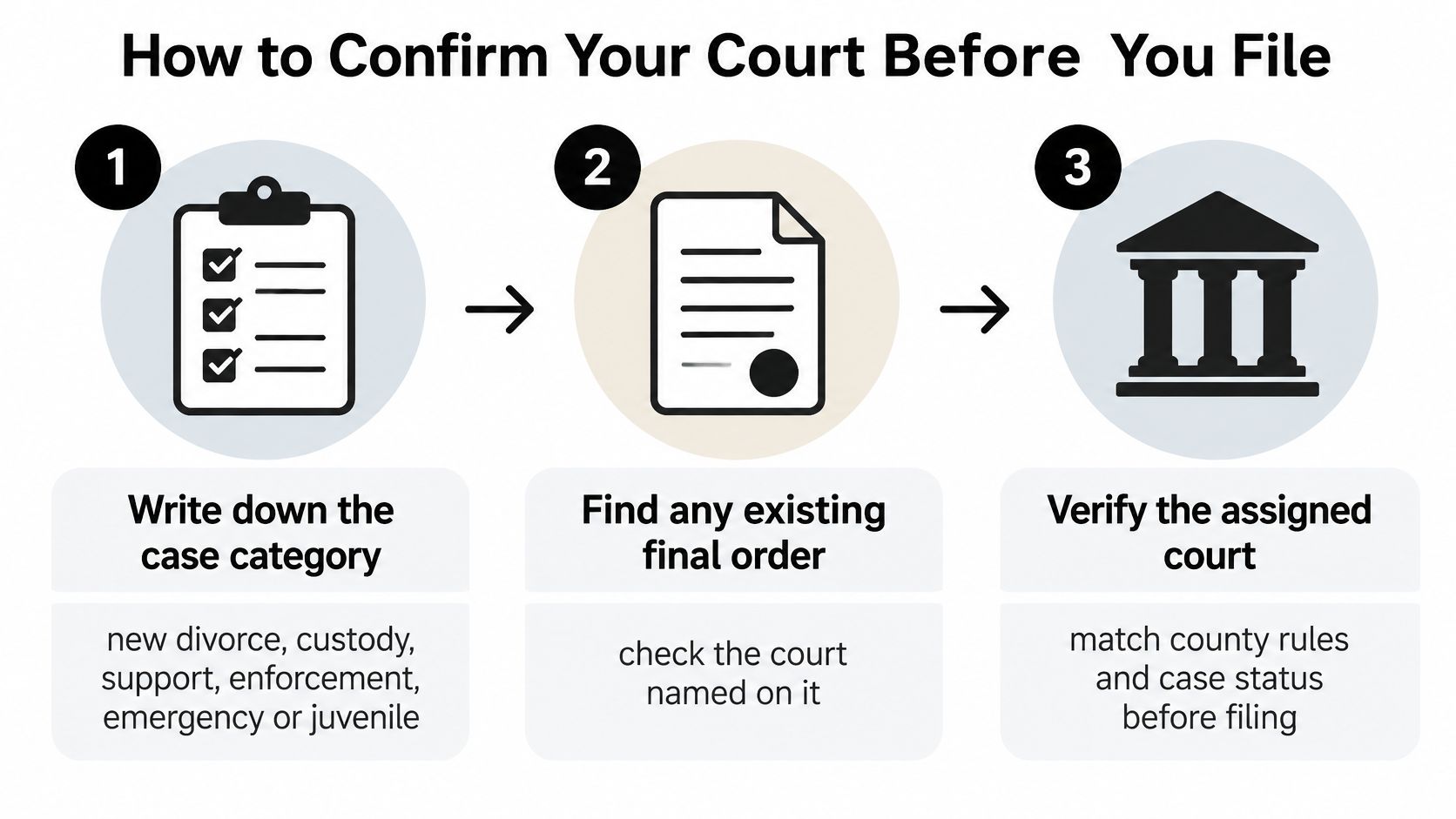
Use a document-based verification routine
Write down the case category. Describe the requested action, such as new divorce, custody modification, support enforcement, emergency custody, or juvenile matter. Common mistake: Asking only where “family cases” go, without identifying the proceeding.
Find any existing final order. Locate the signed decree or custody order and note the court name and case number. Common mistake: Bringing an unsigned draft or relying on memory instead of the actual order.
Identify whether the request is new or post-judgment. Tell the clerk if a case is pending, even if no final order has been signed. Common mistake: Calling a modification a new custody case because it raises a new problem.
Check the applicable assignment order. Read the order for your filing category, including any separate post-judgment directions. Common mistake: Using a court number from an old article without checking whether the assignment has changed.
Confirm the receiving court with the District Clerk. Give the case number if one exists, ask which filing office handles the submission, and ask whether a transfer or reassignment is needed. Common mistake: Assuming the nearest courthouse is the right destination.
Keep a dated record of the answer. Save written instructions or note the office contacted, the response, and when you received it. Common mistake: Remembering the court name but forgetting an accompanying transfer instruction.
Prepare for the call and the filing
Clerks can explain administrative procedures, but they can't choose legal claims or advise you about the merits. If your question is whether a court legally retains jurisdiction, rather than where documents should be submitted, legal review may be necessary.
Once the filing destination is confirmed, use the Montgomery County family court required-forms guide to prepare questions about the filing packet. Checking forms is a separate task from confirming the court.
Before calling, have your case category, existing case number, signed order, and a short description of the requested relief in hand. That gives staff something concrete to check instead of asking them to reconstruct your case history.
What Happens After You File in Montgomery County
The Montgomery County family-court local rules set a six-month standard for trying or dismissing family-law cases. The period runs from the appearance date or, when a Family Code waiting period applies, from the date that waiting period expires, whichever is later. This is an outer limit for disposition, not a hearing date. The rules also require financial information statements in divorce-related domestic-relations cases and matters to modify conservatorship, support, or possession periods.
After docketing, check the assigned court's procedures for settings, required submissions, and temporary relief. Filing a petition does not itself request or schedule a hearing, so confirm what step is needed to obtain a setting.
Prepare the file for the assigned court
For a case requiring a financial information statement, gather the details needed to complete it, along with supporting income records. Keep readable copies of the current decree or custody and support orders, plus any later modifications. A dated timeline can help connect the requested relief to the relevant events.
Before a setting, check what documents the court requires and how they must be submitted. The Montgomery County district court family-docket procedures guide describes procedures for a particular court, so its instructions may not apply to every family case in the county.
Emergency requests need a judicial decision
If a child's safety is at risk, seek legal guidance promptly about requesting temporary relief from the court handling the case. Describe the specific conduct, when it occurred, and the immediate concern. A judge decides whether the requested relief and urgency are justified; the timing of a hearing depends on the assigned court, case type, and relief requested.
Before a setting: Organize the facts the judge needs to decide, along with the documents that support them.
Confirm Your Court and Take Your Next Step
Which Montgomery County district court will hear your family case? The answer depends on the case assignment and its procedural history. A new filing and a request to enforce an existing order may not go to the same court.
If you already have a decree or custody order, Enforcement of Court Orders in The Woodlands explains enforcement matters in Montgomery County.

What to do next
- Finish verification: Complete the document-based routine, then save the clerk's answer with the date.
- Build your working file: Gather income records, existing orders, and a concise timeline of relevant events.
- Identify deadlines: Note dates in existing orders, hearing notices, and filing instructions. Ask a lawyer to explain any deadline you do not understand.
- Confirm contact details: Get current District Clerk phone numbers, addresses, and office hours from the official county website.
- Prepare your questions: Separate administrative questions about filing from legal questions about jurisdiction, evidence, and requested relief.
- Keep a record: Save the clerk's answer and the date you received it with your case documents.
If published materials appear inconsistent, ask the clerk which order controls the filing and whether reassignment or transfer is needed before a judge can consider the request.
General information, not legal advice
This article provides general information, not legal advice. Reading it does not create an attorney-client relationship. The correct procedure may depend on the pleadings, existing orders, and current assignment rules.
The Law Office of Bryan Fagan represents families in The Woodlands and Montgomery County in divorce, custody, support modifications, and enforcement matters. To discuss your existing orders, requested relief, and court-assignment questions, visit The Law Office of Bryan Fagan to schedule a consultation.