
If you're in The Woodlands and getting ready to file a divorce, custody case, modification, or support action in Montgomery County, the hardest part usually isn't writing your story. It's walking in with the right packet.
A lot of people print a generic Texas form set, fill it out carefully, and assume they're ready. Then filing day turns into a wasted drive to Conroe, a clerk counter correction, or an e-file return because the packet fits Texas in general but not Montgomery County in particular.
That gap is where most frustration happens. Statewide guides tell you the starting forms. Montgomery County practice adds local filing rules, county packets, standing orders, and a few family-law documents that still have to be handled on paper. When you need Montgomery County family court required forms at filing in The Woodlands, that's the issue to solve.
This guide walks through the practical filing split: what belongs in your e-file envelope, what still needs special paper handling, and which local items catch self-filers off guard. This is not legal advice. It's practical information to help you prepare before you file.
Standing in the Montgomery County Clerk's Office With the Wrong Packet
A Woodlands filer shows up in Conroe with a neatly printed divorce packet from a general Texas forms site and still gets stopped before the case really starts. I see that happen when the petition itself is acceptable, but the opening stack does not match Montgomery County's filing practice.
The clerk is not screening whether your story is true or whether your legal position is strong. The clerk is checking whether the case opening documents fit the county's intake requirements. If the packet is missing a local form, includes the wrong supporting sheet, or leaves out a document the county expects at filing, the result is usually a return, a correction, or a second trip.
Where Woodlands filers usually get tripped up
The first problem is often the civil case information sheet. Montgomery County's District Clerk states that this sheet is filed when a new civil, family, probate, or mental health case is opened, and also with post-judgment modification or enforcement filings in family cases, according to the county's new suits filing guidance.
The next problem is relying on statewide forms alone. Texas forms can get you the right petition title, but they do not always get you through Montgomery County intake. Local standing orders, county packet items, and judge-specific expectations are where self-filers from The Woodlands lose time.
That trade-off matters. A generic packet is faster to find online. A county-matched packet is far less likely to be rejected.
Another common issue is age of the forms. Third-party sites often host older versions, stripped-down versions, or forms that were fine in another Texas county but do not match current Montgomery County workflow. A filer may walk in confident because every blank is filled in, then learn the packet is incomplete for this courthouse.
Practical rule: A petition can be legally sufficient and still be rejected or returned because the filing packet is incomplete for Montgomery County.
One more point, briefly. Some family documents go through the e-filing system, and some county-required items still require separate paper handling. That split catches many first-time filers off guard, but the full filing mechanics belong later in this guide.
Matching Your Case to the Right Filing Track
A Woodlands filer can bring a fully signed packet to Montgomery County and still leave without a file-stamped case because the packet started in the wrong category. I see that with two filings more than any others. Parents use a divorce petition when they only need custody orders, or they file a modification packet when the facts call for enforcement.
The clerk is not there to sort that out for you. Your first job is to match the family problem to the correct opening document and the correct county workflow.
Filing Track Decision Table for Woodlands Family Filings
| Case Type | Lead Petition or Motion | Common Add-Ons at Filing | County Handling Issue to Watch |
|---|---|---|---|
| Divorce without children | Original Petition for Divorce | Civil case information sheet, service documents if citation will issue, any local standing-order materials required by the assigned court | Usually e-filed, but county packet items still need to match the court's family setup |
| Divorce with children | Original Petition for Divorce | Child-related forms, support-related forms, service documents, civil case information sheet, local attachments if required | Intake problems often start when statewide divorce forms are filed without the child-support paperwork the county expects |
| SAPCR to establish conservatorship and support | Petition in Suit Affecting the Parent-Child Relationship | VS-165, Record of Support Order, service documents, county-required opening items | Filers often miss support paperwork because statewide custody instructions and county intake do not appear in one place |
| Modification of existing order | Petition to Modify the Parent-Child Relationship or other modification pleading | Civil case information sheet for post-judgment family filing, service materials, any declaration required by the relief requested | A request to change primary custody within one year gets extra scrutiny if the declaration is missing |
| Enforcement | Motion for Enforcement | Civil case information sheet, service packet, order-specific attachments and proposed enforcement paperwork | Enforcement is a new filing event, but it is not an original SAPCR or divorce opening |
| Protective order | Protective-order forms | County and court-specific paper handling items | Some parts of this track still require paper handling rather than standard family e-filing flow |
| Title IV-D or OAG-related matter | Case-specific pleading tied to the support case | Support records, service paperwork, agency-related documents | The filing path varies depending on whether the Attorney General is already involved |
How to identify your track before you download anything
Start with the order you want the judge to sign, not the conflict you are having at home.
If the parties are married and need the marriage dissolved, that is a divorce track. If the parents were never married and the issue is conservatorship, possession, or child support, that usually points to a SAPCR. If there is already an order and you want to change it, that is generally a modification. If the other side violated an existing order and you want the court to compel compliance or assess remedies, that is enforcement.
That sounds basic, but it prevents a lot of rejected filings.
For custody-only cases, Texas Law Help's SAPCR guided filing information lays out the statewide starting forms, including the Petition in Suit Affecting the Parent-Child Relationship, the VS-165, and the Record of Support Order. That is the statewide baseline. Montgomery County filers still need to check local packet expectations and whether each item belongs in the e-file submission or in separate county handling.
For modifications, Texas Law Help's custody, visitation, or support modification guide points out a filing trap that matters in real practice. A party asking to change primary custody within one year may need the Declaration in Support of Changing Primary Custody within One Year. If that declaration should have been included and is missing, the filing slows down fast.
The county-level trade-off that trips up Woodlands filers
Statewide forms answer, "What pleading fits this type of Texas case?" They do not always answer, "What will Montgomery County intake accept on filing day?"
That gap matters most in three places:
- Original filing versus post-judgment filing: A modification or enforcement filing is tied to an existing order and often to an existing cause number history.
- Child-related cases: Support paperwork and parent-child forms create extra filing pieces that do not exist in a no-kids divorce.
- Paper versus e-file handling: Some family documents go through eFileTexas, while some county-required items or court handling steps still do not fit neatly inside the same upload.
A generic "Texas family packet" does not tell you that split. A county-matched filing plan does.
If your case is a divorce, this guide on filing for divorce in The Woodlands is a useful cross-check before you commit to the wrong opening track.
Where to Download the Montgomery County Family Forms
A Woodlands filer usually realizes the packet problem too late. They have a statewide petition pulled from a good source, but they did not pull the Montgomery County pages that control intake details, paper-only items, and local attachments. That is how people arrive ready to file and still leave with corrections.
Start with county sources first. In Montgomery County family practice, the clerk and district clerk pages answer the question that statewide form libraries do not answer: which local documents belong with this case, and which ones the county expects to be handled outside the main e-file packet.
Statewide forms still matter. Use them to identify the correct pleading for the case type, then match that pleading to the county's filing instructions and local packet materials. That is the practical split many Texas guides miss. They explain the statewide form set, but they do not isolate what Montgomery County will accept by e-file, what must stay on paper, and which standing-order requirements can catch a Woodlands filer off guard.
Start with county pages, then confirm the statewide form set
For Montgomery County practice, pull forms from the county filing pages before downloading anything from a general legal form library. County pages are where filers find local packets, clerk instructions, and court-specific attachments that do not always sit next to the petition itself.
Then confirm you have the right Texas form set for the exact case. Divorce, SAPCR, modification, and enforcement filings branch early. A filer who downloads a general custody packet for a modification case often misses the post-judgment pieces tied to the existing order and cause number history.
County pages also help with a point clients rarely expect. Some required items are listed as filing instructions or standing-order materials instead of looking like a standard "form." If you only search for PDFs with blank lines, you can miss documents the clerk still expects to see.
What to verify before you download or fill anything out
Run this check before you spend time completing a packet:
- Case track: Confirm whether this is an original case, a modification, or an enforcement. The opening pleading changes, and so do the supporting documents.
- Court and county source: Use the Montgomery County clerk or district clerk page for local items. Do not assume a statewide packet includes county attachments.
- Revision date and footer: If the form footer looks old, incomplete, or inconsistent with the county page where you found it, pull it again from the official source.
- Existing cause number details: Post-judgment filings must match the prior case information exactly.
- Signature and verification blocks: Sworn declarations, notarized sections, and signature pages need closer review before filing than standard caption pages.
This is also the stage where support and property issues start bleeding into form selection. A petition may be short, but the supporting paperwork is not. If your filing will involve income proof, reimbursement claims, or child-support positions, review how the supporting numbers appear in the packet. This guide to the financial disclosure form used in Texas family cases is a useful cross-check before you finalize exhibits and disclosures.
Download problems that create avoidable rejections
The form itself is not the only problem. The file quality matters.
Fillable PDFs can save badly. Checkbox selections disappear, typed names shift out of the field, and signature pages flatten in a way that cuts off part of the text. I tell clients to print a clean review copy before submission because a document that looks acceptable on screen can turn into a bad filing copy fast.
Also check whether the county page is giving you a packet, a standalone form, or an instruction sheet with paper-delivery requirements mixed into it. Montgomery County family filing is not just about downloading the right petition. It is about downloading the right combination of petition, county attachments, and handling instructions so the clerk can open the case without sending it back.
Filing Day Mechanics and Fee Details
A common Woodlands filing-day problem looks like this: the petition is ready, the PDF uploads, the filing fee is paid, and then the clerk rejects the submission because one county document was tucked into the e-file instead of handed over on paper. That is the gap statewide guides usually miss. In Montgomery County family cases, success on filing day depends on splitting the packet the right way before you submit anything.
Start by treating the filing as two lanes. One lane is your e-filed opening set. The other is the smaller group of county or protective-order documents that still need paper handling. If those get mixed together, the case may not open cleanly, even when the petition itself is fine.
Build the packet in the order the clerk expects to see it
For most new family filings, the cleanest sequence is:
- Confirm your eFileTexas account, service contacts, and filing party information.
- Finalize the petition and any statewide opening forms that belong in the electronic submission.
- Pull out any county-required paper items before uploading.
- E-file the opening documents.
- Deliver the paper-only items in the format the clerk requires for that case type.
- Save the submission receipt, accepted-stamp copy, and any paper-delivery proof.
That sequence matters because Montgomery County does not treat every family document the same way. Core pleadings usually go through e-file. Certain service, standing-order, and protective-order materials do not. Woodlands filers get tripped up when they assume "mandatory e-filing" means every page belongs in one electronic envelope. It does not.
One form often determines whether the case opens without delay
The civil case information sheet is one of the forms that gets overlooked because it feels administrative. It still matters at intake. Montgomery County uses it as part of opening new suits, and the same form can come back into play on family post-judgment filings such as modification or enforcement matters, as reflected in the county's civil case information sheet filing document.
If that sheet is missing, misclassified, or inconsistent with the petition, the filing may sit in correction status instead of moving forward.
I tell clients to do one last packet review with a simple question: if a clerk sees only the captions and lead forms first, will the case type be obvious? If the answer is no, fix that before filing.
Fees, channels, and the one-trip problem from The Woodlands
I do not quote fee amounts in a guide like this because clerk costs change, and outdated numbers create bad filing-day decisions. The practical point is simpler. Confirm the current filing fee, any citation fee, and any extra issuance charge before you leave The Woodlands for Conroe or hit submit online.
Here is the filing-channel breakdown individuals typically need:
| Filing Type | Filing Fee | Submission Channel | Notes |
|---|---|---|---|
| Original divorce petition | Varies by current clerk schedule | E-file core pleading, paper submission for county-required exceptions | Check whether citation or service requests add separate charges |
| Divorce with children | Varies by current clerk schedule | Split between e-file and paper items | Child-related filings often have more supporting documents to sort |
| Original SAPCR | Varies by current clerk schedule | E-file main filing, paper items where required | Case classification needs to match the relief requested |
| Modification | Varies by current clerk schedule | Usually e-file core motion, with county paper exceptions if applicable | Review post-judgment opening requirements before submission |
| Enforcement | Varies by current clerk schedule | E-file main pleading, paper exceptions where required | Service setup matters early in these cases |
| Citation issuance | Separate clerk charge may apply | Clerk processing | Confirm current amount before filing day |
The trade-off is convenience versus control. E-filing from home in The Woodlands saves the drive, but only if the packet is correctly divided. If you are unsure whether a document belongs in the electronic stack or the paper stack, that uncertainty is often what causes the rejection.
If court costs are the problem
Texas filers who cannot afford filing costs may be able to file a Statement of Inability to Afford Payment of Court Costs. That can keep a necessary family filing from stalling over fees alone.
Payment methods, cashier procedures, office hours, and records-desk practices can change. Verify those details with the clerk close to your filing date, not from an old screenshot or a forum thread.
Texas Family Code Touchpoints Inside the Forms
A lot of Woodlands filers get tripped up here. They download the right-looking petition, fill in names, addresses, and dates, then leave statutory sections half-finished because the questions look repetitive. That is a common reason a filing stalls, especially when the form is asking the court to make findings it must have under the Texas Family Code.
Divorce and residency statements
In a divorce, the petition usually tracks Texas Family Code Chapter 6. The residency section is doing real work. The court needs enough sworn information to confirm that Texas has authority over the divorce and that Montgomery County is the proper county for filing.
If that section is vague, the problem is not cosmetic. The clerk may accept the filing, but the case can still slow down later when the court reviews whether the pleadings support the relief requested.
Parenting fields and support sections
For SAPCRs, divorces with children, and many modifications, the form language usually follows Texas Family Code Chapter 153. Conservatorship, possession, and decision-making terms are not interchangeable labels. If a filer checks boxes or types requests that do not match the legal structure the court uses, the paperwork reads confused before the case even gets to a hearing.
Child support sections usually tie back to Texas Family Code Chapter 154. That is why the forms ask for income, employer information, and health insurance details. Those entries help frame support, medical support, and related requests in a format the court can act on.
I tell clients to slow down on these pages. The names and addresses are easy. The legal requests are where mistakes happen.
Temporary orders requests need their own support
A petition opens the case. It does not automatically give the judge enough to enter temporary restraints, temporary conservatorship terms, temporary support, or exclusive-use requests.
If a filer wants immediate relief, the supporting motion and any sworn statement need to match that request clearly. In practice, this is one of the places where statewide forms can mislead self-filers. The form may mention temporary orders generally, but Montgomery County judges still expect the request to be properly stated and supported in the filed papers.
The forms also signal procedure
Some of the most important Family Code touchpoints are easy to miss because they look like routine form language. A verification, a sworn inventory-related statement, a UCCJEA declaration in a child-related case, or a military status statement can affect whether the court can move forward cleanly.
That matters in Montgomery County because local practice often exposes weak pleadings fast. A filer from The Woodlands may get the statewide petition uploaded correctly by e-file, then hit a problem because a county-specific paper item, standing-order acknowledgment, or child-related declaration was incomplete or inconsistent with the main filing.
The practical rule is simple. If the form asks for a sworn fact tied to residency, children, support, or temporary relief, fill it out as if the judge will read that page first. Many times, that is exactly what happens.
Serving the Other Party After Filing
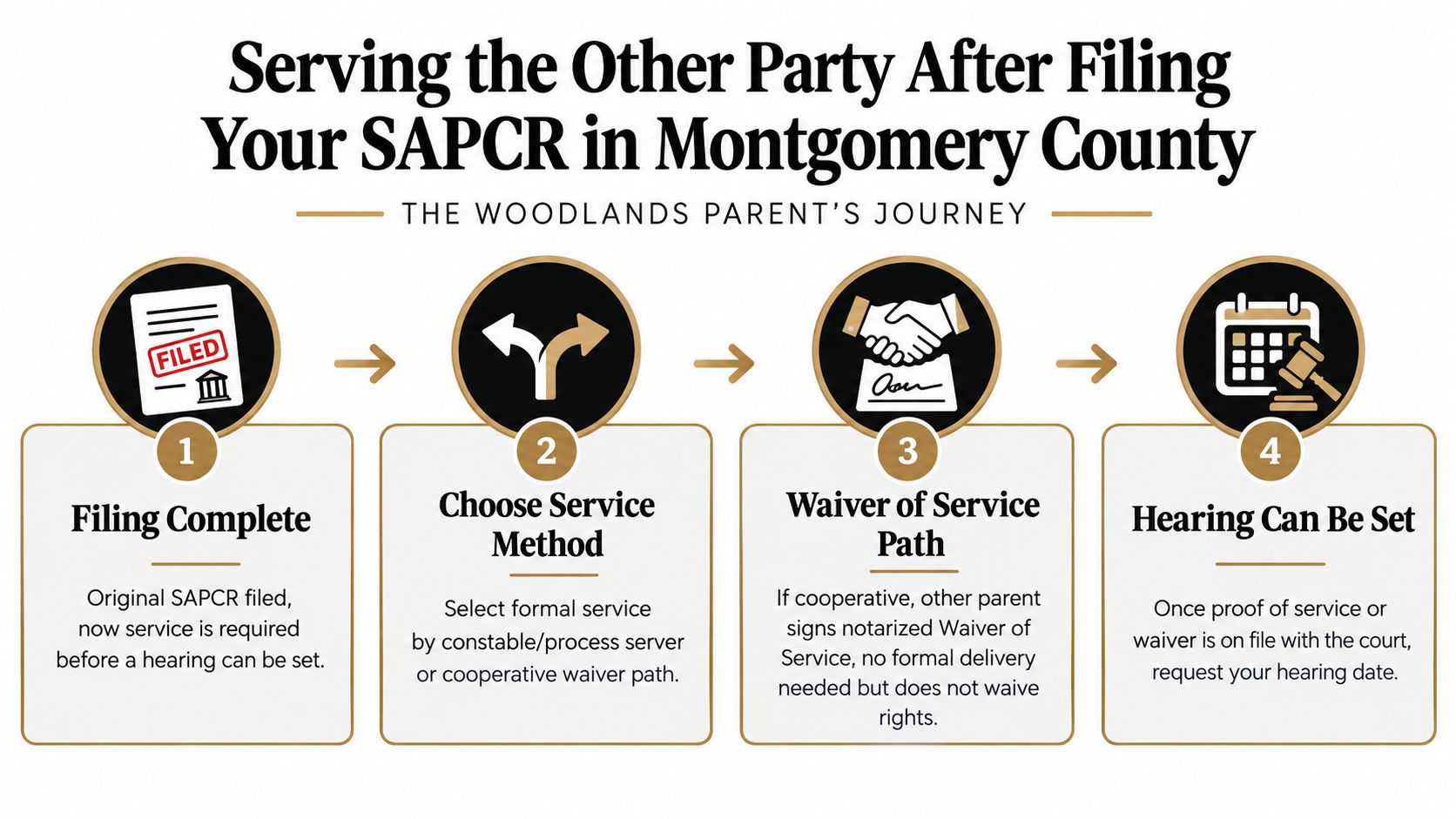
A Woodlands filer can get a case accepted by the clerk in the morning and still lose weeks by handling service the wrong way that afternoon. Filing opens the case. Service gives the court a path to act against the other side.
In Montgomery County, I see two mistakes over and over. A party hands the papers to the other side personally and assumes that counts. Or the parties agree informally, but no signed waiver or return ever makes it into the file. Either way, the case stalls because the court file does not show valid service.
Start with the right service path
After filing, the clerk issues citation for service unless the case will proceed on a valid waiver. That choice matters early because it affects timing, cost, and how quickly a hearing can be set.
If the other party is cooperative, a waiver can save service fees. It still has to be signed correctly and filed. A text message saying "I got it" does nothing for the judge.
If cooperation is doubtful, formal service is usually the safer track. In practice, that often means constable service or a certified private process server. Formal service costs more up front, but it avoids the common Woodlands problem where a respondent promises to sign, delays for two weeks, then hires counsel after valuable time has already been lost.
A common Montgomery County stall
A parent files an original SAPCR, pays the filing fee, and leaves thinking the case is underway. The other parent lives nearby in The Woodlands and says service will not be a problem. So the filer waits on a waiver instead of sending citation out.
Nothing comes back signed.
Now the case is open but inactive. No valid waiver. No return of service. No clean path to default deadlines or a final hearing. At that point, the filer usually ends up paying for formal service anyway, just later than necessary.
What has to come back into the court file
Service is not only about getting papers to the respondent. The proof matters just as much. Montgomery County judges and clerks look for a file that shows the full chain:
- issued citation
- petition and any filed attachments served with it
- signed waiver, if waiver is used
- return of service from the constable or process server, if formal service is used
- any additional orders or notices that had to accompany the initial filing
Texas Rule of Civil Procedure 99 governs citation and the answer deadline. If the respondent was served and does nothing, default may become an option. If the respondent files an answer, the case shifts into the normal contested or negotiated track. For a respondent trying to size up that deadline, this guide on what to do after being served divorce papers in The Woodlands explains the response side.
A short walkthrough can also help:
Out-of-county and out-of-state service
Service outside Montgomery County is usually workable, but it gets less forgiving. The papers must go to the right address, through an authorized method, with proof returned in a form the court can use.
Service in another Texas county is often routine if the address is good. Service outside Texas can raise jurisdiction questions, especially in child-related cases or support matters. That is where self-filers spend money twice, once on a failed attempt and again to correct it.
The practical rule is simple. Do not guess on service. Choose waiver only if the other side is ready to sign and return it promptly. Otherwise, get citation issued and send it out through a proper server so the Montgomery County file shows service without gaps.
Your Filing Checklist and Next Steps
You are at the clerk counter or staring at your e-file envelope, and the problem is usually not the petition itself. The problem is the extra page you missed, the verification you did not notarize, or the county form you uploaded when it needed to go in paper. That is what gets Woodlands filers sent back to fix a packet that looked complete at home.
Start with a final review tied to your case type and filing track. Statewide Texas guides typically list only the petition and statewide supplements, without Montgomery County standing-order materials or local filing splits between e-file and paper.
Final filing checklist
- Confirm the exact case category: Original divorce, SAPCR, modification, enforcement, and protective-order-related filings do not use the same stack of forms.
- Pull forms from official sources: Use Montgomery County family court materials and Texas-approved forms. Third-party templates are where I see caption errors, outdated warnings, and missing sworn language.
- Check whether the case-opening sheet is required: For many new suits and some post-judgment filings, the civil case information sheet is still treated like a practical intake document. Leaving it out can slow acceptance.
- Build the packet in order: Lead pleading first. Then add child-related forms, service documents, required exhibits, and any county-specific attachments.
- Separate e-file documents from paper items: Do not drop everything into one electronic envelope and hope the clerk sorts it out. If Montgomery County expects a document in paper, treat that as a separate task.
- Review signatures line by line: Family filings get rejected for small things. Missing notary blocks, unsigned verifications, and incomplete certificate-of-service language are common examples.
- Handle fees before you hit submit: Pay the filing fee or prepare a Statement of Inability to Afford Payment of Court Costs that is complete and signed.
- Save acceptance records immediately: Keep the accepted filing notice, submission receipt, and file-stamped copies together. You will need them when service starts or if the clerk questions a later filing.
- Set your service plan the same day: Filing opens the case. Service is what keeps it from sitting still.
The local issue Woodlands filers miss
The key local question is straightforward: Which Montgomery County forms must be e-filed, which must stay on paper, and which standing-order materials need to travel with the case?
That answer changes the way the packet is assembled. Montgomery County does not run on one universal family-law checklist, and a filer who uses only statewide forms often finds that out after a rejection notice arrives. The safer approach is to match the county packet to the filing track before filing day, not after.
A caution on family and probate crossover matters
Some Woodlands families are handling a divorce, custody dispute, or support case while also dealing with an estate. Do not assume the family-court workflow carries over. Probate uses a different local form system, different filing expectations, and different review habits at the county level. Montgomery County maintains separate probate resources through the county probate forms page at https://www.mctx.org/departments/departments_d_-_f/county_clerk/probate/forms.php.
This article is not legal advice. It is a practical guide for Woodlands and Montgomery County filers who want a smoother first filing day. If your packet involves emergency child issues, service problems, standing-order questions, or a prior rejection, a short file review often costs less than refiling and correcting the case later.
The Law Office of Bryan Fagan helps people in The Woodlands and across Montgomery County with divorce, custody, child support, modification, enforcement, property division, and probate matters, including cases where local filing rules and service issues slow things down. If you want a lawyer to review your packet before you file or take over a case that's already hit a procedural snag, visit The Law Office of Bryan Fagan to schedule a consultation.