
You're in The Woodlands, checking the mail between work and school pickup, when an envelope from the Texas Office of the Attorney General changes your afternoon. It may mention a child-support review, arrears, enforcement, or a hearing in Conroe. You may not know whether to call the state, the District Clerk, or the court, and you may worry that one missed procedural step will decide the case.
A Montgomery County Title IV-D child support court Conroe hearing is part of a coordinated state system, not just a private dispute between two parents. The hearing may be in person or remote, and the result can depend heavily on notice, financial records, and whether you respond properly to an administrative review. The practical information below is designed for parents in Montgomery County, including The Woodlands, Magnolia, Willis, and nearby communities.
Understanding Your Montgomery County Court Situation
Montgomery County child-support matters in Conroe are tied to Texas's statewide Title IV-D system. The Texas Office of the Attorney General is Texas's official Title IV-D agency and handles child-support enforcement, case services, and related notices under Chapter 231. That means a local hearing can involve a state agency even though you're appearing at a courthouse in Conroe. The Texas Attorney General's child-support materials explain the agency's statewide role.

A notice from the OAG usually isn't the same thing as a private custody lawsuit. In a private family case, one parent generally brings claims against the other parent. In a Title IV-D case, the state has a formal role in establishing or enforcing a support obligation, processing payments, and addressing issues such as arrears, service, and account records.
The District Clerk and the Title IV-D Division also perform different functions. The clerk's office helps maintain court records and directs child-support questions to the appropriate payment or agency contact. The Title IV-D court handles hearings involving support orders and enforcement. Treating these offices as interchangeable can waste time, especially when your question concerns a hearing date rather than a payment account.
Why the state's involvement matters
Texas Family Code procedures recognize that the state may have an assigned support right. When a petition seeks establishment, modification, or enforcement of that right, the Title IV-D agency must receive notice under the applicable statutory framework. That requirement helps explain why the paperwork may list the OAG even when the hearing takes place before a local judge.
The system is centralized because payments, notices, administrative reviews, and court enforcement need to connect. Your local courtroom is one part of that structure. The judge decides legal orders, while agency personnel may present the state's position or help move the case through the required process.
Practical rule: Read every page of the notice, not only the date. The document may identify the type of review, the relief requested, the appearance method, and the office you must contact.
If the paperwork is unclear, keep the original, scan it, and make a short timeline of what you received and when. That record can matter if you later need to explain why you did or didn't attend, object, or provide documents.
The Role of the Texas Attorney General in IV-D Cases
The OAG changes the setting because the case is not handled only as a parent-to-parent disagreement. Texas identifies the Attorney General as the state's official Title IV-D agency, and IV-D courts decide matters that establish and enforce child-support orders on behalf of the State of Texas. The agency's role is described in the OAG's explanation of Title IV-D and child support in Texas.
The practical division is important. The OAG may manage case services, payment records, notices, and enforcement activity. The court, however, issues or modifies judicial orders and decides contested matters that require judicial action. Calling the payment unit won't replace a court appearance, and appearing in court won't necessarily correct an account-record problem without separate communication with the agency.
Administrative review and a courtroom hearing
Some disputes begin through an administrative process rather than with an immediate evidentiary hearing before a judge. An administrative review may address disputed arrears or a proposed review order. The parties may also reach an informal resolution. Those paths can be efficient when the records are accurate and the issue is narrow, but they can be risky when income, payments, credits, service, or arrears are disputed.
If you don't agree with a nonagreed child-support review order, Texas Family Code Section 233.022 provides a procedural route for an objection to be treated as a request for a court hearing. The Title IV-D agency must make the hearing-request form available to clerks and parties. The statutory text of Section 233.022 is a useful starting point, but the exact deadline and filing method should be checked against your notice and the clerk's instructions.
That distinction gives you more than one point of contact:
- The OAG or agency contact: Use it for case-service questions, payment processing, account information, and agency forms.
- The District Clerk: Use the clerk's office for filing and court-record questions, including where a required objection or request must be submitted.
- The IV-D court: Use the hearing to present a legal position, challenge evidence, request relief, or respond to the judge's questions.
A Child Support Attorney in The Woodlands may assist with establishing, modifying, and enforcing child support in Montgomery County. Legal representation is especially useful when the state's records and your own records don't match, or when a proposed order could affect enforcement consequences.
Conroe Court Locations and Hearing Logistics
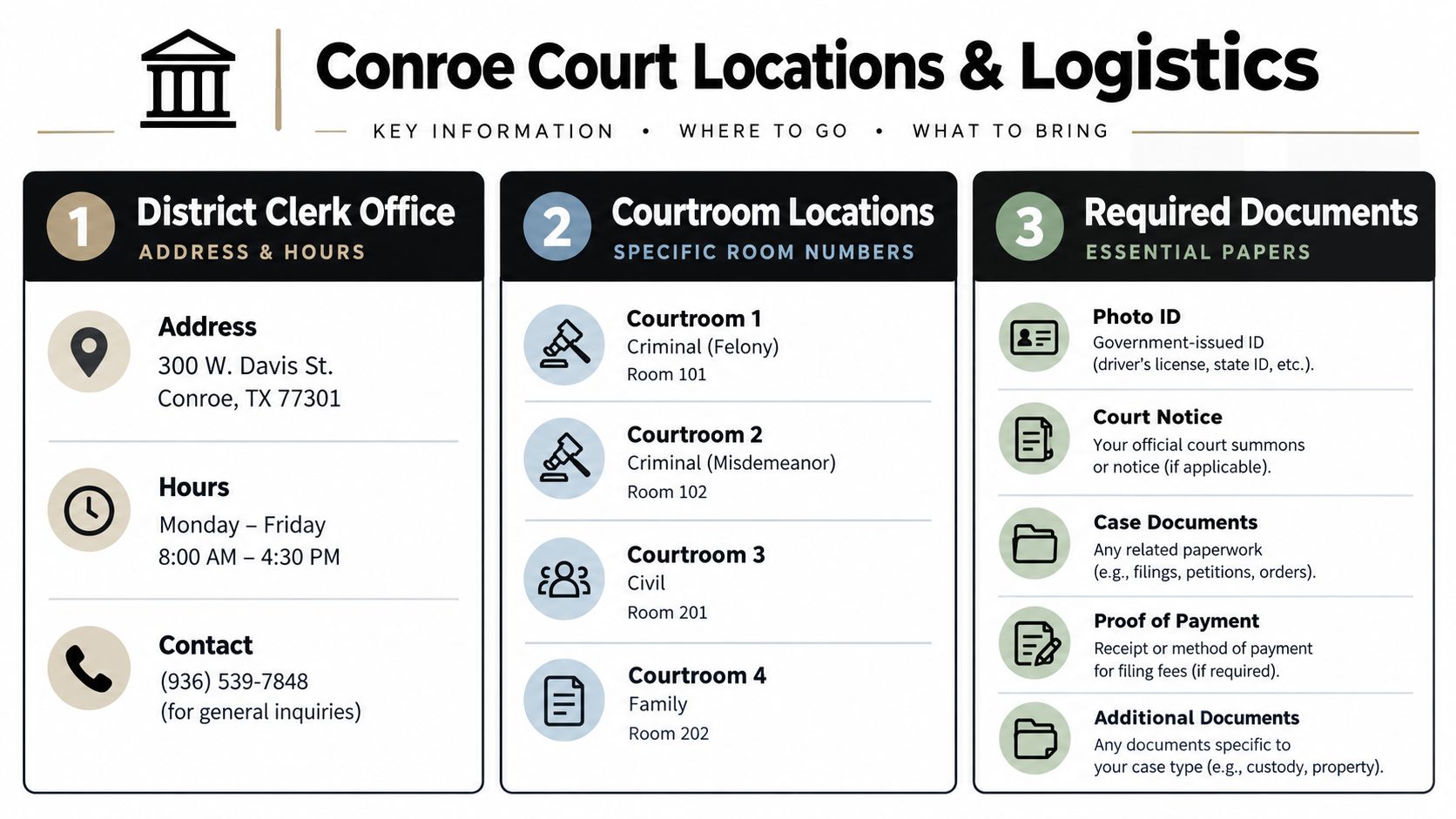
Conroe's Title IV-D proceedings are concentrated in the downtown courthouse area. The Montgomery County District Clerk lists the Title IV-D Division at 301 N. Main Street, Suite 103, Conroe, TX 77301. The county's child-support page also provides local contact information and directs parents to the appropriate child-support resources.
The Texas court directory identifies Title IV-D Court No. 07 and Title IV-D Court No. 08 at 301 N Thompson, Suite 102, Conroe, TX 77301. Assignment can depend on the court and county involved, so don't assume that the District Clerk address and the courtroom address are identical. Confirm the location on your notice before leaving The Woodlands.
Contacts and arrival planning
The listed dedicated Title IV-D hearing phone number is 936-539-7819. The administrative contact listed for these matters is 936-538-8047. The Montgomery County family docket procedures information can provide broader local-court context, but it doesn't replace checking the notice for your particular hearing.
These dockets are specialized and serve Montgomery County and, depending on assignment, surrounding counties. That specialization means the calendar and sign-in process may be structured rather than informal. Bring your notice, identification, file information, and organized documents. Don't rely on a clerk to reconstruct your case from a verbal explanation at the counter.
Before traveling from Panther Creek, Sterling Ridge, Creekside, or another Montgomery County community, verify:
- The exact court number and courtroom.
- Whether the hearing is in person or remote.
- The required sign-in location.
- Whether a filing or objection must be submitted before the hearing.
- Which phone number handles scheduling rather than payment-account questions.
Real-Life Scenarios from Montgomery County Hearings
Consider a realistic situation involving a parent who lives near Sterling Ridge. She receives a nonagreed child-support review order and believes the arrears calculation doesn't account for payments made directly to the other parent. She is frustrated because the state's account shows one position, while her bank records and messages show another.
She first calls the payment office, but the account question isn't resolved before the listed court date. Instead of ignoring the order, she gathers the paperwork, identifies the disputed entries, and asks about the procedure for objecting and requesting a court hearing. Under Texas Family Code Section 233.022, an objection to a nonagreed review order can be treated as a request for a court hearing, and the Title IV-D agency must make the hearing-request form available. The statute's procedural language is the point she uses to identify the formal path, not as a substitute for confirming local filing requirements.

On hearing day, she arrives with a labeled folder. One section contains the notice and prior orders. Another contains payment proof arranged by date. A third contains her income information and a short written explanation of the specific credits she believes are missing. She doesn't try to tell the entire history of the relationship. She focuses on the order, the account entries, and the relief she wants the judge to consider.
A judge may first ask whether the parties can resolve the issue. If they can't, the court may address the objection, the agency's records, the parent's evidence, and any questions about service or calculation. The room may feel less dramatic than expected, but the details matter. A clear answer to a narrow question is more useful than an emotional account that never identifies the disputed entry.
Texas also allows IV-D judges to hold hearings remotely unless a party objects, and some child-support courts use Zoom. Texas Law Help's explanation of virtual court and child support IV-D hearings describes that option. A remote appearance can save travel from The Woodlands, but it creates its own risks. A weak internet connection, a muted microphone, or an inability to display documents can make a serious dispute harder to present.
Watch the following video before deciding how you'll prepare for a remote appearance:
Whether you appear at the courthouse or by video, treat the hearing as a formal court proceeding. Test the device, keep the notice beside you, and remain available for the entire scheduled window unless court staff tells you otherwise.
Essential Documents for Your Child Support Hearing
The right documents answer the judge's practical questions. What is the current income? What payments were made? What insurance exists? Why should the order be enforced, modified, or left unchanged? Bring materials that connect directly to those questions instead of a box of unsorted papers.
Texas Law Help identifies several records obligors should bring, including tax returns, pay stubs, insurance proof, proof of payments, job-search evidence, and benefits letters. Its guidance on what to expect in child-support IV-D court is broad, so you should match the documents to the specific issue listed in your notice.
Build the file around the requested relief
For a modification request, start with current income information and evidence explaining the change you want the court to consider. For an enforcement matter, emphasize the existing order, payment history, communications about payment, and any records that show compliance or a dispute. For an arrears challenge, create a simple reconciliation instead of handing over pages without an explanation.
A useful working file might include:
- Income records: Pay stubs, tax returns, benefits letters, and other records that show current financial circumstances.
- Insurance records: Proof of health insurance coverage, premiums, or other support-related insurance information.
- Payment records: Receipts, canceled checks, electronic confirmations, money-transfer records, and a list matching each payment to the claimed obligation.
- Employment records: Job-search evidence when unemployment or reduced work is part of the explanation.
- Court papers: The current order, the hearing notice, prior review documents, and any filing that identifies the issue before the court.
Make the judge's review easier
Use a cover page that states the issue in one sentence. Then arrange the evidence chronologically or by category, with page numbers if the file is substantial. Keep the original documents available, and bring copies or electronic versions in the format the court will accept.
A document is not decisive merely because it looks official. A pay stub may show income but not explain a payment dispute. A text message may show an agreement but not prove that the court order changed. Your job is to explain what each record proves and what it doesn't prove.
Don't alter screenshots or crop away dates and names. If a record is incomplete, say so. Credibility often turns on whether your presentation is accurate about both helpful and unhelpful facts.
Enforcement, Modification, and Legal Timelines
Enforcement and modification are different legal tasks. Enforcement asks whether an existing obligation was violated and what remedy the court should consider. Modification asks whether the order should change based on legally relevant circumstances. Combining the two without separating the evidence can make your position difficult to follow.
For an enforcement matter, Texas Family Code Section 157.062 requires the respondent to receive the motion and notice of hearing by personal service no later than the tenth day before the hearing. The notice must identify the hearing's date, time, and place. The Texas Family Code enforcement discussion provides the cited procedural reference.
Check service before arguing the merits
If you received papers shortly before the hearing, write down exactly when and how they reached you. Keep the envelope, delivery record, or service paperwork. Don't assume that a short preparation period automatically cancels the hearing, and don't assume it has no legal significance. The court may need to address service before reaching the underlying allegations.
A parent facing enforcement should also examine the order itself. Identify the payment terms, due dates, medical-support provisions, and any language concerning compliance. Then compare those terms with payment confirmations and other records. A general statement that you paid “most of it” is less useful than a dated explanation tied to the order.
Modification requires a focused explanation
A request to modify support should identify what changed and what order you want the court to enter. Bring updated financial records, but don't rely on income proof alone if the notice raises other issues. Insurance, employment status, benefits, and payment history may all affect how the court understands the request.
The trade-off is straightforward. Informal communication can resolve a bookkeeping problem quickly, but it won't necessarily change a court order. A formal filing and hearing create a legal record, but they also require attention to pleading, service, evidence, and deadlines. If enforcement is the issue, enforcing child support in Montgomery County may require more than contacting the payment office.
A missed notice issue can affect the hearing, but it doesn't automatically decide the whole case. Preserve the proof and raise it through the proper court process.
If you receive a contempt-related notice, face disputed arrears, or want an order changed, get advice before making admissions or signing a proposed order. The procedural route matters as much as the financial explanation.
Your Immediate Next Steps and Preparation Plan
Start with the notice in front of you. Mark the hearing date, court number, appearance method, and every deadline. If the document uses unfamiliar terms such as review order, arrears, enforcement, or modification, write those terms down so you can ask a precise question rather than making a general call that sends you between offices.
What to do next
- Confirm the setting: Verify whether your Montgomery County hearing is in person or remote, and confirm the assigned Title IV-D court and location.
- Review service: Record when you received the motion and notice, and preserve the envelope, delivery record, or service documents.
- Collect financial proof: Gather tax returns, pay stubs, insurance proof, payment records, job-search evidence, and benefits letters that relate to the issue.
- Separate disputed entries: Make a short list of each payment, credit, income figure, or order provision you dispute, with the document supporting your position.
- Contact the right office: Use the OAG for agency and account questions, the District Clerk for filing or record questions, and the court contact for hearing logistics.
If your hearing is virtual, arrange a quiet location and test your device before the appearance. If it's in Conroe, plan your route from The Woodlands and confirm whether you need to report to the District Clerk's Title IV-D Division or the assigned courtroom. Do not wait until the hearing morning to discover that the addresses serve different functions.
You can review child support hearing information for Montgomery County, Texas as you organize your questions and documents. This article is general information, not legal advice, and it doesn't create an attorney-client relationship. The correct response depends on your notice, service history, existing orders, financial records, and the precise relief requested.
If the state's account conflicts with your records, the notice came late, or you're unsure whether to object to a review order, a consultation can help you identify the procedural path before the hearing. Don't ignore the paperwork, and don't assume that a phone call alone protects your position.
The Law Office of Bryan Fagan helps families in The Woodlands and Montgomery County address child-support establishment, modification, and enforcement issues in local family courts. Visit The Law Office of Bryan Fagan to schedule a consultation about your Conroe Title IV-D hearing, notice, payment dispute, or requested modification.