
In Texas, property acquired by either spouse during marriage is presumed community property unless the spouse claiming otherwise proves it is separate, and the name on the title doesn't decide it.
If a deed lists only your name, what records would prove the property belongs to your separate estate? That's the question many couples in The Woodlands don't ask until divorce brings an old purchase, inheritance, or refinance under scrutiny.
Understanding what is considered marital property starts with timing and source. Protecting a separate-property claim requires something more practical: documents that connect the asset you own today to the money or property you originally brought into the marriage.
What Counts as Marital Property in Texas
Which documents show whether an asset is community or separate property? In Texas, the answer often depends on when and how the asset was acquired, and whether records connect its current form to its original source.
Texas uses community property and separate property to describe property owned by spouses. Under Texas Family Code §3.002, community property generally includes property acquired by either spouse during marriage unless it qualifies as separate property. Property owned before marriage, or later acquired by gift or inheritance, generally falls within the separate-property category.
That starting point does not settle every asset's history. A paycheck deposited into an account bearing only one spouse's name is not necessarily separate money. An inheritance may retain its separate character after entering a joint account, but records may be needed to show where the funds went.
The person claiming separate ownership needs proof
Under Texas Family Code §3.003, property possessed by either spouse during marriage or at dissolution is presumed community property. A spouse claiming separate ownership must support that claim with clear and convincing evidence. The evidence must leave the judge firmly convinced, rather than merely make one explanation seem more likely than another.
A dated statement is more useful than a confident recollection. If parents gave you money, a gift letter, transfer record, and statement showing the deposit can help establish its source. The stronger the paper trail from the original source to the asset you own now, the easier it is to assess the claim.
Practical rule: Preserve records linking an asset today to the money or property from which it came.
A closing statement, for example, may show that a home's down payment came from a premarital account. The statement ties a specific payment to a source, rather than relying only on whose name appears on the deed.
Consider a Woodlands home bought during marriage using both spouses' paychecks. The timing and funding generally point toward community ownership, even if the deed lists only one spouse.
Now consider a Montgomery County house bought before the wedding and later refinanced. The premarital purchase supports a separate-property claim, while the refinance file and loan history help show what happened afterward. Refinancing alone does not automatically make the house community property.
Common assets and how Texas usually classifies them
This table gives a starting point, not a final answer. A documented gift, a different acquisition history, or an enforceable marital agreement may affect the result.
| Item | Usually classified as | Why it lands there |
|---|---|---|
| Wages and salary earned during marriage | Community | Earned by either spouse during marriage |
| Home bought during marriage with joint funds | Community | Acquired during marriage using community funds |
| Home owned before the wedding | Separate | Owned before marriage; later marital mortgage payments may support reimbursement without changing ownership |
| Inheritance received during marriage | Separate | Received by descent |
| Cash gift to one spouse from a parent | Separate | Gift made individually to that spouse |
| Retirement contributions made during marriage | Community | Contributions earned during marriage, subject to the account's documented history |
| Bank account opened before marriage | Separate as to traceable premarital funds | Later marital deposits require separating the components rather than treating the whole account alike |
| Business started during marriage | Community | Acquired during marriage, subject to documented exceptions |
| Personal injury recovery for pain and suffering | Separate | Personal to the injured spouse; other settlement components need individual review |
| Credit card debt taken on during marriage | Usually community liability | Incurred during marriage, though creditor liability and divorce allocation require separate analysis |
Labels alone rarely settle the question. A retirement account may include premarital savings as well as contributions earned during marriage. A personal injury settlement may include different categories of compensation, and each may need individual review.
For a business, gather formation documents, ownership agreements, capital contribution records, and financial statements. The opening date matters, but so does whether an existing separate business was reorganized or separate funds were used to buy an ownership interest.
Ownership and economic claims
A spouse may establish that a house is separate while the community estate has a claim related to community money used to reduce its mortgage principal. Reimbursement gives the community estate a credit; it does not transfer the house to the contributing spouse.
A premarital investment account also needs more than an opening date to explain its full history. Later deposits, withdrawals, purchases, and distributions can affect what portion is traceable to premarital funds. Reviewing those records helps keep components with different histories from being treated as one undivided balance.
Tracing Separate Property Through Shared Accounts
Suppose you deposit $100,000 of premarital savings into an account, later add community paychecks, and eventually withdraw enough that the balance falls to $40,000. The common-account tracing approach described in Texas Bar examination materials may cap the traceable separate component at $40,000 unless other records establish a different path.
Mixing money doesn't automatically erase a separate-property claim. It makes tracing, the documentary process of following funds, necessary.
This visual outlines the path from a mixed deposit to a supported classification.

Follow transactions rather than account names
Under the common-account approach, withdrawals are generally presumed to use community money first. But later paycheck deposits don't necessarily restore separate money that was already spent.
- Identify the separate source. Start with a dated premarital statement, probate distribution, or documented gift.
- List every later deposit and withdrawal. Include transfers between your own accounts so money doesn't disappear from the schedule.
- Find the lowest balance in each period. This helps identify whether the claimed separate funds could have remained intact.
- Follow replacement assets. Connect a withdrawal to the purchase, then follow sale proceeds into the next account or asset.
- Account for community contributions. Identify mortgage principal payments and improvements separately from the ownership claim.
A spreadsheet helps organize the transactions, but it doesn't replace the underlying statements. Save readable PDFs and identify the account, statement period, transaction date, and supporting document for each entry.
For another explanation of the process, this video can accompany your document review.
Records that prove each classification
| Record | What it proves | Common gap |
|---|---|---|
| Monthly account statements | Source and flow of funds | Missing months or closed accounts |
| Closing or settlement statement | Purchase price and source of down payment | Lost copy years later |
| Loan amortization schedule | Principal paid; paired payment records identify the funds used | Refinancing breaks the sequence |
| Wire confirmations and transfer records | Movement between accounts | Confirmations never saved |
| Gift letter or probate record | Separate character of inherited or gifted money | Gift made by word of mouth only |
| Appraisal at marriage and at divorce | Baseline and later value, supporting analysis of appreciation and improvements | No baseline value at the wedding |
Start requesting missing records early. An unexplained transfer into a closed account can require more work than reviewing a large account with a complete history.
A Woodlands Divorce Walkthrough
Consider this hypothetical scenario involving Dana and Marcus, a couple living in Panther Creek. Marcus bought a Sterling Ridge townhouse in 2016 using $60,000 saved before the wedding.
They married in 2019 and paid the mortgage from a joint checking account funded by both paychecks. In 2022, they refinanced and received $40,000 in cash, deposited it into that account, and spent it on a new roof and a family trip.
The townhouse and its loan require different questions
The townhouse starts as Marcus's separate property because he acquired it before marriage. The community wages used afterward don't automatically give Dana an ownership percentage in the home.
They may, however, support a reimbursement claim benefiting the community estate. Dana's potential recovery through division of that estate isn't the same as personally owning part of Marcus's separate townhouse.
The refinance cash needs a separate review. It's connected to a separate asset, but borrowed money isn't automatically separate merely because separate property secured the loan.
A refinance closing file can answer questions that the current deed never will.
Counsel would examine the loan documents, the basis for the credit, and the deposit and spending history. Even if a separate component can be established, the joint account records must show what happened to it.
The roof and family trip also shouldn't be treated alike. Spending on an improvement raises different economic questions from spending on a consumed family expense, and neither expenditure alone determines the townhouse's ownership.
The truck has a simpler history
Marcus also bought a truck in 2020 with joint funds. On these hypothetical facts, it's community property, even if only Marcus appears on the registration.
Dana should gather:
- Purchase evidence: The 2016 townhouse closing statement and proof of Marcus's original funds.
- Marriage-period loan records: Mortgage statements from 2019 onward showing principal reduction and payment history.
- Refinance documents: The 2022 closing file, disbursement records, and joint-account statements.
Marcus needs those documents too. They can support his separate-property claim while allowing both spouses to evaluate any community reimbursement claim.
The same family history can produce a very different result when the records are complete. Collecting them before negotiations begin gives both spouses a more reliable basis for settlement.
Exceptions That Change the Default Answer
Property acquired outside Texas
A Colorado condo doesn't become community property just because its owner moves to The Woodlands. Texas recognizes separate treatment for property acquired while domiciled elsewhere if it would have been separate had the acquiring spouse been domiciled in Texas.
Keep the original purchase file and evidence of where the couple lived when the property was acquired. An out-of-state deed identifies the property, but its location alone doesn't answer the marital classification question.
Debt requires its own analysis
Under Texas Family Code §3.202, a spouse's separate property generally isn't liable for the other spouse's debts, while exposure of community property turns on the obligation and management rules. Ownership classification, creditor collection rights, and responsibility assigned in a divorce decree are different questions.
A premarital student loan, credit card in one name, tax lien, and business guarantee signed during marriage shouldn't be placed in the same bucket. Counsel needs to review when the obligation arose, who signed, what property secures it, and which collection rules apply.
Being assigned a debt in a divorce decree doesn't necessarily change the creditor's contractual rights.
Written agreements can alter the result
A valid partition or exchange agreement can change the default treatment of property, including agreed treatment of income from separate property. An oral promise or informal note usually won't provide the protection spouses assume it does.
For example, spouses may agree that particular earnings or assets will belong separately to one of them. The document must satisfy applicable legal requirements, and its language must clearly cover the property in dispute.
Prenuptial & Postnuptial Agreements in The Woodlands involves drafting and review of marital property agreements for Woodlands clients. When evaluating an existing document, a Montgomery County postnuptial agreement attorney can review its execution, scope, and application before you rely on it.
Joint title isn't a complete answer
Adding a spouse's name to an account doesn't, by itself, resolve every ownership question. Nor does removing a name establish separate ownership.
A deed may contain language relevant to a gift or transfer, so the actual instrument matters. Review the signed document and surrounding evidence rather than assuming that a title change automatically converted everything from separate to community property, or the reverse.
How Texas Divides Marital Property in Divorce
Texas courts divide community property in a manner that is “just and right,” considering each spouse's rights and the children's interests under Texas Family Code §7.001. A fair result can be unequal. The Cornell Legal Information Institute's marital-property overview explains that financial and nonfinancial contributions may both matter.
The court considers the spouses' circumstances
Issues that commonly arise in Montgomery County family district courts include the length of the marriage, each spouse's earning capacity and health, and the size of each spouse's separate estate. Fault, including adultery or cruelty, may also enter the analysis.
These factors do not yield a simple formula. A spouse who spent years caring for children may have different earning prospects from a spouse whose career continued uninterrupted. The court considers the circumstances together.
The form of an award also matters. A business interest may come with operating costs, liabilities, or no ready buyer, while cash offers more immediate flexibility. A spouse's share should be assessed by what it can realistically provide, not just its stated value.
Build an inventory that supports a decision
A useful property inventory should identify:
- Acquisition date: When the asset or ownership interest was acquired.
- Funding source: The account, loan, gift, inheritance, or other source used.
- Title history: Current ownership documents and relevant prior transfers.
- Valuation date: When the stated value was measured and how it was determined.
- Attached debt: The current balance, security, and relevant payment obligations.
- Separate component: Any premarital, inherited, or gifted interest supported by records.
For a home in Alden Bridge or a business in Creekside, records can affect both classification and value. A clean title alone may not show how an asset was funded or what happened after a transfer. Account statements, loan records, deeds, and refinancing documents help establish the property's history and whether funds became mixed.
Value needs its own evidence. A county tax appraisal may differ from a market appraisal, and gross business revenue is not the owner's equity value. Compare proposed awards by net value, accounting for debt and obligations. A house with a substantial mortgage and repair needs may provide less usable value than an investment account, even if their listed values look similar.
In complex or high-asset cases, early valuation gives spouses time to examine assumptions, identify missing information, and negotiate a buyout using more than estimates. Property division help in The Woodlands can include evaluating debts alongside the assets they affect. The Property Division Lawyer in The Woodlands service addresses division of community property and complex assets in Woodlands divorces.
Community Property When a Spouse Dies
What belongs to the survivor before inheritance is determined?
After letters testamentary or administration are granted and the required inventory materials, or an authorized replacement affidavit, are filed, a surviving spouse may request partition. Under Texas Estates Code §360.253, the court divides community property into equal shares: one for the survivor and one for the deceased spouse's executor or administrator. The survivor must provide a bond before partition proceeds.
Partition identifies each spouse's ownership share. Inheritance rules then determine who receives the deceased spouse's share.
Who inherits when there's no will?
Under Texas Estates Code §201.002, the survivor receives the deceased spouse's community estate if the deceased spouse leaves no surviving child or descendant, or if all surviving children or descendants are also the survivor's. If the deceased spouse has descendants from another relationship, the distribution changes.
Those descendants may also have rights in the deceased spouse's separate estate. The rules for separate property differ from the rules for community property, so the family relationship and the property's classification both matter.
Can an agreement provide survivorship?
Both spouses must sign an agreement identifying the covered property and establishing survivorship under Texas Estates Code §§112.051–112.052. Community ownership alone does not establish that the survivor automatically inherits the deceased spouse's share. The agreement's wording and the asset's records determine whether survivorship applies.
A community property agreement can show whether the spouses intended survivorship for a particular home, account, or other asset. Read the covered-property language carefully. An agreement naming an investment account may not cover real estate.
Who manages the property during administration?
Under Texas Estates Code §453.009, a qualified personal representative may administer the deceased spouse's separate property and specified community property under the deceased spouse's or joint management. The survivor generally retains control of community property under the survivor's sole management. Management, ownership, and inheritance are separate questions, and account records help answer each one.
For example, suppose a Panther Creek couple has a jointly controlled investment account and a separately managed business account. The executor reviews the investment account's agreement and ownership records to identify the deceased spouse's interest. For the business account, the executor checks its management status and business records to determine whether it falls under the representative's authority. Those records show who manages each account during administration; the will or survivorship agreement helps establish who ultimately receives the deceased spouse's share.
Confirm Your Property Classification Before You Act
What to do next
- Gather the original records. Collect the closing file, deeds, and statements for every asset acquired before the wedding. Request archived copies before closing accounts or losing online access.
- Build a concise inventory. List acquisition date, funding source, title, value, and attached debt. Mark uncertain entries for review instead of guessing.
- Avoid further mixing. Stop depositing marital income into premarital or inherited accounts where practical, and keep separate money separately documented. Don't hide funds, interfere with necessary household payments, or violate court orders.
- Preserve records before transactions. Don't refinance, retitle, or sell a claimed separate asset without first saving the supporting documents and obtaining advice about the consequences.
- Review marital agreements with counsel. Locate any prenup, postnup, or partition agreement, including schedules and amendments. Don't rely on your memory of what it says.
- Check the estate-planning documents. Review beneficiary designations and survivorship language against your current plan. If a divorce is pending, ask counsel before changing anything.
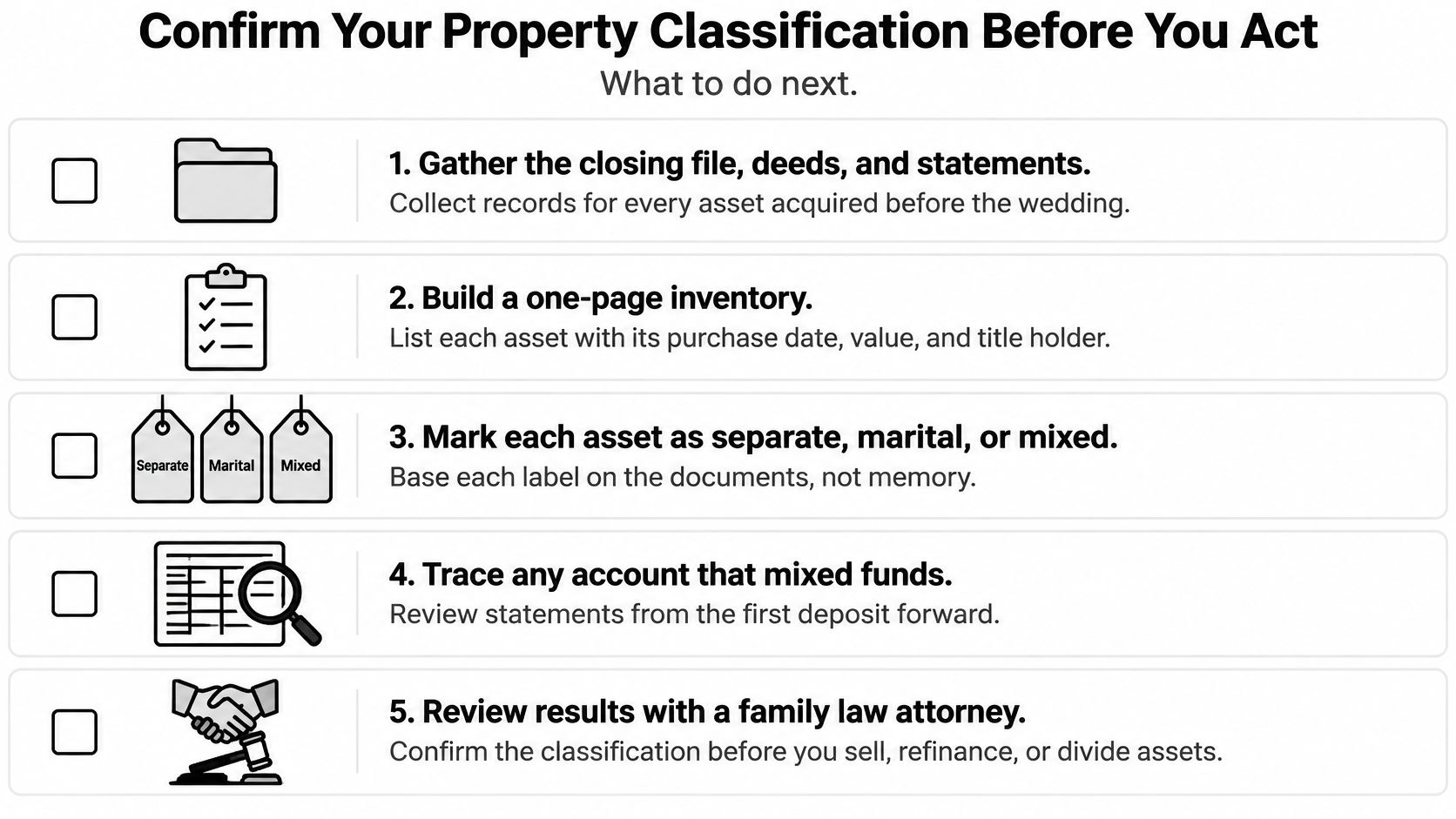
Use this visual checklist to organize the classification review.
Bring questions along with the documents
You don't need a finished accounting before seeking help. An organized folder with clear gaps is more useful than an inventory that confidently labels every asset without support.
Create folders for real estate, bank accounts, investments, retirement, businesses, and debts. Keep original files unchanged, and put your notes or transaction explanations in separate documents so someone reviewing them can distinguish evidence from your interpretation.
For each uncertain asset, write down the specific question. Was the deposit a gift to you individually or to both spouses? Did the refinance pay off an earlier loan, release cash, or both? Which account funded the improvement?
Those questions help focus document requests and professional review. They also reduce the risk of negotiating around an assumption that later proves wrong.
Before you sign: Make sure you understand both the claimed ownership and the records supporting the proposed value.
A missing statement doesn't necessarily defeat your position. It does mean you should investigate alternative records, such as transfer confirmations, lender files, probate distributions, or the receiving account's history, before treating the classification as settled.
This article provides general information, not legal advice. Outcomes depend on the specific facts, available evidence, applicable law, and any enforceable agreements or court orders.
The Law Office of Bryan Fagan helps Woodlands and Montgomery County families address property classification, divorce property division, and related probate questions. If you'd like help reviewing your inventory before filing or signing an agreement, visit The Law Office of Bryan Fagan to schedule a consultation.