
You've lived in The Woodlands for years, and your home may be the largest asset you'll leave behind. You might want a child, spouse, or another trusted person to receive it without sending the property through a probate transfer of title. A transfer on death deed in The Woodlands, Texas, can help, but only if you follow Texas's formal rules exactly.
The document isn't a shortcut that works because you signed a form and placed it in a drawer. The deed must be properly prepared, acknowledged, and recorded in the county where the property sits. After death, the beneficiary also has work to do before the county records reflect the transfer.
What Is a Transfer on Death Deed
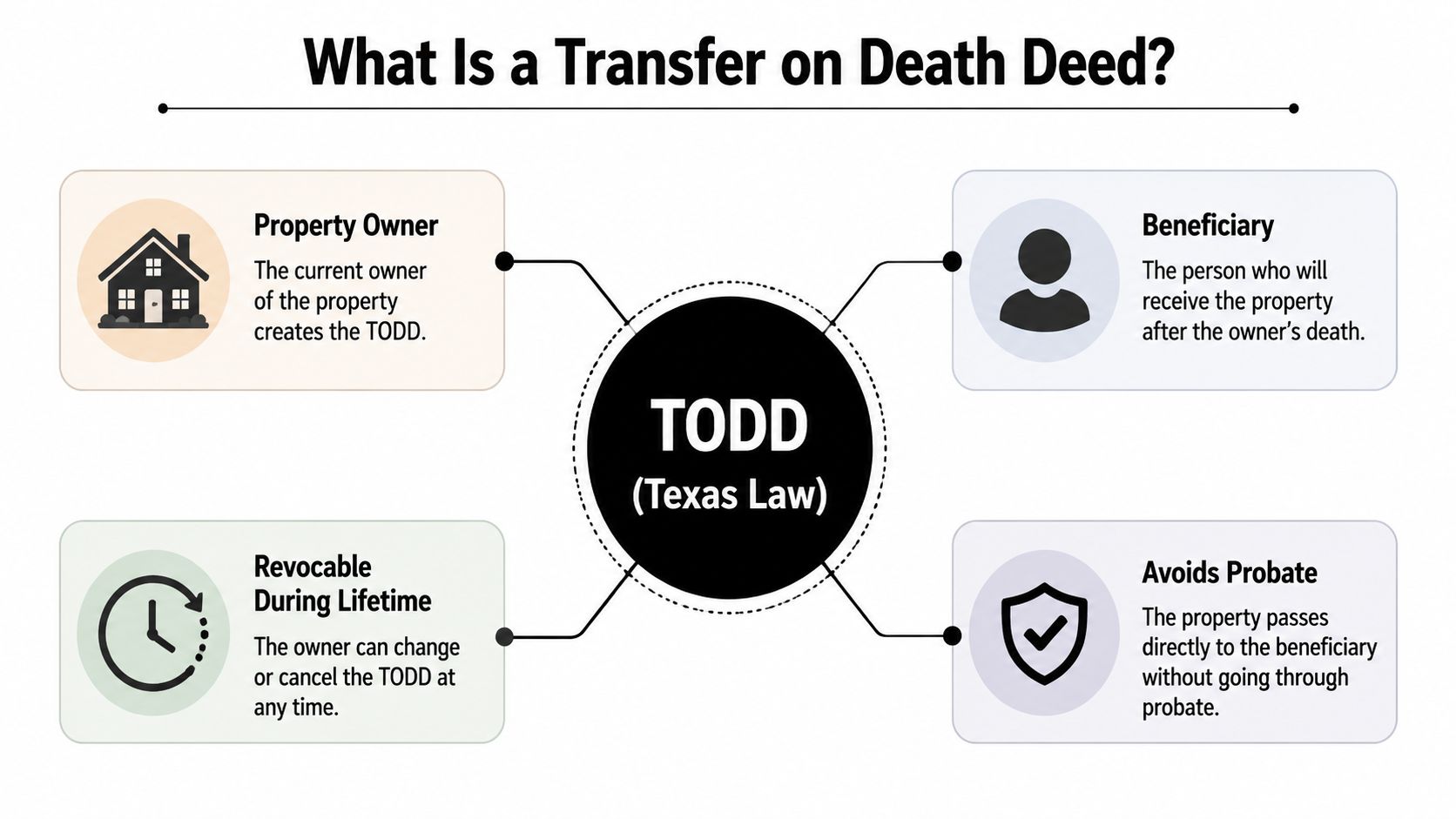
A homeowner in Creekside may want a daughter to receive the home after the owner dies while keeping the freedom to sell, refinance, or change the plan during life. A Texas transfer on death deed, commonly called a TODD, is built for that situation. It names a beneficiary for a later transfer, while the homeowner retains present control.
Under Texas Estates Code Chapter 114, a TODD is a nonprobate transfer instrument. In plain English, it can move the property outside probate for the asset identified in the deed. The deed operates like a conveyance scheduled to take effect at death. Naming a beneficiary does not give that person current ownership.
The owner keeps control
A TODD is revocable during the owner's lifetime. Texas law permits revocation even when the deed includes wording intended to make it permanent. The homeowner can generally continue living in the property, sell it, mortgage it, or place another encumbrance on it without giving the beneficiary present ownership rights. The statute also preserves homestead rights and applicable residence-homestead ad valorem tax exemptions during life, as described in the Texas statutory text.
That flexibility separates a TODD from an immediate gift of ownership. It also differs from a will. A will gives instructions ordinarily handled through probate, while a TODD is designed to address title transfer for the property named in the deed.
Practical rule: A TODD only works for the property and beneficiary designations it covers. It isn't a complete estate plan by itself.
For a Woodlands homeowner, the deed's legal effect is only part of the planning question. The property must be identified clearly, the beneficiary designation must match the owner's intent, and later title work may still be needed. Local recording and post-death affidavit requirements can determine whether the intended transfer is reflected in the county records.
How It Works in Montgomery County
A homeowner can sign a transfer on death deed in another city and still need to record it in Montgomery County. The property's location controls the filing office, not the owner's address, workplace, or mailing address. For a Woodlands property located in Montgomery County, the relevant office is the Montgomery County Clerk's deed records.
That distinction matters for homes near The Woodlands. Neighborhood names and mailing addresses do not always identify the county that holds the parcel record. Check the legal description and county records before sending the deed for filing. A document recorded in the wrong county cannot satisfy the recording requirement for the property.
Signing and recording are separate acts
Texas made TODDs available through Chapter 114, effective September 1, 2015. The provision applies to deeds executed and acknowledged on or after that date when the transferor dies on or after that date. The deed must contain the elements required for a recordable instrument, state that the transfer occurs at death, and be properly acknowledged.
Signing alone isn't enough. The county clerk must receive and record the deed during the owner's lifetime. A signed deed left in a desk, sent to a beneficiary, or submitted after death does not meet that timing requirement.
The process works like a relay. Each stage must be completed before the next one can produce the intended result:
- Execution: The owner signs the deed.
- Acknowledgment: The owner acknowledges the signature before a notary or through a legally permitted remote notarization process.
- Recording: The deed is filed in the deed records of the county where the property is located, before death.
- Death transfer: After the owner dies, the beneficiary's interest is determined under the statute and must be reflected in the title records through the required follow-up documents.
The family should keep the recorded instrument, recording information, and filing confirmation with the estate papers. After death, the beneficiary or title professional may need to prepare a death certificate and a supporting affidavit or other post-death filing before a sale or refinance can proceed. The county record is the starting point for proving that the deed was recorded on time, but it does not eliminate every title-clearance step.
A community property agreement for Texas spouses addresses a different ownership and planning issue. It should not be treated as a replacement for reviewing TODD requirements. Likewise, The Divorce Process in The Woodlands: What to Expect concerns divorce filings in The Woodlands and Montgomery County, not transfers of real property at death.
Owners should resolve uncertainty about the parcel description, county, recording status, or post-death paperwork while they are alive. Once the owner dies, the family cannot recreate a missed recording deadline. For transactions occurring under the new 2026 rules, ask how the transaction-level notice requirement affects the closing and title process before relying on the deed alone.
Benefits and Limitations Compared to Wills
A TODD can be efficient for one clearly identified property. Its strength is narrowness. It can direct that property to a named beneficiary without making the beneficiary a current owner, and it can help the property avoid a probate transfer of title when the statutory requirements are met.
A will serves a broader purpose, but it normally operates through probate. It can address personal belongings, nominate an executor, and coordinate instructions for assets that aren't covered by another transfer method. A revocable living trust can provide broader management and distribution instructions, but it generally requires careful funding and administration.
| Feature | Transfer on Death Deed | Last Will and Testament | Revocable Living Trust |
|---|---|---|---|
| Main function | Transfers the specified real property at death | Provides instructions for estate distribution | Holds and manages assets under trust instructions |
| Probate treatment | Can bypass probate transfer for the deeded property | Generally requires probate for assets passing under the will | Can avoid probate for properly transferred trust assets |
| Control while alive | Owner can sell, mortgage, or revoke | Testator retains control of individually owned assets | Owner may manage trust assets as trustee |
| Flexibility | Focused on the deeded property and named beneficiaries | Can address a broad range of estate matters | Can provide continuing management and detailed distribution terms |
| Revocation | A later qualifying deed or revocation can cancel it | Can usually be changed under will rules | Usually changeable while the trust remains revocable |
| Main limitation | Doesn't replace a complete estate plan | Court-supervised transfer may be required | More involved administration and asset coordination |
Where a TODD fits
A TODD may suit an owner whose primary concern is a particular home and a straightforward beneficiary plan. It may be less suitable where the family situation involves competing claims, multiple properties, a beneficiary who needs continuing management, or instructions that depend on conditions after death.
Debt treatment also matters. A TODD doesn't make the property free of existing obligations, and it doesn't function as a universal plan for estate administration. Readers considering a broader trust structure can review information about revocable trust forms in Texas, while recognizing that forms and trust funding require individualized review.
The right comparison isn't “Which document is best?” It's “What problem must the plan solve?” A TODD may handle the transfer of a Woodlands home. A will, trust, beneficiary designation, and other documents may be needed for everything else.
Step-by-Step Execution Process
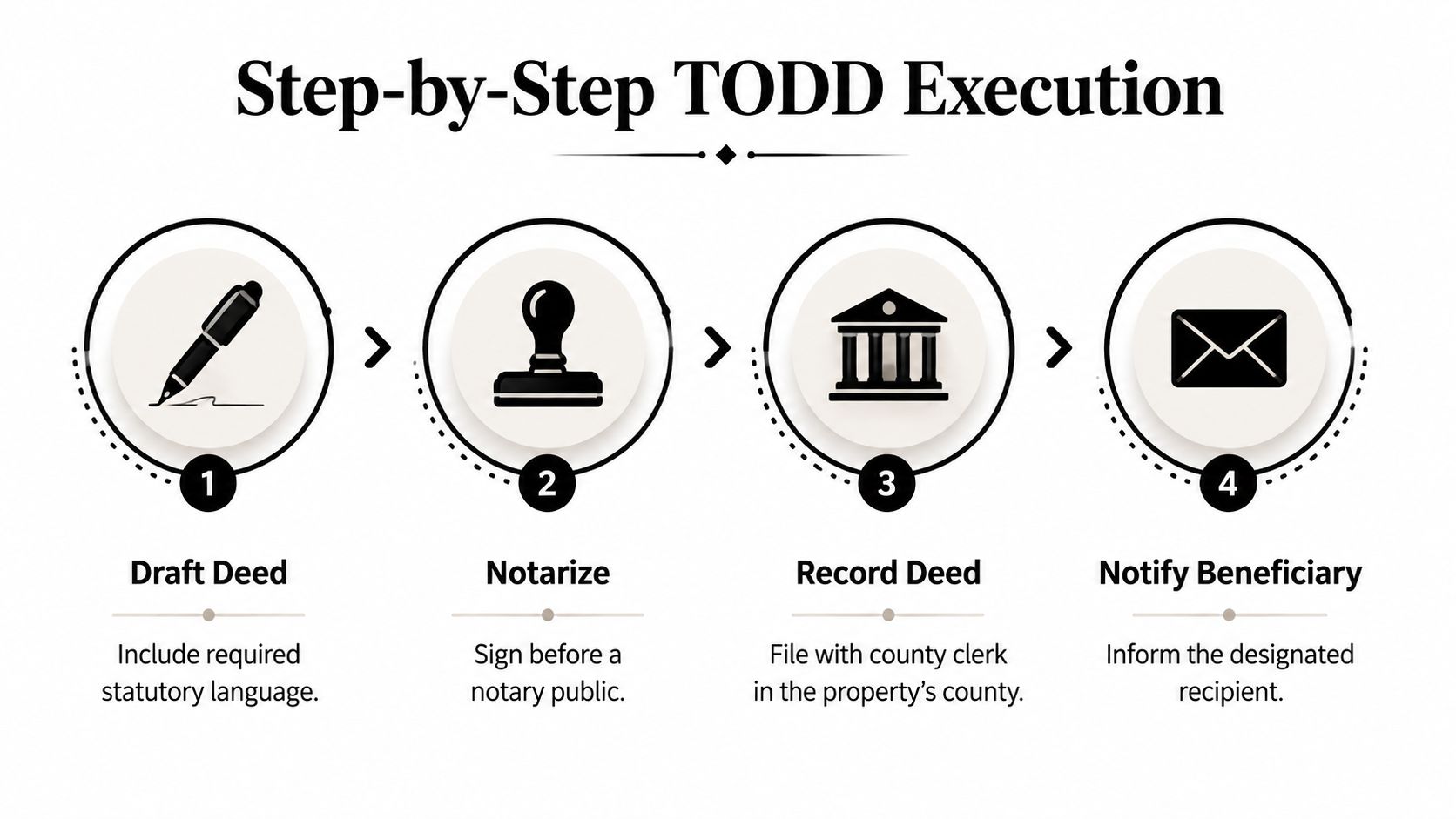
Creating a TODD is a sequence, not a single signature. Each step addresses a different legal risk, and skipping the last step can undo the work completed in the first steps.
Start with the deed language
The instrument must contain the essential elements of a recordable deed and must state that the transfer occurs at death. The property description should match the recorded land records, and the beneficiary designation should be clear enough to identify who is intended to receive the property.
An owner should also review how multiple beneficiaries are described. Under Texas law, concurrent beneficiaries generally take equal undivided shares without survivorship unless the deed states otherwise. That language can produce a different outcome from what a family casually expects, especially when children, spouses, or blended-family members are involved.
Complete acknowledgment correctly
The owner must sign and acknowledge the document during life. Traditional notarization remains familiar, but Texas also permits remote notarization for TODDs, a useful option for an owner who is older, traveling, or living outside Montgomery County. Remote signing doesn't eliminate the need for a properly completed instrument or timely recording.
Record before death
The deed must be recorded in the county where the property is located before the owner dies. For a Montgomery County parcel, that means filing with the Montgomery County Clerk. Make sure the recording has occurred, rather than assuming that mailing or submitting the document completed the process.
Finally, keep proof of recording with the estate file and tell the intended beneficiary where the information can be found. The beneficiary doesn't need present ownership, but the family will need to locate the recorded instrument later.
The deadline is tied to the owner's life, not to the family's discovery of the document.
A later review should check whether the owner still owns the described property, whether the beneficiary designations remain appropriate, and whether a later deed or revocation has changed the plan. A will cannot revoke or override a TODD. Revocation must follow the statutory mechanics, including proper acknowledgment and recording before death, as explained in Texas Estates Code Section 114.057.
The 120-Hour Rule and Post-Death Steps
A Woodlands homeowner may have a properly recorded TODD, yet the beneficiary still has work to do after the death. The transfer depends on two separate checkpoints. The deed had to be executed, acknowledged, and recorded in the county where the property is located while the owner was alive. Then, the beneficiary must satisfy Texas's survival requirement.
Under Chapter 114, the beneficiary must survive the transferor by 120 hours for the transfer to vest. Because the survivorship source is already cited in the next section, this section does not repeat that link. If the beneficiary does not meet the requirement, the share lapses and is handled under estate rules as though it were a will devise. Families can therefore face a result different from the one they expected from the deed.
The affidavit matters
A recorded TODD does not cause the county's title records to update automatically at death. Texas State Law Library guidance explains that the beneficiary must file an affidavit of death to establish the transfer in the property records. Its guidance on transferring property after death covers both the lifetime recording requirement and this later filing.
For a Montgomery County property, the post-death process generally follows this order:
- Locate the recorded TODD: Confirm that the Montgomery County Clerk recorded the deed before the owner died.
- Confirm survivorship: Verify that the beneficiary lived through the required period.
- Prepare the affidavit: Identify the owner, date of death, property, recorded deed, and beneficiary's claimed interest.
- Record the affidavit: File it with the appropriate county clerk so the land records show the claimed transfer.
- Check title and obligations: Review mortgages, liens, taxes, and competing ownership claims before a sale or refinance.
The affidavit functions like a bridge between the death certificate and the public title record. It gives a buyer, lender, or title company a document to review, but it does not erase other estate questions.
A TODD may transfer the named property without a full probate administration, while other assets still require court or estate work. The Montgomery County probate court process may involve those separate matters. The affidavit completes a title-record step, not the entire estate plan.
Common Pitfalls and Legal Risks
A Woodlands homeowner may record a TODD correctly and still leave serious questions for the beneficiary. The deed handles a particular property transfer, not every ownership, debt, or family issue.
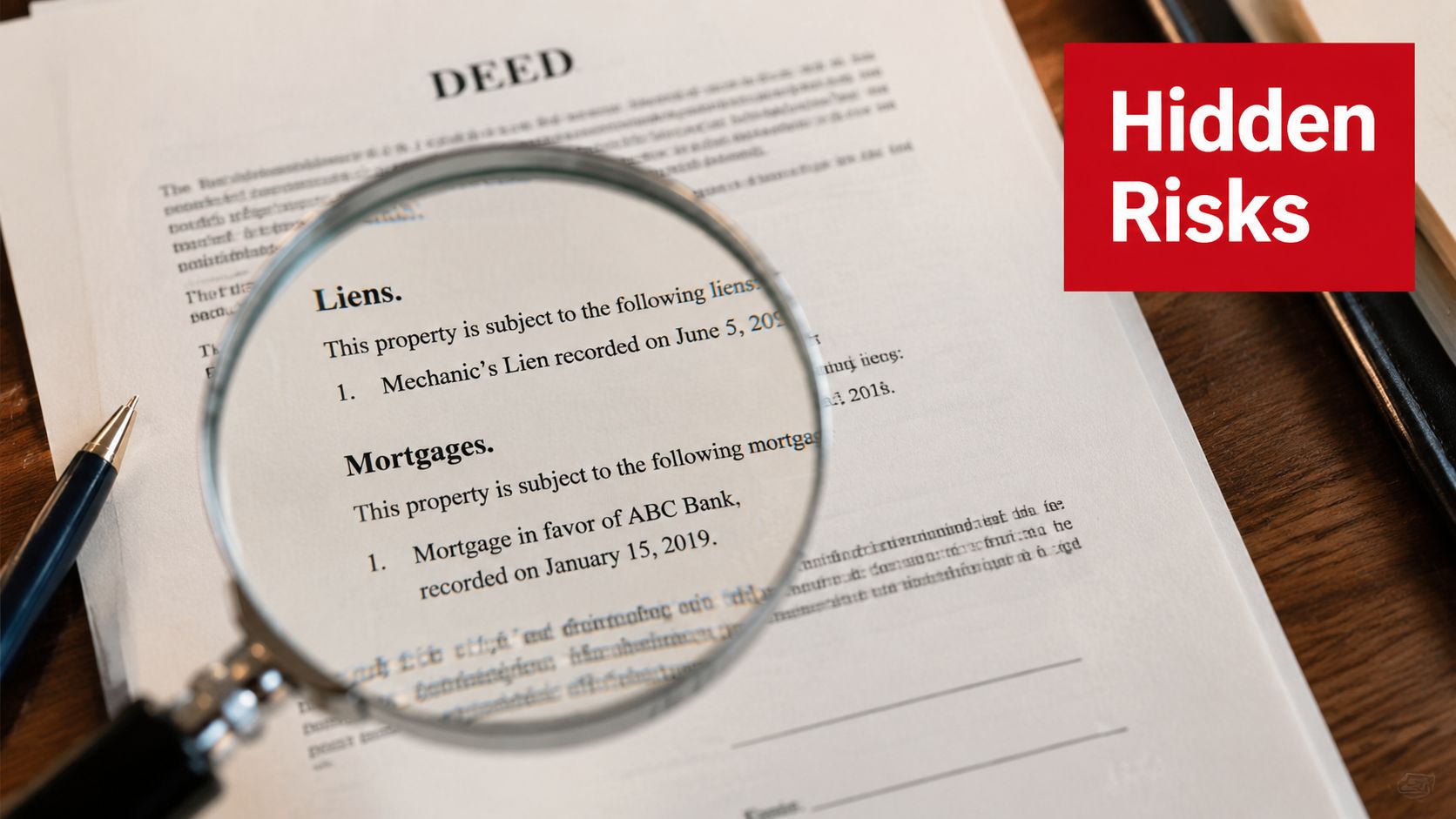
The beneficiary receives the property subject to liens, mortgages, and other encumbrances that exist when the owner dies. Texas Estates Code Section 114.104 addresses these obligations and related notice procedures when an estate administration is opened. A transfer-on-death deed does not erase a deed of trust, tax claim, mechanic's lien, or other recorded burden. The beneficiary should have the title reviewed before selling or refinancing.
Family structure can change the result
Survivorship rules can alter an apparently simple plan. A beneficiary who does not satisfy the 120-hour requirement may not receive the intended interest. Concurrent beneficiaries generally receive equal undivided shares unless the deed provides otherwise. Joint-owner survivorship arrangements may also control the result in some circumstances, as reflected in the Texas beneficiary rules discussed earlier.
Blended families need particular care. A deed naming one person may conflict with the owner's broader intentions, especially if the owner assumes a later will can change the recorded plan. It cannot. A qualifying revocation or later deed must be completed and recorded before death.
Residential transactions now require attention
HB 5642 establishes a transaction-level notice requirement for residential real-estate transactions. The measure requires real estate license holders to provide written notice about TODDs, with implementation rules due by December 1, 2025 and an effective date of January 1, 2026, according to the HB 5642 bill information. Since the effective date has arrived, Woodlands buyers, sellers, and agents should raise TODD questions during the transaction.
The notice does not replace legal advice. It alerts transaction participants to review the recorded deed, beneficiary rights, and title history. A missing, unclear, or conflicting record can delay closing while the parties determine who has authority to sell or sign documents.
Next Steps for Woodlands Homeowners
A TODD may be a sensible part of an estate plan for a home in The Woodlands or elsewhere in Montgomery County, but the details control the result. Start by identifying the exact property, confirming the current deed, and deciding whether the intended beneficiary arrangement still reflects the owner's family circumstances.
What to do next
- Review ownership: Confirm who owns the property and whether any joint-owner arrangement affects the proposed plan.
- Check the legal description: Use the recorded deed and county land records, not only the property's mailing address.
- Choose beneficiaries carefully: Consider survivorship, equal undivided shares, alternate beneficiaries, and blended-family consequences.
- Prepare and acknowledge the deed: Make sure the instrument satisfies Texas Estates Code Chapter 114.
- Record in the correct county: For a Montgomery County property, confirm filing with the Montgomery County Clerk before the owner's death.
- Preserve the paperwork: Keep the recorded deed accessible and tell a trusted person where it is located.
- Plan for death administration: Make sure the beneficiary knows that an affidavit of death must later be filed.
The Law Office of Bryan Fagan handles probate and estate-related matters for families in The Woodlands and surrounding Montgomery County communities. An attorney can review whether a TODD works alongside your will, trust, ownership structure, and beneficiary plan.
This article is for general informational purposes only. It isn't legal advice, and it doesn't create an attorney-client relationship. Texas property and estate-planning results depend on the documents, ownership history, family circumstances, debts, and recording details involved.
If you're considering a transfer on death deed for a home in The Woodlands or Montgomery County, The Law Office of Bryan Fagan can help you review the recording requirements and coordinate the deed with your broader estate plan. Schedule a consultation to discuss the property, beneficiaries, and post-death steps before you sign or record anything.