
A couple in The Woodlands may assume their home will pass automatically to the surviving spouse because both names appear on the deed. That assumption can create trouble. In Texas, joint title alone doesn't necessarily create a right of survivorship, and ordinary community property may still require probate administration.
A community property agreement can help, but it isn't a universal estate-planning solution. The document may convert separate property into community property, establish survivorship rights at death, or affect how assets are classified if the marriage later ends in divorce. Those choices can simplify one problem while creating another.
This article is educational and isn't legal advice. Texas property classification depends on the documents, timing, title history, tracing records, and the goals of both spouses.
What a Community Property Agreement Actually Does
Consider a hypothetical Woodlands couple who owns a home in Creekside. Both spouses are listed on the deed, and each believes the survivor will automatically become the sole owner when the other dies. After one spouse dies, the family learns that the deed doesn't contain the necessary survivorship arrangement. The surviving spouse may still need to address the deceased spouse's interest through estate administration.
That's the distinction many families miss. Ordinary community property and community property with right of survivorship aren't the same thing. Texas Estates Code Section 112.052 says survivorship can't be inferred merely because property is community property or jointly owned. A valid written agreement is the important part, as explained in Texas Estates Code Section 112.052.

Two functions that often get confused
A community property agreement can serve different legal purposes:
- Conversion: Spouses can agree that separate property becomes community property. That may change ownership rights during the marriage and affect what happens in a divorce.
- Survivorship: Spouses can agree that covered community property passes to the surviving spouse when one spouse dies. If the agreement satisfies the statutory requirements, the covered property can move outside the ordinary probate path.
The Texas Constitution has expressly allowed spouses to convert separate property into community property by written agreement since the amendment to Article XVI, Section 15, approved on November 2, 1999, and effective January 1, 2000. The same provision permits written survivorship arrangements for community property. The Texas State Historical Association describes these changes in its history of Texas community property law.
A survivorship agreement doesn't necessarily change the property's character while both spouses are alive. It creates a death-triggered transfer. That's different from a partition or exchange agreement, which can make property one spouse's separate property immediately.
Practical rule: If your goal is for a spouse to receive an asset at death without probate, ask whether the document creates survivorship rights. Don't rely on the words “jointly owned” by themselves.
You should keep reading if you own a home, business interest, investment account, inherited asset, or other property whose classification matters. You should also pay close attention if you brought substantial property into the marriage or have children from a prior relationship. The same agreement that simplifies a death transfer may influence a later divorce dispute.
How Texas Law Defines and Governs These Agreements
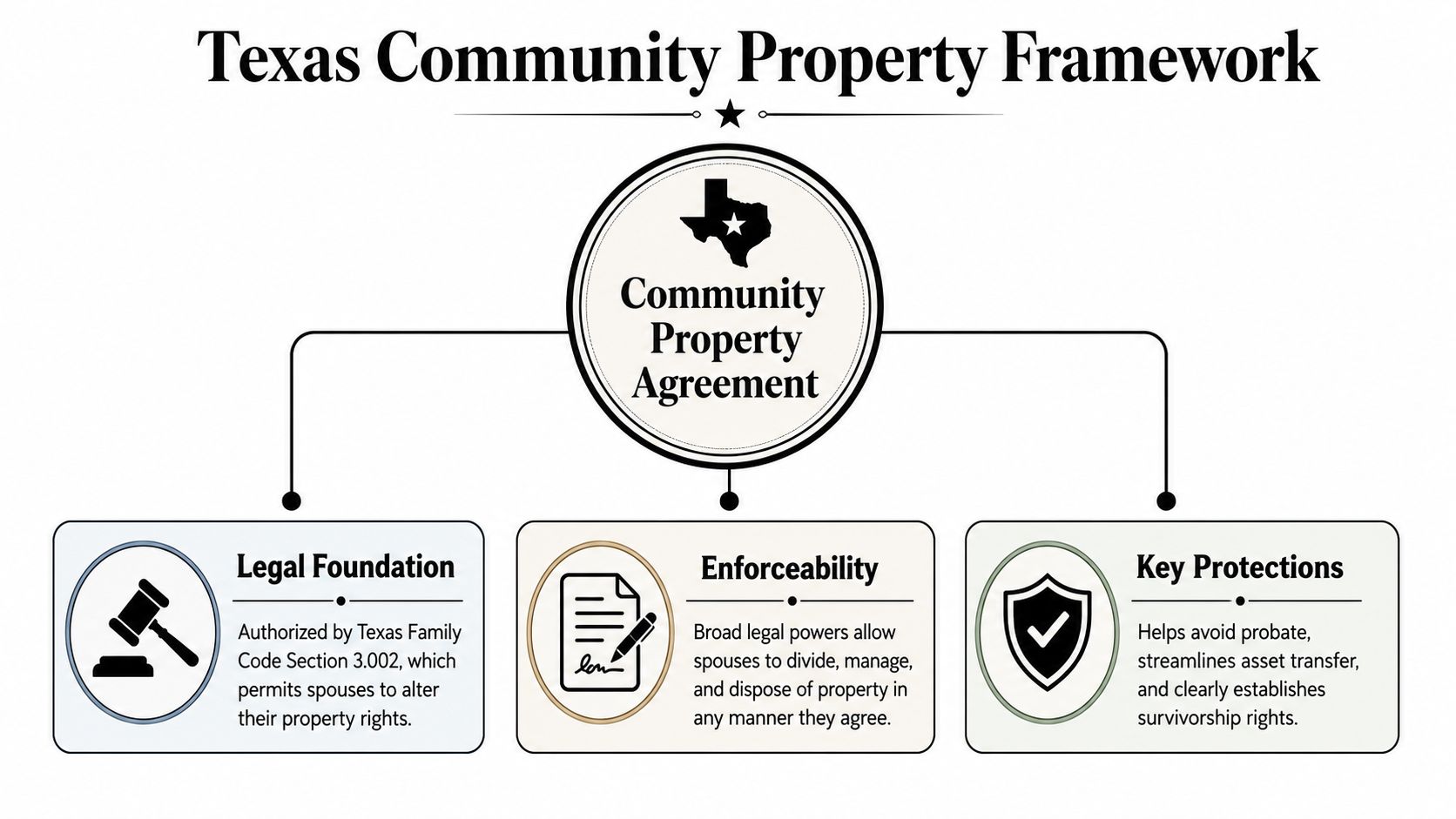
Texas starts with a broad classification rule. Under Texas Family Code Section 3.002, community property generally means property acquired by either spouse during marriage that isn't separate property. Texas law also applies a broad presumption to property possessed by either spouse during marriage or at dissolution, which places practical importance on documentation and tracing. The statutory framework appears in Texas Family Code Section 3.002.
That presumption doesn't mean every asset is permanently community property. It means the spouse asserting separate-property treatment may need reliable evidence, such as acquisition records, inheritance documents, gift records, account statements, or tracing information. A carefully drafted agreement can remove uncertainty by stating what the spouses intend to convert or cover.
Conversion under the Texas Family Code
Texas Family Code Section 4.202 allows spouses to agree that all or part of separate property will become community property. Section 4.203 supplies the practical formalities. The agreement must be in writing, signed by both spouses, identify the property, and state that the property is being converted to community property. The agreement can be enforceable without consideration, as reflected in Texas Family Code Sections 4.202 and 4.203.
A title change isn't a substitute for that agreement. Moving a deed into both names, adding a spouse to an account, or placing an asset under a shared label doesn't automatically establish the required conversion intent.
Survivorship under the Texas Estates Code
Texas Estates Code Section 112.051 allows spouses to agree that existing or future community property becomes the surviving spouse's property when one spouse dies. Section 112.052 requires a written agreement signed by both spouses and recognizes statutory survivorship language. The statute also makes clear that survivorship must be created by agreement, not assumed from ownership labels. The governing provisions are collected in Texas Estates Code Chapter 112 and Section 112.051.
For families evaluating classification and complex assets, a Property Division Lawyer in The Woodlands addresses division of community property and complex assets for Woodlands divorces.
Survivorship Agreements Versus Partition and Exchange Agreements
These agreements answer different questions. A survivorship agreement asks what happens at death, while a partition or exchange agreement asks who owns property during the marriage and after a divorce.
Under Texas Family Code Section 4.102, spouses can partition or exchange property so that transferred property becomes the receiving spouse's separate property. The agreement may also affect future income and earnings from that property. A survivorship agreement, by contrast, leaves the underlying community-property character in place during the marriage and activates its transfer mechanism when a spouse dies. The statutory partition framework is described in Texas Family Code Section 4.102.
| Feature | Survivorship Agreement | Partition or Exchange Agreement |
|---|---|---|
| Timing | Operates when one spouse dies | Changes classification during the marriage |
| Property character | Keeps covered property as community property during marriage | Converts transferred property into one spouse's separate property |
| Creditor impact | May expose property to the risks associated with community ownership | May change which spouse owns the asset and how creditor issues are evaluated |
| Probate effect | Can transfer covered property directly to the survivor if statutory requirements are met | Doesn't automatically provide a survivorship transfer merely because property becomes separate |
| Divorce consequences | May affect the classification and division analysis | Directly changes the separate-property and community-property framework used in divorce |
Choosing the tool
If the primary goal is to simplify the transfer of marital property to the surviving spouse, survivorship may be the better fit. If the goal is to preserve a business, inherited asset, or premarital property as one spouse's separate property, partition and exchange may be more relevant.
Neither tool is a complete creditor-protection plan. Reclassifying an asset can alter ownership exposure, but the result depends on the asset, the parties' debts, applicable law, and the document's terms. A couple should also consider whether the desired arrangement is fair if the marriage ends.
The property issues that arise in a Montgomery County divorce can involve homes, businesses, investment accounts, and debt allocation. Montgomery County Family Courts: A Local Guide provides information about how family law cases proceed in Montgomery County courts serving The Woodlands.
What Happens to the Agreement During a Divorce
A community property agreement isn't only an estate-planning document. It's also a divorce-risk document.
Filing for divorce doesn't automatically terminate the agreement. The divorce itself generally ends the marital property regime and can require the court to classify, value, and divide assets and debts. Whether a particular clause remains relevant may depend on its language, the asset involved, the parties' conduct, and whether the agreement was properly executed.
Suppose spouses signed an agreement covering a rental property that one spouse owned before marriage. If the document converted that separate property into community property, the classification may become a central issue in the divorce. The spouse who originally owned the property may argue that the agreement didn't meet statutory requirements, while the other spouse may rely on the signed document and the parties' conduct.
The questions a divorce court may face
A court may need to examine:
- Execution: Did both spouses sign the agreement?
- Identification: Does the document clearly identify the property?
- Intent: Does it state that the property is being converted, or does it create survivorship rights?
- Validity: Did the spouses have capacity and enter the agreement voluntarily?
- Scope: Does the document cover the disputed asset, later-acquired property, income, or only a defined category?
- Evidence: Do title records and financial documents support the interpretation?
A survivorship provision generally concerns death, not a routine division at divorce. But a dispute over whether the agreement also converted separate property into community property can materially affect the marital estate. That's why signing a document for probate convenience without considering divorce consequences can be shortsighted.
A document that feels simple in an estate-planning meeting can become important evidence in a contested property case.
If the marital home is involved, review both the agreement and the title history before assuming what happens. The practical questions discussed in what happens to the house in a divorce often depend on classification, equity, reimbursement claims, and the parties' agreement.
Divorce also raises creditor concerns. Converting separate property into community property can change the ownership structure and may affect how creditors view or pursue the asset. That doesn't mean every conversion is unwise. It means the couple should understand the trade-off before signing, especially when one spouse owns a business or faces professional liability exposure.
Creating Modifying and Revoking Your Agreement
Start with the asset list, not a template. Identify the home, accounts, business interests, inherited property, investment real estate, and other assets the spouses want to address. Then decide whether the purpose is conversion, survivorship, partition, or a combination that the document can lawfully and clearly express.
A workable drafting process
- Define the objective. Decide whether you're trying to transfer property at death, change ownership during marriage, clarify separate-property treatment, or address several goals.
- Identify the assets. Use legal descriptions for real estate and precise identifying information for accounts, business interests, and other property.
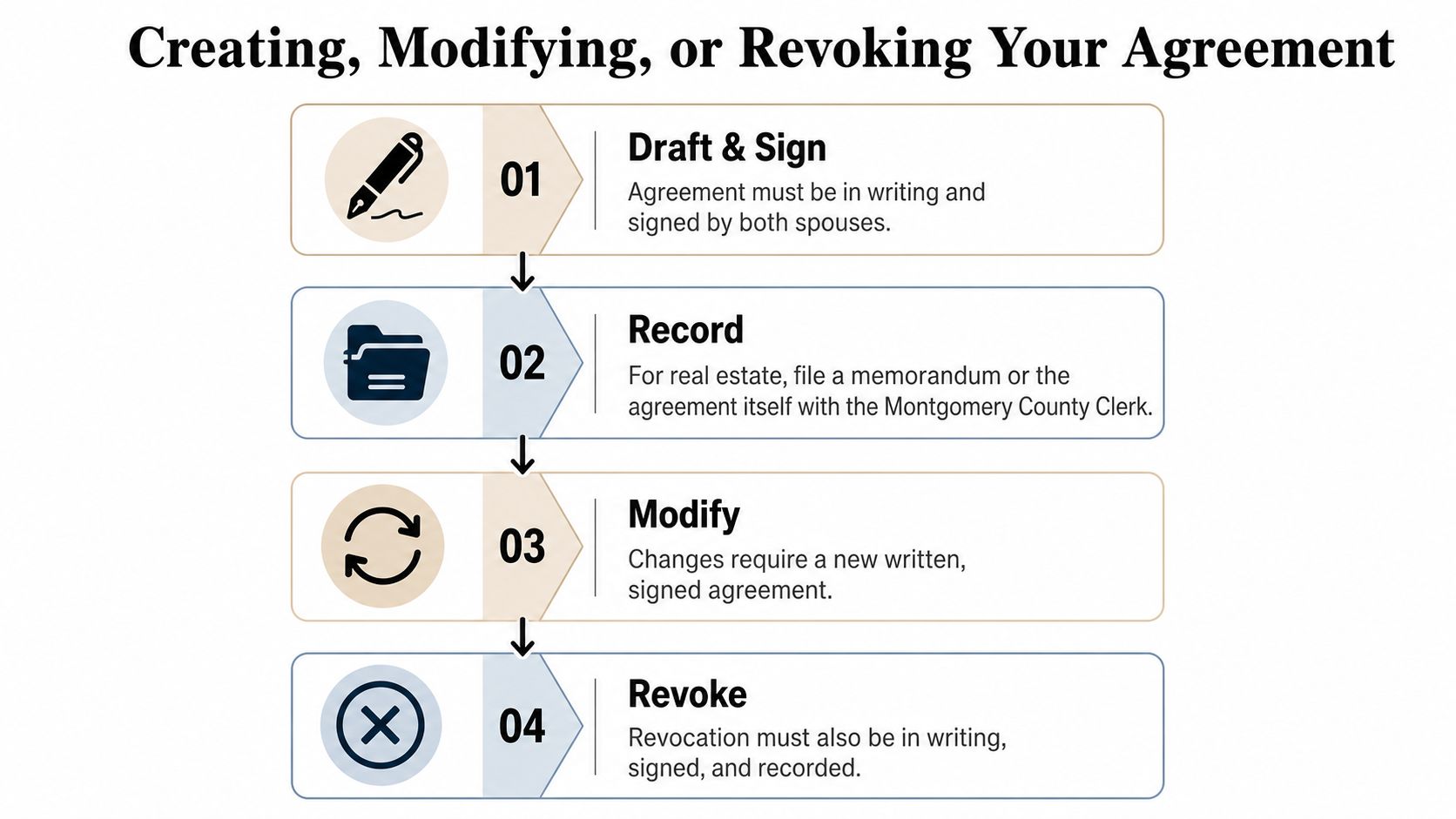
- Use the correct written terms. For conversion, Texas Family Code Section 4.203 requires a written, signed agreement that identifies the property and states the conversion intent. For survivorship, Texas Estates Code Chapter 112 requires a written agreement signed by both spouses.
- Coordinate the records. Make sure deeds, account registrations, business records, beneficiary designations, wills, trusts, and tax documents don't contradict the agreement.
A mere transfer of title into one spouse's name, or into both names, doesn't by itself convert separate property under Texas Family Code Section 4.203. The document needs to show the spouses' agreement and identify the intended legal change.
Changes and revocation
Modify an agreement with a new written document signed by both spouses. The new document should identify the earlier agreement, state which provisions change, and explain whether the amendment replaces, supplements, or revokes specific terms. Ambiguous amendments create avoidable disputes later.
A survivorship agreement may be revoked by mutual written consent, but the timing matters. If the spouses are already in divorce proceedings, one spouse may challenge the validity, voluntariness, scope, or effect of the revocation. For real estate, recording the appropriate document with the Montgomery County Clerk helps keep the land records consistent, but recording doesn't cure a defective agreement.
Couples seeking help with drafting or reviewing an agreement may consider a postnuptial agreement attorney in Montgomery County. The right review should examine the agreement alongside the couple's complete property and estate plan.
Local Guidance for The Woodlands and Montgomery County Families
A community property agreement may make sense for a couple in Panther Creek, Alden Bridge, Sterling Ridge, or Creekside when the spouses have a clear shared goal. Common examples include property brought into the marriage, a closely held business, inherited assets, investment real estate, or a desire to simplify the surviving spouse's ownership of marital property.
The decision deserves extra care in blended families. A survivorship arrangement directing covered property to the surviving spouse may not match a spouse's separate intention to leave particular assets to children from a previous relationship. A will alone also doesn't answer every title and classification question, especially when the agreement changes ownership during marriage.
Local issues worth putting on the table
A high-asset divorce in The Woodlands can turn on details that couples overlook during estate planning. A business may have separate and community components. A home may have a complex acquisition and refinancing history. An inherited account may have received marital contributions. Those facts can affect classification and reimbursement arguments.
A local family law attorney in The Woodlands, Texas can help connect the document to the family's broader property and court concerns.

What to do next
- Review current titles: Check deeds, account registrations, business records, and existing estate documents.
- Discuss shared goals: Decide what should happen during marriage, at death, and if the marriage ends in divorce.
- Gather financial documents: Collect purchase records, inheritance records, statements, loan documents, and prior agreements.
- Separate the questions: Ask whether you need conversion, survivorship, partition, or a broader marital agreement.
- Schedule a consultation: Bring the documents to a local family law attorney who understands Montgomery County procedures.
The Law Office of Bryan Fagan offers guidance on marital property agreements, property classification, divorce-related division, and probate concerns for families in The Woodlands and surrounding Montgomery County communities. To discuss whether an agreement fits your assets and goals, visit The Law Office of Bryan Fagan and schedule a consultation.
This article is not legal advice. It provides general educational information, and your rights may depend on the exact agreement, property records, family circumstances, and current Texas law.