
A custody order can feel workable when it's signed and completely impractical later. A parent in The Woodlands may now be commuting to Conroe for work, a teenager may be resisting a schedule that once fit, or a new household arrangement may have changed the child's daily needs. The question usually arrives in plain language: how do I file for custody modification?
The answer depends on more than completing a form. You'll need to identify the correct Montgomery County filing path, determine whether the change is agreed or contested, connect your request to a material change in circumstances, and present organized evidence showing why the proposed order serves your child's best interest. This guide walks through those decisions, including the Texas one-year affidavit rule that can stop an unprepared case at the outset.
When Life Changes and You Need a New Order
A Woodlands parent's commute has stretched toward Conroe. Their teenager now attends a different school, and the existing possession schedule creates long drives on school nights. The other parent believes the arrangement still works, while the child says it no longer fits daily life.
That parent needs more than the statement, “Things have changed.” Texas courts begin with the existing order. The filing should identify a specific, continuing change and connect the requested revision to the child's welfare.
The practical roadmap
The Montgomery County filing process usually follows these steps:
- Confirm jurisdiction. Determine whether Montgomery County is the proper place to file, especially when the existing order came from another Texas county or state.
- Choose the agreed or contested path. A signed agreement can reduce disputes, but the court still must receive and approve it.
- Document the change. Collect records involving school, transportation, work, medical needs, safety, or parenting-time problems.
- File the SAPCR petition. The pleading identifies the existing order, requested changes, and supporting facts.
- Serve the other parent. An agreed case may proceed with a waiver. Without one, formal service is required.
- Request temporary orders when necessary. Temporary relief can address urgent parenting or support issues while the case is pending.
- Prepare for the final hearing. The judge will assess admissible evidence, credibility, and the child's best interest.
Practical rule: A modification case asks the court to replace provisions that no longer fit with a new order tailored to the child's current circumstances.
Texas Family Code §156.101 supplies the standard that shapes each decision. The circumstances of the child, a conservator, or another affected person must have materially and substantially changed since the prior order, and the proposed modification must serve the child's best interest. Those requirements affect the filing route, the evidence collected, and the exhibits presented at hearing. In Montgomery County, preparing for those requirements before filing can determine whether the case proceeds smoothly or faces avoidable delay.
Texas's Legal Standard for Changing Custody
Texas Family Code §156.101 sets the threshold. A court may modify a conservatorship, possession, or support order when circumstances involving the child, a conservator, or another affected person have materially and substantially changed since the prior order, and the requested modification serves the child's best interest. TexasLawHelp describes examples of potentially qualifying changes, including family violence, child abuse, relocation that increases expenses, new household members, instability, parental alienation, and significant changes in the child's needs.
The court looks for facts, not dissatisfaction with the other parent or a preference for a different schedule. A move, changed work demands, school problem, medical development, or safety concern may support modification, but its legal importance depends on the evidence and the order being challenged. A two-year-old order does not automatically qualify for modification. The filing must connect the current circumstances to the requested change and explain why the new arrangement serves the child.
The one-year hurdle
A request to change the child's primary residence within one year after the prior order faces an added requirement under Texas Family Code §156.102. The petition generally must include a supporting affidavit with specific facts showing that the child's present environment may endanger physical health or significantly impair emotional development, that the child is being cared for by the petitioner, or that another statutory exception applies, including an agreement under the applicable Chapter 9 provision.
This affidavit rule blocks many unprepared early filings. If the affidavit does not meet the statute, the court generally should not consider the primary-residence request. The rule can apply to an agreed case as well as a contested case. Agreement may reduce the dispute, but it does not replace the required pleading or affidavit.
Identify the provision you want changed
A request to change conservatorship addresses decision-making rights or the designation of a managing conservator. A request to change possession and access concerns the parenting schedule. A request to remove or revise a geographic restriction concerns where the child's primary residence may be maintained.
The best-interests analysis applies whether the order names sole or joint managing conservators. In Montgomery County, that legal classification affects the filing path: parents who agree still need a filed modification and judicial approval, while a contested case requires an Original Petition to Modify the Parent-Child Relationship. A primary-residence request filed within the one-year period also requires careful review of the affidavit requirement before filing.
Forms and Paperwork Used in Montgomery County
Montgomery County self-represented parents commonly encounter forms through the District Clerk, the courthouse resources serving Conroe and The Woodlands, and Texas courts' statewide forms. The central pleading is the Petition to Modify the Parent-Child Relationship, often called a SAPCR modification petition. It identifies the child, the parties, the existing order, the requested changes, and the facts supporting the material-change and best-interests allegations.
Match the packet to the case
An agreed modification and a contested modification aren't interchangeable.
- Agreed petition. Use the agreed path when both parents accept the proposed conservatorship, possession, support, or geographic terms. The parties still need a filed case and a judge's approval.
- Original petition. Use the contested path when the other parent won't sign, refuses to cooperate, or disputes the requested terms. The petition must give fair notice of what you're asking the court to change.
- Supporting affidavit. If the request involves changing the child's primary residence within the statutory one-year period, review §156.102 carefully before filing. A general statement that the child would be happier with you won't satisfy a specific-facts requirement.
The packet may also include Texas Supreme Court forms used in SAPCR matters, a Standing Order addressing child support and health care, and Mandatory Disclosure materials exchanged early in the case. Financial information needs to be complete and consistent. A practical overview of the financial disclosure form can help you understand the type of information typically requested, but it doesn't replace checking the current court forms.
Details that prevent avoidable delays
Use the existing order's exact cause number and citation information. Don't guess at the court, date, or case designation. If the packet requests a Certificate of Last Address, provide the most recent reliable address information required by the form and protect confidential information through the proper filing process.
Montgomery County also has local filing details that can matter in unusual cases. A separate Notice of Filing may be required in cases involving affidavits of voluntary relinquishment. That isn't a routine custody-modification shortcut, so confirm whether it applies before submitting documents.
For parents looking specifically at Custody & Support Modifications in The Woodlands, the relevant subject is modifying existing custody, visitation, and support orders in Montgomery County. Missing forms, inconsistent answers, and an absent proposed order are common reasons a case stalls before a judge reviews the requested relief.
Filing the Petition and Serving the Other Parent
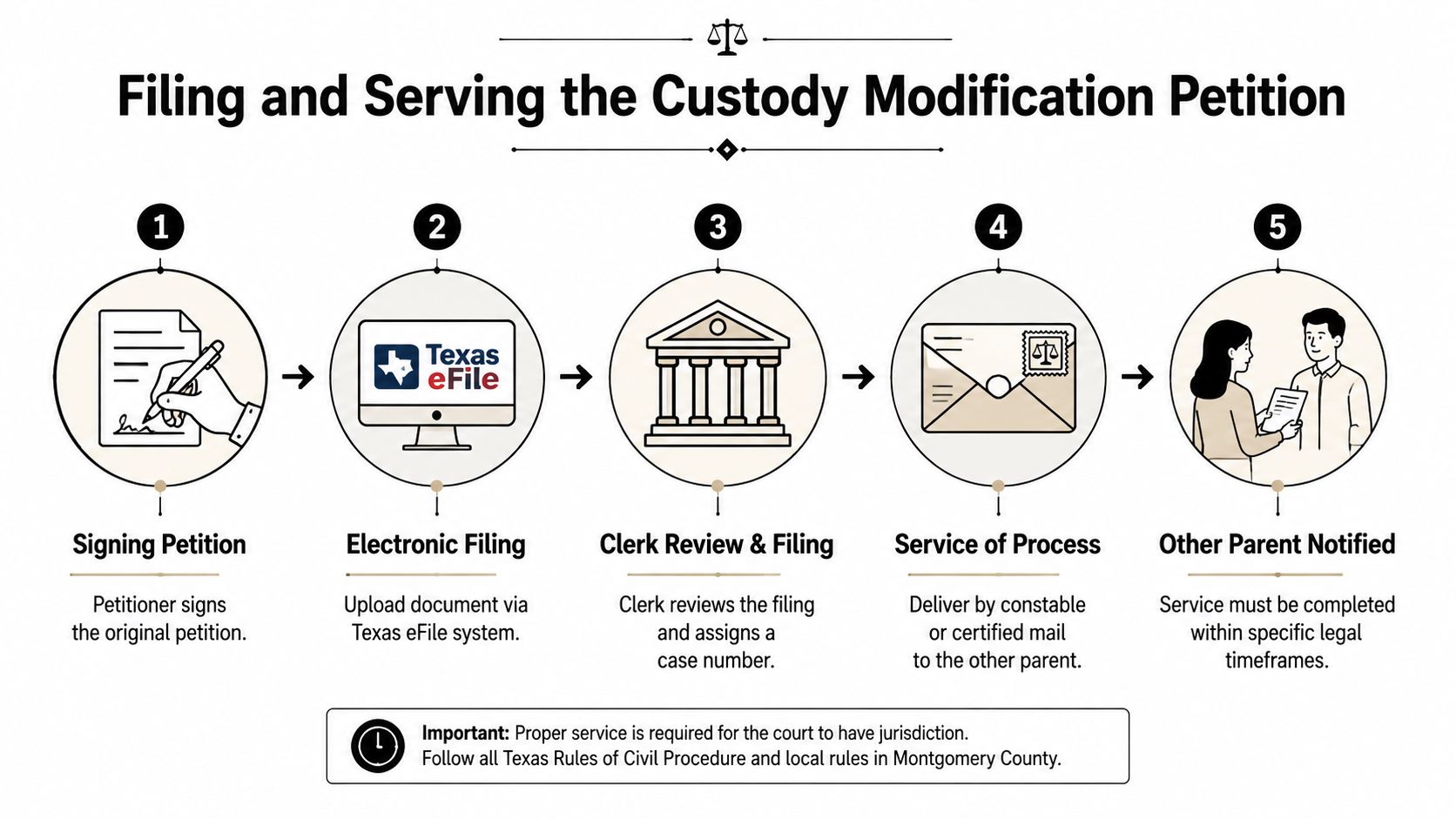
The filing sequence starts after you've signed the petition and assembled the required attachments. Montgomery County filings generally move through the Texas eFile system, so scan documents clearly, select the correct case category and filing code, and confirm that confidential information is placed in the required confidential form rather than exposed in a public pleading.
The filing fee for a Texas SAPCR modification is commonly around $300, although the exact amount should be confirmed with the clerk because fees can change. If income is limited, request a waiver using Texas Rule of Civil Procedure form TCRP-1. The waiver request is a sworn financial application, not a casual note asking the clerk to excuse payment.
Where the case belongs
Texas jurisdiction typically connects to the child's residence or the court that issued the existing order. TexasLawHelp explains that a modification petition should generally be filed in the county where the current order was made, which is particularly important for Montgomery County families whose existing SAPCR order came from a Montgomery County court. If the order came from elsewhere, confirm venue and jurisdiction before filing.
Before you submit: Check the cause number, filing code, confidential information form, requested relief, supporting affidavit if required, and proposed order.
Service is a separate legal step
Filing doesn't notify the other parent by itself. In an agreed case, the responding parent may sign a waiver of service, so a constable doesn't need to deliver the citation. If the parent won't waive service, a constable or private process server delivers the citation and petition, and proof of service must be filed with the court.
The Montgomery County Family Courts local guide addresses how family law cases proceed in Montgomery County courts serving The Woodlands. Use the filing confirmation and clerk's instructions to track whether service or a waiver has been properly filed.
Building the Evidence the Court Wants to See
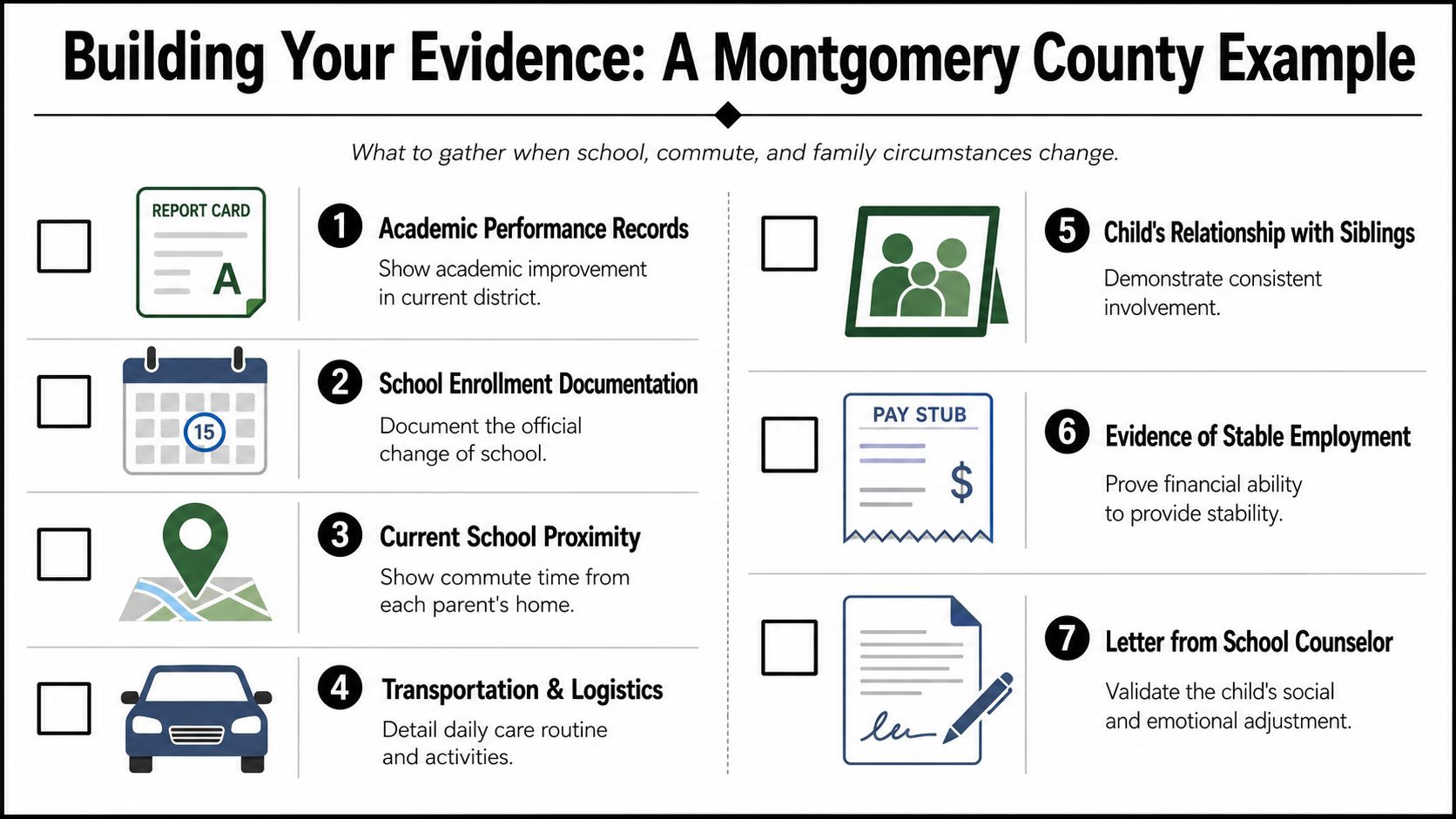
A teenager in The Woodlands changes schools after the other parent's job relocates. The teenager now lives closer to one parent, faces a different commute, and wants to spend school nights there. That account may support modification, but the court needs evidence connecting those facts to the child's daily life and the specific order requested.
Focus the file on documents that prove the change, its effect on the child, and why the proposed order is workable. School enrollment records, attendance information, grades, transportation details, and messages about missed exchanges may all help. If the child's medical or emotional needs have changed, relevant treatment records may matter. A loose stack of every receipt and text message can dilute the argument the court needs to hear.
Build an indexed record
Organize exhibits around the issue in dispute:
- School records: Enrollment, attendance, academic performance, and communications from school staff.
- Schedule evidence: A calendar showing denied or missed possession, exchange problems, and actual parenting time.
- Transportation proof: School locations, work schedules, and practical details showing how each proposed schedule would operate.
- Communications: Texts and emails addressing logistics or contradicting a factual assertion, with dates and surrounding context.
- Witness information: Declarations or testimony from people with firsthand knowledge, such as a teacher, counselor, relative, or childcare provider.
Montgomery County courts need a usable hearing presentation. Prepare an Exhibit List, label documents consistently, and keep copies for the judge and the other side. A tabbed binder and short chronology are more useful than an unorganized collection of screenshots. Guidance on presenting evidence in court explains how organization, foundation, and relevance affect the presentation.
Avoid evidence that creates a new problem
Social-media rants and character attacks rarely establish what changed for the child. Recorded conversations can raise admissibility and consent issues, so an argument captured on a recording may create a separate dispute. Before presenting evidence, assess whether it is relevant, authentic, and legally usable.
Preserve messages in their original context. Keep screenshots showing dates and participants, export conversation records when possible, and store school, medical, financial, and parenting documents in one secure folder or binder. Expert input from a parenting coordinator, custody evaluator, or licensed professional counselor may assist in a complex case, but a private evaluation is not automatically persuasive. Its value depends on the evaluator's role, the information reviewed, the methodology, and whether the court can properly consider the opinion.
Temporary Orders and the Day of Your Hearing
A final modification order resolves the case. Temporary orders address what happens while the case is pending. A parent may seek temporary relief for an adjusted possession schedule, child support issues, health-care responsibilities, or restrictions on contact when waiting for a final hearing would create a practical or safety problem.
In Montgomery County, the request commonly begins with a Motion for Temporary Orders and a setting on an associate judge's docket. The motion should state the immediate problem and the specific temporary arrangement requested. General conflict isn't enough. The judge needs to know what must change now, how the current arrangement affects the child, and why the requested temporary terms are workable.
Know the courtroom setting
Family matters may be heard through the 410th, 284th, or 359th District Court in Conroe, depending on the case and docket. Confirm the assigned court, courtroom, hearing format, and check-in instructions before the setting. Associate judges hear much of the family docket, and their rulings carry significant weight in how the case proceeds.
Bring:
- Your exhibit binder: Include an indexed set for yourself, the judge, and the opposing party.
- A date calendar: Mark the existing schedule, disputed exchanges, school dates, and key events.
- A short outline: List the requested relief, the evidence supporting it, and the facts you must explain.
- Required filings: Bring filed copies, service information, and any proposed order connected to the hearing.
Dress neatly and address the judge formally. Let the judge control the pace. Don't interrupt, argue with the other parent from counsel table, or introduce surprises that weren't disclosed as required.
Most short hearings are tightly managed, often lasting under an hour, although the duration depends on the issues and the court's docket. Credibility and preparation usually matter more than an unusual legal argument. Answer the question asked, avoid exaggeration, and keep returning to the child's needs rather than the history of the adult relationship.
What to Do Next and How a Local Attorney Helps
Use this checklist before filing:
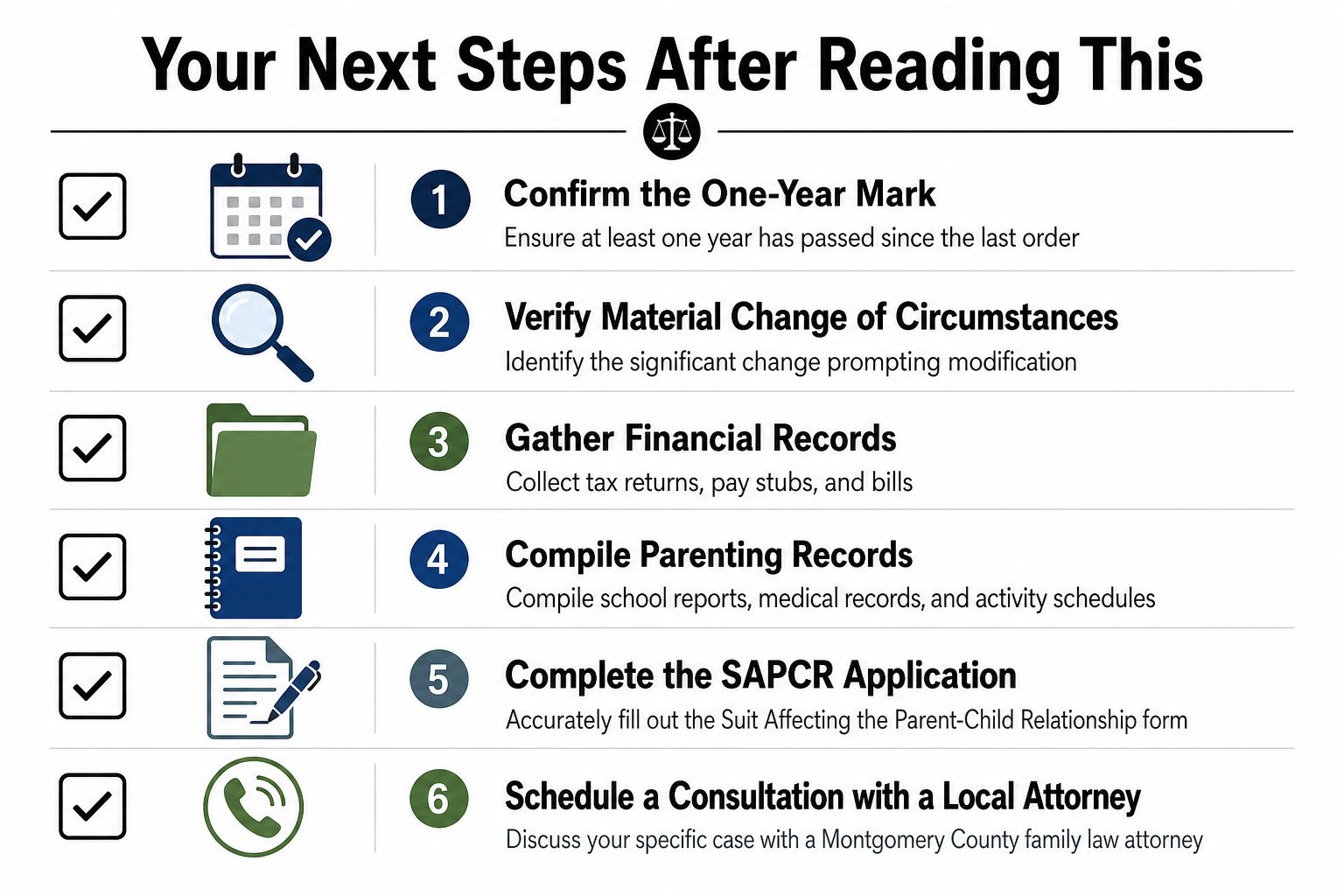
- Confirm timing: Determine whether the one-year restriction applies to the requested change.
- Identify the change: Write a fact-based explanation of what materially and substantially changed.
- Gather records: Collect financial documents, school information, medical records, calendars, and relevant communications.
- Complete the petition: Use the appropriate SAPCR modification forms and identify the existing order accurately.
- Plan service: Decide whether a waiver is realistic or formal service is necessary.
- Consider temporary relief: Request temporary orders if the child's immediate schedule, safety, or support needs require court action.
- Prepare focused exhibits: Select documents that prove the change and support the proposed order.
A parent who follows those steps approaches the courthouse at 210 W. Davis in Conroe with a coherent request. The parent who arrives with vague complaints and a kitchen-sink binder forces the judge to sort out the case, and that rarely helps.
Local preparation matters
Use eFileTexas carefully, verify that the clerk accepted the filing, and check the docket for settings. If you want a jury, address the jury fee and timing requirements early rather than assuming you can raise the issue at the hearing. Calendar the associate judge's setting and confirm whether witnesses will appear in person or through another permitted format.
Formal courtroom behavior applies in Montgomery County just as it does in Harris County. Arrive prepared, silence your phone, bring organized copies, and speak respectfully. A local attorney can help draft pleadings, handle discovery, evaluate evidence, prepare temporary-orders requests, and present the final hearing without losing sight of the specific relief sought.
For parents who want counsel with the local process, a custody modification lawyer in The Woodlands can review whether the facts support filing and whether the agreed or contested route makes sense. This article is not legal advice. Texas custody law and Montgomery County procedures can turn on facts that a general guide cannot evaluate.
The Law Office of Bryan Fagan helps parents with custody-modification pleadings, discovery, temporary orders, service issues, and final hearings in Montgomery County. If your existing order no longer fits your child's circumstances, schedule a consultation by visiting The Law Office of Bryan Fagan to discuss the facts and the filing path.