
You signed a revocable trust form online, placed it in a folder, and assumed the hard part was finished. In The Woodlands, that mistake can leave your home, bank accounts, and other property outside the trust when your family needs the plan most.
A revocable trust form is only the starting document. Funding the trust, coordinating it with your will and beneficiary designations, and following Texas rules determine whether it helps your family avoid probate in Montgomery County. This guide explains what the form does, what it must contain, and where DIY planning commonly breaks down. This article is educational information, not legal advice.
What a Revocable Trust Form Actually Does for Your Family
A Woodlands couple once signed a revocable trust form they downloaded online. They named each other as trustees and listed their children as beneficiaries. Years later, they discovered that the family home was still titled in their individual names, and their bank accounts had never been transferred. The trust existed on paper, but it held little or nothing.

A revocable living trust is a legal arrangement created during your lifetime. You transfer property to a trustee, often yourself, and the trustee manages that property under written instructions. You generally retain control while you're alive, can amend the trust, and can revoke it under the terms and governing law.
A will works differently. It gives instructions for property that remains in your name at death and usually requires probate before the personal representative can distribute those assets. A revocable trust can hold property during your lifetime and provide instructions for management if you become incapacitated, followed by distribution after death.
The form is the container
The form identifies the trust's basic structure. It can name the settlor, trustee, successor trustee, beneficiaries, and distribution terms. But the document doesn't automatically move your assets into the trust.
Practical rule: A signed trust with no properly transferred property is a plan without the property it was designed to manage.
Families use revocable trusts because they want continued control, a clear succession plan, and a way for a successor trustee to step in if the creator can't manage financial affairs. Those benefits depend on execution and administration, not merely on downloading a document.
Blended families need even more care because a trust must coordinate the surviving spouse's interests, children from prior relationships, and property acquired during marriage. A useful local resource on that issue is estate planning for blended families in The Woodlands, but no general form can decide the right distribution structure for every family.
Required Elements Under Texas Law
A Texas revocable trust form needs more than signatures and a convenient template. The document must establish the basic legal components of a trust and describe how the arrangement will operate.
Start with the trust's legal foundation
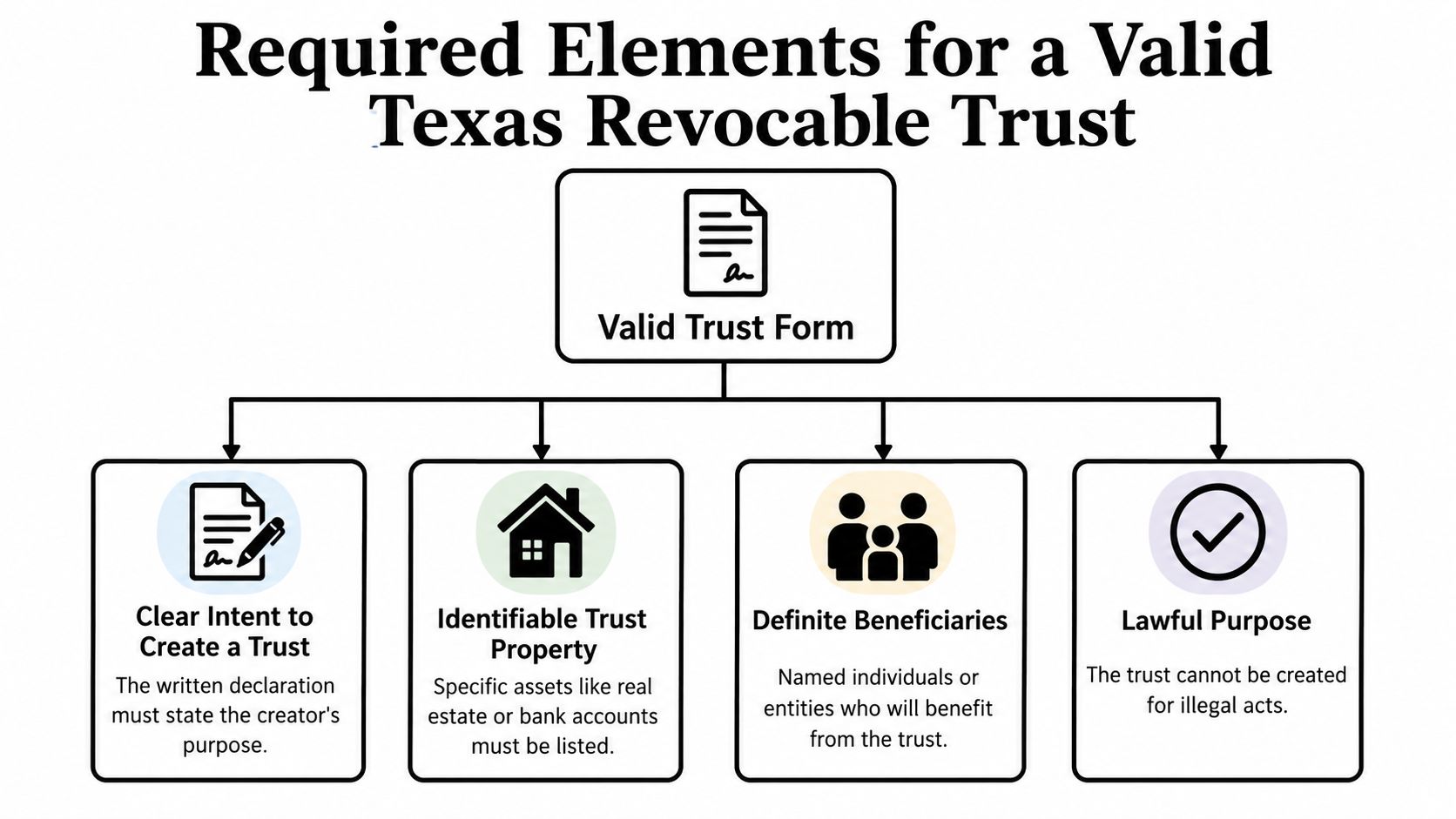
A sound form should clearly address four elements:
- Intent: The settlor must show a clear intention to create a trust and impose duties on a trustee.
- Trust property: The document must identify property that will be held or transferred to the trust. Property can include real estate, bank accounts, brokerage assets, and business interests.
- Beneficiaries: The people or organizations who may benefit must be identifiable under the trust terms.
- Lawful purpose: The trust must serve a lawful purpose and cannot be structured to accomplish illegal conduct.
For real estate, written documentation and proper transfer mechanics matter. A house in The Woodlands generally requires a deed transferring ownership to the trustee or trust structure. A bank or brokerage institution may require its own retitling documents or a certificate of trust before changing ownership records.
Texas law also makes precise drafting important. Under Texas Property Code Chapter 112, a settlor may revoke a trust unless the trust instrument or a later modifying instrument makes it irrevocable. If the trust was created in writing, a revocation, amendment, or modification must also be in writing.
A commonly cited Texas rule is that trusts created since 1943 are generally treated as revocable unless the document expressly provides otherwise, as discussed in this Texas estate-planning presentation. I recommend stating revocability directly instead of relying on a legal presumption.
Use a certification when institutions need proof
Texas Property Code Section 114.086 permits a trustee to use a certification of trust rather than provide the entire trust document to a bank, title company, or another institution. The certification generally addresses the trust's execution date, settlor, acting trustee and mailing address, trustee powers, revocability, who may revoke, cotrustee authority, and how title should be held.
That process protects privacy while giving institutions the information needed to process a transaction. It also makes clear why a form must be drafted for actual administration, not just signing.
If a divorce involves division of community property or complex assets, a Property Division Lawyer in The Woodlands handles that separate family-law issue. The trust should be reviewed alongside the property division work, not treated as an isolated document.
Typical Provisions in a Texas Revocable Trust Form
A complete trust form should tell you who created the trust, who manages it, what happens during incapacity, and how property is distributed after death. If the document skips those questions, it may not match your family's needs.
The opening provisions establish control
The declaration of trust identifies the settlor and confirms the creation of the trust. It usually names the initial trustee, often the person or couple creating the trust, and explains the trustee's authority to manage trust property.
The successor-trustee section matters just as much. It should identify who takes over if the original trustee resigns, becomes incapacitated, or dies. A vague instruction to choose someone later creates uncertainty precisely when the family needs a functioning decision-maker.
Beneficiary provisions should identify the primary beneficiaries and the people who inherit if a beneficiary dies first. Distribution provisions then explain whether beneficiaries receive property outright or under continuing trust terms. Those terms matter for minor children, beneficiaries who need ongoing management, and families seeking staged distributions.
Revocation, incapacity, and divorce need attention
A revocation and amendment clause should explain how the settlor changes the trust. In Texas, written trusts require written amendments or revocations, so a form that offers only informal instructions is inadequate.
The trust should also explain what happens if the settlor loses capacity. A successor trustee may need authority to pay expenses, manage investments, maintain a home, and handle other financial responsibilities without waiting for a court proceeding.
Divorce creates another review point. Texas Estates Code Section 123.052 provides a rule that revokes certain revocable provisions benefiting a former spouse or the former spouse's relatives after divorce when the trust was executed before the marriage ended. It also addresses certain revocable fiduciary nominations and powers of appointment involving a former spouse or covered relatives.
That statutory rule doesn't replace a full estate-plan review. A divorce can change property ownership, beneficiary designations, trustee choices, and instructions for children. Your trust should coordinate with a pour-over will, which directs probate assets into the trust after death. The will can help catch assets that were missed, but it doesn't make poor funding disappear.
DIY Forms Versus Attorney-Prepared Trusts
A DIY revocable trust form may work for someone with uncomplicated assets, one clear beneficiary group, and no unusual family or property concerns. The trouble starts when the form looks complete but leaves ownership, transfer, or Texas-specific issues unresolved. Signing the document is only a small part of the work. The trust must also connect to the assets it is meant to control.
An online template supplies language. An attorney-prepared trust connects that language to deeds, account ownership, beneficiary designations, community property, business interests, incapacity planning, and a pour-over will. That coordination is what determines whether the plan functions after signing.
| Situation | DIY Form | Attorney-Prepared |
|---|---|---|
| Single person with straightforward assets and one beneficiary | May provide a basic starting structure | Adds coordinated documents and a funding plan built around your situation |
| Married couple with community property | May not explain ownership or survivor control clearly | Addresses marital property and each spouse's planning objectives |
| Blended family | Often leaves competing interests unresolved | Can coordinate spouse protections, children from prior relationships, and successor trustees |
| Minor children | May offer generic distribution language | Builds instructions for management and inheritance decisions |
| Business interests | May not address transfer restrictions or governance | Reviews the business interest and related documents before transfer |
| Property in multiple states | May overlook local title and probate consequences | Coordinates the trust with property-transfer requirements in each jurisdiction |
| Recent divorce or major life change | Easy to leave outdated beneficiaries and trustees | Provides a full review of the existing plan |
A generic form can miss Texas-specific requirements and practical issues. Community-property rules may affect what each spouse owns, what can be transferred, and what should happen after the first death. A form cannot determine those answers from a blank template.
Texas families also need to examine how the trust fits with deeds, financial accounts, business records, beneficiary forms, and the pour-over will. If those pieces do not match, the document may express the right intent while assets still require probate or administration outside the trust.
The right question is whether your family can identify, transfer, and administer every important asset without guessing.
If you have a blended family, business ownership, property in multiple states, or a recent divorce, have an attorney review the entire arrangement. A trust attorney serving The Woodlands and Texas can assess whether the document, ownership records, and transfer steps work together.
Funding the Trust After Signing the Form
Signing is not funding. The trust bypasses probate only for property conveyed to the trustee during the settlor's lifetime. An asset still titled individually at death remains a probate asset, as explained in this estate-planning discussion of revocable trusts and pour-over wills.
Follow the asset trail
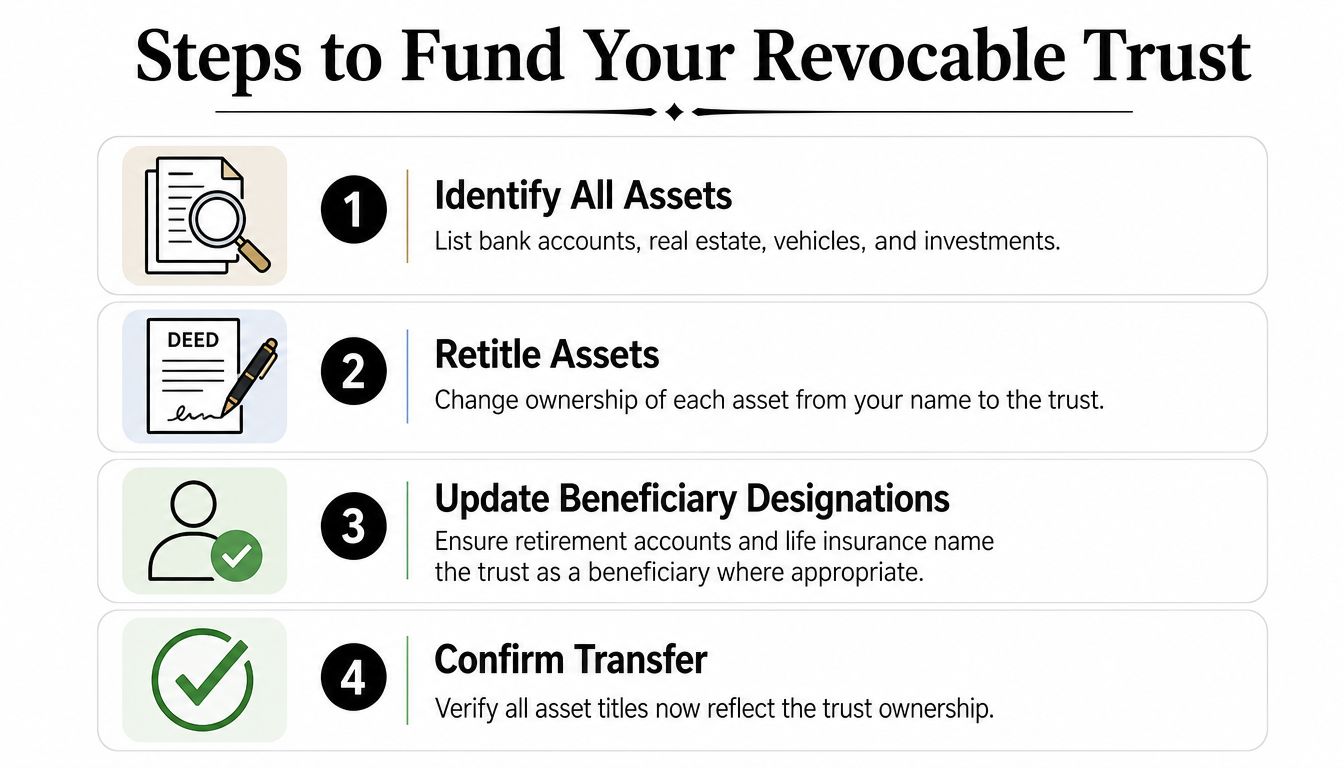
Start with a complete inventory. Include the home, other real estate, bank accounts, brokerage accounts, business interests, vehicles, valuable personal property, retirement accounts, and insurance policies.
Then match each asset with the correct transfer method:
- Real estate requires title work. A deed generally transfers the property to the trustee. The deed must be prepared and recorded correctly for the county where the property is located.
- Bank and brokerage accounts need institution paperwork. Ask each institution what it requires to retitle ownership or establish the trust as the account owner.
- Business interests need document review. Company agreements may restrict transfers or require consent. Don't assume a trust can receive an ownership interest without checking those terms.
- Vehicles and personal property need a deliberate plan. Some assets may be assigned generally, while titled property may require separate procedures.
- Beneficiary designations require coordination. Retirement accounts and life insurance may pass by beneficiary designation rather than trust ownership. The right choice depends on the plan and the family's objectives.
Bank accounts and cash assets are among the most common gaps in trust funding, according to this discussion of funding bank accounts and cash assets. Those accounts deserve a line-by-line review.
Confirm every transfer
Keep copies of recorded deeds, account confirmations, assignments, and beneficiary forms. A checklist should show which assets moved, when the transfer occurred, and whether the institution accepted the trust documentation.
A pour-over will remains useful for property missed during life, but it may require probate administration before that property reaches the trust. Funding the trust correctly is the cleaner solution.
For a visual explanation of the process, review this short video before you begin transferring assets:
How Revocable Trusts Affect Probate in Montgomery County
A signed revocable trust does not keep an estate out of probate by itself. The result depends on funding, recorded title, beneficiary designations, and whether the trustee can identify each asset and follow the trust instructions. Signing the form is only a small part of the work. Retitling property correctly is what gives the trust practical effect.
That distinction matters in Montgomery County. A home in Panther Creek, Alden Bridge, Sterling Ridge, or another Woodlands community remains tied to its recorded deed. If the trust owns the home, the successor trustee can administer it under the trust terms. If the deceased owner still holds title personally, the family may need probate before the property can be distributed.
The trustee may still face administrative work, creditor issues, tax questions, and recordkeeping duties. A properly funded trust can, however, keep trust-owned assets outside the probate process and allow the trustee to manage them without asking a probate court to transfer each one. Property left outside the trust can require a different process. Review the Montgomery County probate court process before assuming every asset will pass privately.
A California legal review shows how revocable trusts became established in estate and probate practice. The first reported California case using the phrase “revocable trust” appeared in 1900. Reported cases mentioning the term rose from 1 case during 1900 to 1925, to 6 during 1926 to 1945, 9 during 1946 to 1960, 11 during 1961 to 1971, 63 during 1972 to 2000, 856 during 2001 to 2010, and 1,642 during 2011 to 2021, according to this California legal review of revocable trusts. Those figures concern California cases, not Montgomery County, but they show the trust's broad role in estate administration and litigation.
Market estimates also place revocable trusts among widely used estate-planning tools. They do not measure local probate results. Families should focus on ownership records and Texas procedure, not market size. A separate Montgomery County Family Courts local guide explains how family-law cases proceed in courts serving The Woodlands, which is a separate court context from probate.
Your Next Steps and When to Seek Legal Guidance
Use this checklist before you sign or rely on revocable trust forms:
- Inventory everything: List real estate, accounts, investments, business interests, vehicles, insurance, and personal property.
- Choose fiduciaries: Name successor trustees and backups who can manage property responsibly.
- Review beneficiaries: Account for spouses, children, former spouses, minor beneficiaries, and blended-family concerns.
- Choose the right drafting method: A simple situation may suit a basic form, while complex assets or family relationships call for customized work.
- Execute the documents correctly: Complete the trust, pour-over will, powers of attorney, and related documents with appropriate formalities.
- Fund the trust: Retitle each intended asset and keep proof that every institution accepted the transfer.
- Review after life changes: Revisit the plan after divorce, remarriage, a major purchase, a death, or a change in trustee or beneficiary.
Contact The Law Office of Bryan Fagan if you have a blended family, substantial or complex assets, business ownership, or a divorce or other major life change. The firm handles estate planning and probate matters for families in The Woodlands and surrounding Montgomery County communities. This article is not legal advice, and your documents should be reviewed against your specific facts.
Schedule a consultation with The Law Office of Bryan Fagan to review your revocable trust form, beneficiary designations, and funding documents together. The goal is a working Texas estate plan, not an unsigned or unfunded promise sitting in a drawer.