 Skip to content
If your family in The Woodlands is staring at a hospital discharge summary, an unpaid stack of bills, or a parent who keeps saying they're fine when everyone can see they're not, you're probably already in the hardest part of a guardianship dispute. One sibling wants to step in. Another says the situation isn't that serious. The proposed ward may still be speaking for themselves, but the room is full of worry, resentment, and second-guessing.
A contested guardianship is what happens when someone challenges the need for guardianship, the choice of guardian, or the scope of authority the court is being asked to give. In Montgomery County, that usually means a formal probate fight, not a private family arrangement. The court has to look at evidence, hear objections, and decide whether guardianship is necessary under Texas law.
For families in The Woodlands, Creekside, Alden Bridge, Panther Creek, Sterling Ridge, and nearby Montgomery County communities, the process can feel unfamiliar fast. The court does not just ask who is worried the most. It asks who has proof, what alternatives already exist, and whether a narrower option would protect the person without taking away more rights than necessary. If the situation is urgent, a temporary option may also come into play, and that's where a temporary guardianship attorney in Montgomery County can help frame the next move.
When Families Disagree on Guardianship in The Woodlands
A common Woodlands scenario starts. One adult child notices that an aging mother in Alden Bridge is missing medications, paying duplicate bills, and struggling with appointments. Another sibling sees the same parent shopping, talking, and insisting she does not need help. Both siblings may be acting out of concern, but they're not seeing the same level of risk.
That kind of split often turns into a contested guardianship because the family is no longer arguing about help in the abstract. They're arguing about whether the court should take away certain decision-making rights, who should be trusted to manage those decisions, and whether the current arrangement is still workable. In Texas, a guardianship application is not a casual request. It is a probate proceeding with notice, proof, and a judge's oversight.
What makes it contested
A proceeding becomes contested when someone objects to the application, the proposed guardian, or the amount of authority requested. Sometimes the objection is simple, the person isn't incapacitated. Other times the dispute is deeper, involving old family conflicts, money, or a disagreement over who has been helping the parent all along.
Practical rule: if the family has stopped talking in good faith and started collecting evidence, the case is probably headed for court.
That's why local venue matters. For many The Woodlands families, the case belongs in Montgomery County, not Harris County, because Texas generally requires filing in the county where the proposed ward resides. The local probate process, the judge's expectations, and the courtroom rhythm all matter. If your family is also dealing with child-related issues, the standards feel different, but the same courthouse culture applies, and even a Child Support Attorney in The Woodlands works in the related space of establishing, modifying, and enforcing child support in Montgomery County.
What a Contested Guardianship Means Under Texas Law
Texas does not take away an adult's rights lightly. Under the Texas Estates Code, a guardianship must be necessary and must use the least restrictive alternative that will address the problem. In practice, the court should ask whether the person can still make some decisions with support before it approves a full guardianship. Families in The Woodlands often reach out to an adult guardianship lawyer in The Woodlands at this stage because the legal standard is narrow, and the proof has to fit that standard.
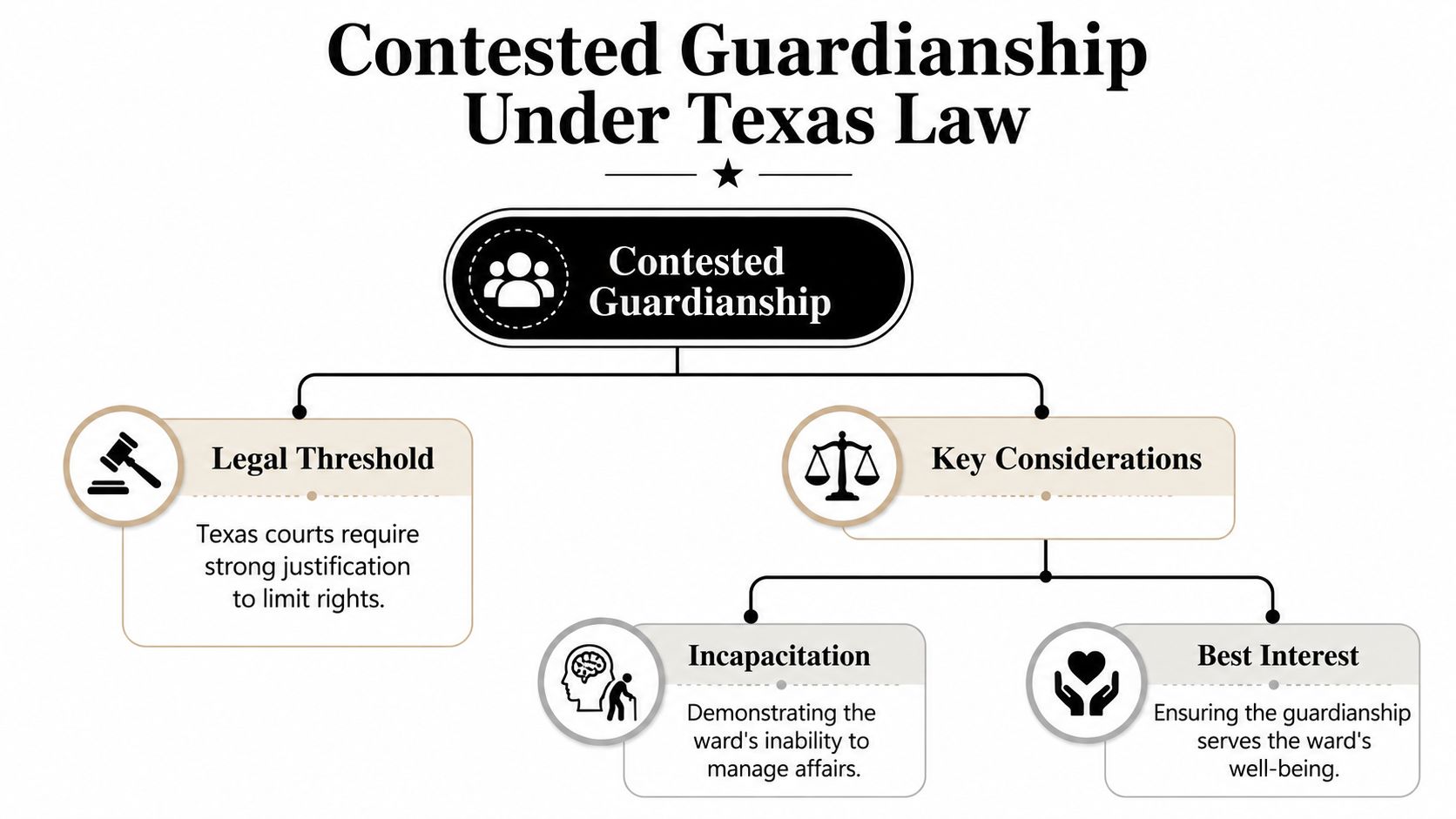
Full guardianship is a serious legal intervention. It may be appropriate, but only when smaller tools will not solve the problem. A durable power of attorney, a supported decision-making arrangement, or another limited option may address part of the issue without removing more rights than the law requires. The court should compare those choices directly, not readily accept whichever family member is speaking the loudest.
Incapacity is the legal gatekeeper
Texas guardianship procedure turns on a court finding of incapacity, and that finding must be supported by medical evidence. Incapacity is not the same as old age, a difficult week, or one poor decision. The legal question is whether the person can care for personal needs, handle financial needs, or communicate responsible decisions because of a mental, physical, or developmental condition. The evidence has to tie the condition to the functional problem.
That is why the quality of the medical proof matters so much in contested cases. A report that is stale, incomplete, or inconsistent with what family members are seeing can create a real dispute over whether the court should act at all. In Montgomery County probate court, judges tend to focus on whether the evidence shows actual decision-making limits, not just a diagnosis or a general concern.
The scope of authority matters too
Under the Texas Estates Code, the fight is often not only about whether a guardian is needed, but how much authority is really required. A proposed guardian may ask for broad control over property, medical decisions, or both, while the other side argues for a narrower arrangement or no guardianship at all. Courts can and do pay attention to supports, not just labels.
A well-drafted petition, or a careful objection, should stay focused on that distinction. The better filings do not ask for more control than the facts justify, because overreaching can weaken credibility in a contested hearing. In Montgomery County, that practical restraint matters, since the judge will want to see that the request matches the person's actual limitations and the least restrictive path available.
Common Grounds for Challenging a Guardianship
A guardianship contest usually starts with one of three problems, and sometimes all three show up at once. The first is weak incapacity proof. The second is an unsuitable applicant. The third is a workable alternative that makes guardianship unnecessary.
| Grounds for Contest | What It Means in Practice |
|---|---|
| Weak incapacity evidence | The medical proof doesn't clearly show the person can't manage personal or financial decisions. |
| Unsuitable applicant | The person asking to serve may have a conflict, a credibility issue, or a strained history with the proposed ward. |
| Existing less restrictive option | A power of attorney, trust, or support arrangement already addresses the concern without full guardianship. |
The evidence fight usually comes first
The court wants more than a family dispute. It needs medical evidence tied to the legal standard of incapacity. If a doctor's note is vague, old, or written without a clear functional analysis, the opposing side may argue that it doesn't prove the level of impairment needed for guardianship. That's especially true when the proposed ward still handles some decisions independently.
The applicant's credibility can become central
Even if the proposed ward needs help, the court still has to decide who should be trusted. A person who is asking for guardianship can be challenged if there's a conflict of interest, a record of poor financial judgment, or evidence that the relationship is more about control than care. Judges notice patterns. They also notice whether the applicant has been transparent about money, access, and communications.
A working alternative can defeat the need for guardianship
Sometimes the strongest objection is simple. If a valid power of attorney, trust, or support arrangement already exists and is functioning, guardianship may be unnecessary. That point often changes the case from “Who should control everything?” to “What still needs legal protection, and what doesn't?”
One real-world pattern comes up often in Montgomery County. A parent with meaningful assets is still able to participate in decisions with some help. One child petitions for guardianship. Another child objects and produces an existing power of attorney plus evidence that the parent still understands the basics of their care and finances. In that kind of case, the court may focus closely on whether the petition is broader than the facts justify.
Navigating the Montgomery County Probate Process
In Montgomery County, the procedure matters as much as the family story. A contested guardianship moves through probate on a court-managed track, and each step can affect the next one. Miss a deadline, rely on weak medical proof, or ignore the proposed ward's rights, and the case can shift quickly.
The application generally belongs in the county where the proposed ward resides, which for many Woodlands families means Montgomery County. Texas also requires a Physician's Certificate of Medical Examination dated no more than 120 days before filing. That timeline matters because the court is looking at current capacity, not last year's diagnosis.
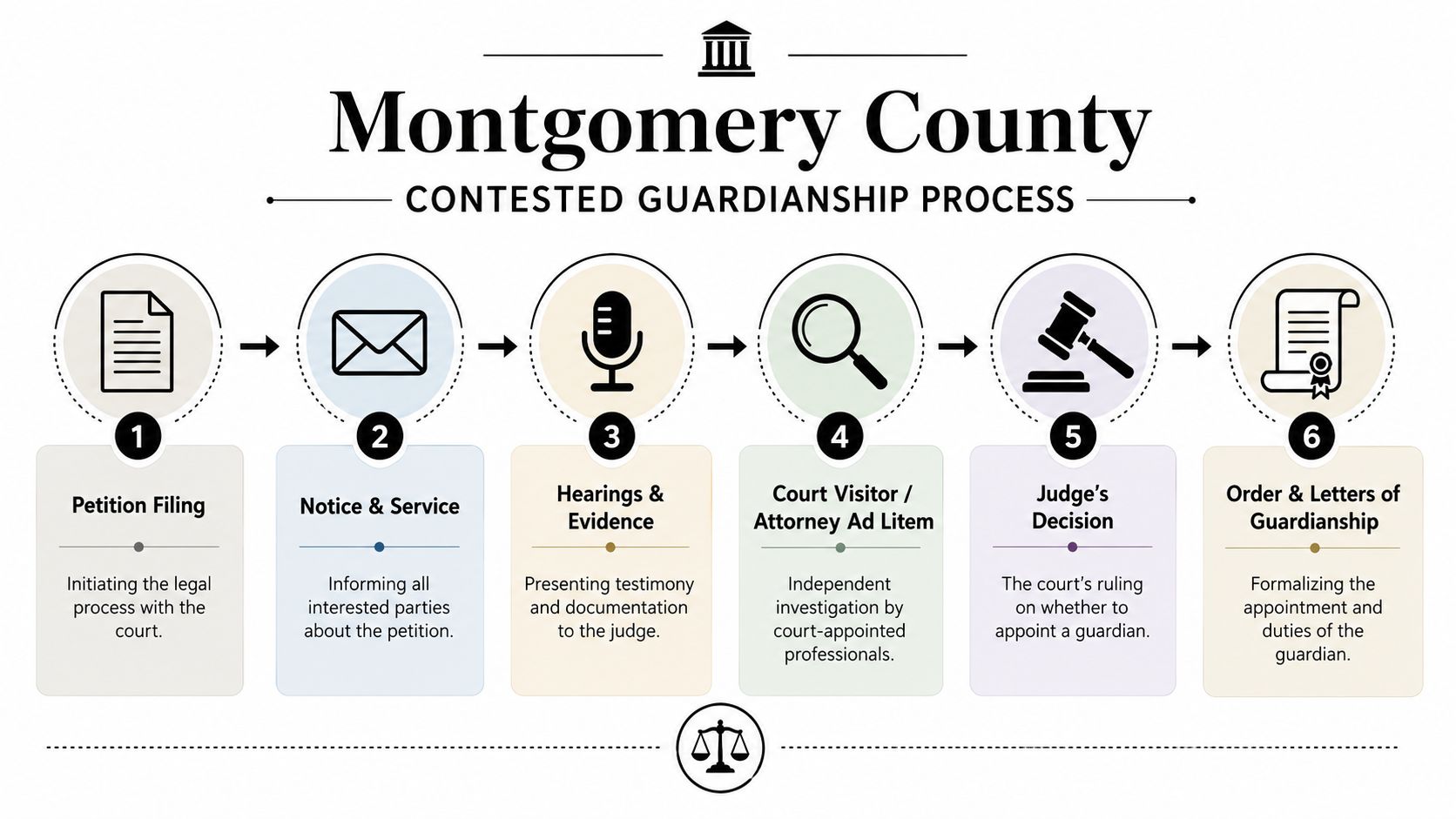
The usual path through the case
File the application.
The petition starts the case and tells the court what authority is being requested.Serve notice and cite interested people.
Family members and other required parties are notified so they can object if needed.Appoint an attorney ad litem.
The court appoints counsel to protect the proposed ward's interests.Review the medical evidence.
The physician's certificate and any additional records become a focal point.Hold the contested hearing.
Witnesses may testify, documents come into evidence, and the judge evaluates credibility.Issue the order and letters.
If guardianship is granted, the court formalizes the appointment and defines the scope.
Temporary relief can matter before the final hearing
If there's immediate risk, the court may need to address the situation before the case is fully tried. That's where temporary or emergency relief can be considered. It's not a substitute for the full case, but it can stabilize medical access, finances, or living arrangements while the dispute is pending. For a local overview of court movement and probate filing expectations, the Montgomery County probate court process is worth understanding before the first hearing date is set.
If the hearing is contested, prepare for the judge to care less about family titles and more about documented facts, consistent testimony, and the freshness of the medical record.
Evidence Defenses and Long-Term Strategies
A contested guardianship is usually won or lost on evidence, not emotion. Judges in Montgomery County want to see medical records, caregiver observations, financial records, and testimony that lines up with the legal standard. If the evidence tells one clear story, the court can act with confidence. If it doesn't, the case can stall or narrow.

What the court tends to weigh
Doctors, family members, and caregivers can all matter, but the judge is looking for consistency. Financial records may help show mismanagement or exploitation. Friends or neighbors may help describe day-to-day functioning. The best evidence does not just describe concern, it connects concern to decision-making limits.
Common defenses often attack the foundation
A strong defense may challenge the credibility of the applicant, the completeness of the medical report, or the logic of the claimed incapacity. If the applicant has been shutting out other family members, using the situation to gain control, or offering only selective evidence, that can weaken the petition. The same is true when the medical proof is too thin to support a broad guardianship.
The case can continue after appointment
This part surprises many families. The fight doesn't always end when the judge signs the order. Contested guardianship conflicts frequently continue after appointment through motions to set aside, requests to remove or replace a guardian, or petitions to end the guardianship if it is no longer needed. That lifecycle view matters because a bad appointment can be challenged later, and a once-necessary guardianship can become unnecessary if circumstances change.
Important: if the guardian starts acting outside the order, or the ward's condition improves, the law gives families a path to revisit the appointment instead of treating it as permanent no matter what.
That long-term strategy is often the difference between a one-time objection and a real protection plan. Families who document problems early usually have more options later.
Finding a Lawyer and Preparing for What's Next
Choosing a contested guardianship lawyer The Woodlands families can trust means looking for real probate court experience, not just general family-law familiarity. Guardianship disputes move through probate procedure, medical evidence, and county-specific expectations. An attorney should be able to explain venue, the attorney ad litem's role, and the difference between full and limited authority without sounding rehearsed.
The right consultation should feel practical. Ask how the lawyer would challenge a stale physician's certificate, what they do when siblings disagree, and how they handle emergency relief if someone is at immediate risk. Also ask how they approach post-appointment disputes, because some cases do not end with the first order.
The Law Office of Bryan Fagan handles family and probate matters for The Woodlands and Montgomery County, and that local court familiarity can matter when a guardianship case collides with other family issues. Other local probate counsel may also be a fit, but whichever firm you choose, make sure the lawyer has handled contested hearings in Montgomery County, not just uncontested filings.
What to do next
- Gather documents: collect medical records, bills, prior powers of attorney, trusts, and any texts or emails that show the family dispute.
- Write down the timeline: note when the concerns started, what changed, and who has been providing care.
- Avoid direct escalation: don't threaten family members or pressure the proposed ward into signing documents.
- Preserve the medical record: make sure any physician's certificate or related report is current and complete.
- Schedule a consultation: bring the facts to a lawyer who works in Montgomery County probate court.
This article is for informational purposes only and is not legal advice. Guardianship cases turn on specific facts, court procedure, and current medical evidence, so the right strategy depends on your exact situation.
A CTA for The Law Office of Bryan Fagan. If you're dealing with a guardianship dispute in The Woodlands or Montgomery County, schedule a consultation to talk through the facts, the court process, and the next steps for your family.
