 Skip to content
If you're in Panther Creek, Alden Bridge, Sterling Ridge, or Creekside, and you've been the steady parent for years, the question usually doesn't come up in a vacuum. It comes up after a birthday party, a school meeting, a doctor's appointment, or a moment when your spouse says, “We should make this official.” Then the other biological parent reappears, stops cooperating, or just keeps fading in and out, and the path forward gets a lot less simple.
A stepparent adoption in Texas is a court case, not a family nickname change. The judge has to clear the legal path first, which usually means dealing with the other parent's rights before the adoption can be granted. In Montgomery County, that's where families often get stuck, not on love or commitment, but on procedure, proof, and timing.
A local stepparent adoption lawyer The Woodlands families can rely on has to understand both sides of that equation. The legal work is technical, but the everyday stakes are straightforward. You want the child protected, the paperwork done right, and the case moving without avoidable delays.
A Woodlands Family Ready to Make It Official
A common call starts with a story like this. A stepfather in Panther Creek has been in a child's life since kindergarten. He takes care of school drop-offs, doctor visits, and bedtime routines, and everyone in the house already treats him like Dad. Then the biological father, who has been mostly absent, suddenly resurfaces, or maybe he never really left legally even though he disappeared in daily life.
That's when the emotional question turns into a legal one. The court does not treat stepparent adoption as an automatic family-status update, because the judge is creating a permanent parent-child relationship and ending another one if the facts support that result. Texas adoption practice is built around court approval and the child's best interest, not just the family's agreement.
What families usually need to understand first
The practical sequence usually starts with termination issues, then moves to adoption. Texas family-law sources describe stepparent adoptions as cases that often take 3 to 6 months when things are straightforward, while agency or CPS adoptions can take 12 to 24 months (Griffin and Cain family law adoptions). That local timing matters because it affects when the adopting stepparent gets full parental rights and responsibilities.
The bottleneck is almost always the other parent. If that parent is missing, hostile, or still legally in the picture, the case stops being a clean paperwork file and becomes a termination case first. Texas law treats that seriously because a child can have only two legal parents at a time, and adoption is handled separately from termination under Chapters 161 and 162 of the Texas Family Code (Your Texas Law Firm adoption overview).
Practical rule: if the other parent's rights are not resolved, the adoption usually cannot be finalized.
Families in The Woodlands and Montgomery County do file these cases locally, and firms serving The Woodlands, Spring, Conroe, Magnolia, and nearby communities list stepparent adoption as a regular family-law service (Kemp Law Firm family law practice area). That means this is not a rare process. It's a routine court procedure with predictable pressure points.
Who Qualifies and What Texas Law Actually Requires
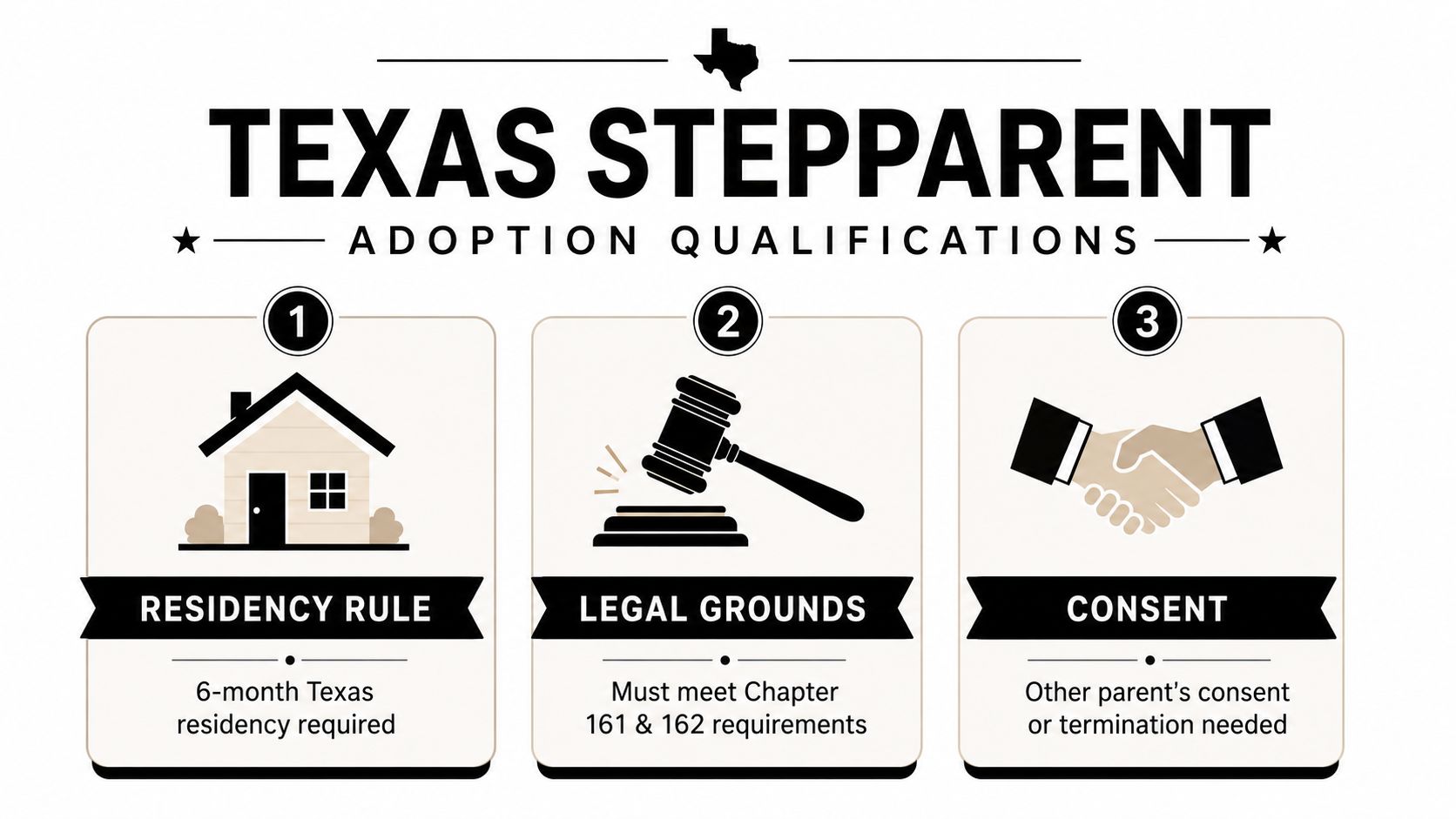
Texas stepparent adoption rests on two legal tracks, termination under Texas Family Code Chapter 161 and adoption under Chapter 162. The court has to clear the first track before it can finish the second, because the adoptive stepparent does not become the child's full legal parent until the prior parent-child relationship is legally ended and the court signs the adoption order.
The core legal thresholds
One Texas source says stepparent adoptions commonly involve at least a six-month residency period in which the child lives with the stepparent, unless the requirement is waived, along with background checks and termination of the other parent's rights (Woodlands Attorneys adoption article). That residency detail matters because the court wants to see an established family relationship before it permanently transfers parental rights.
Texas also requires written or in-court consent from a child age 12 or older in these cases, and Texas Law Help explains that a stepparent adoption requires a termination order before the adoption can move forward (Texas Law Help stepparent adoption FAQ). In practice, that means older children are not just passive subjects of the case. Their consent is part of the record.
What happens to the other parent
The adopting stepparent usually needs one of two things from the other biological parent, a valid voluntary termination or a court order ending rights. If the parent signs voluntarily, the case is cleaner. If the parent fights, disappears, or cannot be found, the lawyer has to build the termination case first and that is where most of the time and cost get spent.
The point is simple. Before anyone files an adoption petition, the family has to know whether the other parent is going to cooperate, contest, or force a search-and-service process. That decision shapes every other step.
If you are dealing with a paternity issue that still needs to be sorted out before adoption, a local Adoption Attorney in The Woodlands, TX can explain how those pieces fit together without guessing at the court's expectations.
The Paperwork, Evidence, and Court Filings
The filing packet has to match the legal path you're on. If the other parent consents, the record looks different than if that parent must be served, searched for, or terminated over objection. Montgomery County clerks and judges care less about how the family talks about the child and more about whether the file proves the legal elements in the right order.
The documents that usually matter most
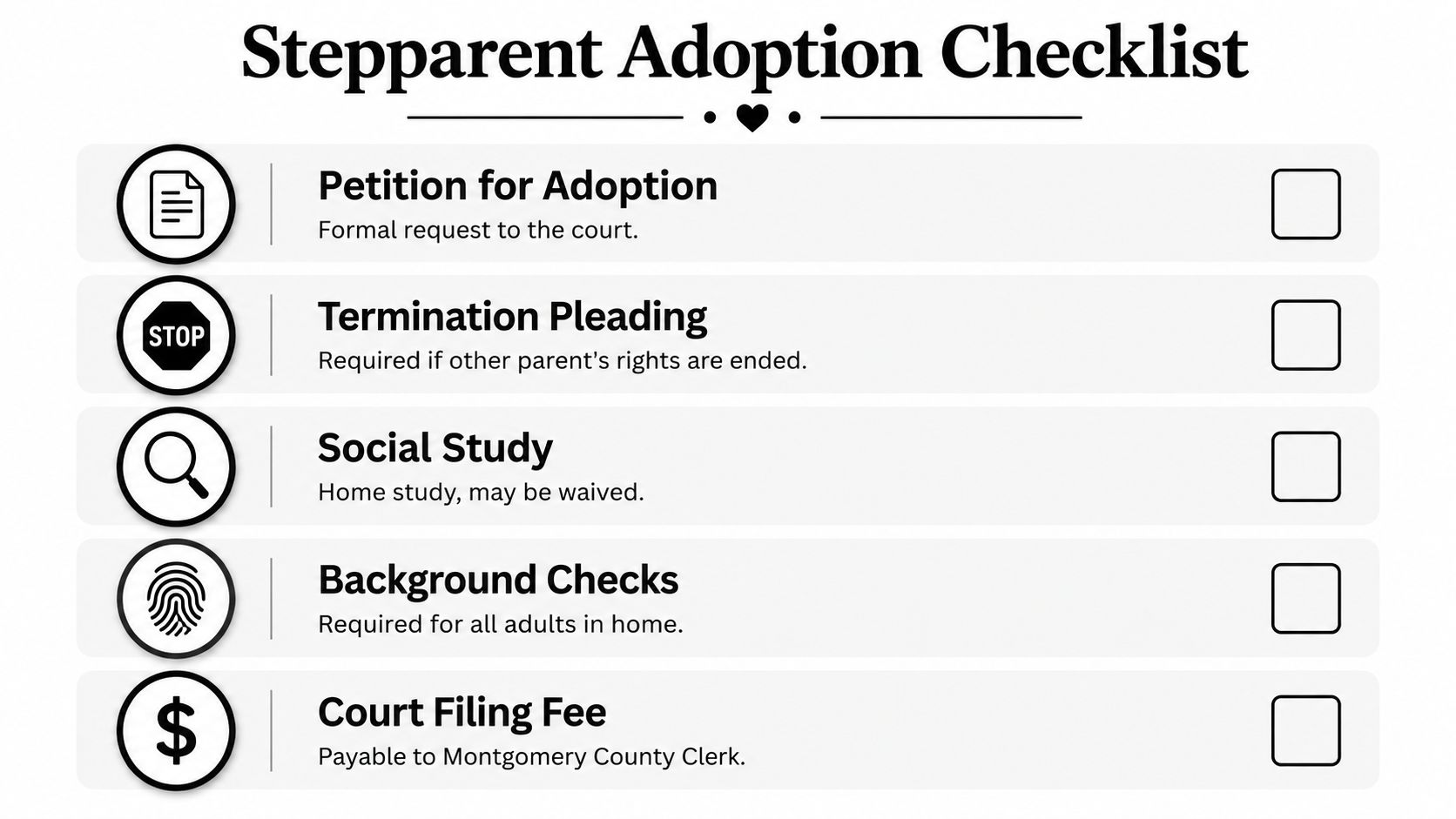
A solid file often includes the petition for adoption, the termination pleading, background checks, and whatever proof supports the child's living arrangement and the family relationship. If a social study or home study is required, that goes in the mix too, though some requirements can be waived in certain cases. The child's consent, if the child is 12 or older, belongs in the record as well.
The evidence has to do more than look nice in a folder. It should show the court that the child has been living in a stable home and that the adopting stepparent has been doing the work of parenting. School records, medical records, photos, and affidavits of residence are the kind of materials that help the judge see the day-to-day reality behind the pleadings.
The court's job is not to reward good intentions. It is to decide whether the adoption is in the child's best interest.
If the other parent is absent, the file also needs the citation or service path that fits the facts. If the parent is alive and still has rights, you cannot skip termination and jump straight to adoption. Texas adoption practice is structured that way because the court must be satisfied that the legal relationship is ready to be replaced, not just supplemented.
A local file also has to be clerk-friendly. That means clean captions, the right county, the right party names, and documents that line up with Montgomery County filing expectations. Small clerical mistakes can slow a case that already has enough moving parts.
Uncontested Versus Contested Paths in Montgomery County
The cleanest stepparent adoption file is the one where the other parent signs, the legal papers match, and nobody needs to fight over termination. Those cases can move in the straightforward 3 to 6 month range mentioned earlier (Griffin and Cain family law adoptions). But once the other parent is missing, uninvolved, or hostile, the adoption stops being a short family-law file and becomes a termination case with its own litigation risk.
What changes when the other parent is hard to find
Texas Law Help notes that the stepparent adoption path depends on whether the other parent is alive or already terminated, and that a termination order is required before adoption can be finalized (Texas Law Help stepparent adoption FAQ). If the parent cannot be located, the lawyer may have to build a search record and use the proper citation path, including publication when allowed by the court. That is not a formality. It is the due-process step that protects the eventual order from being attacked later.
When the other parent contests termination, the timing expands because the court has to hear evidence, not just review signatures. Abandonment, lack of contact, failure to support, and the overall family history become central. At that point, mediation may help if the dispute is really about consent language or terms of surrender, but mediation does not solve every case. If the parent is determined to fight, the judge will want proof, not compromise theater.
The local reality in Montgomery County
Court scheduling matters too. A contested termination hearing may not be the only delay, because local dockets, continuances, and service issues can all stretch the timeline. Families usually feel that delay most after they expected the case to be done already. That is why a good lawyer gives a realistic path at the start, not a polished estimate that assumes cooperation.
If the other parent is missing or hostile, the case is won or lost on proof, service, and timing, not on the adoption petition itself.
That is the litigation reality most local guides skip. The adoption order is the finish line, but termination is the bottleneck.
What Stepparent Adoption Really Costs Locally
Costs in a Woodlands stepparent adoption depend on whether the case is clean or contested. The filing fee, social study costs, background checks, certified copies, and attorney fees all sit on the same ledger, but they do not behave the same way. Some are paid up front, some show up during the case, and some come at the end when the order is signed.
Flat fee and hourly billing do different jobs
Clean files often fit a flat-fee package because the work is predictable. Contested termination usually pushes the case into hourly billing because the lawyer cannot know how many hearings, filings, and service attempts the case will take. A flat fee gives budget certainty, while hourly billing tracks the actual work done. That is useful when the case has moving parts, but it makes the total harder to forecast.
Here is a simple way to compare them.
| Factor | Flat-Fee Package | Hourly Billing |
|---|---|---|
| Predictability | Higher, easier for a straightforward file | Lower, depends on how the case develops |
| Best fit | Uncontested or consent-based adoption | Contested termination or missing-parent cases |
| Risk exposure | Lower on billing surprises, but scope matters | Higher if the dispute expands |
| Lawyer focus | Efficient when the facts are stable | Better when litigation is likely |
A quote is trustworthy when the lawyer explains what is included and what triggers extra work. If the answer is vague, that is a warning sign. The cheapest number can become the most expensive choice if the lawyer is not prepared to handle a termination fight.
What to watch for in a fee conversation
Ask whether the quote includes the termination case, the adoption case, hearings, and any likely service issues. Ask who pays filing-related costs and when. If a lawyer gives a low price but avoids talking about contested termination, the quote is probably built for the easy version of the case, not the one you have.
The Law Office of Bryan Fagan represents families in The Woodlands in adoption matters, so a local consultation can help you compare how the file would be handled before you commit to a fee structure. That kind of conversation is especially useful when the other parent is missing or resistant.
Choosing the Right Lawyer for a Woodlands Adoption File
The right lawyer for this job is not just someone who “does family law.” A stepparent adoption lawyer The Woodlands families can trust needs real adoption experience, comfort with contested termination, and day-to-day familiarity with Montgomery County filing and courtroom practice. Those details matter because this is a procedural case with permanent consequences.

What separates a real adoption lawyer from a generalist
A strong lawyer should be able to talk through Chapter 161 termination and Chapter 162 adoption without sounding like the case is just another custody modification. They should also know whether the file is likely to need a social study, how the clerk wants the papers presented, and how local judges tend to react when service or consent is messy.
Out-of-area lawyers create problems here more often than families expect. A non-local firm may prepare a technically decent packet and still miss local filing expectations, which can lead to re-filing or delay. One Woodlands family learned that the hard way after their first attorney sent in papers that did not match what the court expected, and the case had to be corrected before it could move.
Questions worth asking in a consultation
- How often do you handle stepparent adoption and termination cases? Adoption-specific work is different from ordinary custody practice.
- How do you handle missing or hostile parents? That answer tells you whether the lawyer understands the bottleneck.
- Will you appear in Montgomery County yourself? Outsourced appearances create avoidable friction.
- What happens if the case becomes contested? You need an honest answer, not a sales pitch.
You can also review how the firm handles family-law matters more broadly through its family-law attorney page in The Woodlands, Texas, especially if your adoption issue overlaps with custody or support problems.
The right choice should feel grounded, not flashy. In this area, process knowledge beats marketing every time.
Your Next Steps, Common Questions, and a Local Path Forward

What to do next
- Gather records. Collect school, medical, and residence documents that show the child's daily life.
- Confirm residency. Make sure the child has lived with the stepparent long enough for the case facts to line up.
- Identify the other parent. Know whether the case is voluntary, contested, or missing-parent from the start.
- Request a consultation. A lawyer can tell you whether termination should come first.
- Budget for the full case. Include filing costs, possible study costs, and attorney fees.
Quick questions families ask
How long does a missing-parent case take? It usually takes longer than a consent case because the lawyer has to handle search, service, and termination issues before adoption can be finalized.
Can the other parent block the adoption? They can fight it, but they cannot stop the court from deciding a properly supported termination case.
Is a home study always required? Not always. Some requirements can be waived, but the file still has to satisfy the court.
What changes after the order is signed? The stepparent becomes the child's legal parent, with the rights and responsibilities that go with that status.
This is general information, not legal advice. If you want a case-specific answer for your family in The Woodlands or Montgomery County, use the free family-law consultation page for The Woodlands and get the facts checked before you file.
The Law Office of Bryan Fagan helps Woodlands and Montgomery County families with stepparent adoption, termination issues, and the court process that ties them together. If your case is stuck because the other biological parent is missing, uninvolved, or fighting the adoption, visit The Law Office of Bryan Fagan to schedule a consultation and talk through the next step.
