 Skip to content
You don't need a stranger to tell you your marriage is “fine” on paper when the money and family picture have already changed. In The Woodlands and across Montgomery County, I hear the same story over and over. One spouse starts a business in Conroe, an inheritance is on the horizon, a second marriage brings children from a prior relationship, or debt has started creeping in where nobody expected it.
That's where a postnuptial agreement attorney Montgomery County couples can trust becomes useful. A postnup is not a sign that the marriage is broken. It's a way to put the financial rules in writing before a later fight turns a simple issue into a courtroom mess. This is general information, not legal advice, and Texas courts will always care more about the process behind the agreement than the label on the front page.
Why Couples in The Woodlands Are Asking About Postnuptial Agreements
A couple sits at the kitchen table in Sterling Ridge. One spouse is proud because a small business in Conroe is finally taking off. The other spouse is thinking about the house, the retirement accounts, and what happens if that business starts changing the family's financial balance in ways nobody discussed when they got married.
That's the reason postnuptial agreements come up in Montgomery County. They're not just for wealthy people, and they're not just for couples who don't trust each other. They're for married people who've had a material change in circumstances and want to decide, now, how property and debt should be handled later.
The situations that usually trigger the conversation
A postnup makes sense when the marriage has moved into a new financial phase. That can mean a spouse receives an inheritance, opens a company, becomes the main income earner, stops working to raise children, or starts carrying most of the debt risk. It can also mean the family structure changed after the wedding, especially in blended families where one spouse wants a clearer plan for children from a prior marriage.
The point is simple. If your life looks different now than it did on the wedding day, you should not rely on assumptions. You should write the rules down.
Practical rule: If the asset, debt, or family issue would cause a serious fight in a divorce, don't leave it to memory or goodwill.
If you're trying to understand how property issues play out when spouses split, the house is often the first place the fight starts. This overview of what happens to the house in a divorce gives useful context for Montgomery County homeowners.
What this article helps you decide
You need three answers before you sign anything. First, whether a postnup fits your situation at all. Second, what the process should look like if you do it right. Third, how Texas courts in Montgomery County are likely to treat the agreement if one spouse later attacks it.
For clients in The Woodlands, I also point them to Prenuptial & Postnuptial Agreements in The Woodlands when they want drafting and review of marital property agreements for Woodlands clients. That's the practical lane this kind of planning belongs in.
What a Postnuptial Agreement Actually Does Under Texas Law
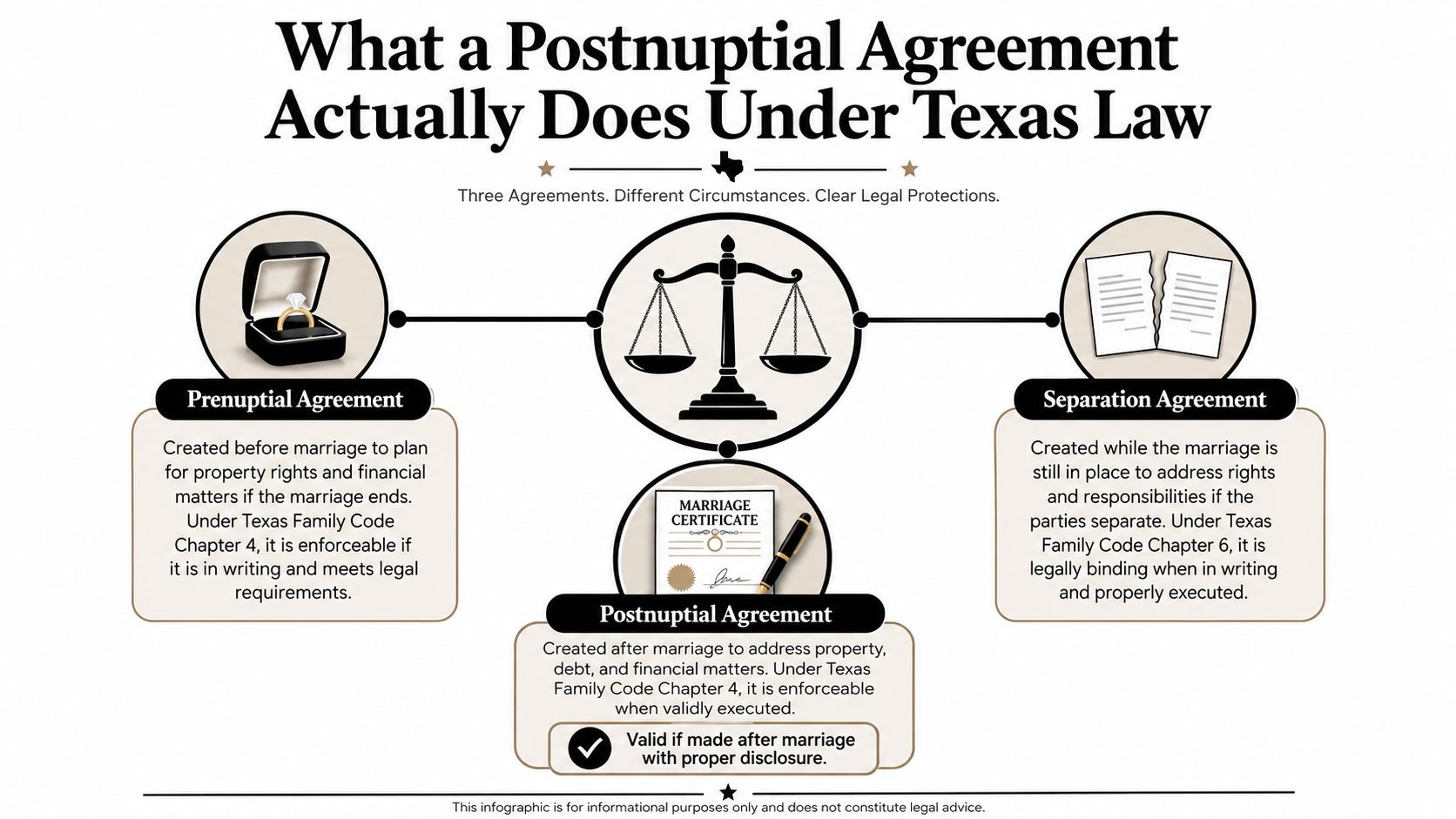
A postnuptial agreement is a contract spouses sign after the wedding. Under the Texas Family Code, marital-property agreements are enforceable when they are entered into voluntarily and with adequate disclosure, and Texas remains a community-property state, so property acquired during the marriage is presumed community property unless a valid agreement changes that result (Texas Family Code guidance on marital agreements).
That default rule is what drives the fight. If you are married in Texas and you do not have a valid agreement changing it, community property starts as the baseline for assets, debts, and financial rights acquired during the marriage. A postnup lets spouses change that baseline for specific property, liabilities, or future claims.
What it can cover
A good agreement does more than say “separate property stays separate.” It should identify the marital residence, retirement plans, family businesses, and debt allocation with enough precision to hold up when the marriage is under stress, because those are the issues that usually turn into litigation later (drafting guidance on postnuptial agreements). It can also spell out dispute resolution, including whether future disputes must go to mediation first or can go straight to court.
A Conroe business owner and a spouse who kept the household running may need a postnup that says exactly how the business is treated, how business debt is handled, and whether either spouse has a buyout right if the marriage ends. That kind of detail matters more than broad promises.
A postnup is strongest when it names the actual assets and liabilities people will fight over later, not when it hides behind vague language.
The agreement has to do real work. Vague language invites arguments about intent, tracing, and whether the spouses changed the default community-property rules or just talked around them.
A postnup is not a prenup, and it is not a separation agreement. A prenup is signed before marriage. A postnup is signed during the marriage. A separation agreement deals with spouses who are already living apart or sorting out the end of the marriage. The legal effect depends on timing, disclosure, and whether the signing record is clean.
For readers who want a broader service overview, learn more about prenuptial agreement law in The Woodlands and compare that process with Prenuptial & Postnuptial Agreements in The Woodlands, which covers marital property agreement review for Woodlands clients.
Common Reasons Montgomery County Couples Pursue a Postnup
Some couples come in because they're trying to protect new wealth. Others come in because they're trying to prevent old problems from wrecking a marriage. Both motives are legitimate. The law doesn't care whether the conversation happened because of gratitude, caution, or distrust, it cares whether the agreement was made the right way.
Business ownership and inherited wealth
If one spouse starts or inherits a business in The Woodlands, Spring, or Conroe, a postnup can define whether that business stays separate and how growth is treated. That matters even more when the business is becoming the family's main financial engine. The same is true for inherited wealth, especially when a parent's estate plan may send assets into the marriage unless the spouses set clear boundaries.
Blended families and second marriages
Blended families create hard questions fast. A spouse may want to protect children from a prior marriage, keep certain property available for probate planning, or make sure a future divorce doesn't rewrite estate expectations. Postnuptial planning can help, but it has to be coordinated carefully with broader estate goals, especially if the family also expects probate issues under the Texas Estates Code.
Debt, spending, and one spouse stepping back
A postnup also makes sense when one spouse is carrying the debt risk or when spending habits have become a real problem. I've seen couples use a postnup because one spouse is staying home with children and wants clarity about future financial claims, not because they expect divorce, but because they want the marriage to operate on transparent rules.
If the concern is a spouse's hidden debt or financial secrecy, that issue usually shows up again later in divorce litigation. I point clients to Enforcement of Court Orders in The Woodlands when they're also worried about enforcing family-law obligations in Montgomery County.
What not to use a postnup for
A postnup is not a shortcut around child support. Texas courts care about the child's interests, not a private deal that tries to erase that duty. If the goal is to dodge a legal obligation the court won't honor, the document is wasted paper.
What a Postnuptial Agreement Attorney Does for You
A real postnuptial agreement attorney Montgomery County families hire should do more than swap drafts and email a signature page. The job is to build a document that can survive a later attack. That starts with the financial picture, not the legal template.
If a couple in The Woodlands comes in with a business, a house, retirement accounts, or serious debt, I do not start with boilerplate. I start with what a judge will ask later. Who owned what, who knew what, and who had a fair chance to review the deal before signing. Those are the details that decide whether an agreement holds up when one spouse later changes position.
The work that actually matters
A lawyer should review every meaningful asset and debt, then decide which items need specific treatment in the agreement. That includes the home, retirement plans, ownership interests, credit cards, loans, tax issues, and anything else that could become a battleground later. The agreement should use clear language, because vague phrases like “future earnings” usually create more problems than they solve.
Timing matters just as much as wording. A postnup signed during a calm stretch, after both spouses have had real time to review the numbers, looks very different from one pushed across the table in the middle of a fight, after a business sale, or on the eve of a major financial change. In contested high-asset cases, that timing often becomes one of the first places a challenge starts.
A lawyer should also push both spouses toward real independent review. Even when the conversation is friendly, the record matters later. If one spouse later says, “I didn't understand what I was signing,” the cleanest defense is proof that both sides had a fair chance to get advice before execution.
What I push back on
I push back hard on hand-written asset lists, incomplete debt schedules, and casual language about property that sounds good in the kitchen but collapses in court. I also push back when one spouse wants to move too fast. Speed can be the enemy of enforceability.
I also push back when there is no meaningful paper trail showing disclosure, negotiation, and a real opportunity to consult counsel. Those gaps matter. In a later dispute, a judge does not care that the couple said they trusted each other. The court cares whether the process was fair enough to support enforcement.
Bottom line: The attorney's job is not just to draft the paper. It's to create a process record a judge can trust later.
When the agreement may need to work alongside later court orders, the lawyer should think through enforcement from the start. Families who expect future fights over compliance should also pay attention to how the agreement fits with later order enforcement issues in Montgomery County.
For some families, a firm like The Law Office of Bryan Fagan is one option for drafting and review work tied to marital property planning in Montgomery County. The value is in careful execution, not flashy language.
How the Postnuptial Process Works Step by Step
The process should feel deliberate. If it feels rushed, that's usually because someone wants the paper signed before the other spouse has time to think. That is exactly how later challenges get built.
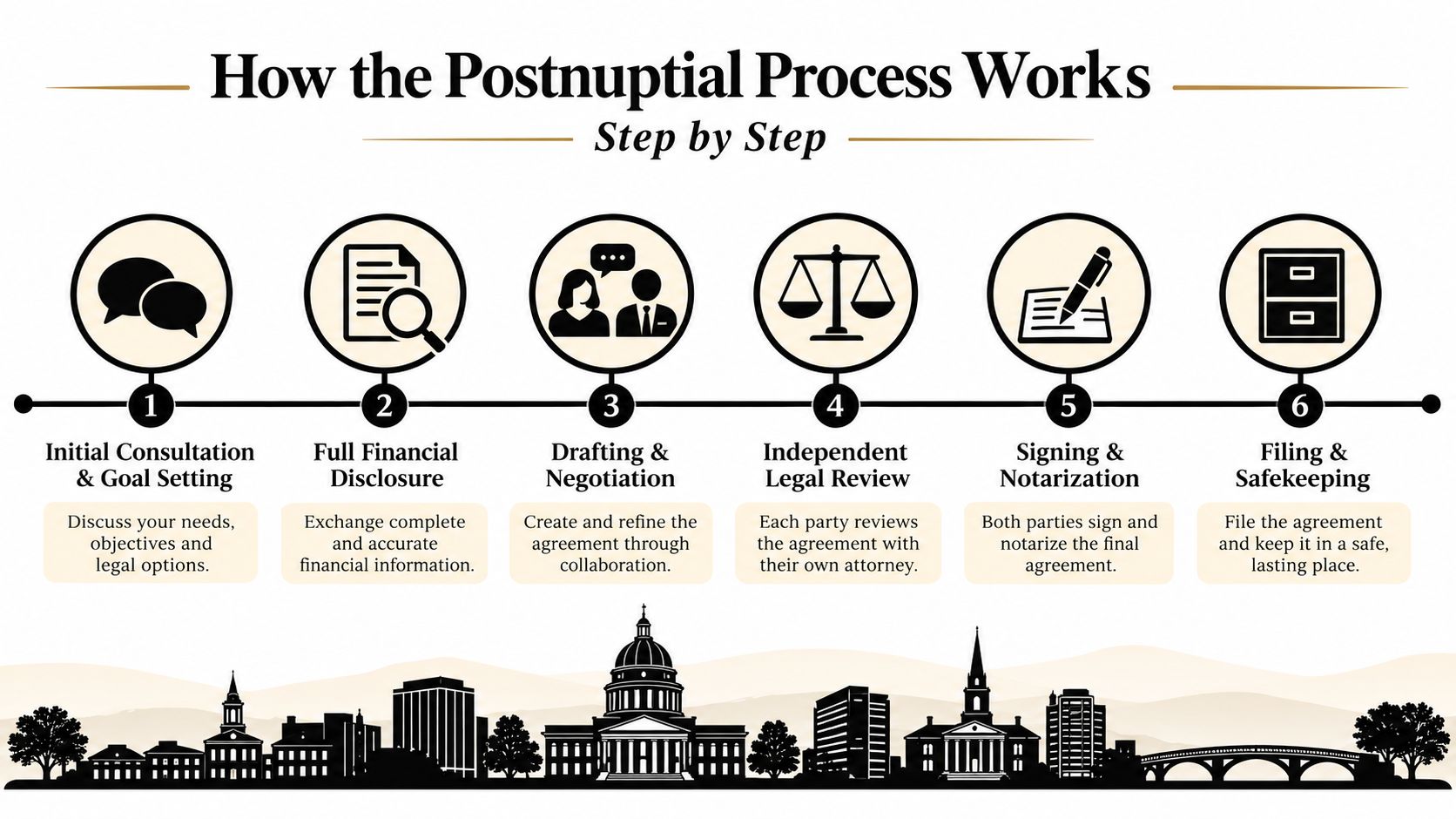
Phase 1 through phase 3
The first meeting is about goals. One spouse wants to protect a business. Another wants certainty about the house. Sometimes both just want the rules written before a major inheritance or sale closes.
Next comes full financial disclosure. Both spouses need a shared schedule of assets and debts, because the agreement is only as strong as the information behind it. After that, one side prepares a draft and the other side reviews it, then the lawyers negotiate the points that matter, like debt allocation, future support terms, and what happens to the marital residence.
Phase 4 through phase 6
Independent legal review comes next. Each spouse should have their own lawyer, or at least a real opportunity to get one, because later enforcement fights often turn on whether the process was fair. Then the agreement is signed and notarized, with execution handled cleanly and without pressure.
The practical questions during this process are straightforward. Who prepares the first draft? What debts are going to be listed and assigned? Does the agreement include mediation before litigation if there's a later dispute? Those questions matter more than cosmetic formatting.
Texas does not require court approval for spouses to sign a valid postnup, but a judge may review it later in a divorce or probate case. That's why the process record matters as much as the final signed pages.
If custody or conservatorship issues are also in the background, it's smart to keep the family-law picture aligned with the property planning. A local custody resource like Child Custody Lawyer in The Woodlands, TX is relevant when a marital agreement sits alongside parenting issues.
Cost and Timeline for a Montgomery County Postnup
People delay these agreements because they're worried about cost. That's understandable, but doing nothing can cost more later if the marriage ends in a contested property case. In Montgomery County, simple agreements usually move on a different track than high-asset negotiations with businesses, blended family concerns, or anticipated disputes.
What changes the fee structure
A straightforward postnup for a couple with limited assets and no prior-marriage complications is usually easier to price than a deal involving multiple retirement accounts, a family company, or a valuation fight. Many attorneys handle simpler agreements on a flat-fee basis and more complex negotiations by the hour. The more the spouses disagree about what belongs in the agreement, the more the cost climbs.
Timeline depends on disclosure
A practical timeline often runs roughly four to ten weeks when both spouses exchange disclosures quickly and respond to drafts without delay. If either spouse drags its feet on asset schedules, debt information, or lawyer review, the timeline stretches. A postnup is not a rush job if you want it to hold up later.
| Case Type | Typical Fee Structure | Estimated Timeline | Complexity Drivers |
|---|---|---|---|
| Simple marital-property agreement | Flat fee is common | Usually faster when disclosure is complete | Limited assets, few debts, no business ownership |
| Moderate complexity | Flat fee or hourly mix | Extends when drafts are revised | Home, retirement accounts, debt allocation |
| High-asset or contested matter | Hourly billing is more common | Longer because negotiation takes time | Business interests, blended family issues, independent counsel, possible disputes |
The cost of doing nothing is often the most expensive option. If there's no valid agreement, a later divorce may put the whole property picture back into the courtroom, and that's where fees rise fast.
When Postnups Still Get Challenged in Texas Courts
A notarized agreement is not magic. Courts still look at how it was made and whether the process was fair. That is the part many underestimate.
The pressure points judges notice
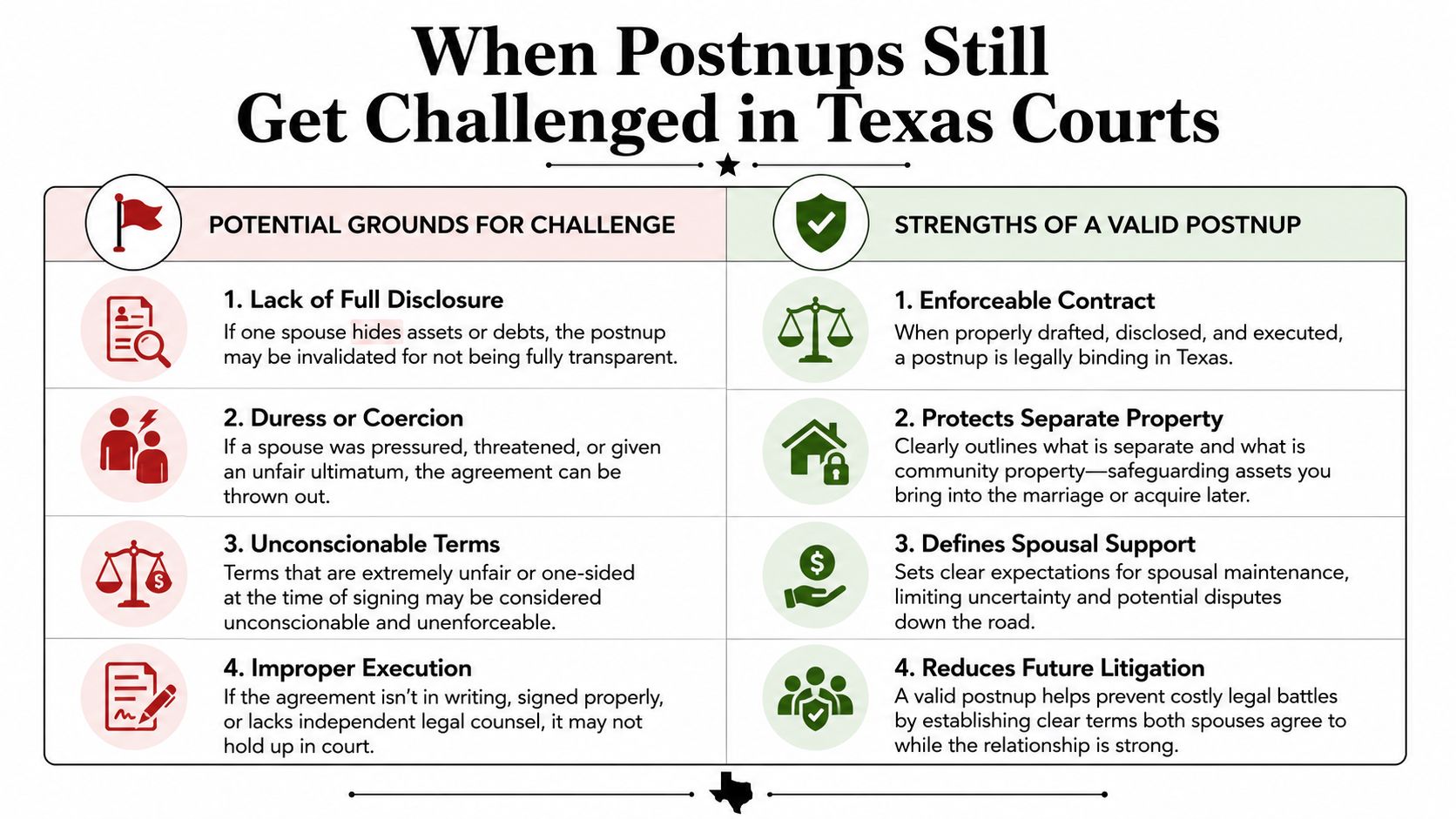
A postnup can still get challenged if one spouse claims duress, coercion, hidden assets, or terms that are so one-sided they look unfair. Timing matters too. If the agreement gets signed right after a separation, an affair disclosure, or a financial blowup, a judge will look harder at whether anyone had meaningful choice.
Independent legal review matters for the same reason. If one spouse had a lawyer and the other signed quickly without real advice, that fact can matter in a contested high-asset case. I also tell clients to watch for bargaining-power imbalances, especially when one spouse controls the accounts and the other spouse is being asked to sign under deadline pressure.
Divorce, death, and probate pressure
The challenge doesn't always come during divorce. It can come later when one spouse dies and the agreement gets tested in a probate setting under the Texas Estates Code. It can also come when the agreement affects children from prior marriages or inherited wealth that someone expected to stay outside the marital estate.
For a deeper look at hidden-asset problems that can overlap with postnup disputes, the article on your guide to hidden assets divorce Montgomery County is a useful companion piece.
A postnup is strongest when the spouses can prove they were both informed, both voluntary, and both clear on what they were giving up.
Woodlands and Montgomery County Questions Readers Ask Next
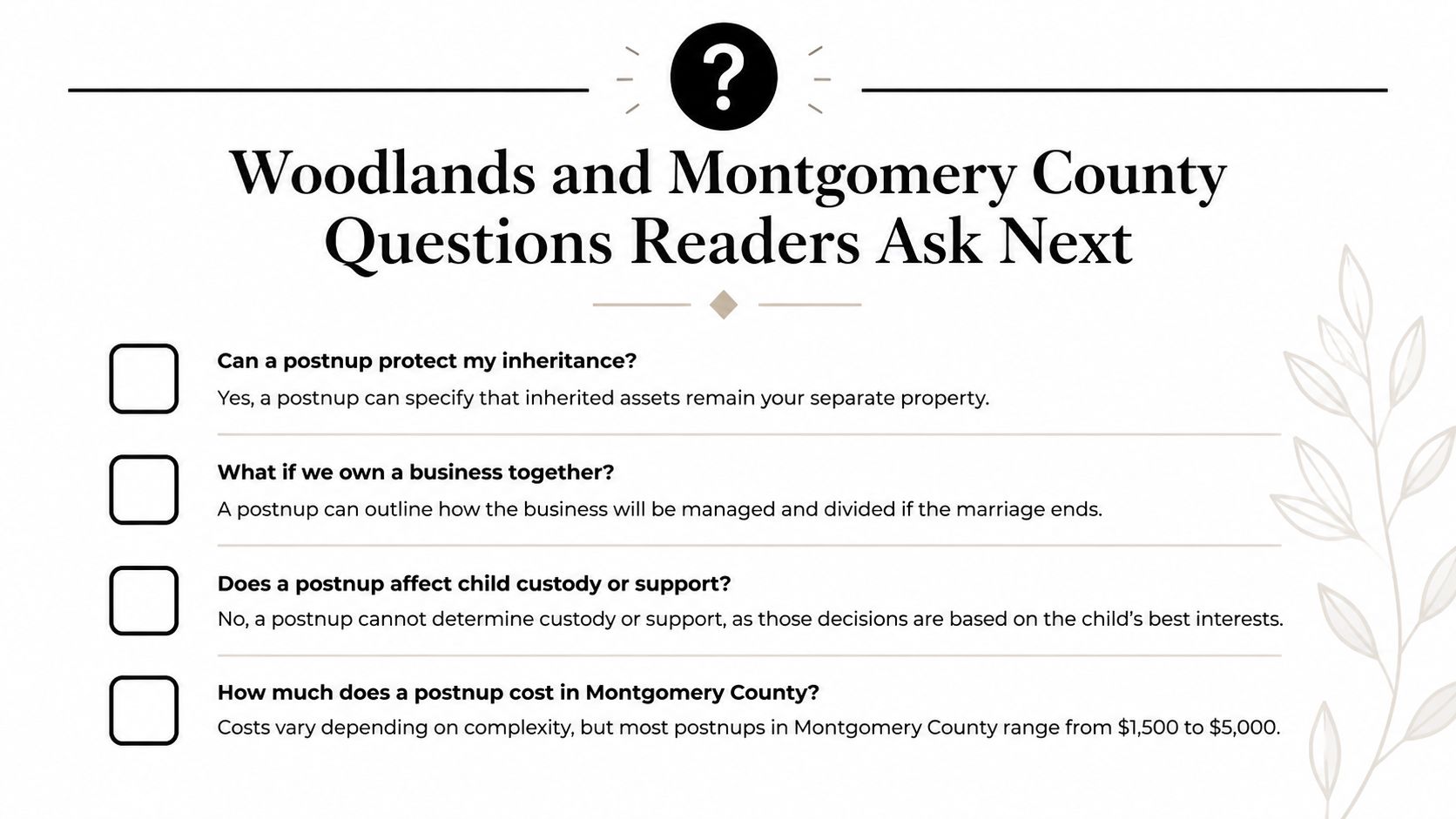
A Sterling Ridge couple asked me whether a postnup could protect an inheritance, and the answer is yes, if it's drafted cleanly and the disclosure is real. They also wanted to know whether it would control what happens in a later divorce or if one spouse dies. That depends on the exact language, the process, and how the agreement fits with the rest of the family's legal plan.
What to do next
- Gather three years of tax returns.
- List every account and debt.
- Write down the issues that matter most to your household.
- Schedule a consultation with a Woodlands or Conroe family law attorney.
- Do not sign anything until each spouse has had independent counsel review it.
A postnup can protect inherited wealth or a family business if the document is drafted with precision and the process is fair. It should not be used to change child custody or wipe out obligations the court won't honor. If death becomes part of the picture, the agreement may also intersect with probate and the Texas Estates Code, so the drafting has to be broader than a divorce-only mindset.
This is general information, not legal advice. If you're thinking about a postnuptial agreement in The Woodlands or anywhere in Montgomery County, take the time to get the process right before signatures start flying.
If you're ready to talk through a postnuptial agreement for your marriage, The Law Office of Bryan Fagan helps Woodlands and Montgomery County families evaluate marital-property issues, disclosure, and enforceability before a dispute starts. Visit The Law Office of Bryan Fagan to schedule a consultation and get clear guidance on the next step.
