 Skip to content
You're raising a question that usually shows up after a family has already lived the relationship for years. A stepparent has been there through school pickups, doctor visits, birthdays, and hard conversations, and now the adult child wants the legal record to match the family. In Montgomery County, that's exactly where adult adoption fits.
An adult adoption attorney in Montgomery County, TX handles a case that's simpler than a child adoption, but still serious. The judge's order can change legal status for inheritance and identity purposes, and the work still has to move through the local court system in Conroe. Texas treats adult adoption as its own process under the Texas Family Code and adoption rules, not as a child custody fight dressed up in different language.
This article is informational only and not legal advice. If your family is in The Woodlands, Conroe, Magnolia, Willis, or nearby communities, use this as a practical guide to what happens before and after the decree.
Why Families in The Woodlands Choose Adult Adoption
A lot of these cases start the same way. A young adult in The Woodlands calls the man or woman who raised them “Dad” or “Mom,” but the law still sees them as unrelated adults. That gap matters more than people expect, especially when the family wants the legal record to reflect a real parent-child bond, not just a long-running tradition.
Adult adoption gives that relationship legal weight. Under Texas law, an adult may be adopted if the petitioner is at least 18 and the adult to be adopted consents, which is why this process is often cleaner than a minor adoption. It does not depend on parental consent or a child-welfare placement process, and that makes it a practical fit for families who are already stable and want legal recognition, not a custody battle. The court order can also support a new legal family status for inheritance and identity purposes, which is why these cases often overlap with estate planning and probate concerns. For people in Montgomery County, the case still has to be completed in the courthouse-based family-law system used in Conroe and nearby local courts.
What adult adoption actually does
It does one main thing, and that's the point. It turns an emotional family bond into a legal one. That can matter for a family name, beneficiary planning, and the way the law recognizes parent-child status after the order is signed.
It also clarifies what adult adoption is not. It is not a custody case. It is not a child-protection investigation. It is not about convincing a judge to place a child in a new home. Local firms in the county openly list Adult Adoptions, which tells you this is a real and recurring service in Montgomery County, not a curiosity reserved for unusual cases. If you want a local example of how firms position family-law help in this area, see Adoption representation for families in The Woodlands.
Practical rule: If the relationship already exists and both adults want the legal bond recognized, adult adoption is usually the right legal frame.
Legal Requirements Under the Texas Family Code
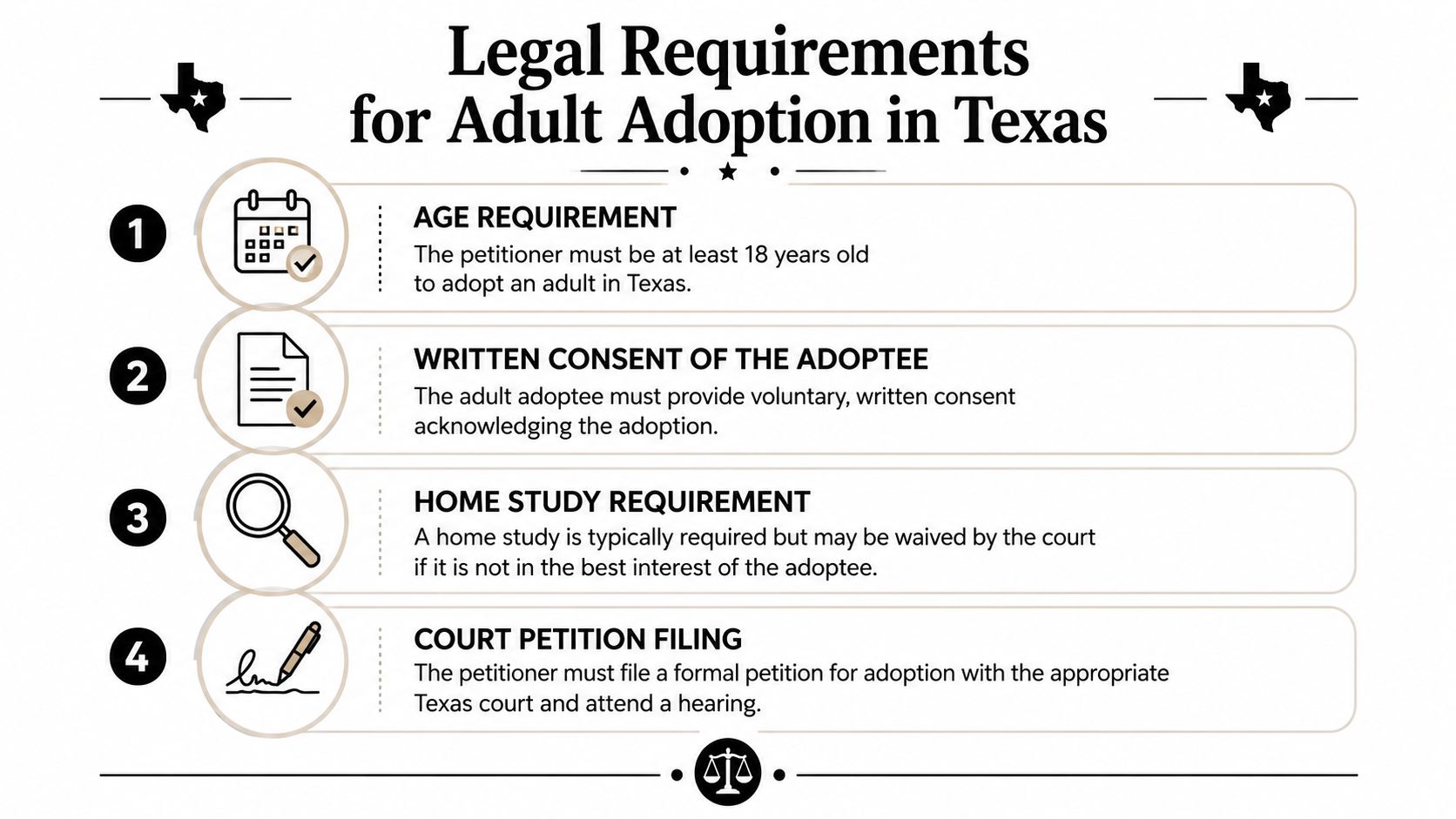
A lot of adult adoption cases in Texas turn on a short list of requirements, and that is exactly how it should be. The petitioner must be at least 18 years old, and the adult being adopted must consent. Once those pieces are in place, the case becomes a court matter about legal recognition, not a fight over a child's placement or welfare. The Texas Family Code sets out that basic framework.
What the law requires, and what it usually does not
The court wants a proper petition, the adult adoptee's consent, and a final order signed by the judge. That is the core of the case, and there is no reason to overbuild it.
In a routine uncontested adult adoption, you usually do not need a child-adoption style home study, a termination fight over parental rights, or the placement process that applies to minors. That matters because the law is dealing with two consenting adults, not a child whose living arrangements have to be evaluated through a more demanding process. If nobody is disputing the adoption, the court can keep the case focused and move it through the normal family-law track.
The mistake I see is simple. People treat adult adoption like a minor adoption and pile on paperwork that does not help the case. The judge cares about the required consent, the correct petition, and a clean file. A heartfelt family story does not fix a sloppy pleading.
Bottom line: Adult adoption in Texas is a court process first, a family milestone second. If the filing is sloppy, the judge will slow it down.
Montgomery County practice adds another layer. These cases still move through the county's courthouse system, so the filing has to fit local hearing routines and clerk expectations in Conroe and the surrounding communities. That includes the way the petition is captioned, how the consent is presented, and whether the paperwork is ready for a straightforward order. When the case is done right, it stays a focused court matter instead of turning into a drawn-out administrative mess.
What adult adoption does
It creates a legal parent-child relationship between adults. That change matters for family identity, the way the law treats the relationship after the order is signed, and the paperwork that follows, including name and estate-planning records.
It also tells you what the case is not. It is not a custody dispute, and it is not a child-protection proceeding. Local firms in the county openly list Adult Adoptions, which shows this is a regular part of Montgomery County family practice, not a rare filing. If you want a local example of how firms present this kind of family-law help, see Adoption representation for families in The Woodlands.
The Montgomery County Court Process Step by Step
Montgomery County is a courthouse-driven legal market, and adult adoption follows that reality. The case starts with a petition and ends with a signed decree, but the steps in between matter because a small filing error can mean a reset. Local firms publicly note regular work near the Montgomery County courthouse and describe adult adoption as part of the county's family-law practice, which matches how these cases are handled in Conroe and surrounding communities.
The filing itself should be prepared carefully before it ever reaches the district clerk. If the petition leaves out consent language, mismatches names, or fails to line up with the identity information the court expects, the clerk or the court can slow the case down. That's why local practice is not just paperwork. It's timing, form, and follow-through.
The Divorce Process in The Woodlands: What to Expect is a useful comparison point for how local family-law matters move through Montgomery County courts, even though adult adoption is a very different kind of case.
How the case usually moves
- Prepare and file the petition. The case starts with the right pleading and the adult adoptee's consent.
- File with the district clerk. The court file has to be opened in the proper Montgomery County family-court track.
- Wait for the case to be set. Some cases move quickly, but anything incomplete can create delay.
- Attend the final hearing. The judge reviews the paperwork and confirms the legal requirements.
- Obtain the final decree. That signed order is the document families use afterward for legal recognition.
The hearing is usually short when the matter is uncontested. The judge wants confirmation that the adults understand what they're asking for and that the legal boxes are checked. If the petition is clean, the process is often efficient. If the facts are unusual, the court may ask more questions.
What causes delays
Delays usually come from preventable mistakes. Missing signatures, inconsistent names, incorrect filing details, or trying to handle the case like a child adoption can all slow things down. In a county-seat court environment like Conroe, that kind of sloppiness stands out fast.
The cleanest cases are the ones where the petition, consent, and hearing presentation all tell the same story. That's the standard I'd use if I were advising a family sitting across from me in The Woodlands.
Common Scenarios Where Adult Adoption Makes Sense
The most common adult adoption cases in Montgomery County are not dramatic. They're familiar. A stepparent has acted like a parent for years, the adult child has grown up, and the family wants the law to catch up with the established family relationship. That's the classic version, and it fits the way Texas adult adoption works because the case is about recognition, not rescue.
Another common reason is inheritance planning. Once the legal parent-child relationship exists, families often want the court order to line up with wills, beneficiary designations, and other estate planning documents. That's where the Texas Estates Code becomes relevant, because the adoption order can affect how a family thinks about heirship and distribution planning. People don't usually want to fight over those questions later, and adult adoption can help avoid confusion by clarifying family status now.
Three real-world patterns
A blended family in The Woodlands may use adult adoption to formalize a bond that started when the child was young. A parent may want the law to reflect the fact that they were the day-to-day parent, even if no formal adoption happened earlier. That's the emotional and legal recognition piece.
An older adult may also seek adoption for identity reasons. They want the name, the bond, and the legal status to align. That's not sentimental fluff. It's a valid reason to seek a court order when the relationship has already functioned like a parent-child relationship for years.
Then there are the estate-planning cases. A family in Montgomery County may want to make sure the adopted adult is legally recognized for inheritance planning and related recordkeeping. That doesn't replace a will, and it doesn't solve every probate issue, but it gives the family a cleaner legal foundation.
If your situation looks like a stepparent relationship, the right local starting point is this Montgomery County stepparent adoption resource, because the family dynamic often explains why the adult adoption question came up in the first place.
A case like this usually comes down to one question. Does the family want the law to reflect a relationship that already exists, or are they still trying to create one from scratch?
What Happens After the Judge Signs the Order
This is the part most websites skip, and it's the part clients care about after the hearing is over. A signed decree is important, but life does not change automatically the moment the judge signs the order. The family still has to use the decree to update records, and the exact downstream steps matter.
One Texas legal explanation says the birth certificate can be changed during the adult-adoption process, but local firm pages often do not explain the practical follow-through in detail. That gap matters because families want to know whether the name change is automatic, whether records need separate updates, and what happens with estate documents. The court order is the legal foundation, but the paperwork after the order is what makes the change usable in daily life. The issue comes up often enough that it belongs in the conversation, not as an afterthought. Adult adoption Q&A discussing record changes reflects that practical concern.
The paperwork that still needs attention
Start with the certified decree. Get copies, because institutions usually want proof, not a verbal explanation. Then check whether a birth record amendment or name update is needed and whether the relevant agency requires a separate request.
After that, notify the places that hold identity and financial records. That usually includes Social Security records, insurance carriers, banks, employers, and any school or professional recordkeeper still tied to the old legal name. If the adult adoptee has estate planning documents, those should be reviewed too, because a new legal family status can affect how the family wants wills, beneficiary designations, and related documents to read.
Estate planning still matters
estate planning for blended families in The Woodlands becomes relevant for many blended families. Adult adoption may strengthen the legal family relationship, but it does not replace a good estate plan. Wills, beneficiary forms, and account titles still need to match the family's intended outcome.
Use the decree to tighten the record. Don't let it sit in a file drawer while the old paperwork stays unchanged. That's how families end up with a legally successful adoption and a messy administrative trail.
How a Local Attorney Protects Your Adoption Case
A local attorney does more than fill in blanks. In Montgomery County, the value is knowing how the courts want the file presented and how to keep the case moving without avoidable mistakes. That means matching the petition to the facts, making sure the consent is clean, and setting the hearing in a way that fits local court practice in Conroe.
Adult adoption looks simple on paper, and that is where people get careless. A lawyer who works in The Woodlands and Montgomery County knows the family-law courthouse rhythm, knows what tends to trip up filings, and knows how to handle issues like name changes, record updates, and estate planning coordination without turning a straightforward case into a scramble. If the family needs help with related planning, adult guardianship guidance in The Woodlands can also matter when capacity, care decisions, or broader family support questions are part of the picture. If a family wants local adoption help, The Woodlands adoption service page is one place to review an option.
Why local practice matters
Montgomery County cases are still court cases. A petition that is technically correct but filed sloppily can get delayed. A hearing packet that does not line up with the decree can force a reset. A name change or record update that is not planned from the beginning can leave the family doing cleanup after the order is signed.
Local counsel also helps when the case has unusual family facts. The adult adoptee may be part of a blended family. Estate planning concerns may already be on the table. The family may want the adoption order to do more than one job. A Montgomery County attorney can keep those issues aligned instead of treating them like separate, disconnected problems.
After the judge signs the decree, the work is not finished. The order has to be copied, sent, and used correctly, or the family ends up with a paper win and a messy record trail. People also need to know which offices will ask for certified copies, which records should be updated first, and which changes may take extra follow-up.
The biggest mistake I see is self-representation done with false confidence. Adult adoption is not hard because the law is complex. It is hard because small errors matter and the court expects the paperwork to be right the first time. Experienced local counsel earns its keep by catching those problems before they slow the case or create cleanup after the decree.
Your Next Steps and Consultation Checklist
If adult adoption feels right for your family, move methodically. Don't start by guessing. Start by lining up the facts the court will need.
What to do next
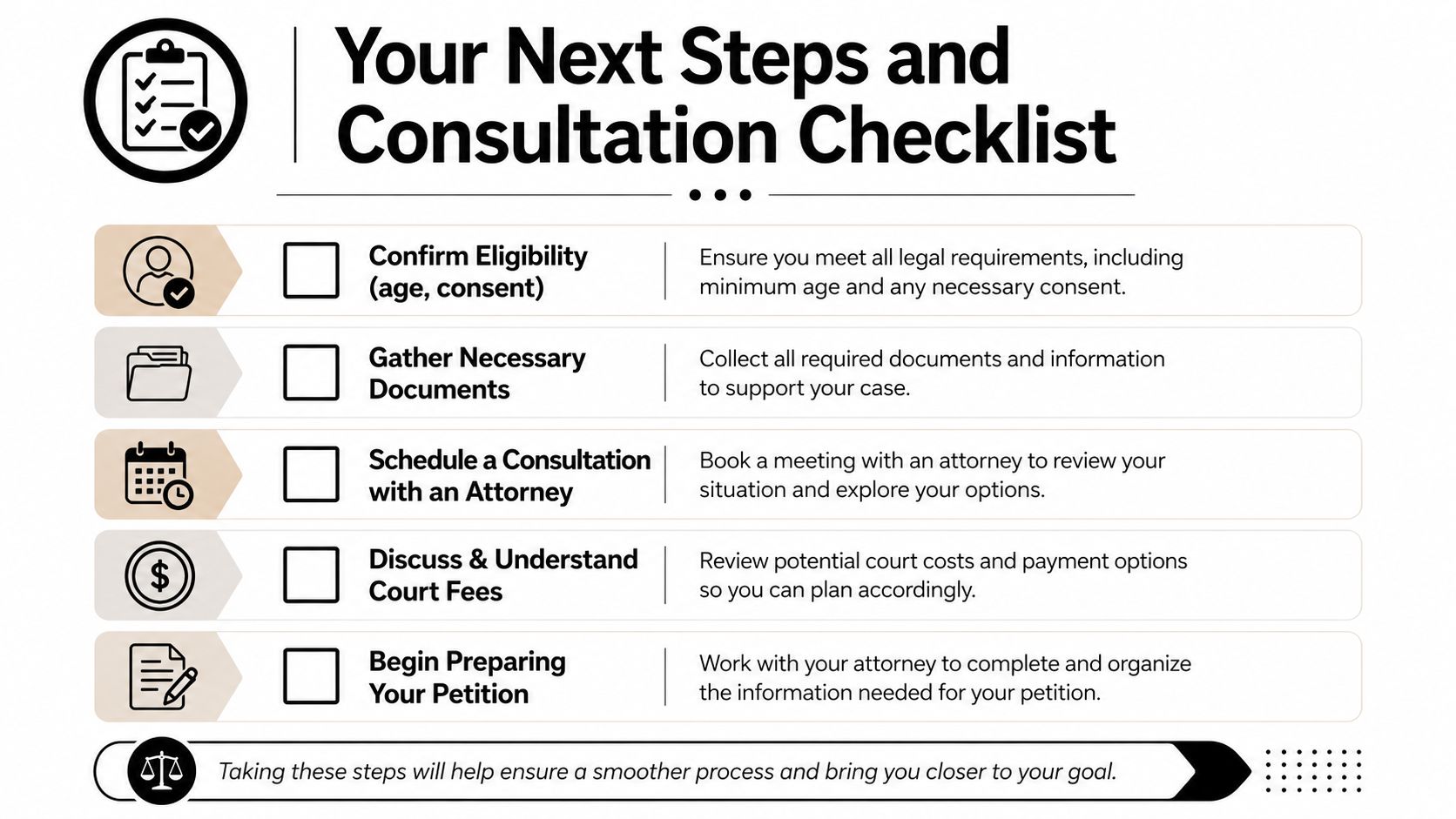
- Confirm eligibility. Make sure the petitioner is an adult and the adoptee is willing to consent.
- Gather documents. Bring identifying records, any prior name documents, and anything tied to the family relationship or estate plan.
- Review the court process. Ask how the petition will be filed in Montgomery County and what hearing setting is likely.
- Ask about record updates. Find out what happens to the birth record, name change, and other identity documents after the decree.
- Discuss estate planning. Make sure the adoption fits with wills, beneficiary forms, and probate planning.
What to expect in the consultation
A useful consultation should not be vague. You should leave knowing whether the case fits Texas adult adoption rules, what the filing will look like in Montgomery County, and what administrative tasks remain after the judge signs. If the lawyer can't explain the post-order steps clearly, that's a problem.
For families in The Woodlands, Conroe, Magnolia, Willis, and nearby communities, the smart move is to get the case reviewed before filing anything. Adult adoption works best when the legal plan is as clear as the family bond.
This is not legal advice, and it's not a substitute for a lawyer reviewing your specific facts. If you're ready to take the next step, schedule a consultation and get a straight answer about whether adult adoption is the right fit for your family.
The Law Office of Bryan Fagan helps families in The Woodlands and Montgomery County handle adult adoption, related family-law filings, and the court steps that follow a final decree. If you want practical guidance for your situation, visit The Law Office of Bryan Fagan and set up a consultation to talk through your next move.
