 Skip to content
A lot of people start looking for a family law attorney the woodlands texas at the worst possible moment. The conversation at home has broken down. One parent has moved into the guest room. Someone is worried about the children, the house, the checking account, or what happens next if papers get filed in Conroe.
In The Woodlands, these cases often carry extra pressure. Families in Panther Creek, Alden Bridge, Sterling Ridge, and Creekside may be dealing with school schedules, shared businesses, stock compensation, retirement accounts, and homes that carry real financial weight. Even when both spouses want to stay civil, the legal issues can get complicated fast.
Good legal help doesn't just mean knowing Texas law in the abstract. It means understanding how local courts work, what judges tend to focus on, what paperwork matters early, and what mistakes can damage a case before the first hearing. That local layer matters more than is commonly understood.
An Introduction to Family Law in The Woodlands Texas
If you're in The Woodlands and your family situation has shifted suddenly, the first step is getting clear on the problem. Family law isn't only about ending a marriage. It also covers children, support, enforcement, protective orders, paternity, modifications, and in some cases the probate issues that surface after a death or during a divorce.
The hardest part for many clients is that several problems usually arrive at once. A divorce may also involve temporary custody. A custody case may also require child support. A post-divorce modification may also involve school zoning, relocation concerns, or a parent who stopped following the order months ago.
A practical starting point is learning what kind of case you have and what court orders already exist. If you don't know that yet, a local overview of family law services in The Woodlands can help you frame the issue before you start making major decisions.
Practical rule: Don't rely on verbal agreements once a family dispute turns serious. If it affects your children, property, or support, assume the details need to be documented.
In Montgomery County, timing matters. Waiting too long can make a temporary problem harder to fix. Moving money, moving out with the children without a plan, or sending angry messages can create avoidable damage.
Three early mistakes show up again and again:
- Acting before reading existing orders. Many parents violate possession terms because they assume the order says one thing when it says another.
- Mixing emotion with evidence. Judges need specifics. Dates, messages, school records, bank statements, and calendars matter more than broad accusations.
- Treating the case like a single event. Most family law matters move in phases. Filing, temporary orders, discovery, negotiation, mediation, and final orders each require a different kind of preparation.
The goal isn't to make a hard season easy. It isn't easy. The goal is to make it manageable, structured, and less chaotic than it feels today.
Understanding the Scope of Texas Family Law Services
Family law in Texas often extends beyond initial expectations. A person may call about divorce and then discover the bigger issue is separate property tracing. Another may think it's only a child support problem when the underlying need is a modification tied to possession, school decisions, and health insurance.
What family law usually includes
A full family law practice in The Woodlands often handles:
- Divorce matters. Contested and uncontested divorces, temporary orders, property division, and final decrees.
- Children's issues. Conservatorship, possession schedules, child support, enforcement, and modification cases under the Texas Family Code.
- Parentage and adoption. Paternity cases, agreed orders, stepparent matters, and adoptions.
- Post-judgment disputes. Cases where one party isn't following the court order, or where life has changed enough to justify updating it.

Where probate and family law overlap
This overlap catches families off guard. During divorce, one spouse may die before final orders are signed. A parent may need to address a deceased former spouse's estate while also dealing with support or custody issues. Beneficiary designations, payable-on-death accounts, homestead rights, and community property concerns can all affect the next legal step.
The Texas Estates Code matters here. For example, independent administration under Texas Estates Code §401.001 is a major feature of probate practice in this area. According to The Woodlands estate administration overview, 75% of Montgomery County wills probated in Probate Court Number One use independent administration, and that process can reduce administration time compared with dependent administration. The same source notes timelines of 12 to 18 months for dependent administration versus 4 to 8 months for independent administration, along with lower costs in qualifying estates.
That matters in family law because probate delay can freeze practical decisions. A surviving spouse, adult child, or executor may need authority to act before a property dispute can be resolved cleanly.
What clients often miss at intake
Some problems belong in the divorce itself. Others need a separate filing.
| Issue | Common mistake | Better approach |
|---|---|---|
| House and mortgage | Assuming title decides everything | Review deed, loan, and community property issues together |
| Retirement accounts | Treating them like cash | Identify whether a later transfer order may be required |
| Child schedule | Using an informal routine only | Compare the routine to the written order or proposed terms |
| Inheritance concerns | Waiting until after death to ask | Check wills, trusts, beneficiary designations, and estate authority early |
Family law works best when the legal plan matches the real family problem, not just the label on the intake form.
If your case touches divorce, custody, support, and estate issues at the same time, make sure your attorney sees the whole picture before the first filing goes out.
Navigating the Montgomery County Family Court System
Residents of The Woodlands don't spend much time thinking about where family cases are handled until they have one. Then the practical questions start quickly. Where do I file. Will I have to go to Conroe. What happens first. How long before a judge hears us.
What filing in Montgomery County actually means
For many family law matters involving The Woodlands, the case proceeds through Montgomery County courts, often in Conroe. The local process isn't just paperwork. It has a rhythm. Petition, service, temporary issues, exchange of information, negotiation, mediation, and if needed, trial.
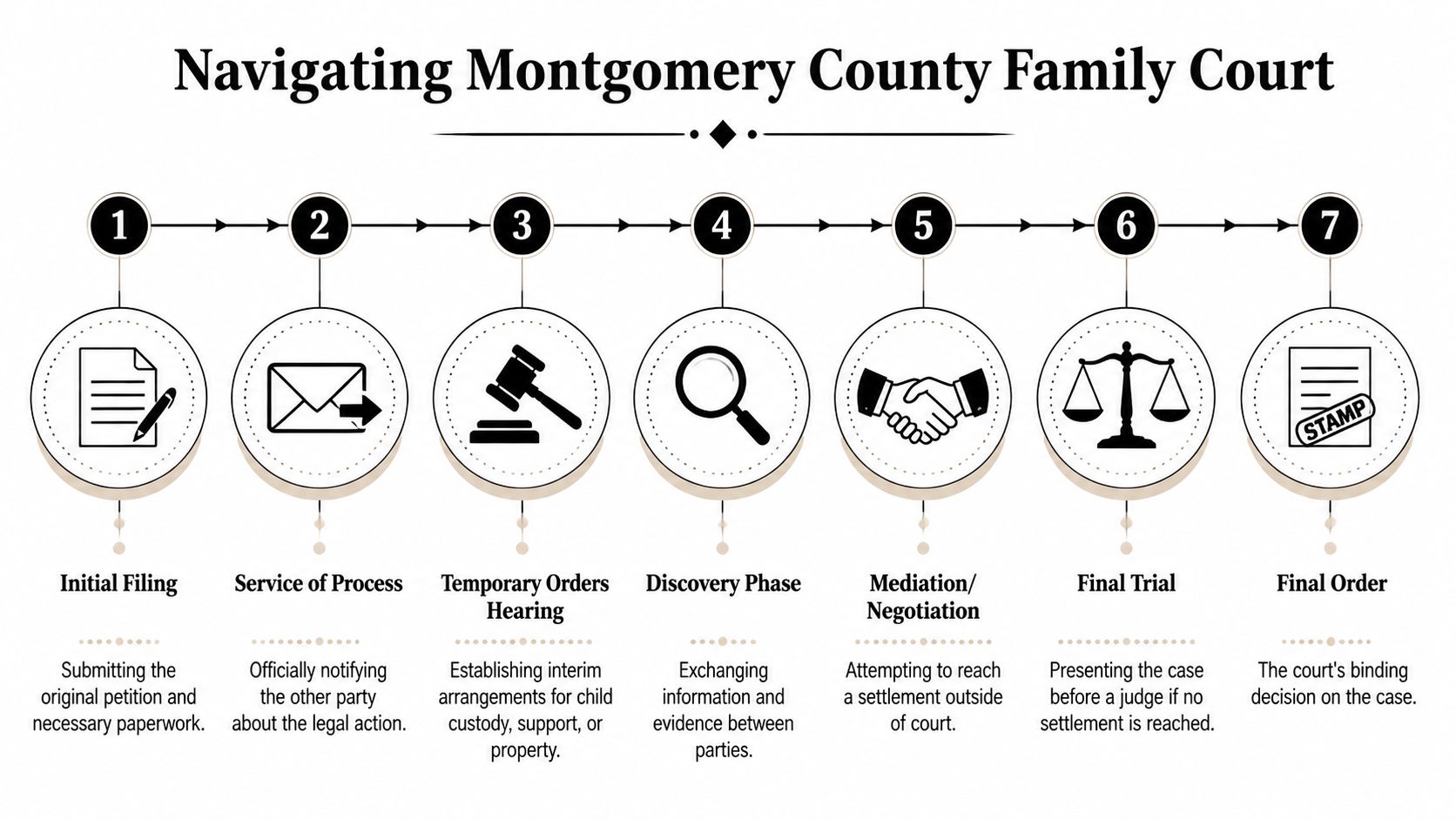
A local court guide on Montgomery County divorce court procedure helps explain the mechanics, but procedure alone isn't enough. How a judge expects parties to behave, how cleanly evidence is presented, and whether a lawyer understands local practice can affect the direction of the case.
According to local commentary on Montgomery County family court practice, family law filings in Montgomery County rose by 15% in 2025. More filings mean busier dockets, tighter hearing settings, and less patience for disorganized presentations.
Why local court knowledge matters
The difference between generic advice and useful advice usually shows up in high-conflict cases. In some courtrooms, a judge may focus heavily on stability, school continuity, and whether a parent followed orders while the case was pending. In others, the immediate issue may be whether the moving party brought clean documents, gave proper notice, and asked for relief the court can realistically grant that day.
That doesn't mean judges are unpredictable. It means they are human decision-makers working within local procedures.
A few practical realities matter in Montgomery County:
- Temporary orders shape advantage. Many cases are effectively built during the temporary phase. Who stays in the home, who pays what, and what possession schedule starts now often influence settlement later.
- Standing orders and routine restrictions matter. Parties can get into trouble by draining accounts, hiding children from the other parent, or changing the status quo without legal advice.
- Mediation isn't optional in spirit, even when trial is possible. Courts expect parties to try to resolve what can be resolved.
What works and what doesn't
Below is the short version I give new clients.
| Works | Doesn't work |
|---|---|
| Organized timelines | Long emotional narratives with no dates |
| Clean exhibits | Screenshots with no context |
| Specific requested relief | Asking the court to "fix everything" |
| Child-focused testimony | Using hearings to punish the other parent |
| Respect for temporary orders | Self-help and retaliation |
If you want a judge to act quickly, bring a narrow request supported by records, not a pile of grievances.
Preparing for your first court steps
If your case is about to be filed, focus on gathering the documents your lawyer will use:
- Orders and pleadings. Existing divorce decrees, custody orders, modification orders, and any notices you've received.
- Financial records. Pay stubs, tax returns, account statements, loan documents, and a current household budget.
- Child-related records. School reports, medical records, attendance data, calendars, and communication logs.
- A short chronology. Key dates, not your whole life story.
People often think they need to tell everything immediately. They don't. They need to tell the right facts in a usable form. That's how local strategy starts.
A Practical Guide to Divorce in The Woodlands
Divorce in The Woodlands is rarely just about whether a marriage should end. By the time someone contacts counsel, the actual concerns are usually more concrete. Who stays in the house. What happens to the children. How are bank accounts handled. What about stock options, bonuses, or a business interest.

Uncontested and contested divorce are different animals
An uncontested divorce usually means both spouses agree on all major terms and can reduce those terms to a workable decree. These cases still require care. A bad decree can create years of enforcement trouble.
A contested divorce means one or more major issues remain unresolved. That may involve conservatorship, the house, support, reimbursement claims, separate property tracing, or disputed debt. In The Woodlands, contested cases often involve more financial complexity than people expect at the outset.
Under the Texas Family Code, property division in divorce must be just and right. That doesn't mean a mechanical split in every case. It means the court looks at the marital estate and makes a division it considers fair under the facts.
High-asset issues need a slower, more disciplined approach
In Montgomery County, many divorces involve compensation structures that don't fit into a simple paycheck model. Clients may have stock awards, deferred compensation, partnership interests, performance bonuses, or ownership in a closely held business.
That changes the work.
A lawyer may need to coordinate with a forensic accountant, valuation expert, or CPA. Separate property claims may require old account records, not just current balances. If one spouse has run family finances for years, the other spouse may need time and discovery to understand what exists.
Common pressure points in Woodlands divorces include:
- The family residence in neighborhoods like Sterling Ridge or Creekside
- Business valuation
- Restricted stock or options
- Retirement accounts requiring later transfer documents
- Claims that an inheritance or premarital asset stayed separate
A short real-world scenario
A couple in Alden Bridge decides to divorce after a long marriage. One spouse works in an executive role and receives salary, annual bonus, and equity compensation. The other spouse handled most child-related scheduling and paused a career for several years.
They agree the marriage is over, but they disagree on value. The employed spouse sees the stock as future compensation and wants to keep it. The other spouse sees years of marital support that helped build the compensation package. They also disagree about whether to sell the house now or after the school year.
Broad statements often hinder rather than help in these matters. The case requires specific records, including grant documents, vesting schedules, and tax documents. Mortgage statements and a proposed plan for the children are also necessary. If either party begins by concealing accounts or taking unilateral financial actions, reaching a settlement becomes more difficult and the court's trust diminishes.
In a high-asset divorce, speed for its own sake usually costs more later. Clean information produces better leverage than rushed demands.
What to do early in a divorce case
A good early strategy is usually practical, not dramatic.
Protect information first
Make copies of tax returns, account statements, deeds, insurance records, loan records, and employment compensation documents. Save them lawfully and organize them by category.
Avoid financial games
Don't move money because you're angry. Don't empty accounts because a friend told you to. Those choices often create emergency hearings and credibility problems.
Think about the decree before mediation
People focus on the deal points but forget the wording. A settlement that sounds good in mediation can fail later if the decree doesn't clearly assign debts, deadlines, refinance obligations, or transfer language.
A useful explanation of core divorce issues appears in this video, especially for people trying to understand how a case can shift from disagreement to structured resolution.
What clients regret most
Not every regret is legal. Some are strategic.
- Waiting too long to get advice after separation
- Assuming civility means no documentation is needed
- Using children as messengers
- Signing informal side agreements that conflict with the final decree
- Ignoring tax impact when dividing assets
If you're searching for a family law attorney the woodlands texas during the first days of a possible divorce, focus on protecting documents, reducing conflict, and getting an accurate read on your options before taking irreversible action.
Protecting Your Children in Custody and Support Cases
Parents often use the word "custody," but Texas law speaks in terms of conservatorship, possession, and access. Those labels matter because they shape the order. Who makes educational decisions. Who determines residence. What schedule applies on weekends, holidays, and summer. What happens when parents don't agree.
Under Texas Family Code §153.002, the court's guiding standard is the child's best interest. In practice, that means judges look closely at stability, follow-through, communication, safety, and whether each parent can support the child's relationship with the other parent when appropriate.
Joint managing and sole managing conservatorship
Many parents assume one of them will "win custody." That's not how many cases are framed.
A court may appoint Joint Managing Conservators when shared rights and duties fit the facts. In more serious situations, one parent may seek Sole Managing Conservator status if decision-making power needs to be concentrated because of safety concerns, instability, or repeated misconduct.
The label is only part of the picture. The actual order matters more than the headline term.
| Issue | Why it matters |
|---|---|
| Right to designate residence | Affects where the child primarily lives |
| Geographic restriction | Controls relocation disputes |
| School decisions | Can become a flashpoint quickly |
| Medical decision-making | Matters in high-conflict co-parenting |
| Exchange terms | Prevents recurring handoff disputes |
High-conflict custody cases are evidence-heavy
When a custody fight turns serious in Montgomery County, parents are often surprised by how invasive the process can become. According to discussion of custody practice in The Woodlands, cases involving major conflict may trigger social studies under Texas Family Code §107.051, and those evaluations can include home studies and tools such as the MMPI-2.
That changes how a parent should prepare. General complaints don't carry much weight. Daily routines, school attendance, medical follow-through, sober parenting history, and documented communication patterns do.
The parent who looks calm, organized, and child-focused usually presents better than the parent who tries to prove every moral failure in the other household.
If you think alienation, substance abuse, or dangerous behavior is in play, bring the proof your lawyer can use. Police calls alone may not be enough. School messages, medical records, therapist recommendations, photos, app logs, and witness details may matter more.
Child support and modification issues
Support cases are often treated like math only. They aren't. The math matters, but so does the evidence behind the numbers and whether a modification is legally justified under Texas Family Code Chapter 154.
This issue has become more pressing for families dealing with changing compensation, inflation pressure, and inconsistent income. A local review of support questions in The Woodlands notes an underserved need for guidance on modifications tied to current economic changes and the proof required to show a material change in circumstances in these cases, discussed in the The Woodlands child support overview.
For higher-income families, support disputes may involve:
- Bonus or commission income
- Self-employment records
- Fluctuating business revenue
- Health insurance and reimbursement issues
- Claims that income is being underreported
Negotiated solutions can work well when both sides have reliable financial records. They often fail when one parent comes in with estimates, verbal claims, or incomplete documents.
Emergency situations and practical first steps
If your child is in immediate danger, your response should be disciplined.
- Document the event clearly. Dates, times, names, what happened, and any photos or messages.
- Preserve records. Don't edit screenshots. Don't coach the child.
- Get legal advice quickly. Emergency relief depends on facts the court can act on.
- Follow existing orders unless immediate safety requires otherwise. Then be prepared to explain exactly why.
Parents also need support outside the courtroom. If you're trying to stabilize emotionally after a divorce or separation while still showing up for your children, a thoughtful divorce recovery guide can help you build healthier routines during the legal process.
How to Choose the Right Woodlands Family Law Attorney
Choosing counsel isn't about picking the person with the loudest marketing or the fastest consultation pitch. It's about fit. Your lawyer needs to match the case you have.
If the issue is a simple agreed modification, you may want efficiency and careful drafting. If the issue is a high-conflict custody dispute in Montgomery County, you need someone who can prepare evidence, manage hearings, and stay strategic when emotions rise.
Credentials matter, but context matters too
One important credential in Texas is board certification in family law. According to Texas family law board certification information, that distinction is held by fewer than one percent of Texas attorneys and requires rigorous testing, peer review, and at least five years of focused practice.
That doesn't mean every good family lawyer is board-certified. It does mean the credential signals a high level of commitment to the field. In complex property, custody, and enforcement cases, that's worth weighing seriously.
The market is also crowded. Avvo's listing for family lawyers in The Woodlands reports 212 family lawyers serving The Woodlands. Plenty of options can make the choice harder, not easier.
Questions worth asking in consultation

Ask questions that expose judgment, not just availability.
- How often do you handle cases in Montgomery County family courts? Local experience matters when temporary orders and courtroom expectations are driving the case.
- What type of case do you think this is right now? A good answer should identify whether your matter is primarily custody, property, enforcement, modification, or some combination.
- What are the likely early pressure points? The answer should sound practical. Discovery, records, school issues, business valuation, or temporary possession may come up.
- Who will work on the file? Some firms delegate heavily. That's not always bad, but you should know who drafts, who appears, and who communicates.
- How do you charge? Understand retainers, hourly billing, and when costs tend to rise.
What to do next
Use this checklist before hiring anyone.
- Bring your documents. Orders, tax returns, pay stubs, account statements, school records, and key messages.
- Write a one-page timeline. Dates matter more than opinions.
- List your top three goals. Not twenty. Three.
- Ask about local court experience. You want specifics, not general confidence.
- Ask how settlement and trial prep work together. Good lawyers prepare for both.
- Read the engagement terms carefully. Know what communication, drafting, and hearing work will cost.
A good attorney doesn't just tell you what can happen. The attorney tells you what to do this week so your case improves instead of drifts.
For people comparing firms, resources on how firms present their services online can be useful too. A legal marketing piece like Gorilla Web Tactics for law firms can help you read law firm websites more critically and separate polished branding from meaningful case information.
If you're evaluating options locally, one available starting point is to review a Woodlands divorce attorney page and compare how clearly it addresses your type of matter. The Law Office of Bryan Fagan is one local option for divorce, custody, support, property division, and probate-related family disputes in Montgomery County.
Your Next Steps and Legal Disclaimer
If you're facing divorce, a custody dispute, a support problem, or a post-decree conflict in The Woodlands, the most useful next step is usually a simple one. Get organized before you get overwhelmed.
Start with your papers. Gather current court orders, financial records, school information, and a short timeline of what changed. If there are urgent safety concerns involving a child, move quickly and document carefully. If the case is financial, slow down and avoid impulsive money moves.
The local court process matters. So do the details of your family. A parent in Panther Creek dealing with a modification needs a different strategy than a spouse in Creekside tracing separate property in a high-asset divorce. Good family law work is specific. It isn't one-size-fits-all.
Keep these takeaways in mind:
- Local procedure affects outcomes. Montgomery County practice is not the same as generic Texas family law commentary.
- Temporary decisions matter. Early hearings often shape settlement bargaining power and parenting routines.
- Documentation wins over emotion. Judges need usable facts.
- The right lawyer should fit the dispute. Some cases need careful drafting. Others need litigation readiness.
This article is for informational purposes only. It is not legal advice, does not create an attorney-client relationship, and should not replace advice based on the specific facts of your case. Family law outcomes depend on details that vary from one matter to the next, including the current status of court orders, evidence, procedure, and local practice.
If you're unsure whether your issue calls for a divorce filing, a modification, an enforcement action, or a probate-related response, that's exactly the point at which a consultation helps most. The earlier you understand your options, the easier it is to avoid mistakes that are expensive to undo later.
If you're dealing with a family law issue in The Woodlands or anywhere in Montgomery County, you can schedule a confidential consultation with The Law Office of Bryan Fagan to discuss your circumstances, your goals, and the practical next steps available under Texas law.
