 Skip to content
A lot of parents in The Woodlands are carrying two plans in their heads at the same time. One plan is daily life: school meetings, therapy schedules, insurance calls, and trying to keep the household steady. The other plan is harder to say out loud: what happens to my child if I get sick, pass away, or end up in a divorce that turns every financial decision into a fight?
That second plan is where families often get stuck. They know their child may need long-term support. They also know that leaving money outright can create problems with SSI or Medicaid. If divorce, custody, probate, or inherited family assets are part of the picture, the risk gets bigger because one poorly timed transfer or one vague order can create a mess later.
A properly built special needs trust can solve that problem. It can hold and manage money for a loved one with a disability while protecting benefit eligibility and creating a structure for future care. In Montgomery County, that planning is often tied directly to custody orders, property division, beneficiary designations, and probate filings. That overlap is where families need practical legal guidance, not a generic form.
Securing Your Child's Future in The Woodlands
A mother in Alden Bridge recently described the fear better than any legal textbook could. She wasn't only worried about money. She was worried about continuity. If she was no longer the person managing medications, school advocacy, and appointments, who would step in, and what money would they legally be allowed to use without hurting benefits?
That question comes up often in The Woodlands, Shenandoah, Magnolia, and across Montgomery County. Families are trying to balance care, financial support, and public benefits at the same time. Some are married and planning ahead. Others are in the middle of a divorce and realize that a settlement, life insurance designation, or inherited asset could land in the wrong place.
Why informal planning usually fails
Good intentions don't create legal protection.
If grandparents plan to "just leave something in the will," or parents assume a sibling will "take care of things later," the family may end up transferring assets directly to the person with disabilities. That can interfere with means-tested benefits and create avoidable conflict among relatives about who controls the funds.
Practical rule: If support for a child with disabilities depends on verbal promises, the plan isn't finished.
A trust changes that. It puts written terms, a trustee, distribution rules, and backup decision-makers in place. It also gives the family a way to coordinate long-term support with education, housing goals, therapy, and adult transition planning.
For many families, skill-building is part of that future planning too. Resources like Sachs Center independent living services can help parents think beyond money alone and consider what adulthood may look like for their child.
The peace of mind families are really looking for
What most parents want isn't a complicated estate plan. They want to know their child will be safe, supported, and not financially cut off because of one legal mistake.
That is why a special needs trust matters so much. It isn't just an estate document. In the right case, it's the center of a larger plan that can connect a divorce decree, a will, beneficiary designations, a guardianship or alternatives to guardianship, and a roadmap for future caregivers.
What Is a Special Needs Trust
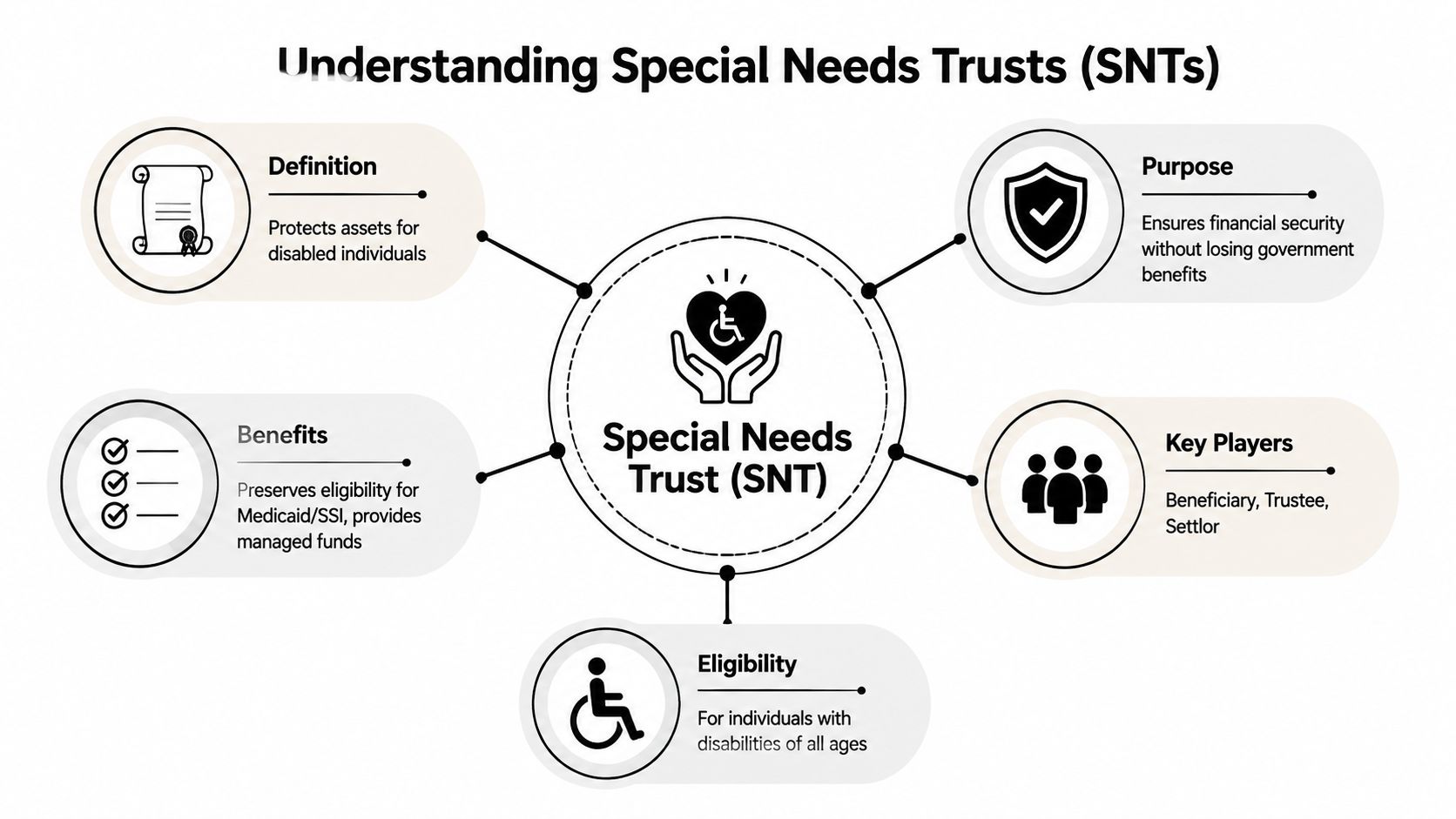
A special needs trust is a legal arrangement that holds money for a person with a disability without putting that money directly in the beneficiary's name. The trust owns the assets. A trustee manages them. The beneficiary receives the benefit of the funds under the trust's rules.
It functions as a protected container. The money is set aside for your child or loved one, but it isn't handed over in a way that automatically counts as the beneficiary's own available asset.
What the trust is meant to do
In Texas, a special needs trust must be structured so the funds aren't available to the beneficiary for basic support such as food and shelter if the goal is to preserve SSI and Medicaid eligibility, as explained in this discussion of a Texas special needs trust structure. That rule is where many DIY plans go wrong.
A trust can often pay for supplemental items such as therapies, equipment, transportation, education support, recreation, and other quality-of-life expenses, depending on the trust terms and benefit rules. The trustee has to understand those boundaries before making distributions.
A lot of families confuse a trust with a savings account. They aren't the same. If you're trying to sort out basic planning choices, this guide on Emergency fund and SNT distinctions is a useful starting point.
A short real-world scenario
Parents in The Woodlands have a teenage son with a diagnosed disability. During a divorce, both parents agree that future support should not be paid directly to the child once he becomes an adult. Instead, they work with counsel to create a special needs trust. One parent names the trust as the beneficiary of a life insurance policy. The other agrees that certain inherited funds from grandparents will also pass into the trust.
The trustee later uses trust funds for therapy equipment, a job coach, and transportation to a transition program. Because the assets were directed into the trust instead of to the son outright, the family has a stronger chance of preserving means-tested benefits while still providing practical support.
The strongest plans don't just answer who gets the money. They answer who controls it, when it can be spent, and how it fits with benefits and family court orders.
If your case also involves custody or support litigation, understanding how local cases move can matter. Montgomery County Family Courts: A Local Guide gives a factual overview of how family law matters proceed in the courts serving The Woodlands.
A visual overview can also help if this is your first time hearing these terms.
First-Party Third-Party and Pooled Trusts in Texas
Not every trust fits every family. The right structure depends on whose money is funding the trust, how the funds are being received, and what should happen after the beneficiary's death.
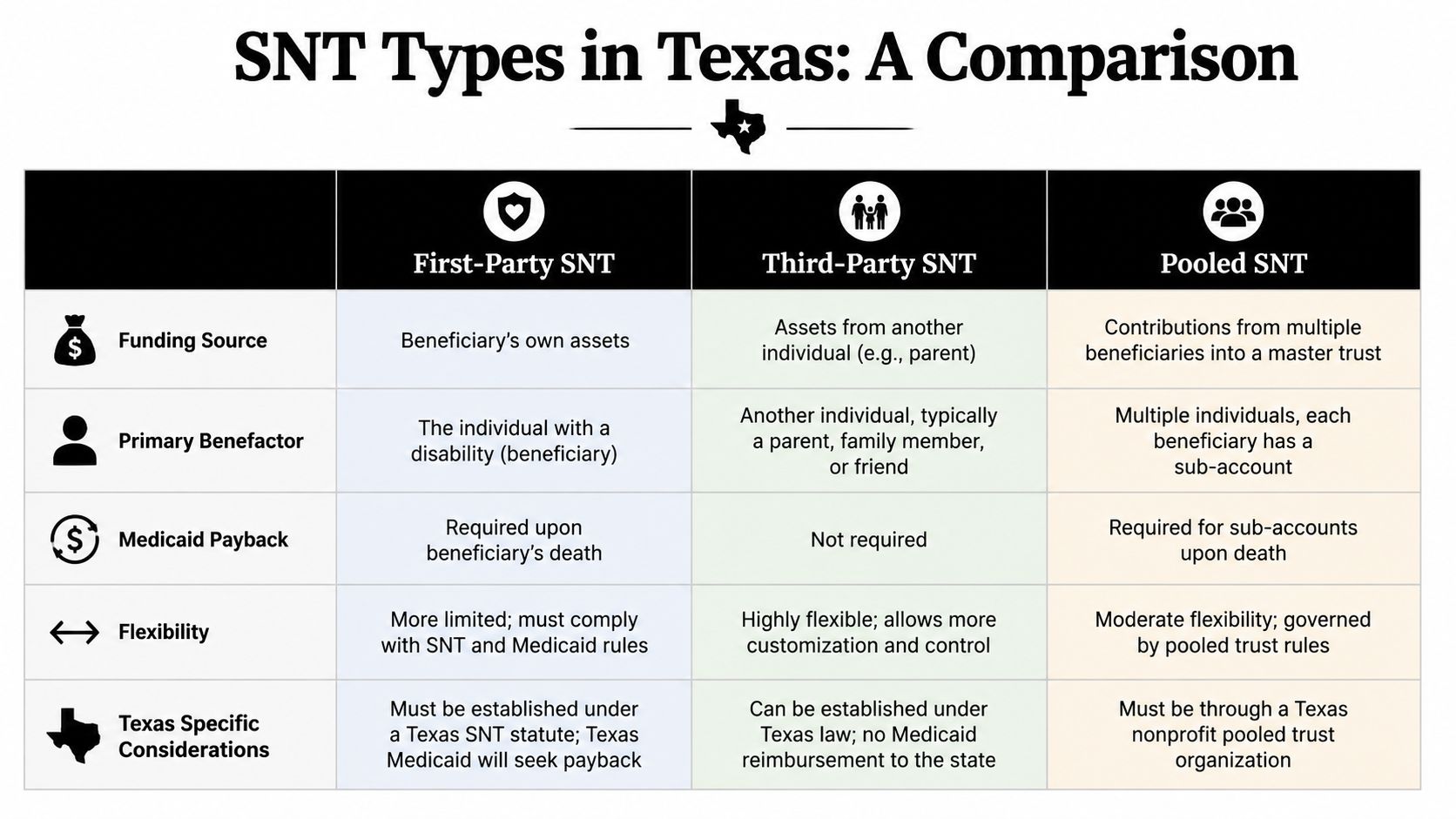
A practical comparison
| Trust type | Usually funded with | Best fit for | Key concern |
|---|---|---|---|
| First-party SNT | The beneficiary's own assets | Settlement proceeds, direct inheritance already received, savings in beneficiary's name | Medicaid payback rules may apply |
| Third-party SNT | Parents', grandparents', or others' assets | Forward-looking family planning | Needs careful coordination with wills and beneficiary designations |
| Pooled trust | Sub-account within a nonprofit-managed master trust | Smaller amounts or cases needing professional administration | Less customization than some standalone trusts |
Who each option is really for
First-party trust. This is often the right conversation when the disabled person already owns the money. That can happen after a lawsuit recovery, a direct inheritance, or accumulated assets that would otherwise create eligibility problems.
Third-party trust. This is usually what parents mean when they search for a special needs trust lawyer in The Woodlands. They want to set aside their own assets now or direct future assets into the trust later. This option is often the cleanest fit for estate planning.
Pooled trust. This can work when the amount being set aside doesn't justify a fully customized private trust or when a family wants nonprofit administration.
Where families make the wrong choice
Trouble starts when people pick the trust type based on convenience instead of funding source.
For example, parents sometimes try to use a third-party design when the funds already belong to the beneficiary. In other cases, a grandparent leaves money directly to the disabled person through a will, which can force the family into cleanup planning later instead of proactive planning.
If your broader estate plan includes revocable trusts, wills, and beneficiary coordination, it helps to review how those pieces work together with a trust attorney in The Woodlands, Texas.
A trust's label matters less than its funding source. That's what usually determines which rules control the plan.
Navigating Montgomery County Probate and SNT Rules
In Montgomery County, special needs planning often doesn't sit neatly inside one practice area. It touches probate, estate planning, divorce, custody, and property division. That's especially true when parents are separating and trying to protect a child with disabilities without creating new conflicts over control of money.
Why local court coordination matters
Some trusts require court involvement or must be reviewed alongside probate or family court issues. In practice, lawyers in this area often have to look at more than the trust document itself. They need to review divorce decrees, child support language, inheritance pathways, account titles, and who has authority to act for the child or adult beneficiary.
Under the Texas Estates Code, trust administration and fiduciary duties are not casual matters. The trustee's role, the court's authority in some proceedings, and the handling of probate assets all require careful drafting and follow-through. If a family is also dealing with estate settlement, a resource discussing probate administration in The Woodlands, TX can help frame how those cases fit into Montgomery County practice.
The family law issue most articles miss
The biggest planning gap I see is this: the trust gets drafted, but the divorce orders don't match it.
That creates avoidable disputes. A decree may require support, reimbursement, insurance, or property transfers without clearly directing funds into the special needs trust. Then one parent dies, remarries, changes a beneficiary designation, or argues later that the decree never required trust funding in the first place.
Data tied to The Woodlands market shows how common that overlap is. Local legal professionals report that 83% of clients seeking special needs trust representation are parents of children under age 12, 67% have high-asset divorces or contested custody cases, and 54% coordinate trust creation with probate or property division proceedings, according to special needs trust data for The Woodlands.
Texas family law also matters here. The Texas Family Code can affect how conservatorship, support obligations, and settlement terms are documented. If the trust language and family court orders point in different directions, the family may spend months fixing a problem that should have been prevented at drafting.
For readers trying to understand filings, timing, and procedural expectations, this overview of the Montgomery County probate court process gives useful local context.
What works better in contested cases
In high-conflict divorce or custody matters, better planning usually includes:
- Consistent language: The decree, trust, and beneficiary designations need to match.
- Defined trustee structure: Pick who serves first, who serves next, and when replacement happens.
- Clear funding pathways: Spell out whether life insurance, inherited funds, or settlement proceeds must flow into the trust.
- Coordination across counsel: Family law and estate planning decisions should not be made in separate silos.
Creating Your Special Needs Trust Step-by-Step
Families usually feel better once the process is broken down into actual tasks. Creating a trust isn't one meeting and a signature. It's a sequence of decisions, and each decision affects how well the plan works later.
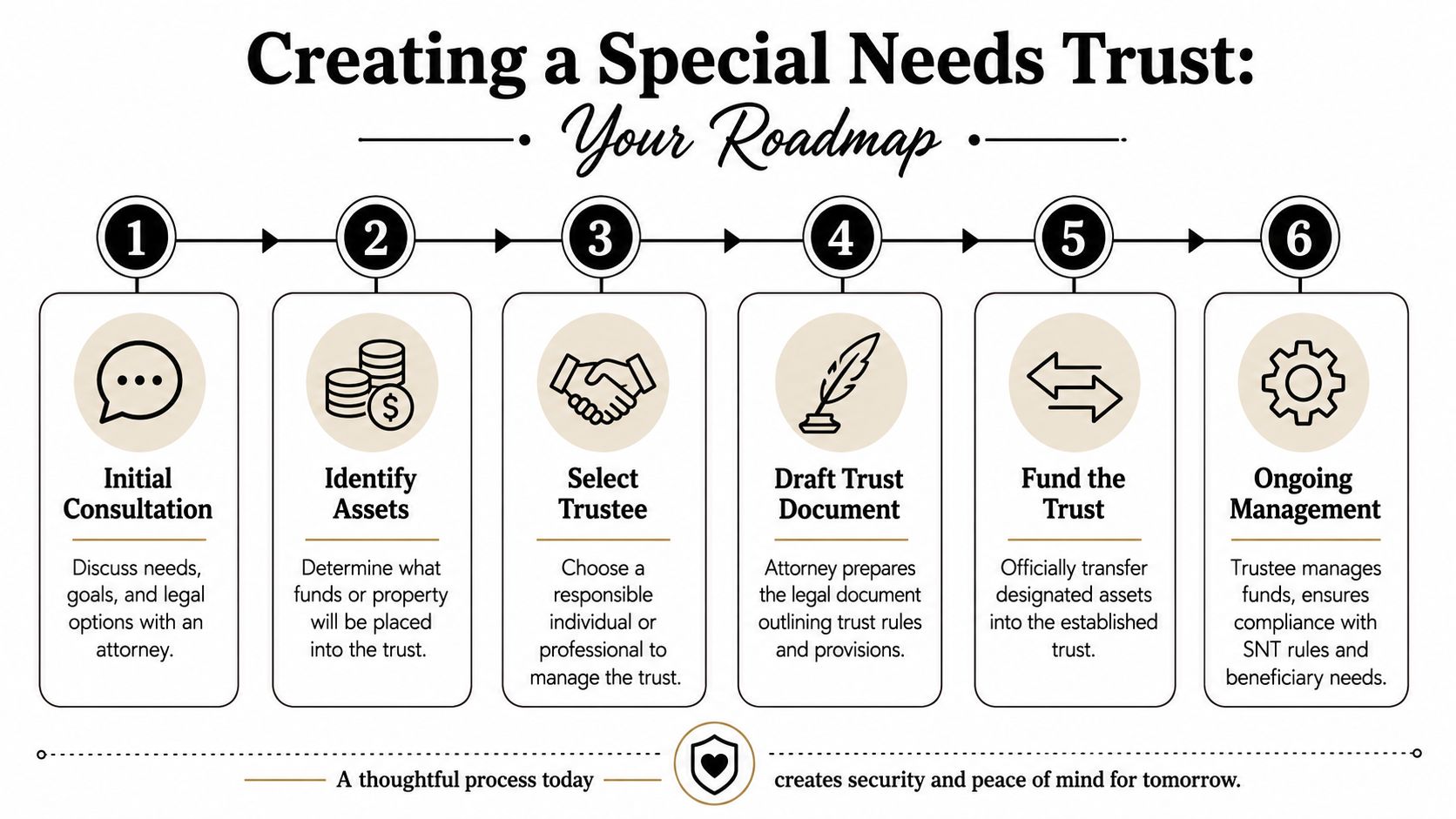
The working process
Initial consultation
The attorney learns who the beneficiary is, what benefits are involved, whether a divorce or probate case is pending, and what assets may fund the trust.Asset review
Families identify what money is available. That may include savings, life insurance, inherited property, settlement proceeds, retirement designations, or future transfers under a decree.Trustee selection
Picking a trustee is not a symbolic choice. It should be someone who can follow rules, keep records, work with benefits limitations, and handle family pressure.Drafting the trust
The trust document defines the trustee's powers, distribution standards, successor trustees, and what happens if circumstances change.Signing and execution
Formalities matter. The trust has to be properly signed and integrated with the rest of the estate plan or litigation documents.Funding the trust
This is the step many families underestimate. An unfunded trust is often just a well-written folder of paper.
Cost and timing in the Houston and The Woodlands area
Families usually want two practical answers right away. How much will this cost, and how long will it take?
The typical cost to establish a special needs trust in the Houston and The Woodlands metro area ranges from $3,200 to $6,800, with legal fees accounting for 72% of total expenses, and the average time from initial consultation to court filing is 14.3 weeks, according to the cost and timing information summarized in the earlier local source.
That timeline can stretch when a divorce is pending, when funding sources are unclear, or when multiple family members want input. It can move faster when the asset source is simple and the trustee decision is already made.
One caution: Drafting is only half the job. If you don't retitle assets, update beneficiary designations, or align the divorce decree with the trust, the plan may fail where it matters most.
What families should prepare before the first meeting
Bring these items if you have them:
- Benefit information: SSI, Medicaid, or other support records.
- Family law papers: Temporary orders, divorce petitions, final decrees, custody orders.
- Asset list: Insurance policies, bank accounts, brokerage accounts, expected inheritance, and any settlement information.
- People list: Possible trustees, backup trustees, and family members who may later be involved in care.
- Care priorities: Therapy, housing support, education, transportation, or long-term supervision needs.
How to Choose a Special Needs Trust Lawyer in The Woodlands
Not every estate planning lawyer handles the family law problems that often come with special needs planning in Montgomery County. And not every family lawyer understands how trust distributions can affect benefits. For many families, the right lawyer needs to understand both sides.
Questions worth asking before you hire anyone
Ask direct questions.
- How often do you handle special needs trusts? You want more than general trust drafting.
- Have you worked on cases involving divorce or custody at the same time? That's critical if support orders or property division will fund the trust.
- How do you address SSI and Medicaid eligibility concerns? The answer should be specific and easy to understand.
- Who helps coordinate beneficiary designations and funding steps? A trust that isn't funded correctly won't do much.
- How familiar are you with local Montgomery County procedure? Local practice matters in both probate and family court.
If you want a broader sense of what estate planning services cover in this area, reviewing an estate planning attorney in The Woodlands, TX page can help you compare whether a lawyer's work includes trusts, wills, and integrated planning.
Red flags families should notice early
Some warning signs show up fast:
- One-size-fits-all documents: If the lawyer treats every family the same, that's a problem.
- No discussion of divorce orders: In contested custody or property cases, that omission can be costly.
- No funding conversation: Good drafting without funding guidance is incomplete.
- No trustee counseling: Trustee choice affects the life of the plan.
- Jargon instead of answers: If the lawyer can't explain the plan in plain English, the family may not understand what they are signing.
The Law Office of Bryan Fagan handles divorce, child custody, property division, and probate matters in Montgomery County. For families whose planning issues cross between those areas, that kind of overlap is worth asking about when comparing options.
Next Steps and Common Questions About SNTs
If you've been putting this off, you're not alone. Families often delay because the process feels technical, especially when divorce, taxes, and future funding are all part of the same decision.
Recent data indicates that 42% of trusts are underfunded within 18 months due to poor tax planning, and 68% of families delay trust creation due to confusion over funding options, as summarized in this discussion of special needs trust funding and tax planning issues. That confusion is one reason practical guidance matters so much.
What to do next
Use this checklist:
- Gather documents: Pull together benefit records, wills, trusts, divorce papers, insurance policies, and account statements.
- List all possible funding sources: Include family gifts, life insurance, inherited assets, settlement funds, and future transfers.
- Choose two trustee candidates: Pick one primary and one backup, then consider reliability and family dynamics carefully.
- Write down care priorities: Note therapies, education goals, transportation needs, housing concerns, and future supervision issues.
- Identify court overlap: If you have a pending divorce, custody dispute, or probate matter, bring those filings to the first meeting.
- Schedule a consultation: Use the meeting to ask how the trust, family court orders, and estate documents will work together.
Common questions families ask
Can grandparents contribute to the trust
Yes, often they can. The better practice is usually to coordinate their gifting and estate documents so assets pass into the trust rather than directly to the beneficiary. That helps avoid accidental eligibility problems.
What about taxes
Tax treatment depends on how the trust is structured, funded, and administered. Families should treat tax planning as part of the setup, not an afterthought. That's especially important when the trust may receive investment assets, settlement proceeds, or transfers related to a divorce.
Can a divorce decree require funding for the trust
It can address support obligations, insurance, and property division in ways that connect to trust planning. The key is precision. Vague language creates future conflict, especially after remarriage, death, or changes in custody.
Do I need a trust if my child is still young
Often, yes. In fact, planning early can be easier because parents can coordinate wills, insurance, and family law documents before money moves the wrong way. Early planning also gives the family time to choose the right trustee and build a better long-term care structure.
The right time to plan is before a benefit problem, inheritance mistake, or divorce dispute forces a rushed solution.
This article is for informational purposes only. It is not legal advice and does not create an attorney-client relationship. Texas trust, probate, and family law issues are fact-specific, and families in The Woodlands and Montgomery County should get advice based on their own circumstances.
If your family is dealing with disability planning, divorce, custody issues, or probate concerns in The Woodlands, a focused consultation can help you sort out the next legal step without guessing. You can schedule a consultation with The Law Office of Bryan Fagan to discuss how a special needs trust may fit into your broader family and estate plan.
