 Skip to content
A medical emergency rarely arrives at a convenient time. In The Woodlands, that often means a spouse is traveling, adult children are spread between Houston and Montgomery County, and family members are trying to make hospital decisions while already under stress. If the family is also dealing with divorce, remarriage, or old disagreements, the conflict gets worse fast.
That's where people start searching for a living will attorney in The Woodlands. They're not looking for paperwork for paperwork's sake. They want clarity, control, and fewer chances for a family fight at the worst possible moment.
Planning for the Unexpected in The Woodlands
A common situation looks like this. A parent in Sterling Ridge suffers a sudden medical crisis and can't speak. One adult child believes every possible treatment should continue. Another insists their parent never wanted prolonged life support. A spouse is trying to help, but there's tension from earlier family disputes, and nobody is sure who has authority to decide.
Without clear written instructions, the family may end up arguing with each other while doctors wait for direction.
A living will helps prevent that confusion. In Texas, the document is commonly called a Directive to Physicians and Family or Surrogates. It gives written guidance about your treatment preferences if you can't communicate and you have a terminal or irreversible condition. For many families in The Woodlands, that document becomes less about end-of-life planning and more about keeping control over personal decisions.
Practical rule: A living will isn't mainly for you. It's for the people who will be left trying to speak for you under pressure.
This matters even more in Montgomery County households dealing with second marriages, blended families, high-asset estates, or pending divorce. Those family structures aren't unusual in Alden Bridge, Panther Creek, Creekside, and nearby communities. They also create more room for disagreement if your documents don't line up.
The best planning is specific, current, and coordinated. A vague form pulled from the internet often leaves too many openings. A carefully prepared directive gives doctors guidance and gives your family a path forward.
If you're trying to protect your wishes and reduce conflict, start with a plain question: if you couldn't speak tomorrow, would the right people know what to do, and would they all agree on it?
Understanding Your Advance Directives in Texas
Many people use the term “living will” to describe several different documents. That causes problems. In practice, each directive does a different job.
A living will tells providers what kind of care you want or don't want in limited medical circumstances. A Medical Power of Attorney names the person who can make certain healthcare decisions for you. A DNR order addresses a specific emergency response issue. If you mix them up, your plan may be incomplete.
What a living will actually does
In Texas, a living will is your written statement about treatment when you can't communicate and you have a qualifying medical condition. It focuses on choices involving life-sustaining treatment and withdrawal of care.
That's different from naming a decision-maker. If your goal is “I want my sister to speak for me,” that's usually not the living will. That's a Medical Power of Attorney.
Here's a visual comparison that helps most clients sort it out.
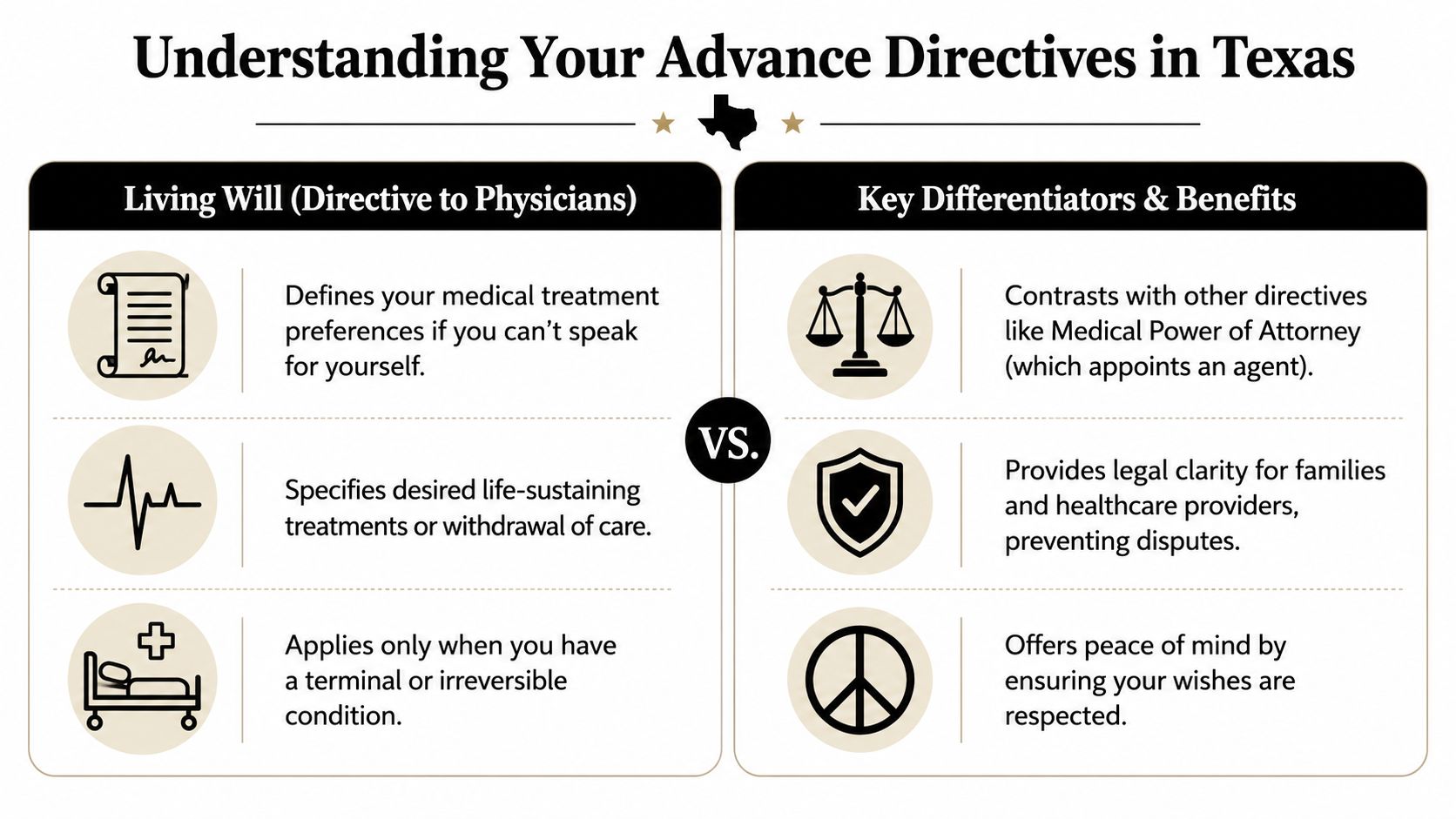
A simple comparison
| Document | Main purpose | Typical question it answers |
|---|---|---|
| Living Will | States your treatment preferences | “What care would you want in this condition?” |
| Medical Power of Attorney | Names an agent to make medical decisions | “Who speaks for you if you can't?” |
| DNR Order | Addresses resuscitation instructions in a defined setting | “Should medical staff attempt resuscitation?” |
If you need someone to make decisions for you outside the narrow role of a living will, review a Medical Power of Attorney in The Woodlands. Many families need both documents, not one or the other.
Why family law issues matter here
A generic estate planning article usually stops with definitions. That's not enough for many families in The Woodlands. If you're separated, in a custody fight, or working through a property dispute, your healthcare directives can become part of a larger legal conflict.
That's why local court procedure matters. A resource like Montgomery County Family Courts: A Local Guide can help you understand how family law cases proceed in Montgomery County courts serving The Woodlands. It doesn't replace legal advice, but it does show why isolated documents can create trouble when they aren't coordinated with the rest of your legal situation.
A complete plan answers two separate questions. What do you want, and who can carry that out if conflict starts.
The Hidden Dangers of DIY Estate Planning
Online forms are tempting because they look fast and cheap. The problem is that a living will only helps if it works when the pressure is highest. That's where many DIY documents fail.
The risk isn't abstract in this area. In Texas, approximately 58% of adults do not have a legally valid will or estate plan, and over 40% of probate cases in Montgomery County, which serves The Woodlands, involve disputes from incomplete or missing healthcare directives, often leading to emergency litigation averaging $15,000–$25,000 in legal fees, according to estate planning and probate data cited here.
Where DIY forms go wrong
The first problem is execution. People sign the wrong version, use disqualified witnesses, or fail to complete related documents that should have been prepared at the same time.
The second problem is language. Generic templates often use broad wording that sounds acceptable until family members interpret it in opposite ways. In a calm household, that may never surface. In a contested divorce or blended family dispute, that ambiguity becomes the whole fight.
The third problem is lack of coordination. A living will shouldn't sit alone in a drawer while your divorce decree, beneficiary designations, and estate planning documents point in different directions. That mismatch creates openings for conflict in probate and guardianship proceedings.
What works better
A lawyer doesn't just fill in blanks. A lawyer tests the document against the actual facts of your life.
That includes questions like:
- Pending divorce issues: Will your spouse still have decision-making authority you no longer want them to have?
- Blended family tension: Could adult children and a current spouse read your wishes differently?
- Property and probate overlap: Do your medical directives conflict with the rest of your planning?
- Local court reality: If a dispute lands in Montgomery County, will your documents hold up clearly enough to reduce court involvement?
Some families also find it helpful to read broader consumer-facing discussions about how law firms explain estate planning topics online, including Gorilla's estate planning marketing insights. Not because marketing solves legal problems, but because it shows how often people are sold simplicity when their actual legal situation is anything but simple.
Cheap documents often become expensive disputes.
A DIY form can be better than nothing in some situations. But if you're in The Woodlands and your family structure is complicated, “better than nothing” usually isn't the standard you want.
Creating Your Legally Sound Living Will Step by Step
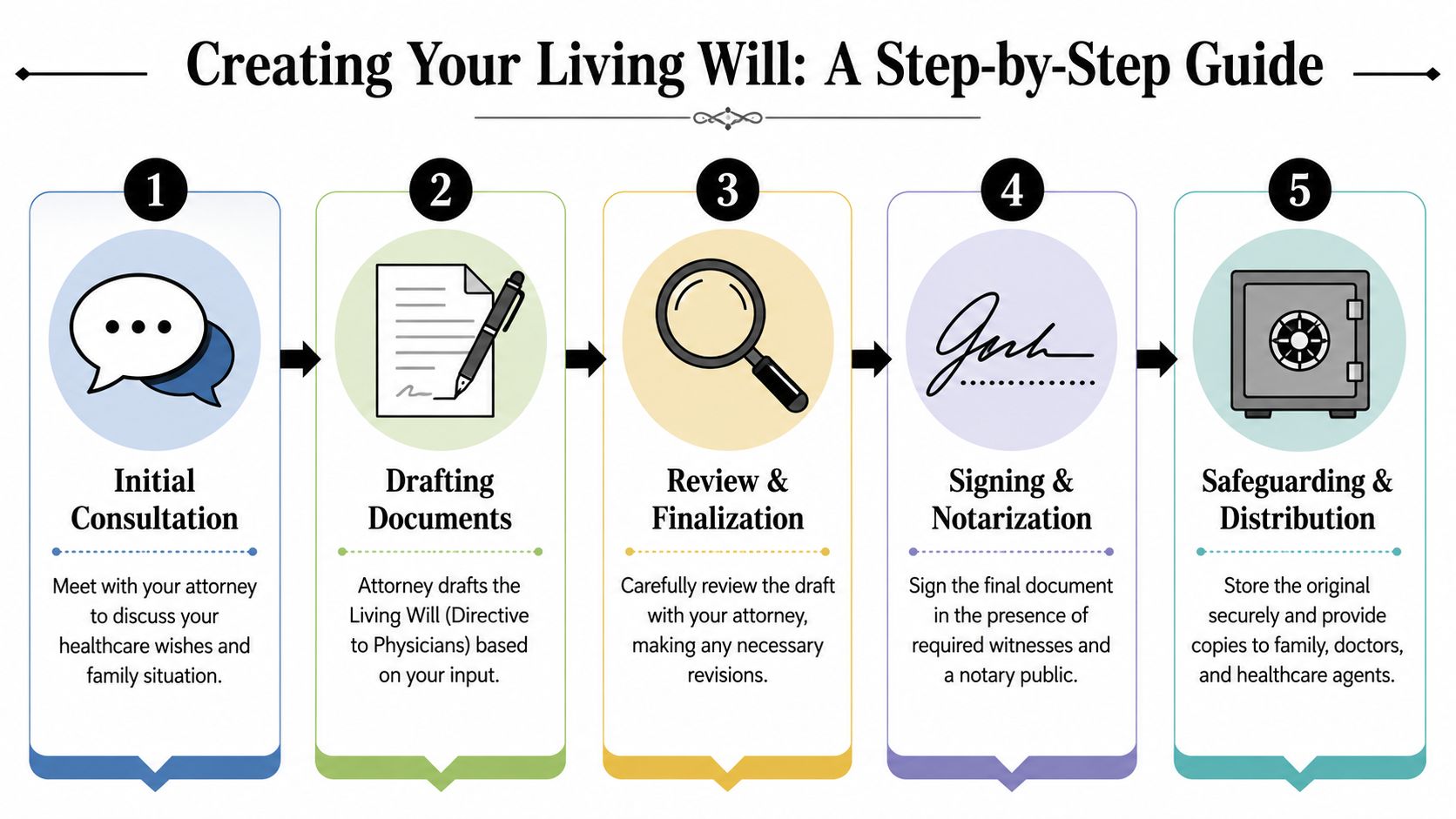
The process should feel straightforward. Good planning conversations are usually calmer than people expect because the focus is practical: who should decide, what treatment choices matter to you, and how to reduce conflict later.
A local Estate Planning Attorney in The Woodlands can help translate those preferences into a document that fits Texas law and your family situation.
Step 1 through Step 3
The first meeting usually starts with values, not forms. You talk about your health history, your family dynamics, and what kind of medical intervention you would or wouldn't want if you couldn't speak for yourself.
Then the drafting starts. The lawyer turns your preferences into precise legal language. That matters because people often say things like “I don't want machines keeping me alive,” but medical situations are more nuanced than that. The document needs wording that physicians and family members can apply.
After drafting, review comes next. During this stage, problems get caught before they become court problems. A soon-to-be ex-spouse, an estranged child, a current partner, or a medical agent can all affect how the final document should be framed.
Step 4 through Step 5
Execution is where many homemade forms break down. The Texas Estates Code establishes that a living will is only valid if signed by the declarant in the presence of two witnesses who are not related by blood or marriage and not entitled to any part of the estate, as summarized in this Texas Estates Code guidance for Montgomery County estate planning.
That requirement matters because the document has to show independent intent. If the witnesses are wrong, the whole directive can be vulnerable when someone challenges it.
A practical workflow often looks like this:
- Consultation and family mapping: Identify decision-makers, conflict points, and related legal issues.
- Drafting with context: Prepare the directive so it matches your actual family situation.
- Review for conflict triggers: Look for divorce, custody, probate, or blended-family issues.
- Proper signing: Follow Texas witness requirements carefully.
- Distribution: Give copies to your physician, your healthcare agent, and the people most likely to be present in an emergency.
This short video can also help you think through the process before a meeting with counsel.
Don't stop at signing
The signed original isn't the finish line. A living will nobody can find doesn't solve much. Keep the original in a place your trusted people can access, and make sure your doctor and decision-makers know it exists.
If your family circumstances change, revisit the document. Divorce filings, remarriage, major illness, and family estrangement are all reasons to update it.
How a Living Will Protects The Woodlands Families
The biggest mistake people make is thinking a living will only matters at the very end of life. In practice, it often works as a conflict-control document. It reduces room for argument when families are already stretched thin.
That's especially important in households dealing with divorce or custody disputes. Data shows that 60% of Texas guardianship cases stem from families lacking clear medical directives, a risk that is especially serious during high-conflict divorces or custody battles when parents dispute medical care, as noted in these The Woodlands elder law resources.

A short real-world scenario
A couple in The Woodlands is in the middle of a hard divorce. Temporary orders are in place. Communication is poor. One spouse then suffers a serious medical event and can't communicate.
The other spouse says, “I'm still the legal spouse, so I should decide.” The injured spouse's adult daughter from a prior relationship disagrees and says the couple had been separated for months and shouldn't be making those choices. Tension escalates immediately.
A properly prepared living will, paired with related healthcare documents, can reduce that fight by making the incapacitated person's wishes clear before anyone is forced into a courtroom.
Where these conflicts show up most often
Certain family structures create predictable pressure points:
- Pending divorces: The legal spouse may still occupy a formal role while the personal relationship has already broken down.
- Blended families: Adult children and a current spouse may each believe they know what you wanted.
- High-asset households: Medical disputes can spill into larger disputes over control, caregiving, and property.
- Custody-sensitive situations: Parents already in conflict may struggle to agree on medical decisions affecting a child or one another.
If your case also involves property division and complex marital estates, the same planning mindset that applies in High-Net-Worth Divorce in The Woodlands often applies here too. The point is consistency. Documents work better when they're prepared with the family law reality in view, not in isolation.
Probate and challenge issues
If someone later tries to contest a living will in probate-related litigation, Texas law doesn't let just anyone file the challenge. In probate court, the challenger generally needs standing as an interested party, such as an heir or beneficiary, before alleging issues like undue influence or lack of capacity under Texas probate litigation principles summarized here.
That doesn't mean a dispute can't happen. It means the document should be drafted and signed with a future challenge in mind.
The best directive is the one that leaves the least room for other people to rewrite your wishes after you lose the ability to speak.
Preparing for Your Consultation A Client Checklist
Good meetings are faster and more useful when you walk in prepared. You don't need a perfect folder or every medical record you've ever received. You do need clarity about the people and conflicts that matter.
If privacy is one reason you've delayed the meeting, it may help to first understand attorney client privilege. People often speak more openly once they understand how confidential legal consultations generally work.
What to do next
- Think about your care preferences: Write down what matters most to you if you face a terminal or irreversible condition.
- List the right decision-makers: Identify who you trust to respect your wishes, not who is most likely to demand control.
- Flag family conflict early: Note any pending divorce, remarriage, estrangement, or custody dispute that could affect medical decisions.
- Gather existing documents: Bring any prior advance directives, powers of attorney, divorce paperwork, estate planning documents, or court orders.
- Identify your doctors and contacts: Have current contact information for your primary physician and the people most likely to be called in an emergency.
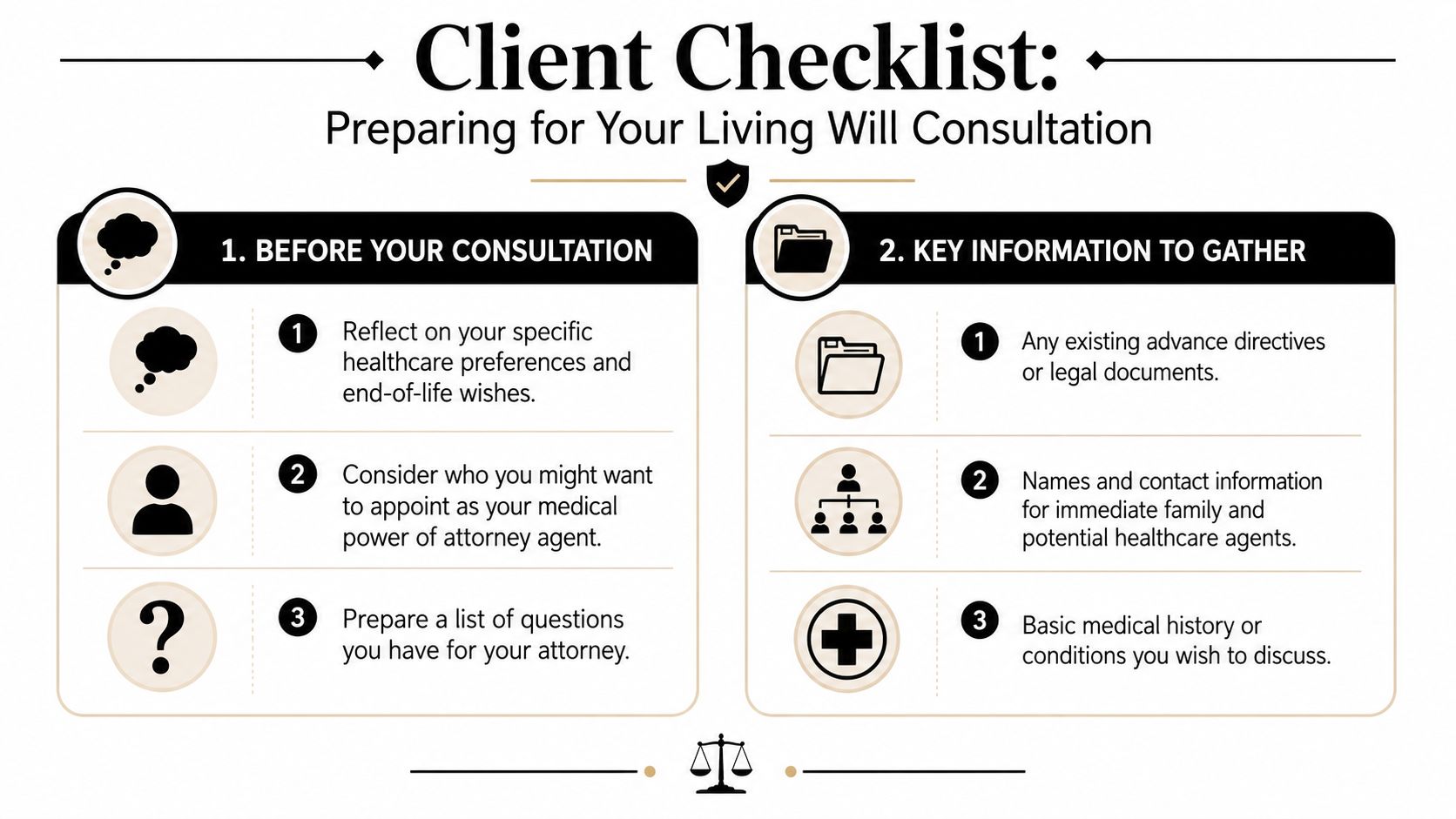
Questions worth asking the attorney
Bring questions that test local experience, not just drafting ability.
- Montgomery County probate experience: How often do you handle disputes involving advance directives or related probate issues here?
- Family law coordination: How do you make sure my healthcare documents work with my divorce decree or pending custody issues?
- Execution details: Who can serve as proper witnesses under Texas law, and how do you avoid signing mistakes?
- Update strategy: When should I revise my living will after divorce, remarriage, illness, or a change in family relationships?
- Document distribution: Who should get copies, and how do you help clients make sure the right people can access them?
If you want to prepare before the meeting, a free consultation family lawyer guide for The Woodlands can help you organize questions and documents when family law issues overlap with healthcare planning.
This article is not legal advice. Texas advance directive law, probate procedure, and family law issues depend on your specific facts. A living will that makes sense for one family in The Woodlands may be incomplete or risky for another.
If you want guidance specific to your family, your health decisions, and any divorce or probate concerns, consider scheduling a consultation with The Law Office of Bryan Fagan. A focused review can help you decide what documents you need, how they should work together, and how to reduce conflict for the people you care about.
