 Skip to content
You may be dealing with this right now. You own a home in Panther Creek or Creekside, you've built retirement accounts, maybe a business interest, maybe a rental property, and now life is shifting. A parent's health is declining. A marriage is under strain. A custody fight is brewing. Or you woke up and realized your family has too much at stake to rely on “we'll get to it later.”
That's where a trust attorney in The Woodlands, Texas matters.
Many individuals treat estate planning and family law like two separate boxes. However, these areas frequently overlap. Divorce affects beneficiary designations. Custody disputes can collide with inherited assets. A trustee's decisions can become a family court issue faster than most families expect. If you live in The Woodlands or anywhere in Montgomery County, you need a plan that functions effectively, not just on paper.
Why The Woodlands Residents Need a Trust Strategy
A lot of families here have done well, but they haven't formalized the legal side of that success. They have a house, brokerage accounts, life insurance, maybe an LLC, and a verbal understanding about “what happens if something goes wrong.” That's not a strategy. That's wishful thinking.
In The Woodlands, that gap matters because family wealth here is often layered. You may have separate property, community property, inherited funds, and assets earmarked for children from a prior relationship. One bad season can turn a manageable situation into a probate fight or a divorce fight.
Local pressure is real
Montgomery County isn't dealing with hypothetical risk. Probate filings increased by 9.8% between 2021 and 2024, totaling 1,247 estate administration cases, according to Super Lawyers information for estate planning and probate in The Woodlands. That tells you something simple. More families here are ending up in court over estates, and more families need planning before a crisis starts.
Practical rule: If your family would struggle to explain who controls what, who inherits what, and who steps in for your children or your finances, your plan is incomplete.
A trust attorney doesn't just draft documents. A good one looks at how your assets are titled, who has authority, how privacy is protected, and what could go wrong if a divorce, incapacity, or death hits your household at the wrong time.
Why this matters more in high-asset neighborhoods
The Woodlands has plenty of successful families who assume a will is enough. Sometimes it is. Often it isn't.
A will still puts your family on the probate track. A trust can help organize ownership, management, and distribution ahead of time. That's especially important if your concerns aren't limited to death. Many of my neighbors are worried about control during life. Who can manage assets if you're incapacitated? How do you protect a child's inheritance if your co-parent relationship is unstable? How do you keep inherited property from getting mixed into a later divorce dispute?
Those aren't edge cases here. They're everyday planning issues in Montgomery County.
What a Trust Attorney Actually Does for Your Family
A trust attorney builds legal structure around your family's assets. That structure should match your life, not some generic online template.
Under the Texas Estates Code, trusts are part of a broader estate planning framework that can govern management, distribution, fiduciary duties, and succession. The practical point is simpler. A trust lets you decide in advance who manages property, who benefits from it, and under what conditions.
The core jobs
A trust attorney usually helps with several kinds of work:
- Revocable living trusts: Often used to manage assets during life and create a smoother transition at death.
- Irrevocable trusts: Sometimes used when asset protection, tax planning, or long-term control is the priority.
- Special needs trusts: Important when a child or dependent needs support without disrupting eligibility concerns.
- Trust administration: Advising trustees on what they can do, what they must do, and how to avoid breaching fiduciary duties.
- Coordination with wills and powers of attorney: Because a trust alone rarely covers the whole picture.
In Texas, privacy is a major practical benefit. There is no statutory requirement for a trust to be registered with a court or state agency, and trusts become effective upon execution by the settlor unless the trust instrument specifies a later date, as noted by Texas Trust Administration guidance for Montgomery County.
That matters. Families in The Woodlands often want to keep financial arrangements out of public court filings when they can legally do so.
A trust is not just a fancy will
A will says where property goes after death. A trust can do that, but it can also do more during life.
It can give a successor trustee authority if you become incapacitated. It can stagger distributions to a young adult. It can separate inherited property from marital property concerns. It can create guardrails when family relationships are strained.
A document isn't the plan. The plan is how your documents, asset titles, beneficiary designations, and family realities all work together.
That's why families often need more than a form. They need someone who understands both the paper and the pressure points.
If you're comparing options, an Estate Planning Attorney in The Woodlands handles wills, trusts, and estate plans for The Woodlands families. That's the right category of help when your goal is prevention, clarity, and family asset protection.
Where Texas family law enters the picture
The Texas Family Code becomes relevant when trust property, inherited property, child support issues, or control of assets intersects with divorce or custody litigation. For example, whether an inheritance was kept separate or commingled can shape later disputes. Whether a parent controls trust distributions can also become relevant in support and enforcement fights.
That's why I don't like siloed planning. If your attorney only thinks about what happens after death, and not what happens during divorce, custody conflict, or incapacity, your plan may fail where your family needs it most.
How to Choose the Right Attorney for Your Needs
You have options here. As of 2024, there were 275 registered estate planning and probate attorneys operating in The Woodlands alone, according to LawInfo's The Woodlands living trust directory. A crowded market doesn't make the decision easier. It means you need a filter.
The right attorney for your family is not the one with the slickest website. It's the one who can explain your plan clearly, spot family law landmines early, and tell you how the documents will work in Montgomery County, not just in theory.
Start with fit, not branding
If you're dealing with high-value assets, a second marriage, a child with special needs, or an active divorce or custody issue, ask one direct question first: Does this lawyer understand both estate planning and the family law consequences of poor planning?
That's the dividing line.
A lawyer who only drafts basic trusts may not be enough if your spouse may challenge separate property claims later. A probate-only lawyer may not be thinking ahead about custody modification, emergency orders, or support disputes. In The Woodlands, those issues overlap more than people expect.
For a practical starting point, families often review a local directory or a page like find your estate planning attorney in The Woodlands to compare services and narrow the field.
Essential questions to ask in a consultation
| Category | Question to Ask |
|---|---|
| Experience | How often do you handle trusts tied to divorce, custody, or blended family issues in Montgomery County? |
| Court familiarity | What problems do you see most often in Montgomery County probate court with poorly drafted trusts? |
| Asset structure | How do you handle separate property, inherited funds, and commingled accounts in trust planning? |
| Trustee selection | What are the risks of naming a spouse, sibling, or adult child as sole trustee? |
| Family conflict | How do you draft plans to reduce fights between beneficiaries or co-parents? |
| Administration | If the trustee needs help later, do you advise on trust administration too? |
| Fees | Do you charge a flat fee, hourly, or both, and what work is included? |
| Communication | Who actually drafts the documents and who answers questions after signing? |
Red flags that should make you walk away
Some warning signs are obvious. Others are subtle.
- Pressure to sign fast: A trust is too important for hard-sell tactics.
- Vague answers about family law overlap: If the lawyer can't discuss divorce, separate property, or child-related consequences, that's a problem.
- No discussion of funding: An unfunded trust is often an expensive binder on a shelf.
- No explanation of trustee duties: Trustees can create serious damage by accident.
- Confusing fee language: If you can't tell what you're paying for, don't hire yet.
Don't hire the lawyer who talks the most. Hire the one who makes the complicated parts understandable.
Reputation matters too, but don't reduce that to star ratings. Read reviews for communication patterns, missed deadlines, and whether former clients felt informed. If you want a practical framework for evaluating online feedback without getting fooled by surface-level marketing, AI Tools for Local SEO's reputation guide is useful.
If your immediate issue is estate settlement after a death, a Probate Lawyer in The Woodlands, TX handles probate administration and estate settlement in Montgomery County. That's a different job from building a trust plan, though the two often connect.
My recommendation
Interview more than one attorney if the situation is high stakes. Bring a written list of assets, family relationships, and active disputes. If the lawyer doesn't ask about divorce risk, child issues, inherited funds, or beneficiary designations, keep looking.
Decoding the Costs of Hiring a Trust Attorney
Most families ask about cost early, and they should. Legal fees matter. But the cheapest trust package is often the most expensive mistake.
In The Woodlands, the work is often more involved because families here tend to have layered assets and more moving parts. The average cost for a customizable living trust in The Woodlands ranges between $2,800 and $4,200, according to the local market information described earlier in this guide. That range tells you something important. You're not paying for paper. You're paying for judgment, drafting, customization, and problem avoidance.
The three fee models you'll usually see
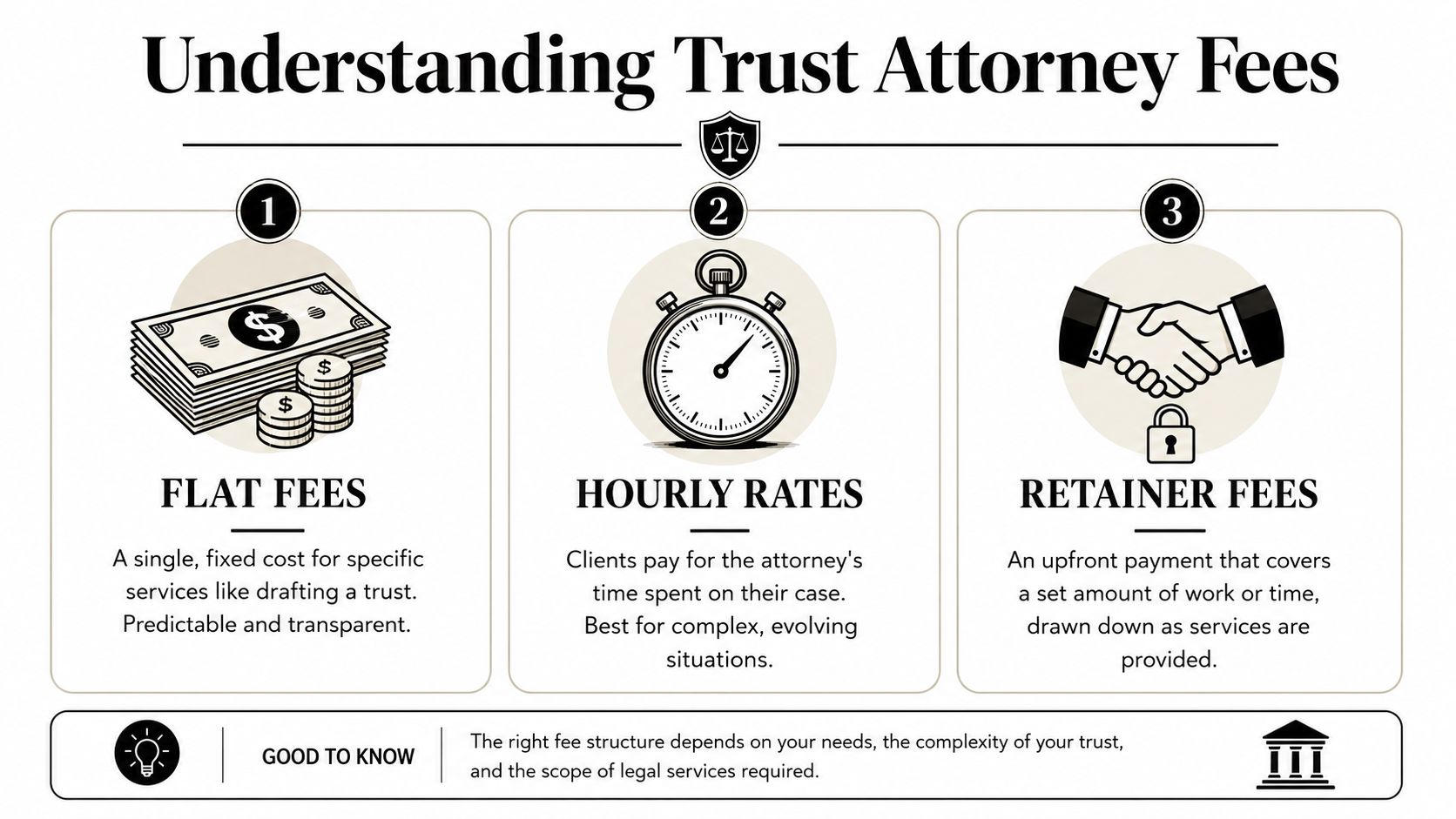
- Flat fees: Common for drafting a defined trust package.
- Hourly billing: More common when the work expands, especially if trust funding, revisions, or disputes arise.
- Retainers: Sometimes used when ongoing administration or litigation support is expected.
The right fee structure depends on the job. Drafting a straightforward revocable trust is different from advising a trustee during a family conflict or coordinating trust issues during a divorce.
A short explainer can help if this is your first time evaluating legal billing.
What you should actually compare
Don't compare price alone. Compare scope.
Ask these questions:
- What documents are included? Trust, will, powers of attorney, transfer documents, deed work.
- Does the fee include funding guidance? If not, the trust may never fully work.
- Are amendments included for a period of time? Families often need revisions after the first draft.
- Will the lawyer coordinate with probate or family law counsel if needed? That matters in high-conflict households.
A trust that doesn't match your assets or family risks is cheap in the worst way.
If your concern has shifted from planning to handling an estate after death, estate administration in The Woodlands becomes the relevant next step. Administration costs can rise when there's confusion, delay, or conflict that better planning could have reduced.
My view is simple. Pay for a plan you can explain, implement, and maintain. Don't pay for a binder that nobody funds and nobody understands.
Navigating Probate and Trusts in Montgomery County
A trust problem in Montgomery County rarely stays a “trust problem.” It often spills into family law, probate procedure, or both.

One local pattern deserves more attention than it gets. According to Montgomery County Court Statistics for 2024–2025, 42% of probate cases in The Woodlands were initiated alongside emergency custody filings, yet only 12% of local probate and trust attorney sites mention this coordination, as discussed by Probate Shepherd's The Woodlands probate attorney page. That gap matters because families don't experience legal problems one at a time.
A real-world scenario
A couple in Sterling Ridge starts divorce proceedings. The wife is beneficiary of a family trust created by her parents. The husband argues that distributions were used for marital expenses, so the money has become tangled with community property claims. At the same time, the parties are fighting over temporary custody after a sudden school and medical decision dispute involving one of the children. Then a grandparent dies, and probate begins.
That's not unusual chaos. That's modern family life in Montgomery County.
Under the Texas Family Code, property characterization can become a major issue during divorce. Under the Texas Estates Code, trustee duties and estate administration obligations still have to be handled correctly. If the lawyers on the case treat those as separate universes, the client pays for it in delay, confusion, and bad strategy.
What coordination looks like
When probate, trusts, and family law collide, your legal team should be asking:
- What is separate property and what has been commingled?
- Who controls trust distributions right now?
- Does a trustee need to document decisions differently because litigation is active?
- Are minor children's interests affected by probate or trust administration?
- Do emergency custody orders change who needs financial access or decision-making authority?
A Divorce Lawyer in The Woodlands, TX provides divorce representation for clients in The Woodlands and Montgomery County. In some families, that work has to be coordinated closely with trust planning or trust administration so one legal move doesn't damage another.
Why local procedure matters
Montgomery County judges expect clean paperwork, clear authority, and prompt action. If you're dealing with a trust-related probate issue, you should understand the Montgomery County probate court process before deadlines start controlling the case.
If emergency custody, inherited assets, and trustee authority are all in play, you need one coherent plan. Separate lawyers working in silos can create new problems by trying to solve old ones.
My strongest advice here is blunt. Don't wait for the family court hearing to start figuring out what your trust says or whether inherited money was handled correctly. By then, you're playing defense.
Your Practical Checklist for Securing Your Family's Future
You don't need to solve everything this week. You do need to start.
The families who avoid the worst outcomes usually do a few basic things early. They gather information, define goals, and get legal guidance before conflict hardens. That's true whether you live in Alden Bridge, Panther Creek, Sterling Ridge, Creekside, or elsewhere in Montgomery County.
What to do next
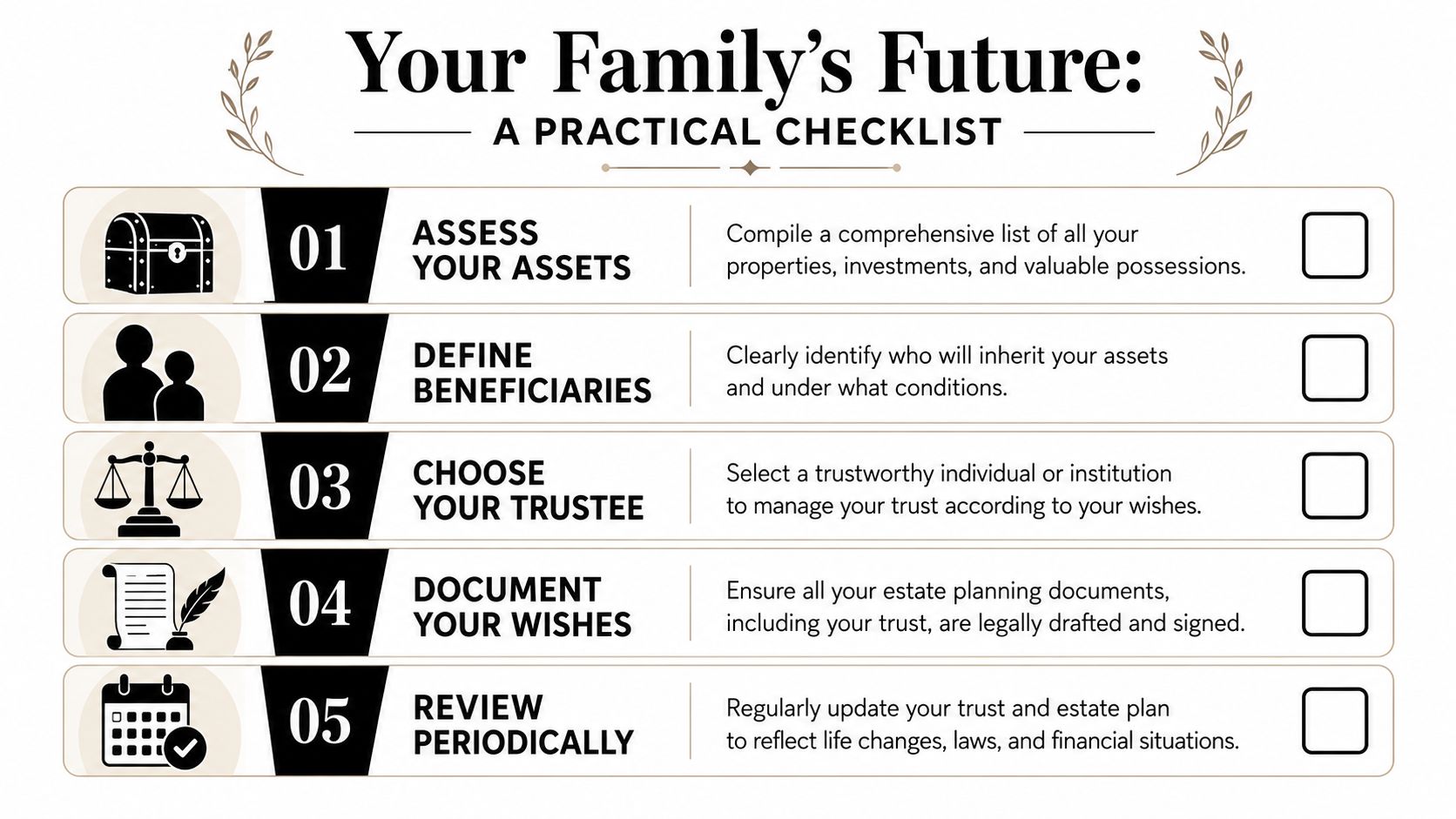
- Gather your asset list: Include real estate, bank accounts, investment accounts, retirement funds, life insurance, business interests, and anything inherited.
- List your family realities: Prior marriages, minor children, special needs concerns, strained relationships, and anyone who should not control money.
- Check title and beneficiary designations: A solid trust plan can fail if the ownership and beneficiary paperwork points elsewhere.
- Choose the right decision-makers: Trustee, executor, guardian, and agent under powers of attorney. Pick people who are reliable under stress, not just familiar.
- Write down your goals: Avoid probate, preserve privacy, protect separate property, plan for incapacity, reduce conflict, or protect children during a divorce or custody fight.
- Bring active legal issues to the meeting: If divorce, custody modification, support enforcement, or probate is already in motion, say that immediately.
- Schedule a consultation: You want advice tied to your actual assets and your actual family, not generic internet guidance.
One final point that people miss
Review your plan after major life changes. Marriage, divorce, death in the family, relocation, a child turning eighteen, a large inheritance, or a serious health diagnosis can all change what your documents need to do.
This article is for general informational purposes only. It is not legal advice and does not create an attorney-client relationship. Texas trust, probate, and family law issues are fact-specific, and the right answer depends on your documents, your assets, and your family situation.
If you're searching for a trust attorney in The Woodlands, Texas, don't settle for someone who only drafts documents. Look for someone who understands how estate planning holds up when life gets messy. That's the standard that protects families here.
If you want to talk through your situation privately, The Law Office of Bryan Fagan is one option for families in The Woodlands and Montgomery County dealing with probate, divorce, custody, property division, and related planning concerns. A consultation can help you sort out what needs immediate attention and what can be handled in a longer-term plan.
