
A parent dies at home in The Woodlands, leaving a paid-off house, one checking account, and a car. The family knows there's no will, the heirs aren't fighting, and nobody wants a full probate administration. The immediate question is practical: can the family use a small estate affidavit to collect the money and deal with the home?
Sometimes, yes. But a Texas small estate affidavit isn't a universal probate shortcut. It's a narrow procedure controlled by Texas Estates Code Chapter 205, with additional document and property rules that matter in Montgomery County. A filing that looks complete can still fail if the heirs, witnesses, venue, debts, or real property are handled incorrectly.
This guide explains how a small estate affidavit in The Woodlands, TX works, what Montgomery County's packet requires, which assets may pass through it, and when formal probate is the safer route. If you're also trying to understand the broader timing of estate administration, this overview of how long probate takes in Texas may help.
When a Woodlands Family Might Actually Need This
Consider a family in Alden Bridge. Their father, a retired Conroe ISD teacher, died at home in The Woodlands. His house was paid off, his checking account held the family's immediate cash needs, and he owned a paid-off car. He left no will, and his adult children agree about what should happen.
Their first instinct is usually, “Can we just move the money and transfer the deed?” The answer depends on the estate's legal facts, not just on whether the family considers it modest.
A small estate affidavit, or SEA, is designed for certain intestate estates that can be handled without opening a full administration. Texas Estates Code Chapter 205 provides the statutory framework. The procedure can be less burdensome than formal probate when the estate has limited qualifying assets, no active dispute, and heirs who can provide consistent sworn information.
Practical rule: A small estate affidavit is a narrow tool for a clean estate, not a substitute for investigating title, debts, and heirship.
The procedure tends to fit best when:
- There is no effective will being offered for probate.
- The estate has limited non-exempt value.
- The heirs agree about their identities and interests.
- No creditor dispute or administration is already pending.
- The property situation does not require broader real-estate title work.
The last point causes many Woodlands families trouble. A house, rental property, mineral interest, or jointly held account may not be treated the way a family member expects. The affidavit may help heirs collect certain assets, but it doesn't automatically resolve every title problem or transfer every parcel of land.
Montgomery County also expects a document-heavy filing. The court must review and approve the affidavit before banks, title holders, or other third parties can safely rely on it. Families in Conroe, The Woodlands, Magnolia, and nearby communities should treat the process as a legal filing with eligibility gates, not as a form delivered directly to a bank.
Who Qualifies Under Texas Estates Code Chapter 205
Texas Estates Code Chapter 205 sets the basic eligibility rules. The central financial threshold is a gross estate value of no more than $75,000, excluding the homestead and exempt property, as explained in the Texas Estates Code Section 205.002 text. Meeting that threshold alone isn't enough.
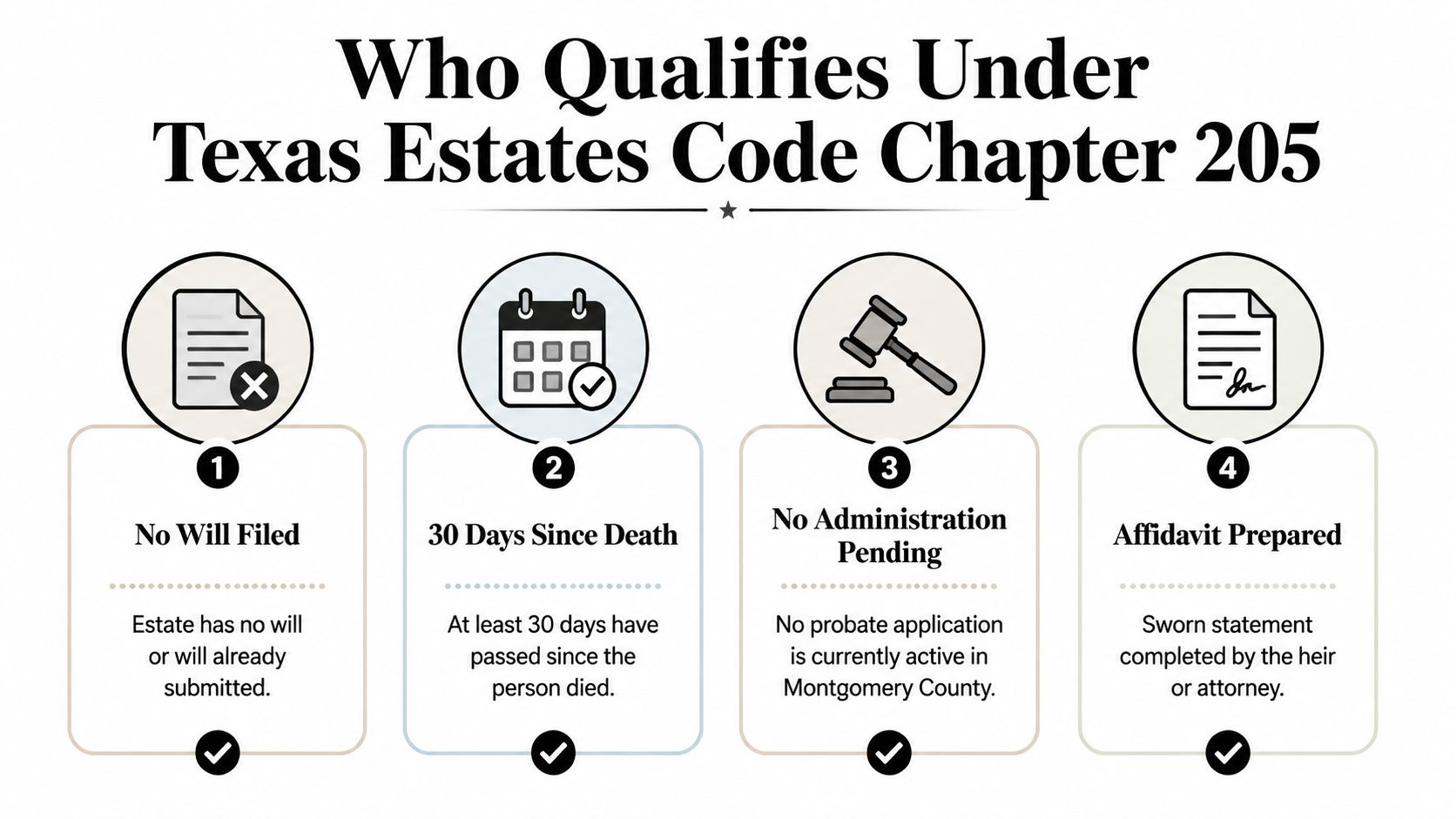
A Montgomery County estate generally must clear each of these gates:
- Intestate status: The decedent died without a will being used for the estate. If a will exists, the family needs to determine the proper probate procedure instead of assuming an SEA is available.
- Waiting period: At least 30 days must have passed since death. The Texas Law Help explanation of small estate affidavits identifies this waiting period as a requirement.
- No pending administration: No administration may be pending or granted, and the affidavit must be filed in the court with proper jurisdiction and venue.
- Qualifying estate value: The non-exempt estate must stay within the statutory limit. Homestead and exempt property aren't counted in the same way as ordinary estate assets.
The filing also needs reliable supporting information. Gather a death certificate, an asset and liability inventory, documentation showing account balances and vehicle ownership, and a complete list of heirs under Texas intestacy law. The affidavit must identify each distributee and explain why that person is entitled to receive property.
A family should also examine creditor information before filing. An estate with unresolved debts can create distribution problems even when the asset value appears to fit the cap. If any heir is a minor or incapacitated, the standard packet may not be sufficient without additional protection or court involvement.
For families comparing local options, a Probate Lawyer in The Woodlands, TX handles probate administration and estate settlement in Montgomery County. A consultation can help determine whether the facts fit Chapter 205 before anyone signs sworn statements.
What Goes in the Montgomery County Affidavit Packet
Montgomery County's process depends heavily on the county-specific small estate affidavit packet. The packet organizes the information the probate court needs to review, and following it closely is more reliable than adapting a generic Texas form found online.
The core filing usually includes the affidavit itself, signed under oath before a notary. It should state the decedent's identity, date of death, residence, family history, intestacy facts, assets, liabilities, and the distribution rights of each heir. The asset schedule needs enough detail for the court and third parties to understand what exists and how the value was calculated.
The witnesses are a major local requirement. Montgomery County probate guidance states that two disinterested witnesses must sign and swear to the affidavit before a notary. They should know enough about the family history and estate facts to support the statements, but they cannot be heirs or people asserting a claim to estate property.
Witnesses and heirship details
Each witness should be prepared to confirm that:
- They're legally capable of giving testimony.
- They know the decedent or the relevant family circumstances.
- They aren't an heir or distributee.
- They don't have a claim against the estate.
- The facts in the affidavit are accurate to the best of their knowledge.
A practical witness statement might read:
I am over 18 years of age, I am not an heir or distributee of the decedent, and I have no claim against the estate. I have personal knowledge of the family facts stated in this affidavit, and those statements are true and correct to the best of my knowledge.
That sample isn't a substitute for the county's form. The county packet may use different wording or place the witness declarations in a different part of the filing. Witnesses should bring valid identification to the notary and should sign only when the required parties and notary are present.
The packet may also require a certified death certificate, a marital-status and heirship affidavit, a complete list of legally capable distributees, and signatures from heirs or other required participants. If a distributee is a minor or incapacitated, a guardian or next of kin may need to be involved, and the standard procedure may no longer be suitable.
A missing heir, inconsistent family history, or unexplained account can matter more than how simple the estate appears.
Review the current Montgomery County small estate affidavit guidance before signing. The county's local packet can reorganize the statutory information, and using the wrong order or omitting a required signature can lead to a return for correction.
Filing in Montgomery County and What to Expect
Montgomery County's workflow is primarily document-driven at the beginning. Families generally prepare the county packet, obtain the required sworn signatures and notarizations, and submit it to the probate department for review rather than treating the initial submission as a traditional contested hearing.
The Montgomery County Probate Court #1 office is located at 210 W. Davis in Conroe. The county accepts small estate affidavit packets by mail and in person under its documented filing procedures. Before sending anything, confirm the current submission method and packet requirements because local instructions can change.
The court must review the affidavit and determine whether it satisfies Chapter 205 and the county's venue requirements. Approval comes before banks, title companies, or other asset holders should rely on the filing. The County Clerk records the affidavit and any companion muniment of title after the court signs the order, not only when the family submits the packet.
A practical review period can take 2 to 6 weeks, depending on court volume and whether corrections are requested, as reflected in the county workflow described in the Montgomery County probate court process. A returned packet doesn't necessarily mean the SEA is impossible. It means the court identified a defect, missing fact, or unresolved issue that must be addressed.
Costs and possible requests
The expected filing costs can include a $300 base filing fee, about $2 per recordable page, and approximately $0.50 per witness signature, with certified copies costing about $5 each, according to the local filing information referenced for this process. Because these amounts can change, confirm the current charges with the Montgomery County Clerk before filing.
The court may request more than the family initially submits. Possible requests include a citation, additional proof of heirship, clarification of debts, or documents supporting the classification and value of an asset.
Preview the packet against the official Montgomery County checklist. Clerks frequently identify recurring defects, including missing notarizations, incomplete heir information, incorrect venue statements, and asset schedules that don't reconcile.
What Property Can and Cannot Pass Through the Affidavit
The most common misunderstanding in The Woodlands is that an SEA can transfer any real estate owned by the decedent. It cannot.
Texas guidance treats real property narrowly. Texas Law Help explains that a small estate affidavit can be used only when there is no real property other than a homestead that passes to a surviving spouse or minor children, and the homestead must be recorded in the property records. Montgomery County's materials likewise state that the affidavit cannot transfer title to real property other than the decedent's homestead.
That means a Woodlands home, rental property, vacant land, or other parcel requires careful classification before filing. A homestead transfer still involves recording and title steps. A rental house or separate land interest can move the estate outside the practical SEA lane.
Retirement accounts, payable-on-death accounts, and life insurance proceeds generally pass according to their beneficiary or contract terms, not because the affidavit creates the beneficiary right. Jointly held assets also require review of the account agreement and ownership form.
| Asset Category | Can the Affidavit Transfer It? | What Usually Handles It Instead |
|---|---|---|
| Bank account with no beneficiary designation | Often, if the estate satisfies Chapter 205 | Court-approved SEA and certified order |
| Personal belongings and qualifying vehicles | Often, subject to estate debts and exemptions | SEA or direct title procedure when available |
| Recorded homestead | Limited homestead treatment may apply | Properly recorded SEA, title review, or formal probate |
| Rental property or non-homestead land | Generally not through the Montgomery County SEA packet | Formal probate, muniment, or another title procedure |
| Retirement account or life insurance | Usually passes by contract | Beneficiary claim with the financial institution |
| Payable-on-death account | Usually passes by designation | Institution's beneficiary process |
| Jointly held asset | Depends on the ownership agreement | Survivorship or contract documentation |
Families considering a deed-based planning option should review the transfer-on-death deed information for The Woodlands separately. That planning device and a post-death small estate affidavit solve different problems.
Common Pitfalls and a What to Do Next Checklist
An adult child in Creekside once assumed the family's SEA was nearly finished because all the heirs agreed and the bank account seemed straightforward. Montgomery County returned the packet after the family treated the homestead like ordinary real property, signed without both disinterested witnesses present, and left the heirship section incomplete.
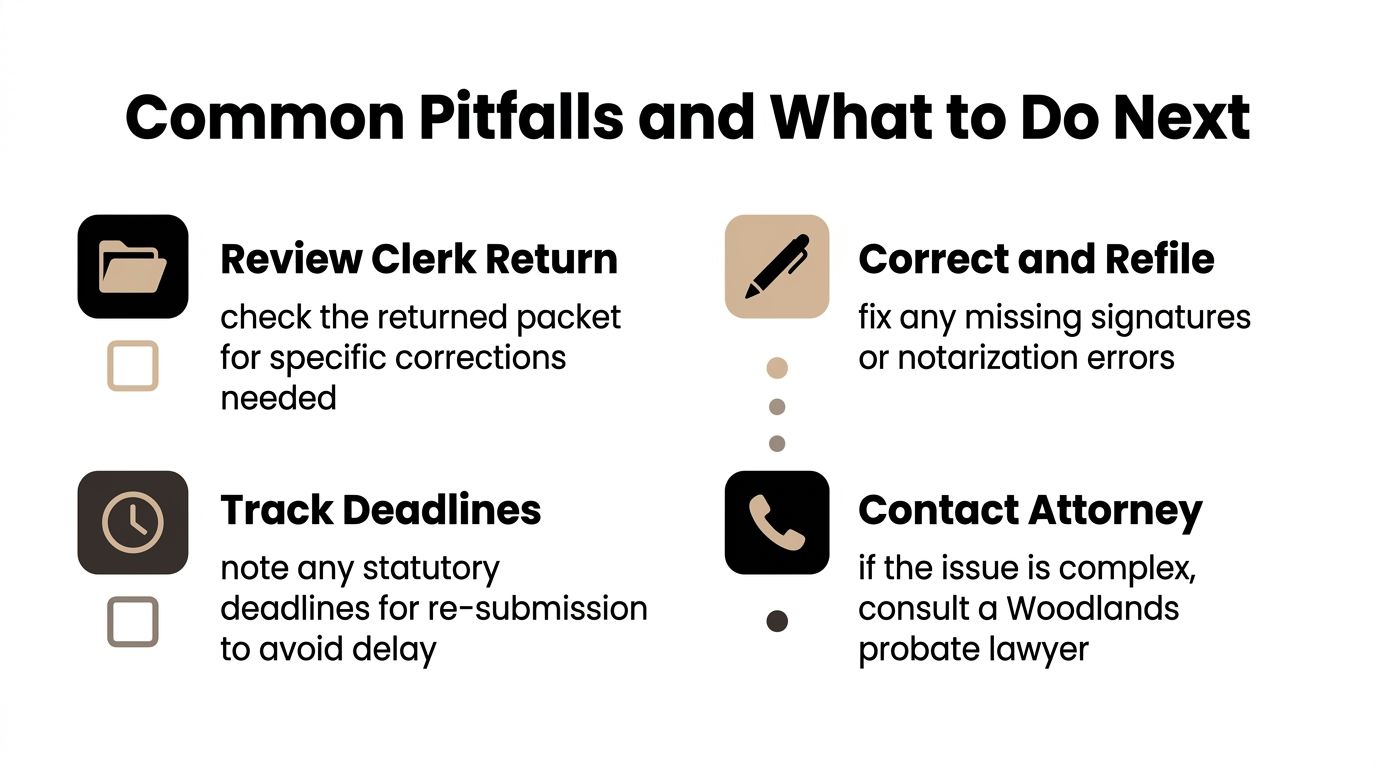
Those errors are fixable in some cases, but they cost time and can create confusion with banks, title companies, and family members. The affidavit must also address debts and the rights of exempt property and family allowances. Closing an account too early can leave the estate without funds to address a valid obligation.
Common trouble spots include:
- Wrong property classification: A homestead isn't the same as a rental parcel or other real property. The distinction affects whether the SEA can be relied on for title.
- Improper witness signing: Both disinterested witnesses should sign and swear before a notary under the county's requirements. Signing separately or using an heir as a witness can undermine the filing.
- Minor or incapacitated heirs: A family cannot list a minor heir and distribute property as though every heir has full legal capacity.
- Incomplete creditor information: Omitting known liabilities can expose the estate and heirs to later disputes.
- Failure to record: Court approval and County Clerk recording are separate parts of the process. The approved affidavit should be recorded in the Official Public Records of Montgomery County before distributing property that requires recorded proof.
What to do next
- Verify asset classification first: Separate homestead, exempt property, personal property, accounts, and any non-homestead real estate.
- Schedule the witnesses: Arrange for two disinterested witnesses and a notary before anyone signs.
- Marshal liability proof: Collect bills, loan information, medical statements, and other evidence of estate obligations.
- Attach the heirship schedule: Identify every distributee and explain each person's entitlement under intestacy law.
- File with the probate court: Submit the completed Montgomery County packet through the probate department.
- Record before distributing: After approval, complete the required County Clerk recording and obtain certified copies for asset holders.
When Professional Guidance Is Worth It
A small estate affidavit can be reasonable for a clean estate involving bank accounts, a vehicle, and adult heirs who agree about the facts. In that situation, the family may be able to prepare the county packet carefully, comply with the witness requirement, and handle the filing without turning a limited estate into a larger proceeding.
The risk changes when the estate includes non-homestead real property, complicated debts, an heir who is a minor or under a disability, conflicting sibling claims, or a missing or unknown heir. Those facts can affect eligibility, the required proof, and the procedure needed to transfer title. They also raise the cost of an error because a rejected filing may delay access to assets or leave a title problem unresolved.
A consultation with The Law Office of Bryan Fagan can be useful when the family is deciding between an SEA, a muniment of title, or formal dependent administration. The office handles probate matters for families in The Woodlands and Montgomery County, including reviewing whether the packet fits the facts before filing. For a straightforward estate, professional review may be unnecessary. For a borderline estate, reviewing the asset classification, heirship, and county packet before signing can prevent a rejected filing or a later family dispute.
This article is not legal advice. Texas probate rules and Montgomery County procedures depend on the estate's specific facts, and you should consult a qualified Texas attorney before relying on a small estate affidavit.
If you're handling a small estate affidavit in The Woodlands or elsewhere in Montgomery County, The Law Office of Bryan Fagan can review the estate facts, heirship, property classification, and county filing materials. Visit The Law Office of Bryan Fagan to schedule a consultation and determine whether an SEA is the right path for your family.