 Skip to content
In Texas, a simple, uncontested probate with a valid will usually takes 6 to 12 months. However, the actual timeline can range from a few weeks to more than a year, depending on the path the estate takes, and in Montgomery County some straightforward cases move faster while local property issues can slow others down.
If you're reading this after a parent, spouse, or other loved one passed away, you're probably not looking for a law school explanation. You want to know what happens next, how long you'll be dealing with court paperwork, and whether the house, bank accounts, or family disagreements are going to drag this out.
That concern is normal. Families in The Woodlands, Panther Creek, Alden Bridge, and nearby Montgomery County communities often hear a statewide average and assume that's the full story. It isn't. The probate timeline depends on the kind of administration involved, the condition of the will, whether anyone objects, and how hard it is to identify and value the estate's assets.
Understanding the Texas Probate Timeline
A family in The Woodlands can leave the courthouse with letters testamentary in hand and still have months of work ahead. Another family can get stuck before the hearing because the original will cannot be located, the deed history is unclear, or no one agrees on who should take the lead.
That is why the honest answer to how long does probate take in texas starts with the estate's facts, not a statewide average. In practice, probate moves in phases, and each phase has its own pressure points. The court filing may be routine. Collecting records, dealing with creditors, and preparing a house for transfer or sale often takes longer than families expect.
How the timeline usually unfolds
Most probate cases begin with an application filed in the proper court, followed by a hearing to admit the will and appoint the personal representative. After appointment, the executor or administrator has to gather estate information, give required notices, identify debts, and determine what can be distributed and when.
That sounds orderly on paper. Real life is less tidy.
In Montgomery County, timing often turns on the condition of the file before it ever reaches the clerk. A complete application with the original will, death certificate, names and addresses for the heirs or beneficiaries, and a clear picture of the assets usually moves better than a file that has to be corrected after filing. Local judges and clerks expect accuracy, and missing information costs time.
Property issues are another common divider. A residence in The Woodlands may look simple until someone discovers the deed was never updated after an earlier death, the mortgage servicer wants additional authority documents, or the executor needs access to insurance, tax, and HOA records before anything can be done with the home.
Why one "average" answer is not very useful
Two estates can start the same week in the same county and finish on very different schedules. One has a valid will, organized records, and beneficiaries who sign what is needed. The other has a handwritten will, a locked house, missing account statements, and a child from a prior marriage asking questions about every step.
The second case is not unusual. It just requires more work.
A better way to understand the timeline is to look at what can slow each stage:
- Court intake problems. Filing errors, missing originals, or notice issues can delay the hearing.
- Asset identification problems. Executors often need time to track down bank accounts, retirement funds, deeds, mineral interests, or business records.
- Debt and title problems. Creditors, tax questions, and unclear ownership of real property can hold up distribution.
- Family conflict. Even limited disagreements can slow signatures, appraisals, property access, and sale decisions.
Some estates also never fit the standard "valid will and named executor" pattern. If there is no will, or the family needs the court to determine the heirs, the process changes and the timing usually does too. For that situation, this guide to an heirship proceeding in Montgomery County explains what the court is looking for.
The practical takeaway is simple. Probate is rarely delayed by one dramatic event. It is usually delayed by a stack of smaller problems, each of which has to be handled in the right order.
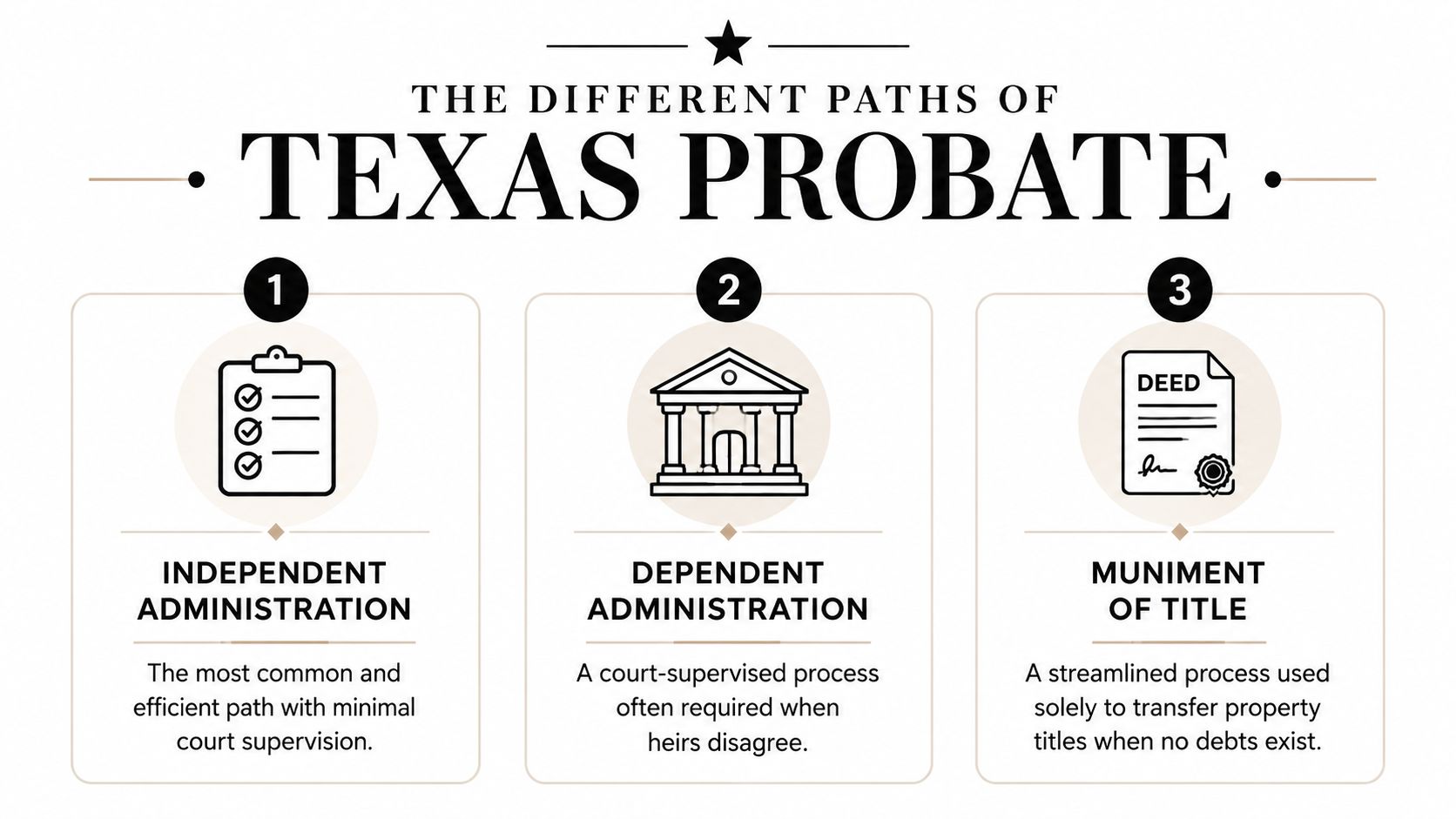
The Different Paths of Texas Probate
Texas probate isn't one single procedure. It offers several paths, and the path chosen often determines whether the estate moves efficiently or gets bogged down.
Independent administration
Independent administration is the route most families hope for. Under the Texas Estates Code, it allows the executor to manage much of the estate with limited court supervision. In plain English, that means the executor can do the job without returning to court for permission at every turn.
This process functions like a project manager who has the authority to move work forward without seeking approval for every step. That freedom saves time. Texas probate guidance notes that independent administration can often be completed in under 6 months because court involvement is limited, as explained in this guide to probate paths in Texas.
This option often works well when:
- The will is valid and clear
- The beneficiaries generally agree
- The assets are identifiable
- There isn't a major fight over debt, title, or control
If there's no will and the family first has to establish who the heirs are, a separate proceeding may come into play. Families dealing with that issue often need to understand an heirship proceeding in Montgomery County.
Dependent administration
Dependent administration is more court-supervised. The executor or administrator usually has to get court approval for important actions. That slows things down, not because anyone is doing something wrong, but because the process itself requires more steps.
This path often shows up when:
- The will is contested
- The family doesn't agree
- The court wants tighter oversight
- The estate is messy enough that independent handling isn't a good fit
The same Texas probate source explains that dependent administration typically extends to 12 to 18 months, and it describes that as a substantial increase in duration because court approval is needed for most major actions.
More supervision can protect the estate, but it rarely makes the estate move faster.
Muniment of title and small estate options
Some estates don't need a full administration. When the facts line up, Texas law offers more simplified options.
A muniment of title may be available when there is a valid will and no unpaid debts other than secured debt. This process is often used mainly to transfer title, especially real property, without opening a full administration.
A small estate affidavit may help in a qualifying estate with limited assets. The verified material available here allows one clear point: estates that qualify for simplified procedures can sometimes be resolved in just a few weeks, as noted in the earlier probate timeline source. Whether an estate qualifies depends on the facts, not wishful thinking.
These shorter routes are useful, but they aren't shortcuts you can force onto the wrong case. If the estate includes unresolved debts, title problems, or family conflict, the court may require a more formal process.
Estimated Timelines for Each Probate Scenario
A family in The Woodlands can leave the courthouse hearing thinking the hard part is over, then spend the next few months chasing bank forms, property records, and signatures. That is usually how probate time is spent. The hearing gets the case started. The work after appointment is what sets the pace.
For a routine estate with a valid will, no fight among beneficiaries, and organized records, probate often stays within the general range noted earlier for straightforward Texas cases. In Montgomery County, some estates move faster than families expect. Others slow down over title issues, appraisals, or missing paperwork, especially when a home in The Woodlands is part of the estate.
Texas Probate Timeline Comparison
| Probate Type | Typical Timeline | Best For |
|---|---|---|
| Independent administration | Can be relatively quick when the will is clear and the executor is prepared | Clear will, cooperative beneficiaries, limited court oversight |
| Simple uncontested probate | Often follows the standard Texas timeline noted earlier | Valid will, routine administration, manageable debts and assets |
| Dependent administration | Commonly takes much longer because the court must approve more actions | Disputes, contested issues, or court-supervised administration |
| Simplified procedure such as a small estate affidavit | Can be resolved quickly if the estate truly qualifies | Estates that meet the legal requirements for a simplified route |
A short local scenario
A widow in Sterling Ridge loses her husband. He left a valid will naming her as executor. The estate includes the house, a checking account, and a few investment accounts. The children are on the same page, and there is no dispute about who gets what.
That case usually follows a predictable pattern:
Application is filed
The probate case is opened and set for hearing.The executor is appointed
The court admits the will and gives the executor legal authority to act.Required notices are sent
Beneficiaries are notified, and creditor notice requirements are handled.Assets are gathered and valued
Bank accounts are confirmed, the home is identified correctly, and the inventory is prepared.Debts and claims are addressed
Valid bills, taxes, and any creditor issues are sorted out before final distribution.Property is transferred
The remaining assets pass under the will after the estate is ready to close.
On paper, that looks simple. In practice, the timeline turns on details. If the executor has the original will, account statements, deed records, and beneficiary contact information ready at the start, the estate has a much better chance of staying on schedule. If those items have to be hunted down after filing, weeks disappear fast.
Real property is often the pivot point in this county. A house may need a clean legal description, updated title work, insurance coordination, or an appraisal before the executor can move confidently. For families dealing with local filing steps and court procedure, this guide to the Montgomery County probate court process helps explain what needs to happen and in what order.
Where time gets lost
Probate delays usually show up in the middle of the case, not on day one.
The inventory is incomplete. A financial institution rejects letters because it wants its own forms. The deed does not match how the family understood ownership. Someone who stayed quiet at first starts asking questions once the house is about to be sold.
The fastest cases are usually the ones where the executor prepares before filing. That is not theory. It is what I see over and over in Montgomery County. Organized records, realistic expectations, and early attention to property issues make a measurable difference in how long the estate stays open.
How Probate Works in Montgomery County
Statewide answers only go so far. In Montgomery County, court practices and local property issues can materially change the timeline.

A local source focused on Texas probate timing reports that while statewide averages suggest 6 to 12 months, Montgomery County's probate court can often process straightforward independent administrations in 4 to 8 months, and it also notes that appraisal of high-value homes in The Woodlands can add 2 to 4 months to the inventory phase. You can review that local discussion in this article on probate timing in Texas with Montgomery County context.
Why some Montgomery County cases move faster
Montgomery County families sometimes benefit from a more manageable local docket in routine cases. When the will is uncontested and the executor is prepared, the process may feel more efficient than what families hear about in larger counties.
That doesn't mean every case is quick. It means a clean case has a better chance of staying clean.
You can get a general sense of local filing expectations by reviewing the Montgomery County probate court process.
The Woodlands real estate issue
The local wrinkle I see most often is real property. In neighborhoods like Panther Creek, Alden Bridge, and Sterling Ridge, the house is often the estate's main asset. That sounds simple until the executor has to confirm title, gather mortgage information, coordinate a valuation, and decide whether the property will be sold or distributed.
When the home is higher value or when multiple heirs have opinions about what should happen next, the appraisal and inventory stage can take longer. That local issue doesn't always show up in statewide articles, but it matters in practice.
What works locally
Some habits consistently help in Montgomery County probate matters:
- Bring the original will early. Waiting to locate it wastes time.
- Gather property records up front. Deeds, mortgage statements, and homeowner association information often become relevant quickly.
- Identify all heirs and beneficiaries clearly. Misspelled names and bad addresses create avoidable problems.
- Decide how the home will be handled. Sale, transfer, or occupancy questions shouldn't be left floating.
A local probate case often turns on ordinary details. The court process is formal, but many delays start with something simple that wasn't ready when it needed to be.
Common Probate Delays and How to Avoid Them
The biggest delays in probate are rarely mysterious. Most are predictable. That matters because predictable problems can often be reduced or avoided.

The deadline you cannot ignore
Under Texas Estates Code § 256.003, a will generally must be filed for probate within four years of the decedent's death. If that deadline is missed, the will can be treated as ineffective for probate purposes, and the estate may pass under Texas intestacy law instead of the decedent's written wishes, as discussed in this explanation of the four-year Texas probate filing deadline.
This is one of the few probate rules that families should treat as urgent from day one. Waiting because the family is grieving is understandable. Waiting because no one wants to deal with paperwork is dangerous.
Bottom line: Delay can change not just the timeline, but the outcome.
The usual trouble spots
Here are the probate problems that most often slow cases down in practice:
- Will disputes. If someone challenges the validity of the will, the case stops being routine. Families dealing with that issue may need focused guidance from a will contest lawyer in The Woodlands.
- Unclear assets. Missing account statements, unknown debts, and incomplete title records create confusion at the inventory stage.
- Family distrust. Even when no one files a formal contest, suspicion among siblings can make every step take longer.
- Creditor issues. Debts need to be identified and handled before the estate is distributed.
- Real estate complications. Occupancy, repairs, title questions, and valuation issues often hold up closure.
What actually helps
Families often think speed comes from pushing harder. Usually, speed comes from preparing better.
- File promptly. The earlier the case is opened, the more room there is to fix problems without creating a crisis.
- Use one reliable set of records. A single folder for the will, death certificate, deeds, account information, and contact details can prevent repeated scrambling.
- Set expectations with beneficiaries. Silence breeds suspicion.
- Treat the house like a project. If real property is involved, get organized about title, insurance, occupancy, and valuation right away.
A practical video overview can also help families understand why delays happen and what the court expects:
The common thread is simple. Probate slows down when families postpone decisions that the court and executor eventually have to make anyway.
Your Checklist for a Smoother Probate Process
If you're at the beginning of this process, don't try to solve everything at once. Start with the basics and get the file organized.
What to do next
Find the original will
A copy may help you understand the plan, but the court usually wants the original if one exists.Order death certificates
Banks, title companies, and other institutions often require them.Make a first-pass asset list
Include the home, bank accounts, vehicles, business interests, investment accounts, and personal property you know about.List known debts and recurring bills
Mortgage payments, taxes, utilities, and other obligations don't disappear when someone dies.Gather property documents
If the estate includes a home in The Woodlands or elsewhere in Montgomery County, collect the deed, mortgage information, insurance, and any homeowner association records.Identify the people involved
Make a clean list of heirs, beneficiaries, and anyone named as executor.Avoid informal distributions
Don't start handing out property before authority is clear. That can create expensive problems later.Ask whether a simplified route is possible
Some estates qualify for a more limited process, but that should be evaluated against the actual facts.Watch for related issues outside probate
If long-term care benefits were involved, families sometimes need to understand Medicaid estate recovery rules before deciding how to handle the estate.Talk with a local probate attorney
A lawyer can help determine the right path, prepare the filing, and flag issues before they turn into delays. In Montgomery County, that local guidance often matters because the house, family dynamics, and court procedure all affect timing.
One important caution
This article is for informational purposes only. It is not legal advice, and reading it doesn't create an attorney-client relationship. Probate outcomes depend on the specific facts, the estate documents, family dynamics, and the court handling the case.
If you need to open probate in The Woodlands or elsewhere in Montgomery County, it helps to get a clear plan early. The right next step is usually a focused consultation, not guesswork.
If you want practical guidance on your specific situation, you can schedule a consultation with The Law Office of Bryan Fagan. A consultation can help you identify the probate path that fits the estate, understand likely timing in Montgomery County, and avoid delays that are easier to prevent than fix.
