
Texas has no state estate tax or inheritance tax, and the 2026 federal estate tax exemption is $15 million per person, or $30 million for a married couple using portability. Most Woodlands families searching for an estate tax attorney need federal exemption planning, probate administration, and coordinated asset transfers under Texas law.
That distinction matters. The popular advice often starts with the wrong question: “How do I avoid Texas estate tax?” Texas doesn't impose one. The better questions are whether your estate could exceed the federal threshold, whether your will and beneficiary designations work together, and whether your family can administer the estate efficiently in Montgomery County.
For a family in Panther Creek, Alden Bridge, Sterling Ridge, Creekside, or another Woodlands community, professional advice usually earns its value through coordination, not merely tax calculations. Real estate titles, retirement accounts, business interests, trusts, creditor issues, probate filings, and federal elections must fit together.
Why Most Woodlands Families Misunderstand Estate Tax Planning
The assumption that Texas residents need an estate tax attorney because Texas charges an estate tax is wrong. Texas has no state estate tax and no state inheritance tax, so a decedent's estate generally isn't facing a separate Texas death tax. Texas voters approved Proposition 8 in November 2015, permanently barring the state from imposing a tax on a decedent's estate. (Edelman Financial Engines explains Texas estate and inheritance tax rules)
That doesn't make estate planning unnecessary. It changes the purpose of the planning. For most Woodlands families, the work centers on probate efficiency, asset protection, beneficiary coordination, and federal exemption management, rather than reducing a Texas estate tax bill.
The threshold that separates tax planning from probate planning
For decedents dying in 2026, the federal basic exclusion amount is $15 million per person. The federal estate tax applies to the value above that exclusion, and the top federal estate tax rate remains 40%. (The IRS states the 2026 exclusion and top rate)
A Woodlands resident with a net worth comfortably below that level may still need a will, powers of attorney, beneficiary reviews, and a probate strategy. That family may have substantial legal work ahead, but the work probably isn't about Texas estate tax. A household near or above the federal threshold needs a different level of analysis, especially if it owns a business, valuable real estate, or concentrated investments.
Local search results often blur estate tax planning and estate administration. They're related, but they aren't interchangeable. Estate tax planning addresses federal transfer-tax exposure during life and at death. Estate administration addresses the practical work after death, including proving the will, transferring title, paying valid debts, and distributing property.
Practical rule: Don't hire based on the phrase “estate tax attorney” alone. Hire based on the problem your family actually needs solved.
If your approximate estate value is below the federal threshold, keep reading because probate and transfer mechanics can still create delays and disputes. If your estate may exceed it, prior lifetime gifts and marital planning deserve focused review rather than a generic online form.
Federal Estate Tax Thresholds That Matter in 2026
Texas residents do not face a Texas estate tax. For Woodlands families, the threshold that matters is federal, and it combines lifetime gifts with transfers made at death. The 2026 basic exclusion amount is $15 million for an individual, up from $13.99 million in 2025, with inflation indexing. (The Congressional Research Service summarizes the federal exemption changes)
Crossing the threshold does not make the entire estate taxable. Federal estate tax generally applies to the taxable amount above the available exclusion after applicable deductions and rules. The top rate remains 40%, so preserving available exemption matters for families with substantial wealth. (The IRS provides the 2026 estate and gift tax adjustment details)
| Year | Individual Exemption | Married Couple with Portability | Top Tax Rate |
|---|---|---|---|
| 2025 | $13.99 million | Not stated as a combined figure in the cited data | 40% |
| 2026 | $15 million | $30 million | 40% |
Portability may let a surviving spouse use a deceased spouse's unused exclusion. The benefit is not automatic. After the first spouse dies, the personal representative generally must complete the required federal filing and election. Missing that filing can permanently eliminate the opportunity to preserve the unused exclusion.
Who needs serious federal planning
A married couple with combined assets near $28 million, for example, falls below the reported $30 million combined 2026 threshold if portability applies. That result still depends on accurate valuations, prior gifts, beneficiary designations, ownership records, and a properly handled portability election. (Family Estate Guide discusses the current exemption framework)
Prior lifetime gifts reduce the exemption remaining at death because the federal system considers lifetime gifts and estate transfers together. An attorney should review gift-tax returns, earlier transfers, trusts, and property valuations before recommending additional gifts. A current balance sheet alone cannot show the family's remaining exemption.
Should you give assets away now
Do not transfer property solely because the exemption is high. Gifting may reduce the property included in an estate, but it can also limit flexibility, affect income-tax planning, reduce control, and create family disagreements. Compare the potential transfer-tax benefit with the value of retaining ownership and decision-making authority.
Federal rules can change, and the exemption is indexed. Your plan should be easy to update rather than left untouched for years. Start with an accurate inventory of assets, then review lifetime gifts, ownership, beneficiary designations, and the couple's portability position.
For a focused local review of wills, trusts, and estate plans for The Woodlands families, see Estate Planning Attorney in The Woodlands.
What an Estate Tax Attorney Does for Texas Families
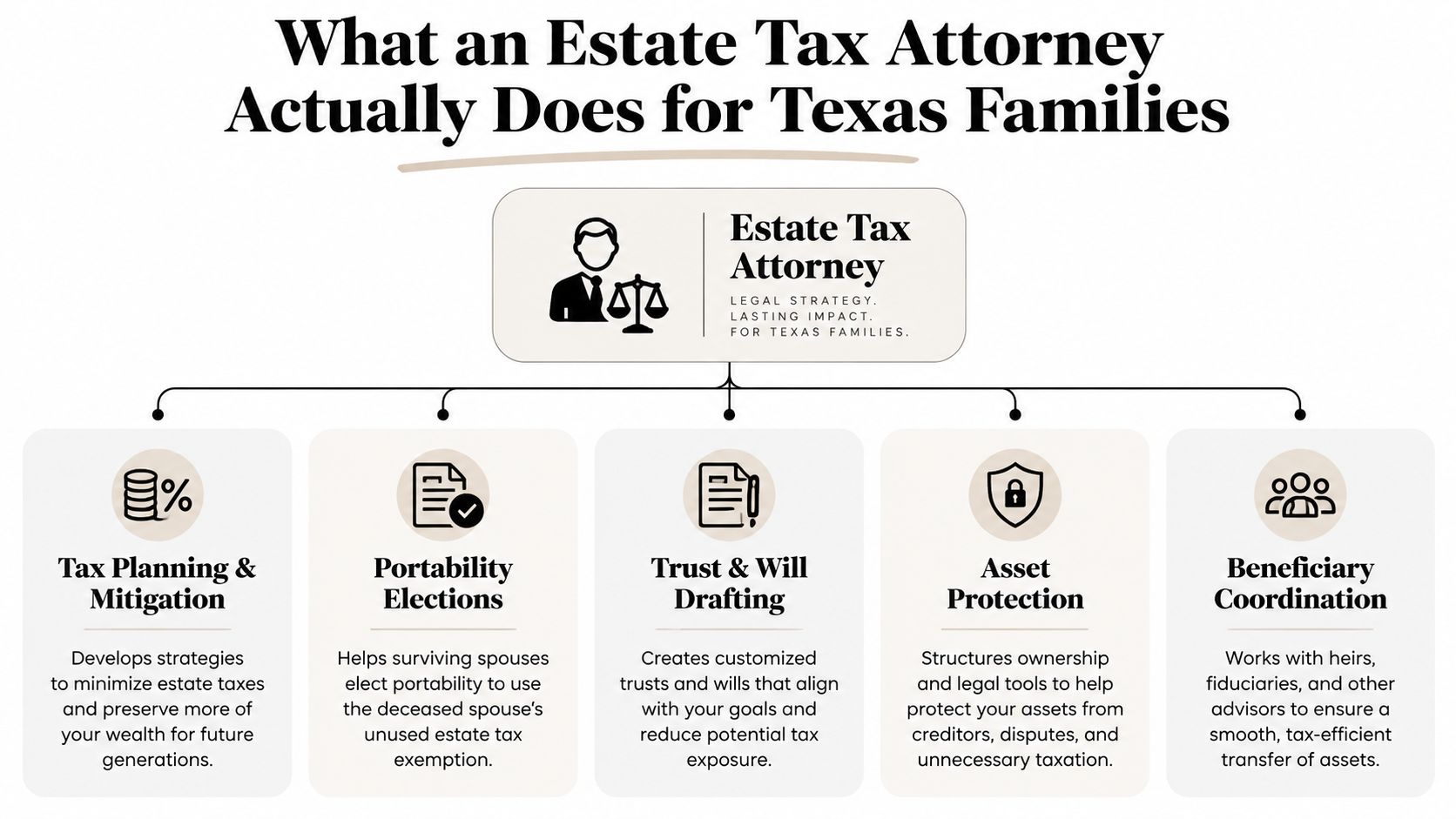
Texas families do not hire an estate tax attorney because Texas imposes its own estate tax. They hire one to coordinate federal exemption planning, ownership, beneficiary instructions, and the transfer of assets that a standard will may not control. The first review should determine whether the family's gross estate could approach the federal threshold, then test whether the documents and ownership structure support the intended tax and administrative result.
The planning work behind the documents
A focused review usually covers:
- Portability elections: Confirming whether the deceased spouse's unused exclusion was preserved through the required filing.
- Trust structures: Deciding whether revocable or irrevocable trusts fit the family's control, protection, tax, and distribution goals.
- Beneficiary coordination: Comparing retirement accounts, life insurance, investment accounts, and payable-on-death designations with the will and trust.
- Asset protection: Reviewing ownership and transfer arrangements for business interests, investment property, and other significant holdings.
- Basis planning: Examining how ownership and transfers may affect the potential step-up in basis at death.
A will does not control every asset. A beneficiary designation can send an account outside probate, while a deed controls the recipient of real estate. Conflicting instructions can produce a result the family never intended.
The administration work families feel most
An attorney also handles title transfers, creditor issues, estate property, business continuity, and distributions. For a family with a closely held company or concentrated investments, the question is how to transfer the asset without avoidable disputes, confusion, or a forced sale.
The plan must fit the Texas Estates Code, the executor provisions in the will, and the practical requirements of the Montgomery County probate court. Online templates can create documents, but they cannot reliably reconcile every deed, account designation, trust provision, and family circumstance.
The best time to find a mismatch is while the owner is alive. The family can still correct title, update beneficiaries, revise trust terms, and set up transfers before administration begins. A Woodlands attorney should focus on those mechanics, not merely prepare a federal tax return.
Montgomery County Probate Rules and Local Court Process
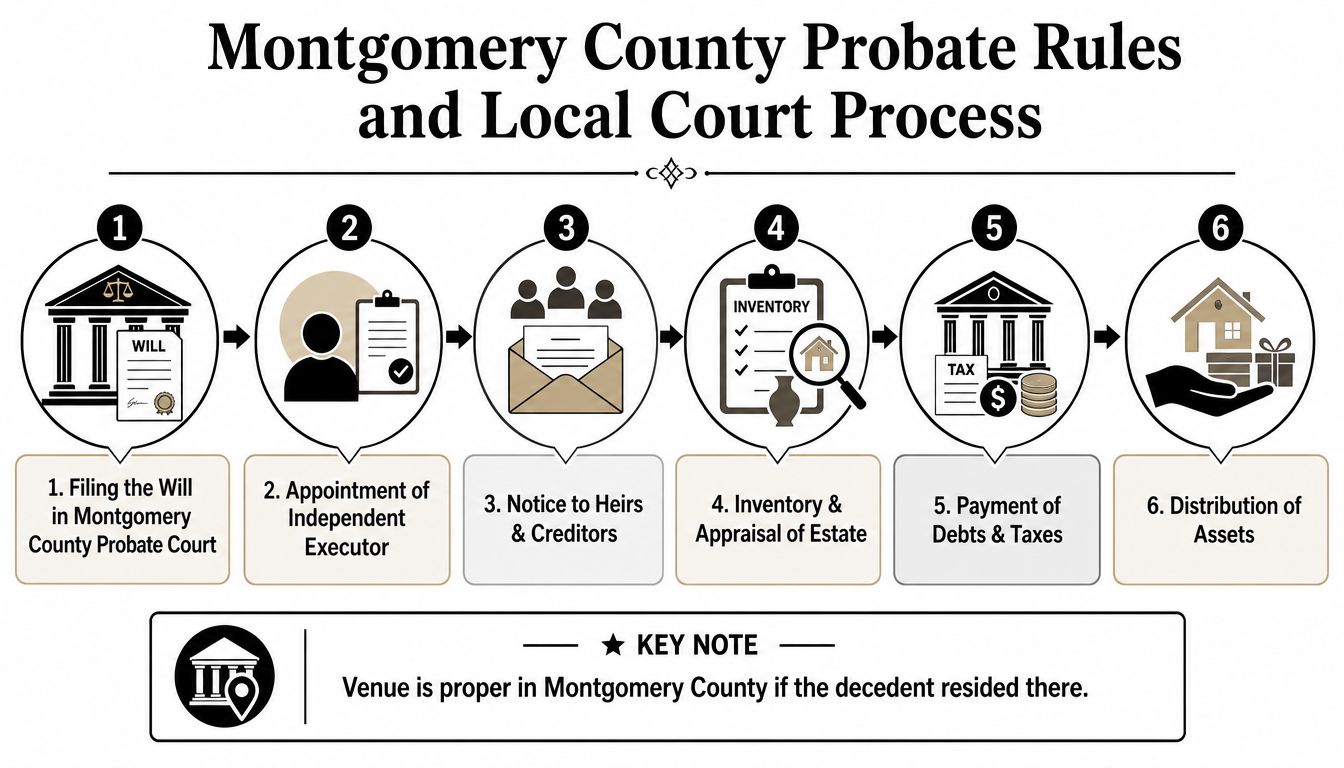
When a Woodlands resident dies, venue usually follows the decedent's domicile or fixed place of residence. Texas Estates Code Section 33.001 generally places probate proceedings in the county where the decedent resided if the person had a Texas domicile or fixed residence. For a Woodlands resident, Montgomery County will usually be the proper probate venue. (Texas Estates Code Section 33.001 addresses probate venue)
The filing location should reflect the facts, not a family preference for another county. Confirm the decedent's domicile, identify Texas assets, and apply the venue rule before filing.
Why independent administration matters
Texas independent administration can reduce ongoing court supervision. After the probate court appoints the independent executor and the required inventory, appraisement, and list of claims are filed and approved, further court action generally isn't required unless the Estates Code specifically allows it. (Texas Estates Code Chapter 402 addresses independent administration)
That structure can let an executor handle many practical tasks, including settling creditors, managing estate property, handling exempt property, selling assets to pay debts or taxes, and distributing the remainder to heirs. The will's language matters, as does the court's initial order.
Consider a surviving spouse in Sterling Ridge whose spouse dies owning a home, an inherited vehicle, and Texas bank accounts. If the will names an independent executor and the court approves the administration, the spouse may be able to sell the vehicle and close accounts with limited additional court involvement. The exact steps depend on the will, the assets, creditor claims, and court requirements.
For additional context about how family law matters proceed in local courts, Montgomery County Family Courts: A Local Guide provides a separate local reference. Estate administration itself is addressed through the Texas probate process, including estate administration services in The Woodlands.
The two-year accounting point
Texas Estates Code Section 405.001 gives an interested person in an independently administered estate a way to petition for an accounting and distribution after two years from the date the clerk first issued letters testamentary or letters of administration. (Texas Estates Code Section 405.001 sets out the accounting and distribution procedure)
If a Montgomery County estate remains open beyond that point, a beneficiary can consider requesting formal information rather than relying only on informal updates. Track the date letters were issued, distributions already made, and the status of debts and assets.
When to Hire an Attorney Versus Handling It Yourself
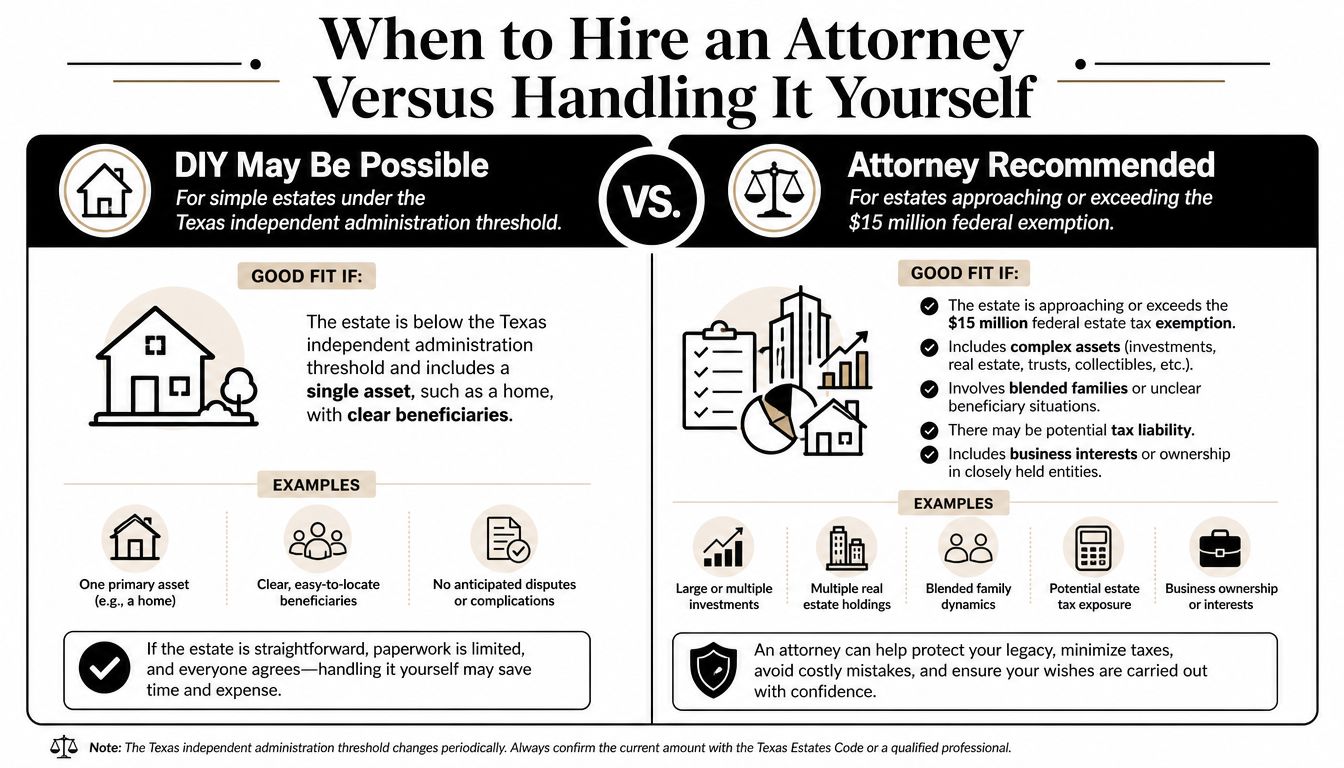
DIY estate planning can work for a simple situation. A single home, clear beneficiaries, limited account types, no business interest, and an uncomplicated family structure may not require advanced tax planning. Even then, the documents must be signed correctly and the ownership and beneficiary instructions must match.
The risks rise quickly when the family's assets or relationships become complicated. Use this decision rule:
- DIY may be reasonable: The estate is simple, beneficiaries are clear, and the will, account designations, and property ownership point in the same direction.
- Hire an attorney: The estate is approaching or exceeding the $15 million federal exemption, as reported for 2026, or prior lifetime gifts may have used part of the available exemption.
- Hire an attorney: The family owns closely held businesses, multiple properties, or concentrated investments.
- Hire an attorney: The household includes a blended family, unequal inheritances, vulnerable beneficiaries, or concerns about control after death.
- Hire an attorney: A spouse has died and portability may apply, or the estate requires a formal probate administration.
The hidden cost of a form
A template can't tell you that a beneficiary designation conflicts with your trust. It won't confirm that a deed transfers the property as intended, identify a missed portability filing, or evaluate whether a business interest needs a succession plan. Those omissions may not appear until the person who created the plan can no longer explain it.
A simple estate deserves simple documents. A complicated estate deserves coordinated advice.
Business owners should treat succession planning as a separate issue from merely naming heirs. A transfer may affect management, voting rights, valuation, and the family's ability to operate the company. Review business succession planning in The Woodlands when a company is part of the estate.
If you're deciding whether a full estate plan is appropriate, consider the local estate planning services for The Woodlands as one resource, then compare the attorney's approach, scope, and communication style before signing an engagement agreement.
Questions to Ask During Your Estate Planning Consultation
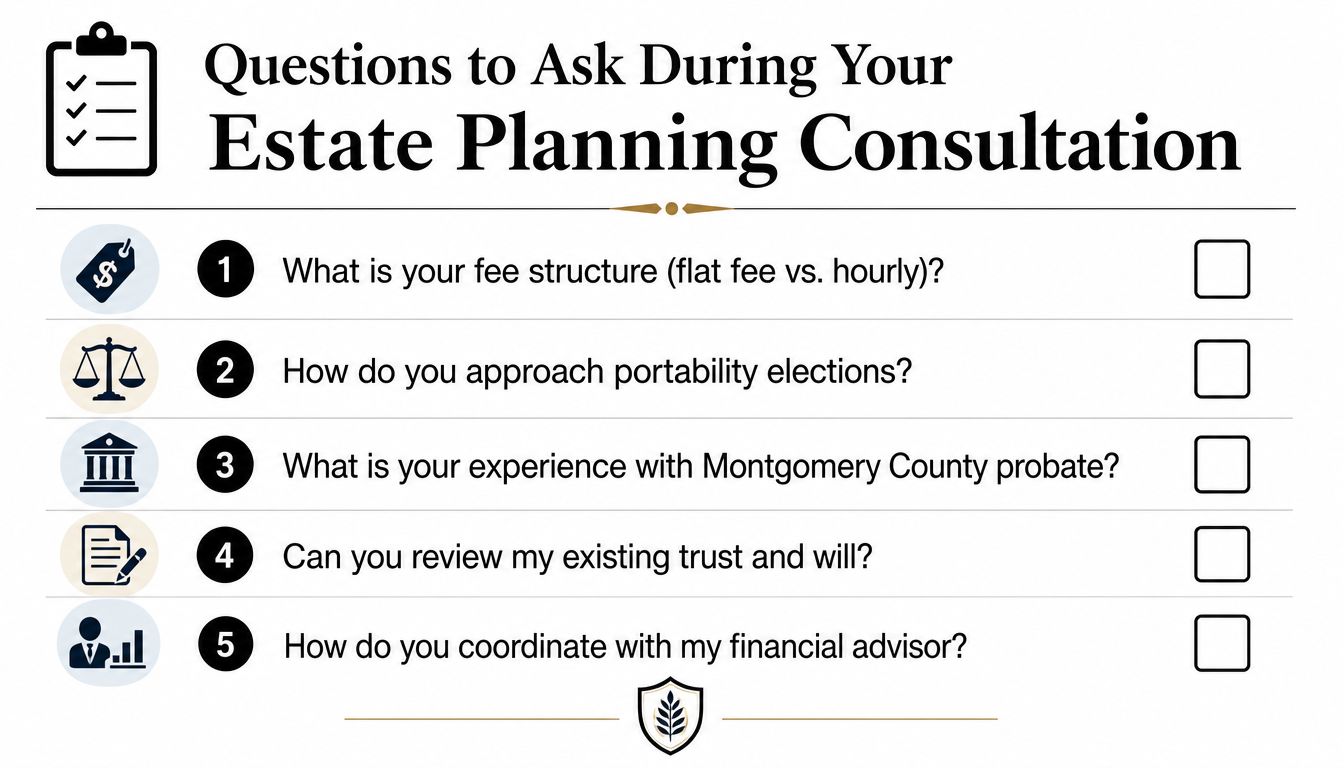
A good consultation should produce clear answers, not just a stack of documents. Ask how the attorney will analyze your assets, coordinate with other professionals, and handle changes after the plan is signed.
Questions worth bringing to the first meeting
- What is your fee structure: Ask whether the work is handled for a flat fee, hourly billing, or a combination, and identify what follow-up work is included.
- How do you approach portability elections: Ask what information is needed after a spouse's death and how the attorney will preserve any unused exclusion.
- What is your Montgomery County probate experience: Ask how the lawyer handles independent administration, venue, inventories, creditor issues, and beneficiary communication.
- Can you review existing documents: Bring old wills, trusts, deeds, and beneficiary forms so the attorney can identify conflicts rather than drafting in isolation.
- How do you coordinate with financial professionals: Ask how the lawyer will work with your accountant, financial advisor, insurance professional, or business advisor when their input affects the plan.
The answers should be specific. An attorney should be able to explain the difference between drafting a document and implementing it, including retitling assets and updating account designations.
Documents to gather
Bring existing wills and trust documents, property deeds, retirement account statements, life insurance policies, business records, and a current asset and debt list. Include information about prior lifetime gifts and any federal gift-tax filings if they exist.
You don't need perfect paperwork before making an appointment. Gather what you can, mark what's missing, and tell the attorney where uncertainty remains. Accurate disclosure is more useful than polished assumptions.
Your Next Steps for Protecting Your Woodlands Estate
The central answer is straightforward. Texas doesn't impose a state estate or inheritance tax, but federal rules, probate procedure, ownership records, and beneficiary designations still determine whether your family receives assets efficiently.
A sound plan should address both lifetime incapacity and death. It should also identify the right executor, preserve flexibility where appropriate, and make sure your documents reflect the way your Woodlands family owns property.
What to do next
- Estimate the estate: Add real estate, investments, business interests, insurance, retirement accounts, and other property, then compare the total with the $15 million 2026 federal exclusion.
- Review portability: If a spouse has died, determine whether a portability election was made or should be evaluated.
- Audit beneficiaries: Compare every account designation with your will and trust.
- Confirm the executor: Check whether the will names an independent executor if that structure fits the estate.
- Verify venue: Confirm domicile and the appropriate Montgomery County filing location under the Texas Estates Code.
- Collect documents: Assemble wills, trusts, deeds, account statements, insurance policies, and prior gift records.
A revocable trust may be part of the solution, but signing one document doesn't complete the plan. Ownership, funding, successor instructions, and beneficiary designations must be reviewed together. Use revocable trust forms and information for The Woodlands as a starting point for questions, not as a substitute for individualized review.
This article provides general information and is not legal advice. Texas probate, federal tax, trust, and property issues depend on the facts, documents, asset ownership, and applicable law. Don't rely on this article to decide whether to file, gift property, change a beneficiary, or proceed without counsel.
The Law Office of Bryan Fagan assists families with estate planning and probate matters in The Woodlands and Montgomery County, including communities such as Panther Creek, Alden Bridge, Sterling Ridge, and Creekside. Visit The Law Office of Bryan Fagan to schedule a consultation about federal exemption planning, probate administration, and coordinated asset transfers.