 Skip to content
You can get through a divorce in The Woodlands and still end up stuck for months on the retirement money. The decree may say the 401(k) gets split, the judge may sign off, and yet the plan administrator still won't move a dollar until a separate order is drafted, approved, and processed. That's where a QDRO attorney in The Woodlands, TX matters, because retirement division is usually less about the divorce judgment itself and more about getting the plan to accept the paperwork that follows.
A qualified domestic relations order is the legal mechanism used to divide retirement benefits in divorce, and federal law requires a QDRO before a retirement plan can pay benefits directly to an ex-spouse or alternate payee. In real cases, that affects many employer-sponsored plans, including 401(k)s, defined benefit pensions, ESOPs, and profit-sharing plans. A divorce decree can say who gets what, but the plan administrator usually needs a separate, plan-acceptable order before the money can move, which is why QDRO drafting is a core step in retirement division cases in The Woodlands and Montgomery County.
What a QDRO Actually Does in a The Woodlands Divorce
A couple signs their divorce decree in Montgomery County, the decree awards half of the 401(k) to the non-employee spouse, and then nothing happens. That delay isn't unusual. The plan administrator still needs a separate order that matches the plan's rules before any transfer or payment can be made.
That separate order is the QDRO. It tells the retirement plan how to divide the benefit without rewriting the divorce decree, and it has to fit the plan's own administrative rules. The decree says what the court ordered. The QDRO tells the retirement plan how to carry it out.
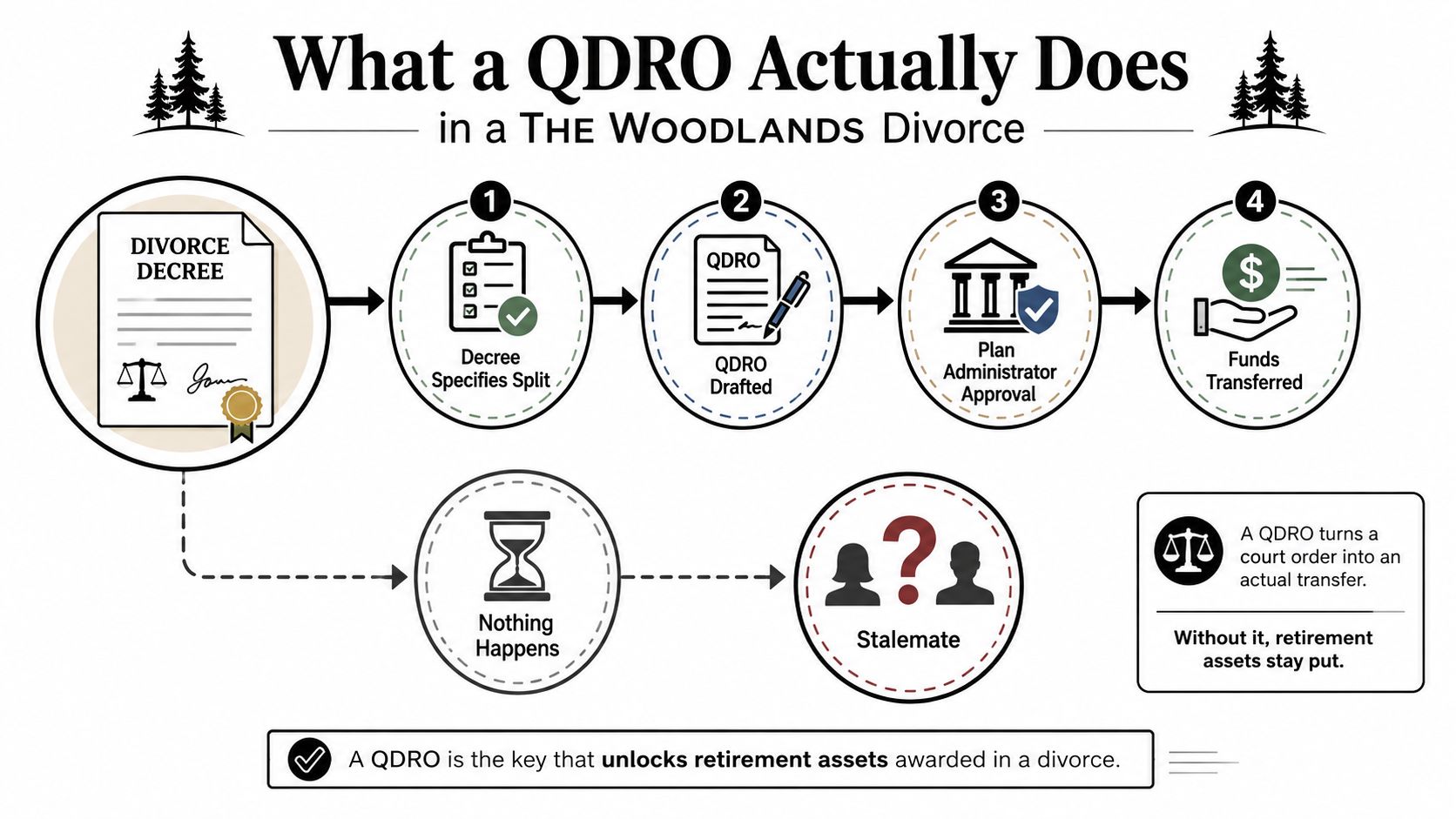
Practical rule: if the order can't be processed by the plan administrator, the award may never reach the ex-spouse the way the decree intended.
Which accounts need the order
The retirement accounts that usually call for a QDRO include 401(k)s, defined benefit pensions, ESOPs, and profit-sharing plans. That's because federal law requires the order before those plans can legally split benefits to an alternate payee. A plain divorce judgment usually isn't enough on its own.
For readers comparing retirement division options, the mechanics matter more than the label. A 401(k) transfer works differently from a pension payout, and the plan's rules control the actual distribution path. That's why it's a mistake to treat all retirement accounts as if they move the same way.
The Dividing 401(k) in the Woodlands Divorce resource is useful if the issue is a defined contribution account rather than a pension. In either setting, the key point stays the same. The decree is the award, and the QDRO is the delivery mechanism.
Texas Law and Federal Rules That Drive the QDRO
Texas family law starts with property classification, not paperwork mechanics. Under Texas Family Code §7.003, retirement benefits earned during the marriage are generally subject to division, while benefits earned before marriage are typically separate property. That's the starting point in Montgomery County cases, including those involving The Woodlands, but it doesn't finish the job.
The retirement plan still has to accept the order under federal standards and its own administrative rules. In other words, a judge can divide the marital share, but the plan won't pay out unless the order matches what the plan can administer. That gap is where many families get frustrated, because the legal win in the decree doesn't automatically become a transfer on the plan side.
A simple example makes this clearer. Suppose one spouse worked for a company headquartered in Montgomery County for 12 years, and the parties were married for the last 8 of those years. The marital share is usually tied to the period earned during the marriage, not the entire employment history. So the decree percentage may look straightforward, but the plan's formula may still require a different drafting method to make the division work correctly.
The practical rule is simple. Texas law determines what can be divided, federal law and plan rules determine how it gets paid. If you're dealing with survivor issues or death-after-divorce questions, that's where Texas Estates Code concerns can come into play, especially when beneficiary designations and plan payment rules collide. The Montgomery County Family Courts: A Local Guide resource is a helpful snapshot of how family law cases proceed in Montgomery County courts serving The Woodlands.
The decree can decide ownership. The plan administrator decides whether the order is processable.
A common mistake is assuming the percentage in the decree is the same thing as what the plan will pay. That's not always true. The drafting has to fit the plan's language, the participant's benefit type, and the administrator's accepted format.
How the QDRO Process Actually Plays Out Locally
A Woodlands-area QDRO case usually moves through six practical phases, and the slow part is often the one people don't expect. The first phase is reviewing the divorce decree language for the retirement division paragraph. If that language is vague, inconsistent, or incomplete, the QDRO draft starts from a weak position.
Next comes plan-document collection. You need the summary plan description, the plan's administration contact, and the actual plan rules, because the order must match the retirement plan's administrative terms rather than just the divorce judgment. After that, the QDRO gets drafted and sent for pre-approval by the plan administrator, which is the step that many guides skip and the step that often saves time later.
Pre-approval can take about 1 to 3 months, according to a Texas divorce practice, and post-signature processing can then take roughly 90 days to 6 months depending on the administrator's timeline. Those are real-world ranges, not guarantees, but they show why a QDRO shouldn't be treated as a same-week filing task. If the plan rejects the draft, the order goes back for revision before court entry.
After pre-approval, the order is presented for court entry in Montgomery County. Then the signed order goes back to the plan for final processing. That last step is where the alternate payee usually waits for the actual distribution, and with many defined benefit pensions, payment doesn't begin until the employee participant becomes eligible to retire.
A client often thinks the case is finished when the judge signs. In practice, that's only the middle of the process.
A fictional example comes up often enough to be familiar. A Spring-area couple settles property division, the decree awards a share of a pension, and everyone assumes the paperwork will be routine. Then the plan administrator requests a different survivor-benefit format, the draft gets revised, and the retirement payment doesn't move until months later. That's the local reality, whether the case is handled in The Woodlands, Conroe, Magnolia, or nearby Montgomery County communities.
A related issue sometimes overlaps with estate planning. If retirement division and beneficiary planning both matter, a consult with an Estate Planning Attorney in The Woodlands can help coordinate wills, trusts, and beneficiary documents with the divorce outcome.
Your QDRO Paperwork Checklist Before the First Meeting
The fastest QDRO files usually start with clean paperwork. If you show up with the decree, the retirement statements, and the plan documents, the attorney can spend time drafting instead of chasing basics. That matters because every missing detail creates another round of email, review, and possible redrafting.
Bring the following to the first meeting:
- Final divorce decree, especially the retirement division paragraph.
- Summary Plan Description (SPD) for each retirement account.
- Most recent statements for the 401(k), pension, or other plan.
- Plan name and administrator contact information.
- Date of hire for the participant.
- Date of marriage and divorce date.
- Any prior QDROs or similar orders already entered.
- Notes on special plan features, such as a separate pension, a 401(k), or multiple employer plans.
The reason each item matters is practical. A defined benefit pension is not drafted like a 401(k). A company can maintain more than one retirement plan. A prior QDRO can change what's left to divide. If you skip those details, the drafting process slows down and the plan administrator may send the order back.
Before you meet with counsel, it's also smart to review How to Prepare for a Divorce Consultation in Texas. The better organized you are at the start, the less time gets spent reconstructing the retirement history later.
What usually saves time: bring the actual plan paperwork, not just screenshots of account balances.
That one habit usually cuts down on back-and-forth and helps the attorney identify whether the case involves one account, several plans, or a pension with survivor-benefit language that needs careful drafting.
What a QDRO Costs in The Woodlands
QDRO pricing is specialized for a reason. Public attorney and practice materials show drafting prices ranging from about $750 per QDRO to $1,500 per QDRO, with hourly review rates around $300 per hour for more complex work, including plan review and order correction. That range tracks with the fact that a QDRO is not a routine divorce add-on. It's a separate legal product that has to satisfy both the court and the plan administrator. For readers handling a larger property split, the issues often overlap with High-Net-Worth Divorce in The Woodlands.
The cost moves up or down based on the plan type and the amount of back-and-forth needed. A straightforward 401(k) division is usually less demanding than a defined benefit pension with survivor rights or a plan that requires multiple revisions. If both spouses have counsel, the process can be smoother. If one side resists or the plan has strict review rules, the bill can grow.
| Cost Driver | Typical Impact | Realistic Range |
|---|---|---|
| Single 401(k) division | Usually simpler drafting | Lower end of published drafting range |
| Defined benefit pension | More plan-specific language | Higher drafting time or hourly review |
| Survivor-benefit issues | More revisions and coordination | Often increases review time |
| Multiple plans | Separate orders may be needed | Cost can scale by plan |
| Plan rejection or amendment | Redrafting and resubmission | Adds attorney time |
Most QDRO fees are not bundled into the divorce retainer. They're usually handled as a separate engagement because the work comes after, or alongside, the property division phase. That's important budgeting information for anyone in The Woodlands or Montgomery County who assumes retirement division is included automatically in the divorce fee.
Bargain shopping usually shows up later as rejected orders and redrafts. That's where the cost lands.
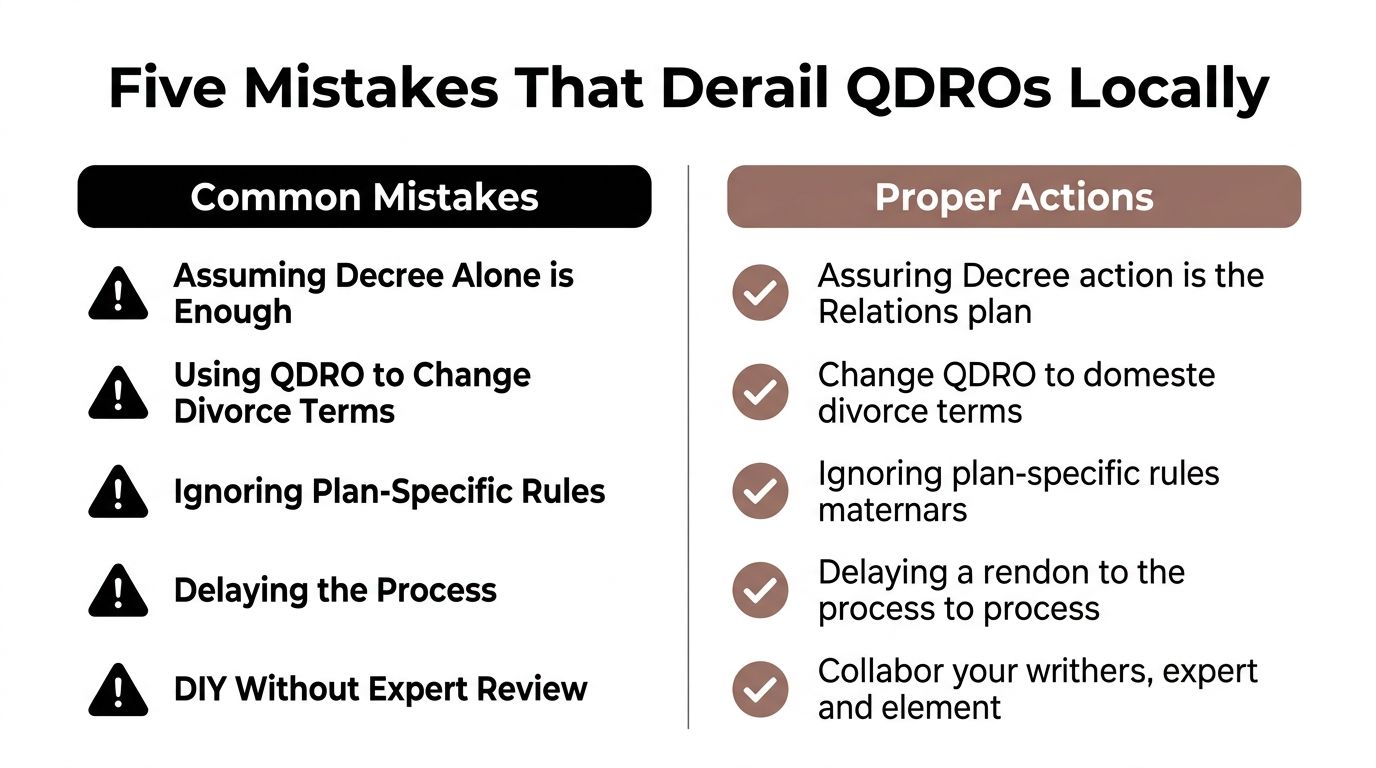
Five Mistakes That Derail QDROs Locally
The first mistake is assuming the divorce decree alone is enough. It isn't. The decree can award the share, but the plan still needs a separate, acceptable order before funds move. A spouse signs a decree, waits, and then learns the administrator won't act without the QDRO.
The second mistake is trying to use the QDRO to change the divorce deal. A QDRO can't rewrite vesting rules or create benefits the plan doesn't already allow. If the order asks for something outside the plan, the administrator will reject it or require a rewrite.
The third mistake is ignoring plan-specific survivor language. That problem comes up often with pensions. If the summary plan description gives survivor options or timing rules, the QDRO has to respect them. Otherwise, the alternate payee can lose the practical benefit of the award even when the decree looked favorable.
The fourth mistake is mixing up shared-interest and separate-interest awards on defined benefit pensions. Those are not cosmetic labels. They affect when the former spouse gets paid and how the benefit is administered.
The fifth mistake is waiting too long. A divorce signed years ago can still create QDRO problems, but the longer you wait, the more likely the plan file, participant status, or retirement timing has changed. That makes the job harder, not easier.
A practical caution: if you're already divorced and the retirement account hasn't been divided, don't assume the delay is harmless. The plan administrator's rules still control, and a stale file can turn a clean property award into a correction project.
Choosing the Right QDRO Attorney and What to Do Next
A solid qdro attorney in The Woodlands, TX should be able to explain the difference between decree language, plan language, and court processing without hand-waving. You want someone who works in Montgomery County family law, understands pre-approval strategy, and knows when a pension needs a different approach than a 401(k). If you're comparing options, the resource on How to Choose a Divorce Lawyer in The Woodlands TX is a sensible place to start for the broader family-law side of the decision.
Use a few direct questions in the consultation:
- Who drafts the QDRO, and who reviews it before filing?
- Do you seek pre-approval from the plan administrator before court entry?
- Is your fee flat or hourly for QDRO work?
- How long do you usually expect the plan review and processing steps to take?
- Have you handled the same plan type before, especially pensions or employer stock plans?
Those questions matter because the process is procedural, not theoretical. You're not just hiring someone to fill in a template. You're hiring someone to reduce the risk of rejection, delay, or a payment that never starts when it should.
What to do next
- Gather the divorce decree and retirement plan documents.
- Confirm whether the plan is a 401(k), pension, ESOP, or something else.
- Request a consultation before the divorce is finalized if possible.
- Ask about pre-approval before the order goes to court.
This is not legal advice. Every retirement plan and divorce decree has its own drafting issues, and your facts may require a different approach.
The Woodlands and Montgomery County families don't need guesswork on retirement division. The Law Office of Bryan Fagan handles divorce, property division, and court-focused family law matters for local clients who need the paperwork done correctly the first time. If your case involves retirement accounts, schedule a consultation with The Law Office of Bryan Fagan and get the QDRO process moving before delays start to stack up.
