
A parent dies, the family finds the home still titled in the parent's name, and a pending sale suddenly stops. That situation is familiar to families across The Woodlands and Montgomery County, especially when there's no will and the estate appears too modest to justify a full probate administration. The mortgage may be paid, the tax bill may still arrive in the decedent's name, and the title company may refuse to insure a transfer until the heirs establish a reliable chain of title.
For many straightforward estates, recording an affidavit of heirship in the Montgomery County real property records can be a practical alternative to immediate court action. But the document isn't just a form to sign before a notary. Newer Texas signing requirements, incomplete family histories, incorrect property descriptions, and county-specific filing mistakes can leave an affidavit unrecorded or weaken its usefulness later.
When a Woodlands Family Reaches for an Affidavit of Heirship
A father in The Woodlands dies unexpectedly. His homestead on Woodlands Parkway is titled in his name alone. He left no will, his adult children are the apparent heirs, and the estate contains little beyond the home. The mortgage has been paid off, but the deed still names their father.
The children have a buyer and a closing date. The title company won't insure the sale because the public records don't show how ownership passed from the decedent to the children. Meanwhile, the Montgomery County tax bill arrives in the father's name, creating another reminder that the family's private understanding hasn't become a public title record.
The family asks whether they can avoid formal probate. An affidavit of heirship may be the lowest-cost path when the facts are complete, every heir can be identified, and no one disputes the inheritance. It gives people who weren't involved in the family's private affairs, including title examiners and lenders, a sworn account of the decedent's family history and property ownership.
Practical rule: A simple estate can still create a complicated title problem if one heir, marriage, divorce, or prior transfer is left out.
The family shouldn't treat the affidavit as an automatic solution. A suspected will, disputed heirship, minor or incapacitated heirs, significant creditor concerns, or uncertainty about community and separate property can make a court proceeding safer. An affidavit also doesn't itself function as a deed, and it won't force every lender or title company to accept the family's preferred method.
For a Woodlands family facing a sale, refinance, or transfer, the first question is not just whether an affidavit is cheaper. It's whether the family can create an accurate, properly executed record that a future title examiner can follow without guessing.
What the Document Actually Does Under Texas Law
An affidavit of heirship is a sworn statement about a decedent's identity, family history, heirs, and relationship to particular real property. Texas Estates Code Chapter 203 gives a properly executed and acknowledged affidavit real evidentiary weight in an heirship or title proceeding after it has been recorded in the deed records for at least five years in the relevant county. The rule is described in Texas Estates Code Section 203.001.
That five-year period matters. Before it runs, the document is still a useful recorded statement, but it doesn't receive the statute's full prima facie presumption. After the period, the recorded facts can serve as prima facie evidence in a proceeding involving heirship or title.
Recording must happen where the land is located. For a Montgomery County property, the affidavit belongs in the county clerk's real property records, not merely in a probate file or a family folder. The county-based system means a filing tied to property in The Woodlands, Conroe, New Caney, or another Montgomery County community must be indexed in Montgomery County's public land records.
What the affidavit can and cannot accomplish
The document can help establish a recorded chain of title for later review by buyers, lenders, and title companies. It can also identify the heirs without immediately asking a court to supervise an administration or issue a judgment.
It isn't a court order, and it doesn't resolve every ownership dispute. It doesn't independently transfer title in the same way a deed does, and it may not satisfy a third party that requires a judicial determination. A will, contested family history, unresolved community-property issue, or formal creditor process can require a different legal route.
The Texas State Law Library describes an affidavit of heirship as an informal probate method used to establish an heirship chain for real property. Families comparing that option with a court proceeding can review the Montgomery County heirship proceeding resource before deciding how much certainty the transaction requires.
What Must Be in the Affidavit Before You File
A Montgomery County clerk can record a document that contains the right signatures and format, but recording doesn't cure a defective family history. The affidavit should give a future reader enough information to understand who died, who survived, what property is involved, and why the listed people are the heirs.
Build the family history first
Use the decedent's full legal name, date and place of death, and county of residence at death. State the complete marital history, including whether the decedent was single, married, widowed, or divorced at relevant times. If a marriage, divorce, or prior death affects inheritance, the affidavit should address it directly rather than leaving the title examiner to infer the answer.
List every child and other possible heir, including adopted children, children from earlier relationships, and descendants of a child who died before the decedent. Include each heir's full name, address, and relationship to the decedent. A family member who seems irrelevant to the current sale may still matter under the intestacy rules in Texas Estates Code Chapter 201.
The affidavit should also address whether property was community or separate property when that distinction affects the heirs' interests. A second marriage, a surviving spouse, or property acquired during marriage can change the analysis.
Match the land records exactly
A street address isn't enough. Copy the property description from the recorded deed or another reliable Montgomery County land record. Include the lot, block, subdivision, and recording reference exactly as shown.
Attach supporting documents that help prove the statements:
- Death certificate: Use a certified copy when available, particularly where the date or identity of the decedent is central to the filing.
- Prior deed: Provide a copy showing how the decedent acquired title and the exact legal description.
- Family-history records: Include divorce decrees, prior death certificates, or other records needed to explain the marital and heirship history.
- Signature pages: Make sure every required signature page is complete, legible, and properly acknowledged.
Vague property language, missing marital history, and incomplete heir information are common reasons a filing creates problems. A clerk's acceptance also doesn't mean a title company will approve the document for an upcoming transaction. The family should compare the draft with the title company's requirements before anyone signs.
Witnesses, Notarization, and the Newer Signing Rules
The signing sequence deserves more attention than it usually receives. Texas law now requires an affidavit of heirship filed for recording to be signed by the affiant, acknowledged or sworn before two credible subscribing witnesses, and acknowledged or sworn before and certified by an authorized officer. Each living heir to the property who isn't under a legal disability must also acknowledge or swear to the affidavit before an authorized officer. The legislation is set out in Texas Senate Bill 648.
That means a family shouldn't assume that one heir and a notary are enough. The safer sequence is:
- Prepare the complete affidavit: Finish the family history and property description before scheduling the signing.
- Have the affiant sign: The person providing the sworn account signs in the required setting.
- Use two credible witnesses: Each witness should know the decedent's family history and have no financial interest in the property.
- Complete the officer's acknowledgment: The notary or other authorized officer verifies identity and completes the required certificate.
- Obtain heir acknowledgments: Each living heir who is not under a legal disability should complete the required acknowledgment or oath.
Choose witnesses for knowledge and neutrality
A witness shouldn't be selected merely because they're available. An adult family friend, longtime neighbor, former colleague, or community acquaintance may be appropriate if that person knows the decedent's marital and family history well. An heir, a person expecting a benefit, or someone whose financial position depends on the property is not a good choice for a disinterested witness.
Notarial practice also matters. Signers should present identification acceptable to the notary, use the correct notarial certificate, and sign in the manner the certificate requires. Remote online notarization may be available for some signers, but the family should confirm that the notary process and resulting document meet the recording and title requirements before relying on it.
Missing witness signatures or incomplete heir acknowledgment language can cause the Montgomery County filing to be returned, or create a record that a title company won't accept.
The firm's separate Child Support Attorney in The Woodlands resource concerns establishing, modifying, and enforcing child support in Montgomery County. It isn't a substitute for guidance on heirship execution, which requires attention to the property and estate facts.
Filing With the Montgomery County Clerk Step by Step
Montgomery County's County Clerk operates offices in Conroe, New Caney, and The Woodlands. The main office is at 210 West Davis in Conroe, and the clerk provides access to an official records search portal. Families should confirm current submission procedures before sending original documents because filing practices and payment options can change.
For attorneys, electronic submission may be available through the iDocket e-filing portal. A self-filer may instead mail or deliver the original signed affidavit, copies, payment, and any required cover sheet to the clerk. The document should be prepared for real property recording and should identify the parties and property clearly enough for indexing.
A practical filing sequence
Start by confirming the county. If the land is in Montgomery County, record it there. If the estate includes land in another county, that county's records may also require a separate filing.
Next, ask the clerk or confirm through the current filing instructions which cover page, recording index code, payment method, and return instructions apply. The clerk's office may reject documents that are illegible, improperly formatted, missing required pages, or submitted without the necessary fee.
The requested filing fee commonly follows a pattern of about $15 for the first page plus $4 for each additional page, although families should verify the current amount before filing through the Montgomery County Clerk's official recording information. A separate process or certified-copy charge may apply when the family asks for a certified copy.
Do not assume that a scanned or double-sided copy will be accepted in every submission channel. Keep pages legible, avoid missing backsides, and retain a complete copy of everything delivered. Ask how the clerk will return the original or provide e-notification after recording, then use the instrument number to verify indexing in the Official Public Records.
Montgomery County Clerk Recording Fees and Options
| Filing Method | Estimated Fee | Typical Turnaround | Return Confirmation |
|---|---|---|---|
| Attorney e-filing through iDocket | About $15 for the first page plus $4 for each additional page | Depends on clerk processing and indexing | Electronic notice or returned recorded copy |
| Mail submission | About $15 for the first page plus $4 for each additional page | Allow for mailing and clerk processing | Returned copy by mail or requested notice |
| In-person delivery in Conroe | About $15 for the first page plus $4 for each additional page | Depends on counter acceptance and indexing | Receipt, returned copy, or later certified copy |
| Certified-copy request | Recording fee plus any applicable certification charge | Depends on the clerk's processing | Certified copy with clerk certification |
A family handling a closing should ask the title company whether it needs an ordinary recorded copy, a certified copy, or a particular indexing result. For questions about selecting the right filing location and court process, review the Montgomery County probate court filing resource.
Affidavit of Heirship Compared With Formal Probate
The affidavit is attractive because it can avoid ongoing court supervision, but convenience comes with limits. It works best where the family history is settled, the heirs are known, and the property is the central issue. It doesn't provide the same finality as a court judgment.
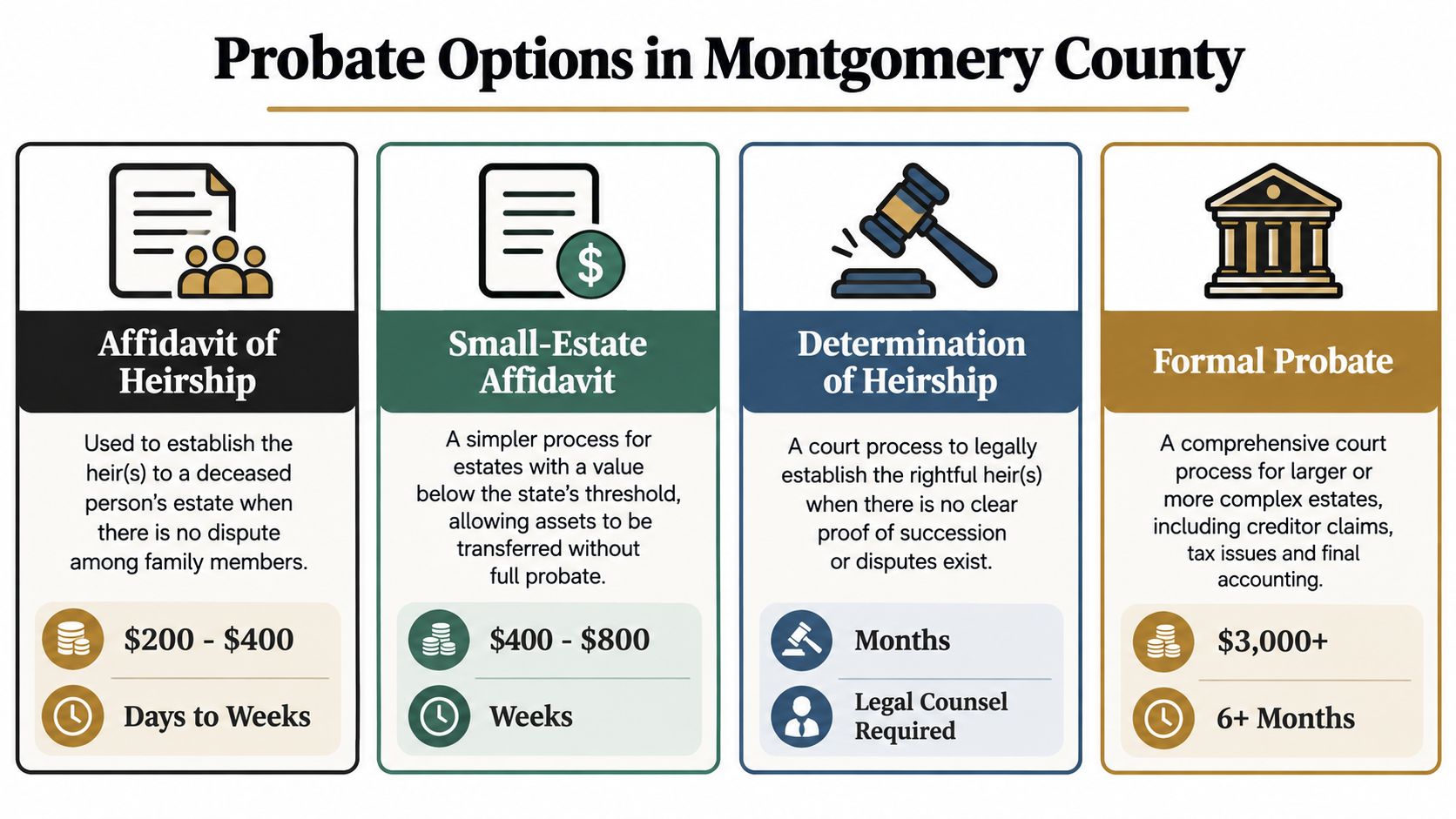
A small-estate affidavit serves a different purpose and shouldn't be confused with a real-property heirship affidavit. A determination-of-heirship suit asks a court to identify the heirs through a judgment. Formal probate administration provides court supervision for broader estate issues, including assets and debts that an informal filing can't adequately address.
The cost and timing estimates shown in the comparison graphic are not promises. Actual fees, attorney work, court requirements, and delays depend on the estate. The important trade-off is legal certainty. An affidavit may be completed without ongoing court supervision, while a determination or formal administration can produce an order that a lender or title company considers more definitive.
Problems that make the shortcut risky
The most damaging errors usually involve facts, not paper quality:
- Omitted heirs: A child, descendant, surviving spouse, or other heir left out can challenge the chain of title.
- Unresolved debts: An affidavit doesn't create the same creditor-notice structure as a formal administration.
- Property classification: Confusing community property with separate property can produce an incorrect distribution.
- Disputed family history: A sworn statement cannot substitute for a contested court determination.
- Third-party requirements: A lender or title company may still require a judicial order.
The recorded affidavit's full statutory evidentiary effect depends on the five-year recording period described in Texas Estates Code Chapter 203. That waiting period can be unacceptable when a family needs immediate financing or a sale.
A Muniment of Title may be appropriate when a valid will exists and the estate can be transferred under a court order without administration. Families considering that route can review the Muniment of Title resource for The Woodlands. The right choice depends on the will, debts, assets, and the requirements of the transaction.
Your Next Steps and When to Call a Local Attorney
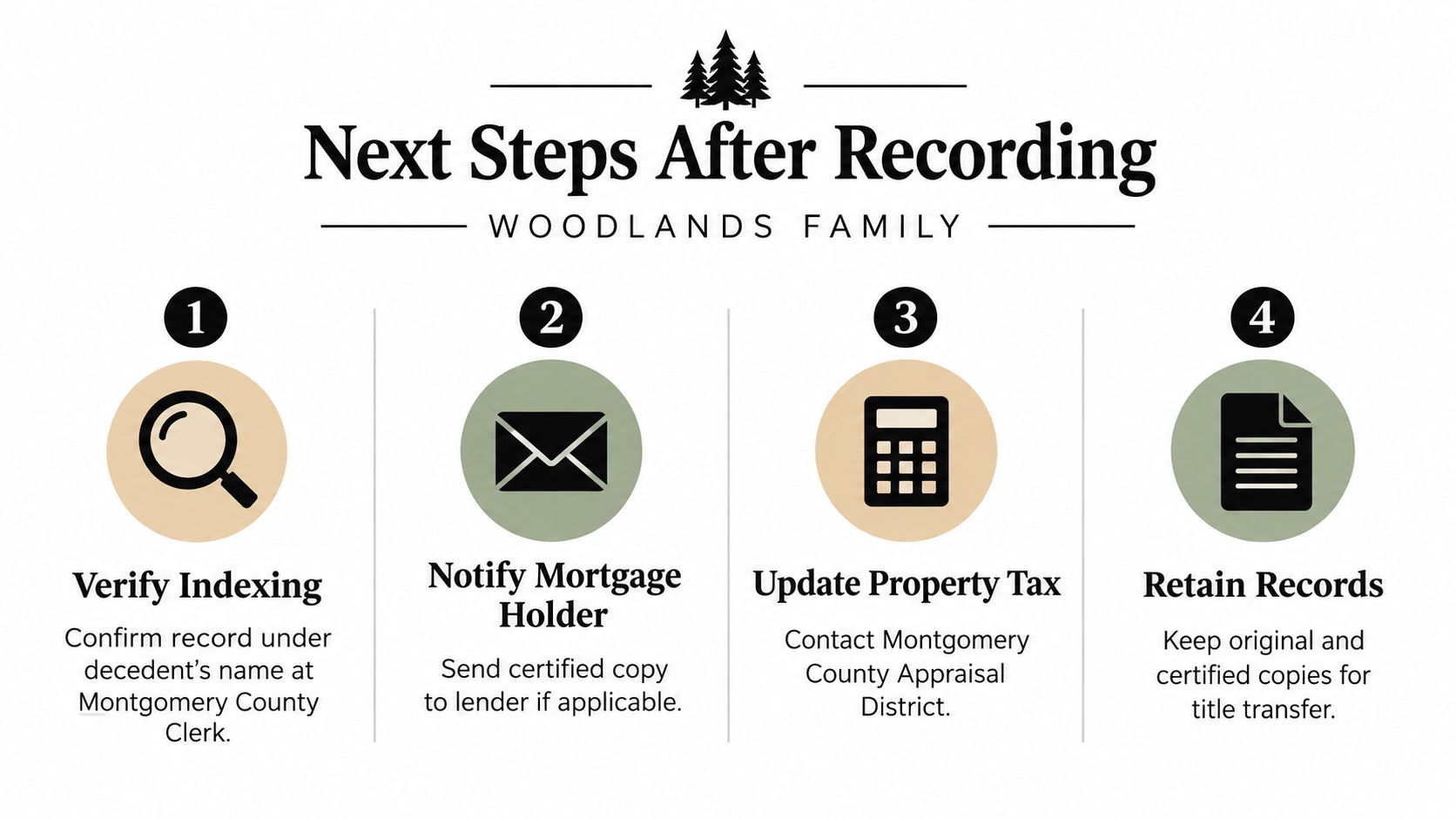
After recording, don't put the document away and assume the title issue is finished. Confirm that the Montgomery County Clerk indexed the filing under the decedent's name and that the property description appears correctly. Send the recorded or certified copy to the title company, mortgage holder if applicable, and any other institution involved in the transfer.
What to do next
- Verify indexing: Confirm the affidavit appears under the decedent's name in the Montgomery County Clerk's records.
- Notify the mortgage holder: Send a certified copy to the lender if a mortgage or servicing account remains.
- Review property records: Contact the Montgomery County Appraisal District about the property account, exemptions, and tax records.
- Retain the file: Keep the original, certified copies, death certificate, deed, and supporting family-history records together.
- Calendar the five-year milestone: Revisit the title record when the affidavit has been recorded for five years, because that period affects its statutory evidentiary weight.
DIY often runs out of road when there's a will, a blended family, a minor or incapacitated heir, creditor exposure, agricultural or mineral interests, a community-property question, or an earlier unrecorded transfer. Texas Estates Code Section 258.001 may also affect heirship challenges, so the family shouldn't rely on a limitations assumption without reviewing the specific facts.
This article is not legal advice. Recording requirements, heirship rights, title-company standards, and probate options depend on the circumstances, and a Montgomery County probate attorney should review uncertain facts before anyone signs.
The Law Office of Bryan Fagan helps families in The Woodlands and surrounding Montgomery County communities evaluate whether an affidavit of heirship, a Muniment of Title, or a court proceeding fits the estate. Visit The Law Office of Bryan Fagan to schedule a consultation before signing or filing when the family history, property title, or heir acknowledgments aren't straightforward.