 Skip to content
A child support hearing notice can make a normal day in The Woodlands turn stressful fast. You see court paperwork, a date, unfamiliar terms, and suddenly you are trying to guess what the judge will care about and whether you are already behind.
Most parents walking into a child support hearing montgomery county texas are not looking for a fight. They want a fair order, clear expectations, and a way to protect their child without getting buried in confusion. That is possible, but only if you treat the hearing like a facts-and-documents problem, not an argument contest.
Texas law gives the framework. Montgomery County procedure, local courtroom habits, and your preparation often shape the result. If you understand what the court is trying to decide, what papers matter, and where people make avoidable mistakes, the process becomes much less intimidating.
Navigating Your Montgomery County Child Support Hearing
The hearing notice matters immediately. It tells you the case is now moving on the court’s schedule, not yours. Whether you live in The Woodlands, Conroe, Magnolia, or another Montgomery County community, the safest response is to slow down, read every page, and start organizing.
What the notice usually means
Most hearings fall into one of a few categories. It may be an initial support case, an enforcement matter, or a request to modify an existing order. The court is usually trying to answer practical questions:
- Who should pay support
- How much support should be paid
- Whether back support or reimbursement issues exist
- Whether an older order should be changed
A hearing is not the time to show up with a loose story and hope the judge sorts it out. Judges want clear facts, reliable financial records, and focused testimony.
What works early
The first useful step is to put every document in one place. That includes the notice, petition, prior orders, pay records, health insurance information, and any communication from the Office of the Attorney General.
Bring order to the paperwork before you try to build legal arguments. Most weak hearings start with disorganized records, not bad facts.
If you have a lawyer, send the papers the same day. If you do not, calendar every deadline and start gathering financial proof now. Delay creates avoidable problems in family court.
The First 30 Days Filing Notice and Initial Deadlines
The first month after service is procedural. That does not make it minor. A strong child support case can get weaker quickly if the response paperwork is late, incomplete, or ignored.
Petitioner and respondent in plain English
The petitioner is the person who started the case. The respondent is the person answering it. If you were served, you are likely the respondent.
That label matters because respondents often assume they can wait until the hearing date to explain themselves. That is a mistake. You usually need to file a written response to protect your position and avoid giving the other side a cleaner path to the order they want.
Read the citation before anything else
Look closely at the citation and petition. Do not skim. Confirm:
- The court and cause number
- Who filed the case
- What relief is being requested
- Whether this is an OAG or IV-D case
- The hearing date, time, and location
If the case involves service problems, procedure can become more technical. Under Texas Family Code guidance on substituted service and notice in child support filings, Texas Family Code §102.009 allows substituted service when a respondent cannot be located, and OAG-related cases often require a 45-day notice period before a hearing can move forward.
Why the OAG may be involved
Parents often tell me, “We already had an agreement, so why is the state in this?” Sometimes the answer is not conflict between the parents. It is prior public benefits.
If the child has received certain state benefits, the case may move through an IV-D process even when both parents thought they were handling support privately. That changes the tone of the case. The paperwork may come from the Attorney General’s office, and the hearing may focus on formalizing support in a way private side agreements never did.
Net resources starts with your paycheck
Before the court can set support, someone has to calculate net resources. The easiest way to think about that is your pay after required deductions recognized under Texas law, not just the number printed at the top of your salary offer or gross income statement.
The court will want reliable proof of income sources and deductions. That can include wages and other qualifying income, along with deductions recognized by the statute.
Practical first-month priorities
- File your answer promptly: A timely answer keeps you in the case and preserves your ability to be heard.
- Request missing records early: Employers, insurers, and payroll departments do not move on your personal timeline.
- Check for prior orders: Many hearing problems start when someone forgets an older divorce decree or support order already exists.
- Separate facts from frustrations: Judges care about finances, child needs, and legally relevant history. They do not want a long relationship recap.
If your paperwork mentions the OAG, do not assume the hearing is informal or routine. Treat it as a real court matter from day one.
How Texas Law Calculates Child Support
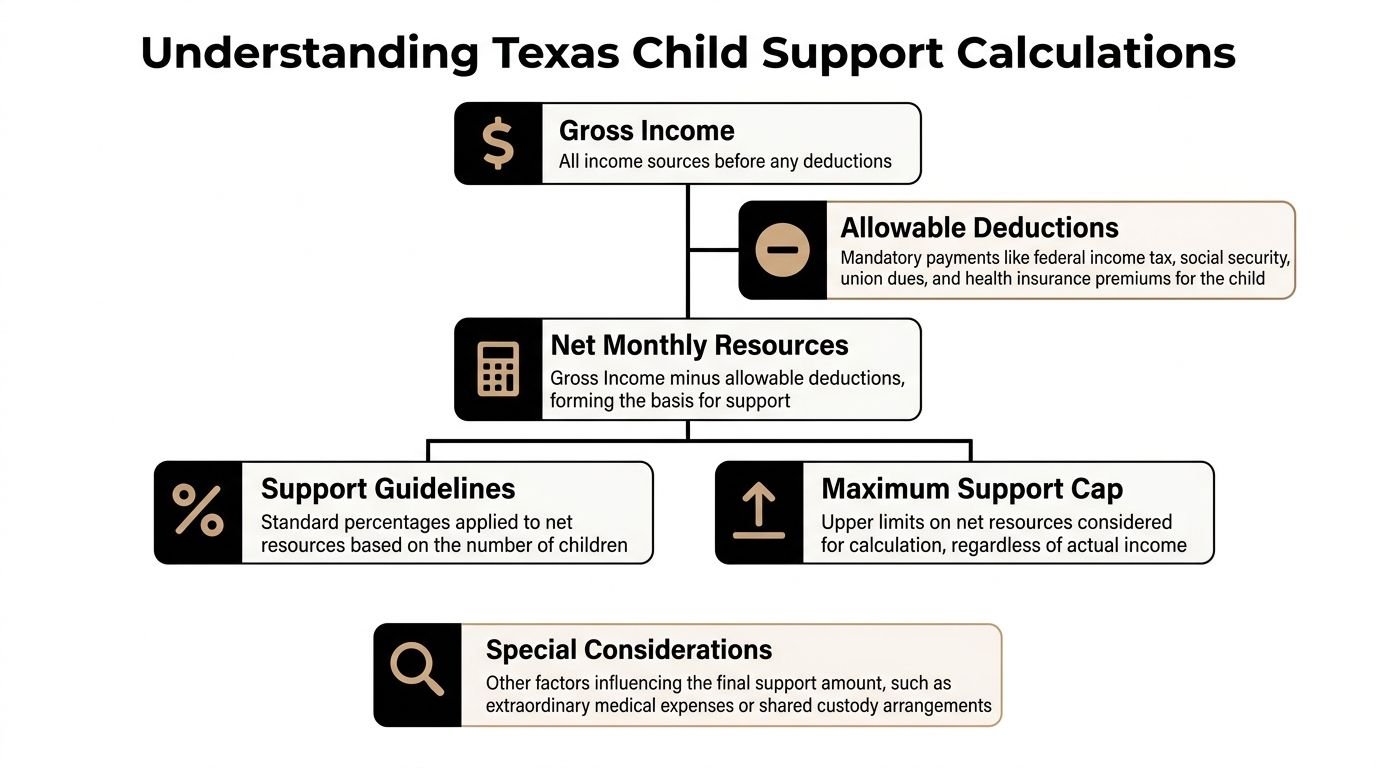
Most parents feel better once they understand the math. Child support in Texas is not pulled out of thin air. The court begins with net monthly resources and then applies guideline percentages under the Texas Family Code.
A parent in The Woodlands preparing for hearing often does best by thinking about this like a careful paycheck analysis. Start with all qualifying income. Then subtract the deductions the law allows. The result is the number the court uses as the support base.
What counts in the calculation
Under Texas child support guideline calculations for net resources, qualifying income can include wages, overtime, bonuses, rental income, dividends, and self-employment earnings. Net resources are calculated after subtracting mandatory items such as federal income tax, Social Security, union dues, and health insurance premiums for the children.
That is why good records matter. If you receive bonuses, commission income, or self-employment revenue, the court will want documentation. If you pay for the child’s health insurance, that should also be documented clearly.
The guideline percentages
Texas guideline support is based on the number of children before the court.
| Texas Guideline Child Support Percentages | Percentage of Net Resources |
|---|---|
| One child | 20% |
| Two children | 25% |
| Three children | 30% |
| Four children | 35% |
| Five or more children | 40% |
The same source explains that for obligors with net resources under $1,000 per month, those percentages are reduced by 5%.
A local example
Take a parent from Alden Bridge who earns salary income, occasional overtime, and a year-end bonus. If that parent walks into court with only a base-pay stub, the picture is incomplete. If that parent instead brings pay stubs, tax records, bonus history, and proof of insurance premiums for the child, the court gets a more accurate net-resources calculation.
That difference matters. Not because the judge wants paperwork for its own sake, but because a correct child support order starts with correct numbers.
When the court may move away from the guideline amount
Guidelines are the starting point, not always the ending point. Courts can deviate when there are unusual facts, such as a child’s special medical needs, significant educational costs, or circumstances involving parenting time and expense allocation.
A request to deviate needs proof. General complaints about cost of living usually do not carry much weight without records tied to the child.
For parents who want a deeper look at local representation options, Montgomery County child support attorney guidance can help frame what issues tend to matter most in these cases.
The court does not reward estimates when records are available. Exact pay information beats memory every time.
Gathering Your Financial Evidence and Documentation
Preparation wins more child support hearings than personality does. In Montgomery County, judges and child support officers want documents they can trust and a parent who can explain them without wandering off topic.

A short scenario from The Woodlands
Sarah is a teacher in The Woodlands. She is preparing for a hearing where support and medical costs are both in dispute. She knows her base pay, but she also receives supplemental pay during the school year and pays for the child’s coverage through her employer.
If Sarah walks in with only one recent pay stub, the court sees fragments. If she brings tax returns, W-2s, current pay records, health insurance premium details for the child, and records of child-related expenses, she gives the court a usable file.
That is the difference between hoping the judge understands and proving the point.
What to gather
Build a hearing folder with copies you can hand over if needed.
- Tax returns: Bring complete returns for at least the recent filing periods available to you. They help show annual income patterns, side income, and consistency.
- Recent pay stubs: These show current earnings, deductions, and whether overtime, commission, or bonuses appear regularly.
- W-2s or equivalent wage records: Helpful for confirming yearly compensation.
- Health insurance proof: If you pay premiums for the child, bring the statement or employer breakdown showing the child-related portion.
- Self-employment records: Profit and loss statements, invoices, account summaries, and business expense records may become critical if income is disputed.
- Expense records tied to the child: Medical bills, therapy invoices, school-related costs, and other child-specific expenses can matter when a party argues for a deviation from guideline support.
Presentation matters in court
Judges notice organization. So do opposing lawyers and OAG attorneys. A clean binder or folder with tabs is not cosmetic. It helps you answer questions quickly and keeps you from looking evasive when you are scrambling through papers.
For child-related spending, parents often do better when they keep receipts and summaries in a consistent format. If you need help documenting child care costs in a way that is easier to organize and present, a simple receipt template can be useful for your records.
What does not work
These are common problems I see:
- Incomplete income disclosure: Leaving out bonus or side-income information usually creates credibility problems.
- Screenshots without context: Random phone screenshots are rarely as persuasive as full statements or official records.
- Stacks of unsorted papers: If you cannot find your own exhibit when asked, your testimony loses force.
- Emotional arguments replacing proof: Saying the other parent is “hiding money” is not the same as proving it.
A practical way to get ready is to watch a walk-through of hearing preparation and use it as a checklist while you build your file.
Keep your tone as disciplined as your documents
The strongest parent in the room is often the calmest one. Not the loudest.
In family court, composure reads as credibility. A parent who answers directly and produces the document asked for usually makes a better impression than a parent with a stronger speech and weaker records.
Courtroom Strategy What to Expect on Hearing Day
Hearing day in Montgomery County usually feels less dramatic than people fear, but more formal than they expect. If your case is in a district court setting such as the 410th or 418th, expect a structured process, a busy docket, and a judge who values efficiency.
Before your case is called
Arrive early. Dress neatly. Bring your papers in order. Silence your phone. If you have exhibits, have them ready instead of buried in a bag or glove compartment.
You may see several people involved in the case process:
- The judge or associate judge
- An attorney for the other parent
- An attorney or representative connected to the OAG
- A child support officer in some settings
- Court staff handling scheduling and paperwork
If an agreement is possible, some discussion may happen before the hearing starts. If not, you need to be ready to state your position clearly and support it.
Why the OAG is in what felt like a private case
Many parents are caught off guard by the Attorney General’s presence. Under Texas Family Code §231.002 and IV-D court involvement when a child received public benefits, the OAG must intervene to establish or enforce support if a child has received state benefits such as Medicaid or TANF.
That means prior benefits can turn an informal parental arrangement into a state-involved support case. In court, that often shifts the conversation away from “we already agreed” and toward “what order complies with Texas law and addresses reimbursement or support obligations.”
How to answer questions effectively
The court usually responds best to short, factual answers. Examples:
- “Your Honor, these are my current pay stubs.”
- “The child is covered on my employer health plan, and the premium record is in Exhibit B.”
- “My position is that guideline support should apply.”
- “I am asking the court to consider these documented medical expenses.”
Do not interrupt. Do not argue with the other parent across the courtroom. Do not use hearing time to revisit every problem in the relationship.
Stay calm and factual. The court is deciding support, not awarding points for indignation.
Local practical trade-offs
In Montgomery County, parents sometimes hurt themselves by trying to win every issue instead of narrowing to the issues that matter. If the court accepts your income numbers but questions your claimed deductions, focus there. If support is the issue, do not spend ten minutes on old parenting disputes unless they directly affect the support question.
Another trade-off is settlement versus contested hearing. A reasonable agreement can save time, cost, and uncertainty. A bad agreement can lock in avoidable problems. The right answer depends on whether the proposed terms match the law and the actual financial facts.
If you are weighing whether to negotiate or present the issue to the court, The Woodlands child support lawyer resources can help you think through the likely hearing posture.
Think beyond the day itself
The hearing does not just produce a number. It creates an order that may affect wage withholding, future enforcement, and later modification. The way you present your case now can also shape how easy it is to revisit the order if circumstances change later.
That is why the best hearing strategy is long-term. Build a record you can live with.
After the Ruling Enforcement Modification and Next Steps
Once the judge rules, the case shifts from argument to compliance. The order should spell out the support obligation, who pays medical support if applicable, and how payment is to be made. Read the order carefully before assuming it says what you thought the judge meant.

Enforcement is part of the system
If support is ordered and not paid, enforcement may follow. That can involve court action focused on missed payments, arrearages, or failure to follow the prior order. Parents often wait too long here, hoping nonpayment will resolve itself. Usually it does not.
If you need to address nonpayment, Montgomery County child support enforcement information is one place to start understanding the available process.
Modification is possible when circumstances change
A child support order is not always permanent. Under Texas law on child support review and modification timing, an order can be reviewed every three years. A modification may also be sought sooner if there has been a material and substantial change in circumstances, which is often presumed when the newly calculated amount would differ from the current order by at least 20% or $100.
That matters in real life. Jobs change. Income rises or falls. A child’s needs develop. Insurance costs move. An order that made sense before may no longer fit.
Recent underemployment issues
Courts have also become more willing to examine whether a parent is deliberately earning less than they reasonably could. In modification disputes, that can affect how the court views income evidence, work history, education, and job efforts.
This is one reason casual under-the-table arrangements, vague testimony about reduced work, or missing employment records can create trouble. A parent asking for a reduction should expect close review.
What to do next
Use this checklist right away:
- Read the signed order line by line: Confirm the amount, start date, payment method, and any medical support terms.
- Set up compliance systems: Save proof of every payment made or received.
- Keep updated income records: Future modification requests often rise or fall on documentation.
- Track child-related changes: Medical, educational, and insurance changes can matter later.
- Act quickly if the order is not being followed: Delay often makes enforcement harder.
- Get legal advice before agreeing to changes outside court: Side agreements between parents often do not change the written order.
One final practical point
Many parents leave court feeling relief, then make a costly mistake by treating the order as flexible. It is not. Until a new order is signed, the existing one controls.
This article is not legal advice and does not create an attorney-client relationship. Every family, every judge, and every fact pattern is different. If you have a hearing coming up in The Woodlands or elsewhere in Montgomery County, focused case-specific advice can make the process much more manageable.
If you are preparing for a child support hearing or dealing with enforcement or modification issues, the The Law Office of Bryan Fagan works with families in The Woodlands and throughout Montgomery County on these matters. If you want to talk through the facts of your case and your next step, scheduling a consultation is a practical place to start.
