 Skip to content

You're trying to file for divorce, change child support, or address a custody problem, but the money available after rent and groceries won't cover court charges. For residents of The Woodlands, that can make an already difficult decision feel impossible.
A Montgomery County Statement of Inability to Afford Court Costs can help you move forward without prepaying qualifying charges. But it's a sworn financial filing, not a discount checkbox. The right approach is to document what you can afford, choose the appropriate payment option, and prepare for the possibility that someone will challenge your statement.
What the Statement Covers and What It Does Not
A filing-fee waiver can affect court costs such as filing and service charges. It does not pay every expense connected with a case.
| Cost item | Covered by the statement? | What to do |
|---|---|---|
| Clerk filing fee | Usually, if the statement is accepted and not successfully challenged | Check the fee for your case using this guide to Montgomery County divorce filing fees |
| Sheriff or constable service fees | Generally, under the same rule | Confirm which service method the clerk will use |
| Copies and certified documents | Usually, when treated as court costs | Ask the clerk before ordering large batches |
| Court-appointed professional fees | Subject to the court's appointment and payment orders | Review any order you receive |
| Privately retained attorney fees | Not covered | Make separate arrangements with your lawyer |
| Mediator, appraiser or expert fees | No automatic coverage for privately arranged services | Confirm the terms before hiring |
| Appeal record or bond | Separate appellate rules apply | Check whether trial-court approval applies to the appeal |
Texas Rule of Civil Procedure 145 governs relief from court costs, including filing, service, and other qualifying clerk or court charges, as explained in the Texas Rules of Civil Procedure. Montgomery County residents use that statewide process.
Court-appointed and privately hired charges follow different rules. A court-appointed professional's fees depend on the appointment and payment orders. A privately hired appraiser's bill does not become a court cost just because the case is in court. Treat the table as a budgeting tool. Court-appointed and privately hired charges follow different rules.
Who Qualifies and How Inability Is Judged
Eligibility turns on your financial circumstances, not merely whether your paycheck falls below a particular amount. The question is whether you can afford court costs while meeting necessities such as housing, utilities, food, and medical care.
Montgomery County doesn't use a separate county income chart for this filing. The Montgomery County Clerk's self-help resources direct residents to the statewide form and guided interview.
A complete filing is different from a judicial decision
The clerk processes your paperwork, but a judge resolves a disputed claim of inability to pay. The other party or clerk may challenge the statement, so the information must withstand more scrutiny than a quick review at the filing counter.
A steady paycheck doesn't tell the whole story. Neither does a low account balance on the day you sign. The court may need to understand your assets, necessary expenses, household contributions, and whether money listed in an account is accessible.
- Disclose savings: Don't omit an account because you've reserved it for an upcoming bill.
- Explain shared funds: Identify marital or household money and describe restrictions on your access.
- Show temporary hardship: A job loss or reduced hours needs a clear explanation, not just a lower income total.
Consistency matters. An unexplained mismatch between your accounts, income, and monthly expenses can make an otherwise understandable request harder to defend.
Gathering Proof of Inability to Pay
Gather your supporting records before you sign. You'll complete the form more accurately, and you won't have to reconstruct your finances under pressure if a hearing is scheduled.
Organize a folder by financial category. Keep the records in date order within each category, and put a short explanation beside anything that might otherwise look inconsistent.
Build a usable evidence packet
- Income: Collect recent pay statements, benefit award letters, and support-payment records. For irregular self-employment income, prepare a deposit summary and distinguish business receipts from money available for household spending.
- Accounts: Save bank statements showing balances and recurring debits. Identify transfers between your own accounts so they aren't mistaken for additional earnings.
- Necessary expenses: Include rent or mortgage records, utility bills, insurance premiums, childcare receipts, medical bills, and debt-payment records.
- Dependents: Keep documents identifying the children or other dependents you support, such as a child support order.
- Assets: Gather property records, vehicle information, and retirement statements. Don't leave an asset out merely because you believe it is exempt or difficult to sell.
Use the same underlying records when preparing other financial paperwork. A financial disclosure form may serve a different purpose, but contradictory account balances or income figures still need an explanation.
Explain the gap instead of hiding it
If your expenses exceed income, show how you're managing: borrowing, overdue bills, help from relatives, or withdrawals from savings. Otherwise, the judge may reasonably ask how those expenses are being paid.
Don't change a truthful estimate just because a receipt is missing. Identify it as an estimate, explain how you calculated it, and look for corroborating records. Every figure should have a traceable basis, even when the supporting evidence isn't perfect.
How to Complete the Statement Step by Step
The Texas Supreme Court's approved statement guidance explains that applicants should use the approved form, or a statement certifying the same information, and sign before a notary or under penalty of perjury. It also advises submitting available evidence supporting inability to pay.
Use this workflow to keep the form aligned with your records.
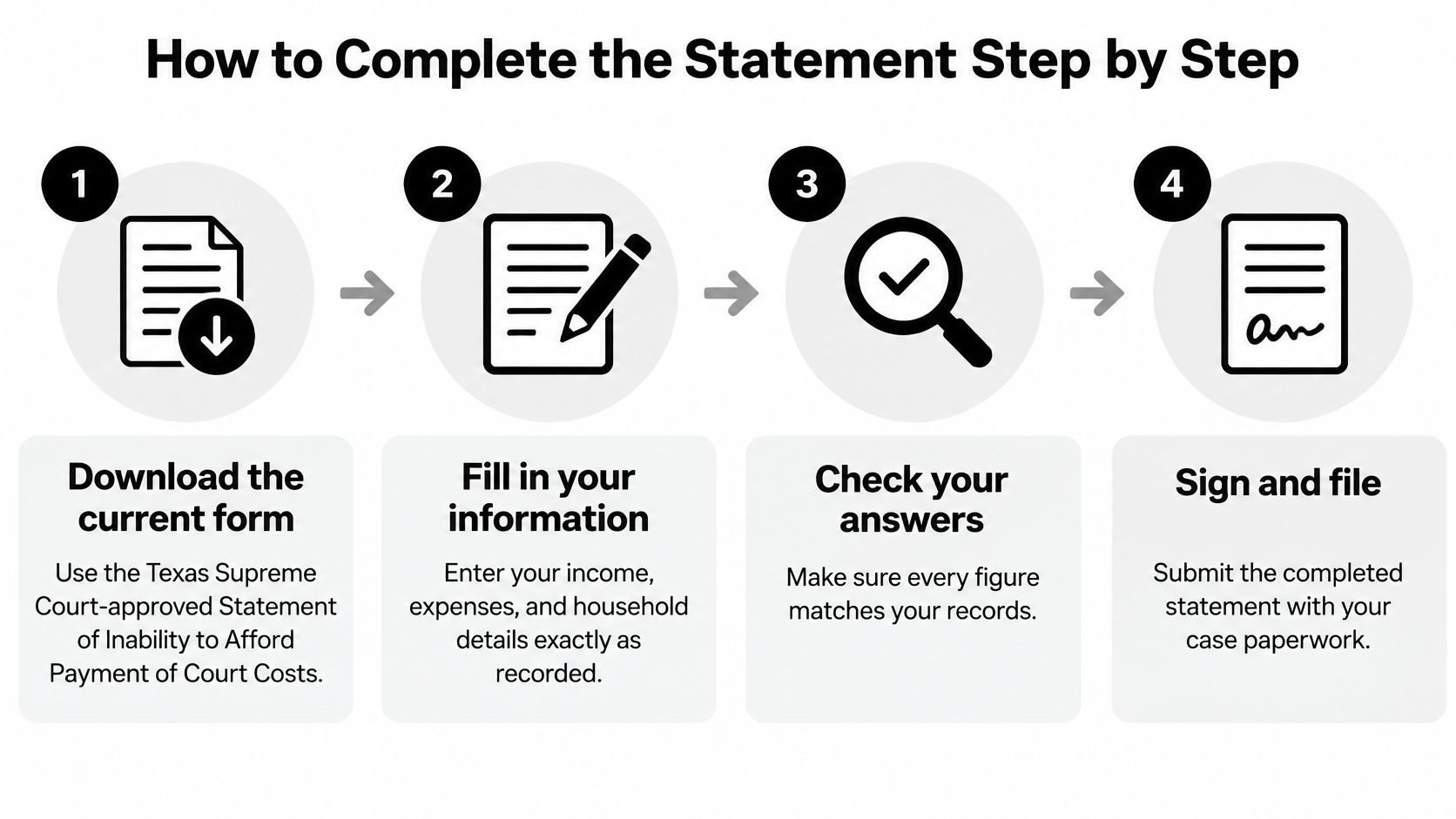
Get the current form. Use the Texas Supreme Court-approved Statement of Inability to Afford Payment of Court Costs or the county-linked guided interview. Avoid completing an old saved copy without checking its version.
Enter income from every applicable source. Include wages, benefits, support payments, and self-employment income as the form directs. Explain fluctuations rather than choosing an unusually low month without context.
Disclose property and accounts. Include bank balances, vehicles, and other requested assets. If you can't access an account or sell an asset readily, explain that restriction instead of omitting it.
Calculate monthly expenses consistently. Use rent or mortgage, utilities, insurance, debt payments, childcare, and medical records. Don't compare weekly income with monthly bills or count the same expense twice.
Choose the payment statement that fits. The official Texas statement includes options for inability to pay, ability to pay only some costs, and payment over time in installments. Temporary hardship doesn't require an inaccurate claim that you can never pay anything.
Identify the request's scope. Check whether you're addressing trial-court costs or an appeal bond or cash deposit. Don't assume those requests are interchangeable.
Review, sign, and retain a copy. Follow the form's oath or penalty-of-perjury instructions. Compare the completed answers with your documents before signing, not afterward.
Full waiver, partial payment or installments compared
| Option | Use it when | What it means |
|---|---|---|
| Full waiver | You cannot pay any listed court cost now | The clerk dockets the case without prepayment unless the court orders payment |
| Partial payment | You can pay some costs but not all | You identify what you can pay; the court determines any required payment |
| Installment payment | Your hardship is temporary, including job loss or disputed access to marital funds | You follow the payment schedule in the order; appellate treatment requires checking the applicable rules |
Partial payment isn't a failed waiver request. It may be the most accurate description of your circumstances. Choosing it is better than understating income or concealing available funds to support an all-or-nothing claim.
Filing in Montgomery County and Handling a Challenge
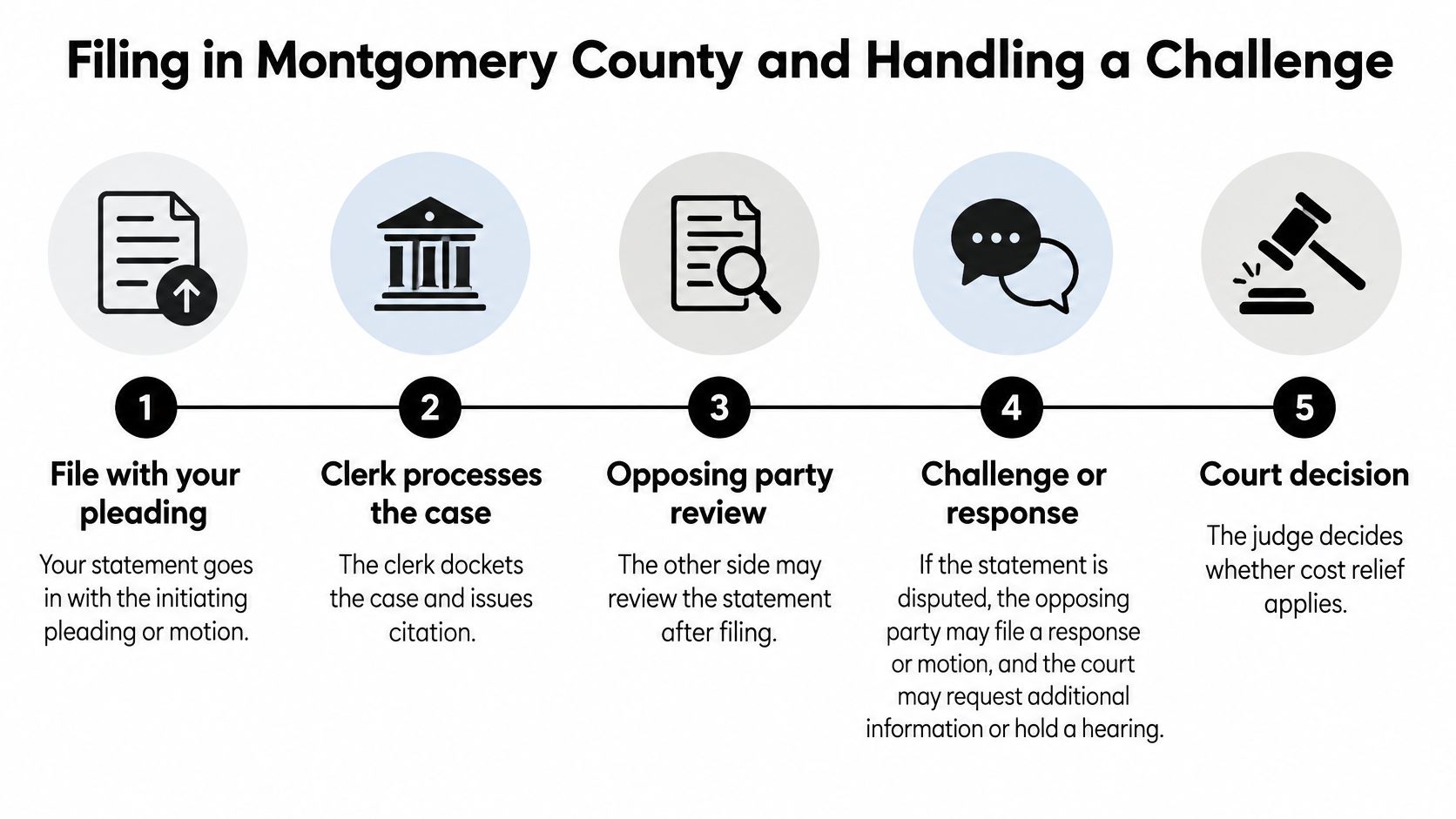
If you file a statement with a petition or motion in Montgomery County, keep a copy showing when it was filed. Check that it reaches the correct clerk, and review the filing requirements for your case using the Montgomery County family court forms required at filing. A cost statement does not replace other required paperwork.
The Texas Supreme Court's Rule 145 order says a filer cannot be required to pay costs without a court order. Before an oral evidentiary hearing on such an order, the filer must receive at least 10 days' written notice under Rule 21a, or notice in open court. At the hearing, you must prove that you cannot afford the costs.
Filing timeline and your action at each stage
| Stage | What happens | Your action |
|---|---|---|
| Filing | The statement accompanies the initiating pleading or motion; the clerk dockets the case and issues citation | Keep a file-stamped copy |
| Challenge | The other side or clerk contests the statement | Monitor notices and the docket, then respond promptly |
| Hearing notice | Notice identifies the hearing and how to attend | Gather evidence and calendar the hearing |
| Evidentiary hearing | You must prove inability to pay | Bring organized evidence and a summary of income and expenses |
| Court order | The court may order payment, partial payment, or installments | Follow the order's schedule and keep a copy |
Preparing for the Hearing
Bring records that support your sworn answers, along with a concise summary of current income, necessary expenses, assets, and access to money. Be ready to explain recent changes in your finances, unusual deposits, and help from other household members.
If the hearing date is announced in open court, write it down immediately and note the attendance instructions. The Law Office of Bryan Fagan serves clients in The Woodlands and across Montgomery County, including people considering whether to seek counsel for a challenge.
How the Statement Affects Divorce, Custody and Support Cases
A Sterling Ridge parent whose pay has been cut files to modify child support. The parent's sworn statement describes the current financial circumstances, while the support paperwork must explain why the existing order should change. Keep the figures consistent, or clearly explain any difference.
A statement about court costs addresses ability to pay qualifying fees. The court still decides the merits of the divorce, custody, or support request under the law that applies to that case. In custody litigation, for example, the evidence must support the requested arrangement.
The Texas Supreme Court's Rule 145 materials explain how a properly filed statement can allow ordinary clerk services without prepayment, unless the court orders otherwise. Treat the statement as sworn evidence: disclose shared or disputed funds accurately, and be prepared to explain what money you can access.
In a support-modification case, changes in income should be reflected consistently across the cost statement and the financial information submitted with the case. If the numbers differ because one document covers a different period or measures income differently, explain why.
Match the financial request to the underlying case
Divorce, custody, and support filings address different legal issues. Identify the relief you are asking the court to order, and make sure your petition and supporting documents address that request. Probate matters follow a different legal process under the Texas Estates Code, so confirm the case type before selecting forms.
The video below discusses Montgomery County family court procedures and can help you understand how local family cases proceed.
The Montgomery County Family Courts: A Local Guide explains how family cases proceed in courts serving The Woodlands. The Law Office of Bryan Fagan handles divorce, child custody, property division, and child support modifications, including complex divorce and custody matters.
Mistakes That Undo a Cost Waiver
Some filing mistakes can weaken a cost-waiver request even when the financial hardship is genuine. A wrong form version, unanswered fields, or arithmetic that does not add up can make the sworn statement harder to assess. Use the current approved form, answer every applicable question, and check that each total is consistent.
One issue deserves separate attention: appeal costs. A partial-payment or installment order may affect appellate costs while it remains in effect. Read the order closely and check the appellate filing requirements before relying on it.
Preserve the record you may need
Keep the signed statement, supporting documents, filing confirmation, court orders, and clerk notices together. Save correspondence about service and any payment required by an order. If the case proceeds to an appeal, bring the order to the lawyer handling that filing and ask how it applies to the appellate costs.
Confirm Your Next Filing Step Before You Sign
Decide what you can truthfully pay before signing. The statement is sworn, and the court can challenge whether your finances support the relief you request. Choose full relief, partial payment, or installments based on what you can pay now and what you can manage over time.
What to do next
- Choose the relief you are requesting: State whether you seek full relief, partial payment, or installments, and make sure the request matches your circumstances.
- Complete and sign the form: Follow its oath or penalty-of-perjury instructions, then save a copy of the signed statement.
- Keep a filing record: Save the filed copy and any order deciding your request.
- Get advice if the request is challenged: Legal guidance can help you prepare for a hearing, especially when the case involves disputed support, custody, or property.
Discuss the filing before you commit
The Law Office of Bryan Fagan offers a free, confidential consultation. You can discuss your circumstances under the attorney–client privilege and ask about your legal rights. Schedule by calling (281) 819-1726 or completing the firm's online contact form.
The firm serves clients in The Woodlands and across Montgomery County, including Panther Creek, Alden Bridge, Sterling Ridge, and Creekside. Bring your draft statement and available financial records so the discussion can focus on your request and the case behind it.
This article provides general information, not legal advice. Confirm the requirements for your situation with a licensed attorney.
The Law Office of Bryan Fagan offers a free, confidential consultation to discuss your financial circumstances and the family-law case behind your court-cost request. Visit The Law Office of Bryan Fagan or call (281) 819-1726 to schedule a consultation before you sign or respond to a challenge.
