 Skip to content

If you've paid for sheriff service, does that mean your spouse has been legally served? No. Payment, an attempted visit, and valid service are different events, and confusing them can derail a divorce or custody case.
For families in The Woodlands, Montgomery County Sheriff Civil Division service of process starts with choosing an authorized server and confirming the right charge. It ends with checking what happened and what the issuing court has on file. A receipt proves you submitted something. It doesn't prove the court can proceed against the respondent.
Who Can Serve Papers in Montgomery County
Choose the server before making a trip to Conroe. The sheriff isn't the only option for an ordinary family-law citation, and an official badge doesn't guarantee a faster attempt.
Under Texas Rule of Civil Procedure 103, authorized options include sheriffs, constables, certified process servers, clerk service by registered or certified mail, and a person at least 18 years old authorized by written court order; a party or person interested in the case generally can't serve the citation.
Who may serve civil process for a Montgomery County case
| Server | Best local use | Limit |
|---|---|---|
| Sheriff Civil Division | Citations, notices, writs, and orders anywhere in Texas, including enforcement | A party or interested person cannot serve; the officer must file a return |
| Constable | Same civil authority as the sheriff; confirm which constable covers the service address | Same authorization limits; the charge is a county fee, not a private quote |
| Certified process server | Routine divorce, custody, support, and modification citations | Not the default for eviction or physical enforcement unless the court allows it |
| Clerk by registered or certified mail | Mail service when the rules allow the clerk to send it | Doesn't replace personal service when personal service is required |
| Adult authorized by written court order | Special service after a judge signs an appropriate order | Must meet the age and disinterest requirements and act within the order |
Match the server to the paper
A routine divorce citation directed to a respondent in Panther Creek may be suitable for a certified process server. A writ requiring physical enforcement calls for a different choice. Eviction citations and enforcement process generally belong with a sheriff or constable unless the court authorizes otherwise.
For routine citations, compare availability, communication, address coverage, and reporting, not just price. Ask how you'll learn that an attempt failed and how the completed paperwork will reach the court. A private server's quoted availability can be useful when scheduling matters, but don't confuse a proposed attempt date with guaranteed service.
The local guide to serving divorce papers in The Woodlands and choosing a constable precinct provides additional context for that decision.
Check the state before trusting the page
Search results mix Montgomery County, Texas with Tennessee and other jurisdictions. Check the government's state, the issuing court, and the office receiving payment before using any instructions.
Practical rule: A deposit shown on another Montgomery County clerk's website isn't proof of this sheriff's charge.
Pick the appropriate server category, then verify the current charge for the actual paper you need served.
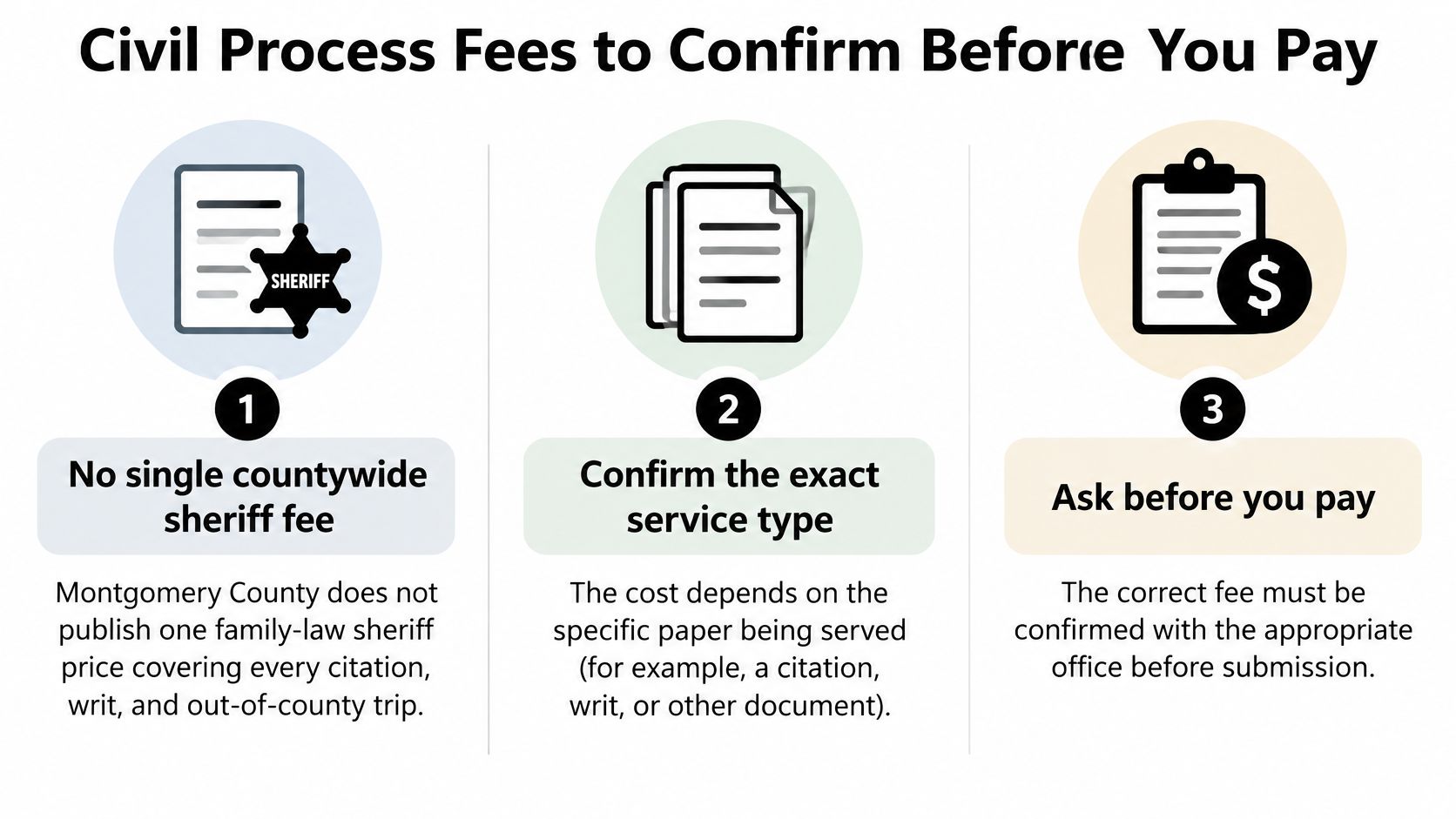
Civil Process Fees to Confirm Before You Pay
Montgomery County Justice of the Peace Precinct 4 publishes a $75 service fee per defendant for small-claims cases on its civil fee schedule. That's a specific precinct charge for a specific case category, not the Sheriff Civil Division price for a divorce citation.
There isn't one published family-law sheriff price that safely answers every citation, writ, and out-of-county request. Confirm the Sheriff Civil Division charge by phone before writing a check, and identify the paper rather than asking what it costs to serve someone.
Separate the charges before comparing prices
Under Texas Local Government Code section 118.131, commissioners courts set reasonable sheriff and constable fees that cannot exceed the necessary cost of providing the service; fees generally may change no more than once annually and must be set before October 1 for the following calendar year.
The Texas Comptroller's civil-service fee reporting program collects county schedules and publishes the Sheriffs' and Constables' Fees Dashboard. Use the current county schedule and that dashboard to check a quoted governmental fee, rather than treating an old blog post as the current price.
Charges to confirm before service in Montgomery County
| Charge | What is known | Confirm with |
|---|---|---|
| Sheriff or constable civil service | Locally adopted governmental charge under the statute, not a private market price | Sheriff Civil Service or the current county schedule and Comptroller dashboard |
| JP Precinct 4 small-claims service | The precinct publishes a per-defendant small-claims service charge | Justice of the Peace Precinct 4 fee schedule |
| Clerk filing fee | Separate from service; prepare a separate check | District, county, justice, or probate clerk handling the filing |
| Private process server | Market quote outside the county fee schedule | The certified server, in writing |
| Service outside Montgomery County | A local payment may not cover service in another county | Issuing clerk and the destination county's service office or certified server |
Use these distinctions when checking the payment instructions.
Ask what the payment actually covers
A deposit isn't necessarily the final cost. Ask whether the amount quoted is the full charge or an advance, who should receive the check, and whether a new address or reissued paper requires another payment. Don't assume an unsuccessful attempt produces a refund or transfers automatically to another server.
For an out-of-county respondent, ask whether the local office will undertake service or whether the papers and payment should go directly to the destination county or a certified server. Legal authority to serve statewide doesn't tell you how a particular office accepts and routes requests.
The Divorce Process in The Woodlands: What to Expect offers a step-by-step look at filing locally. Keep the filing expense separate from the expense of delivering the citation.
Before calling, have the process type, number of people to serve, and whether any address is outside Montgomery County ready. Those details make a fee answer useful.
How to Submit Papers to the Sheriff Civil Division
Start with court-issued process, not just a copy of the petition you filed. The citation, writ, order, or subpoena determines what the server is being asked to deliver or enforce.
The Montgomery County Civil Service contact page lists Sheriff Civil Service at 501 North Thompson, Suite 400, Conroe, with weekday hours of 8:00 a.m. to 5:00 p.m. and telephone (936) 539-7886. Call before a special trip to confirm intake arrangements and payment instructions.
Build the packet around the issuing court
Identify the issuing clerk. Use the district court, county court at law, justice court, or probate filing office responsible for your case. Residents of The Woodlands handling probate must file through the Montgomery County Clerk's office in Conroe. Don't route probate papers as though they were a district-court divorce citation.
Read the issued paper against your records. Check the respondent's exact name, the case number, the issuing court, and the service address. Include an apartment or unit designation when needed, and distinguish a mailing address from a place where the respondent can be found.
Check every attachment. Confirm that the petition and other required documents accompany the citation. Don't assume the server can retrieve missing documents from an electronic filing.
Use the correct request form. If the District Clerk issued the process, use that clerk's Request for Service form rather than substituting a handwritten delivery note. A civil subpoena form belongs with a subpoena request, not an ordinary divorce citation.
For a parent starting a new case, the guide to filing for custody can help distinguish the filing work from the later service request. The service office isn't the place to decide which custody pleading you need.
The intake sequence should follow the paperwork, not the other way around.

Submit a packet you can track
Confirm the charge and prepare the service payment separately from the filing payment. Before sending anything, ask whether the clerk transmits the issued process or whether you must deliver it to Civil Service. That question prevents both duplicate requests and papers sitting in the wrong office.
Keep a complete copy of what you submit, including the request form, attachments, and payment record. Retain the intake receipt or mailing tracking information. Your records should let you identify exactly what the office received without reconstructing the packet later.
Useful locating information belongs in the service request, not buried in unrelated pleadings. Provide a known work address or factual access instructions when appropriate. Avoid guesses presented as confirmed facts, and don't contact or confront the respondent to manufacture an encounter.
A clean packet helps the server act. It doesn't cure an address where the respondent no longer lives.
Follow the request through to the docket
Watch the issuing court's docket for the service paperwork. Don't assume the clerk will call when a return arrives, or that silence means the officer is still working on it.
If the address changes, contact the office handling the request before paying someone else to start over. Ask how to update or withdraw the pending assignment and whether the clerk must issue corrected process. If the citation has become stale or was improperly issued, ask about reissue rather than sending the same defective packet out again.
The recurring failure points are straightforward: incomplete address, missing petition, wrong person, stale process, and no filed return. Check each one before asking the court to act.
The county contact page doesn't publish a sheriff-service completion timeline, success rate, or promised number of attempts. If a hearing is approaching, tell counsel promptly and ask the service office for the actual status rather than relying on an assumed turnaround.
What a Return of Service Does and Does Not Prove
An attempted visit isn't completed service. A text saying an officer knocked at the door is useful status information, but it isn't the court document establishing how process was served.
The Texas Rules of Civil Procedure require an officer's return to be completed and filed with the issuing court at least one day before the scheduled trial. That requirement isn't permission to seek a default immediately after filing the return; other response and default requirements must also be satisfied.
Read the result rather than the status label
A usable return identifies the case, when the server received the process, the place and manner of service, and the server. Read those details against the citation and any service order. A docket label that says service returned doesn't tell you whether delivery succeeded.
Service outcomes and the next lawful step
| Result | Effect on the case | Next step |
|---|---|---|
| Not served and no real attempt logged | That request establishes neither personal jurisdiction nor an answer deadline | Confirm the address and ask the clerk about reissued process |
| Attempted but unsuccessful | The attempt is not valid service | Supply a better home or work address, or ask counsel about substituted service |
| Served but defective | A claimed deadline or default may be vulnerable | Determine whether the return can be corrected or service must be repeated |
| Valid return filed | The response clock can run from the applicable service event | Check the issuing court's file and calendar the correct deadline |
| Waiver or court-ordered alternative | Ordinary citation service may be unnecessary when the waiver or order is valid | File the valid waiver or follow the order's method exactly |
An unsuccessful attempt doesn't start a divorce or custody answer deadline or support a default merely because someone paid for it. It also doesn't establish personal jurisdiction through service. A respondent's separate appearance or valid waiver raises different questions.
Distinguish a paperwork error from a delivery error
A return may contain an omission even though delivery occurred correctly. Conversely, a carefully completed return can describe delivery to the wrong person or an unauthorized method.
Those problems don't have the same cure. Counsel may be able to seek correction of an inaccurate return, but changing paperwork can't turn an event that never happened into valid delivery. Missing required attachments or serving the wrong recipient may require another service effort.
Before seeking default: Compare the filed return with the issued citation and every applicable service order.
For substituted service, preserve the server's account of dates, addresses, and unsuccessful efforts. Counsel can use that record to assess whether a motion is supported. Repeating an unexplained visit to an abandoned address is less useful than documenting why ordinary service hasn't worked.
Posting, email, or leaving papers with a neighbor doesn't become authorized just because the respondent is difficult to locate. For court-ordered substituted service, obtain the order first and follow its method precisely.
Finally, filing the return doesn't itself set the service date. Calendar from the legally relevant event documented in the record and verify applicable court requirements. Don't calculate from the day you mailed a check, and don't treat the officer-return filing requirement as the only deadline that matters.
Family Law Tips and What to Do Next
Say a Sterling Ridge spouse files for divorce and requests sheriff service at an Alden Bridge apartment the other spouse left months ago. While preparing for prove-up, the filing spouse discovers an unsuccessful-service return rather than proof of delivery. The useful next step is a current address or an appropriate waiver, not another copy of the same citation sent to the same empty apartment.
Keep the service receipt with your case papers, but check what the court received.

Choose the family-law solution that fits
For a cooperative divorce, Texas Family Code section 6.4035 permits a waiver of service subject to its requirements. A waiver addresses service; it isn't automatically an agreement to property division, custody, or support. It's not a practical substitute when the other spouse won't cooperate.
Custody and support cases also require attention to who is entitled to citation under Texas Family Code section 102.009. For a modification, give counsel the parent's actual current location, including a Creekside or Panther Creek rental, rather than assuming the address in the old order remains accurate.
Probate citation and notice follow the Texas Estates Code and the particular application. Don't assume a divorce waiver form works for an estate proceeding. Protective orders have a separate local intake path: in Montgomery County, the case is filed through the County Attorney's Office and requires at least one preparation appointment and one court appearance.
Respondents should also understand what to do after being served divorce papers in The Woodlands. Ignoring papers because spouses are talking about settlement can leave important deadlines unaddressed.
Use the accompanying video alongside a review of your own case documents.
What to do next
- Use an authorized server. Don't serve your own citation.
- Verify payment instructions. Confirm the fee and payee by phone before paying.
- Diary a docket check. Look for the filed return, not just an intake receipt.
- Pause a default plan. An unsuccessful attempt or defective return needs review.
- Consider cooperation. Ask about a divorce waiver before buying another attempt.
- Check probate requirements. Confirm the required citation or notice before requesting sheriff service.
- Get advice on alternatives. Ask counsel before requesting substituted service.
This is general information about public Montgomery County procedure, not legal advice. The proper next step depends on your issued papers, service history, court orders, and case posture.
The Law Office of Bryan Fagan handles divorce, child custody, property division, and child support modifications for families throughout Panther Creek, Alden Bridge, and Sterling Ridge. For help evaluating a server choice, unsuccessful attempt, or service problem, visit The Law Office of Bryan Fagan and use the online contact form, or call (281) 819-1726 to schedule a free, confidential consultation.
