
A parent in Sterling Ridge may be ready to ask a judge for a clear schedule because the other parent keeps changing plans, or because a safety concern can't wait. The first move isn't guessing which courthouse is closest. It's identifying the right type of case, checking whether Texas has authority to hear it, and asking for specific orders the court can actually make.
For families in The Woodlands, Conroe, and nearby Montgomery County communities, how to file for custody starts with those decisions. A child's current address matters, but it doesn't settle every question about which state or court should handle the case.
Who Can Start a Custody Case in The Woodlands
A parent in The Woodlands who needs custody orders and isn't already addressing custody in a divorce will generally start an original Suit Affecting the Parent-Child Relationship, or SAPCR. A SAPCR is the Texas court proceeding used to request orders about conservatorship, possession and access, and child support. The Texas State Law Library's custody and support guide explains that a parent seeking custody or visitation orders generally files a SAPCR when those issues aren't already part of a divorce case.
That distinction matters. If parents already have a divorce case on file, they normally address custody within that case instead of opening a separate original custody case. For example, if a Sterling Ridge parent and their spouse are divorcing and haven't resolved a parenting schedule, the divorce case is the place to request those orders. Starting a second, separate custody case can send the family down the wrong procedural path.
What the petition should ask for
Texas gives mothers and fathers equal parental rights and presumes parents should be appointed joint managing conservators. That phrase concerns shared decision-making authority. It does not automatically mean equal physical possession or a 50/50 parenting schedule. The court's orders can assign decision-making responsibilities and set a separate possession schedule.
So don't rely on a vague request for “full custody.” Tell the court what you're asking it to order. A petition should identify the requested conservatorship arrangement, the possession and access schedule, whether child support is requested, and the specific facts supporting any restrictions or emergency relief.
The court needs a workable request, not just a label. If you want exchanges at a particular location or limits on contact, explain the requested terms and the facts that support them. A clearer proposal gives the court something concrete to evaluate.
Practical rule: “Joint managing conservators” doesn't answer how many days the child spends with each parent. Ask for decision-making and possession terms separately.
The right to start a case is also different from the question of where the court has authority to hear it. A parent may be eligible to seek orders but still need to resolve an existing case, an existing order, or an interstate jurisdiction issue before filing in Montgomery County. This is general education, not legal advice for your family's specific circumstances.
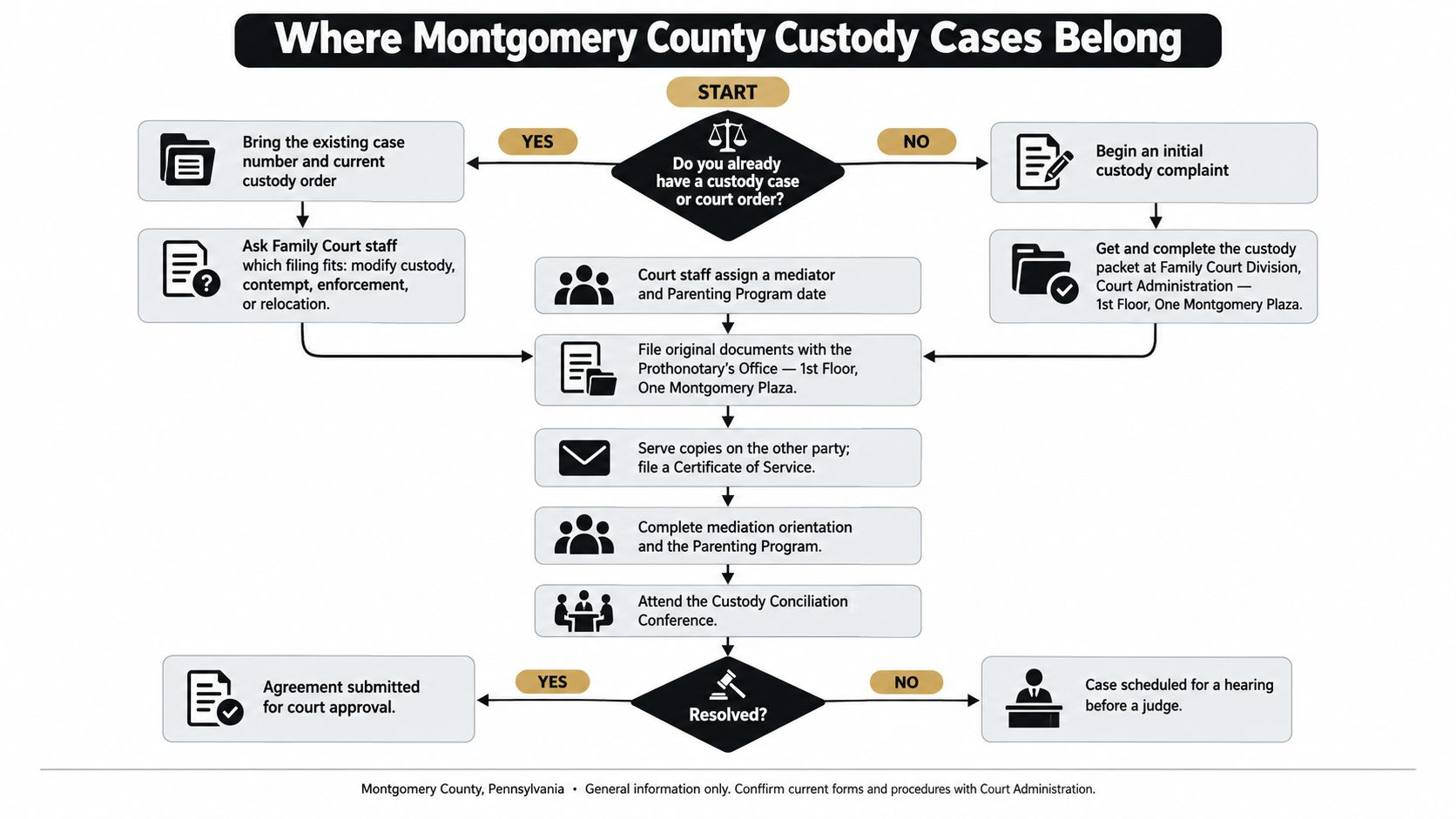
Where Montgomery County Custody Cases Belong
A child living in The Woodlands today doesn't automatically mean a Montgomery County court can decide every custody issue. First separate jurisdiction, the court's authority to hear the case, from venue, the proper county and court location for filing. Under the home-state rules described by TexasLawHelp's SAPCR guide, Texas may be the child's home state if the child has lived in Texas for at least six months, or, for a child younger than six months, since birth. A child who has been away from Texas for less than six months may still have Texas as a home state.
Once Texas is the proper state, the child's residence helps identify the county for filing. A family with a child living in Conroe, The Woodlands, or a nearby Montgomery County community will generally look to the appropriate Montgomery County court. Custody cases are usually handled in district court, though some counties use statutory family courts or county courts at law. Check the correct Montgomery County court before filing. County venue and statewide jurisdiction are related, but they aren't interchangeable.
Check interstate issues before choosing the county
A recent move, a military relocation, a temporary stay, an order from another state, or a case already pending elsewhere can change the filing analysis. The Uniform Child-Custody Jurisdiction and Enforcement Act decision guide lays out separate jurisdiction pathways, including home state, significant connections, a more appropriate forum, and temporary emergency jurisdiction.
In plain English, check the situation in this order: Is there an emergency? Is there already an order or another pending case? If not, which state has initial jurisdiction? Texas Family Code Chapter 152 governs interstate child-custody jurisdiction. Don't assume that a child's physical presence in Montgomery County today answers those questions.
Emergency jurisdiction is generally temporary. It doesn't automatically transfer the case from the state with authority over the child's long-term custody, or replace an existing home-state order. Filing in the wrong state can lead to delay, dismissal, or conflicting orders, even if the child is in The Woodlands when you file. For questions about local venue, see this explanation of which venue may apply between Conroe and The Woodlands.
Preparing the SAPCR Petition and Service
Once you've confirmed the right case type and court, prepare a filing package the clerk can process and the other parent can properly receive. The starting document is the Petition in Suit Affecting the Parent-Child Relationship. Complete it with the orders you're asking for, make copies, and check whether an out-of-state-party declaration applies. TexasLawHelp's guide to getting a custody order as a parent describes the petition, fees, fee-waiver option, and service process.
If you or a respondent lives outside Texas, an out-of-state-party declaration may be required. It's conditional, not a form every Montgomery County parent automatically needs. You can generally file electronically or with the district clerk, but verify the court's current filing method and local requirements before submitting your packet.
Match each paper to the job it does
| Paper | When it applies | What it does |
|---|---|---|
| SAPCR petition | For an original custody case that isn't already part of a divorce or existing SAPCR | Tells the court what orders you're requesting |
| Out-of-state-party declaration | When the filer or a respondent lives outside Texas, if required | Supplies information relevant to the out-of-state party |
| Statement of Inability to Afford Payment of Court Costs | When you can't afford applicable court costs | Asks the court to waive costs |
| Proof of service | After the other parent has been served | Documents that the required notice was delivered |
The filer generally pays a filing fee, plus issuance and service fees when the other parent must be served. Fees vary by county, so confirm current amounts with the Montgomery County district clerk rather than relying on figures from a generic guide. If you can't afford the costs, ask about filing a Statement of Inability to Afford Payment of Court Costs.
In a contested case, the other parent generally needs personal service of the initial papers. A sheriff, constable, or authorized process server delivers them. Mailing the petition or handing it to the other parent yourself isn't the same as formal personal service. Weak or incomplete notice can delay the case or leave the court without a valid basis to proceed against the other parent.
Keep the paperwork local and current. Use the court's applicable forms and filing directions, and confirm the current requirements for Montgomery County with the clerk. This Montgomery County family-court filing forms guide can help orient you to the filing materials.
If a custody order already exists, don't use this original-petition route. The usual path is to request a modification in the court handling the existing SAPCR.
Asking for Temporary and Emergency Orders
A pending SAPCR doesn't always give parents the immediate structure they need. Texas Family Code Section 105.001 allows a court to issue temporary orders addressing a child's safety and welfare, including temporary conservatorship and temporary child support. Those orders can set interim rules while the court considers the final arrangements for conservatorship, possession, access, and support. Read the text of Texas Family Code Section 105.001 when preparing a request.
A parent in The Woodlands who believes a child faces an immediate safety problem can ask the court to address temporary conservatorship or possession while the case is pending. But calling a request “urgent” doesn't make the court grant it. State the facts, not just the conclusion: identify relevant dates, describe what happened, and say precisely what protection or temporary rule you want.
Make the requested order usable
Temporary orders generally require notice and a hearing, subject to statutory exceptions. Follow Montgomery County's procedures for getting a hearing set, and prepare to explain why the specific interim order is needed. A request for “more protection” is less useful than a request that names the practical terms the court should enter.
An ordinary temporary-orders request and a true emergency aren't interchangeable. Emergency procedures may be temporary and don't necessarily settle which state has authority over the longer-term custody case. Keep the requested relief focused on the immediate issue rather than treating emergency wording as a substitute for the jurisdiction check.
Protect sensitive information as you prepare. Don't put a shelter address or another sensitive location into a filing that may be public. Ask whether the court allows protected contact information, and use the court's procedures for handling it. For a general overview of emergency custody orders in The Woodlands, consider how the requested relief fits the facts and local process.
A short video can provide another overview of temporary custody orders and parenting plans:
The court needs specific facts and an order it can enforce. A longer account of the parents' conflict won't necessarily make a temporary request clearer.
Building Evidence and Choosing Representation
A custody filing is stronger when the evidence connects to the specific orders requested and the child's best interests. Separate observable facts from conclusions. A dated message, school record, medical record, or calendar may support a particular claim more clearly than a broad accusation.
If you're asking to change an existing order, use a modification of the SAPCR in the court already handling the case, rather than opening a new original custody case. The Texas State Law Library's modification guidance directs parents seeking to change an existing custody or support order to file a modification in that court.
Organize records around the orders you want
Build one working file with the operative order and cause number, a dated chronology, proof supporting the requested change, current addresses and employment information, and a proposed order. The proposed order should spell out the terms you need the judge to consider, including conservatorship, possession, exchanges, communication, travel, and any geographic provisions.
Useful records may include dated texts, school and medical records, police or protective-order documents, calendars, and witness contact information. Preserve records lawfully. Don't coach the child or make unauthorized recordings. Keep the focus on evidence that helps explain a legally relevant change or the child's needs, not on collecting material to criticize the other parent.
Common avoidable problems include using a modification form for an original case, filing in the wrong county, failing to serve the other parent, or asking for vague relief that can't be enforced. Self-representation doesn't shift these responsibilities to the domestic-relations office. The litigant remains responsible for filing pleadings and paying applicable fees.
Decide whether to handle it alone
A self-represented parent can prepare forms and records without a lawyer, but must still identify the correct court, follow filing and service procedures, and present a precise request. Hiring counsel doesn't eliminate the need to assemble accurate records; it gives you legal help evaluating the filing path, evidence, requested orders, and contested issues.
There's no reliable universal custody success rate to use as a personal benchmark. Outcomes depend on jurisdiction, the facts and evidence, and whether parents reach an agreement. For families weighing legal help, Child Custody Lawyer in The Woodlands, TX describes custody and conservatorship representation for local families. The Law Office of Bryan Fagan handles custody disputes, modifications, and enforcement matters for families in The Woodlands and Montgomery County.
What to Do Next After You Decide to File
A parent in Sterling Ridge whose child has lived in Montgomery County for eight months may generally be able to start a SAPCR locally. That doesn't remove the need to choose the correct court, provide proper notice, and arrange service before the court can proceed against the other parent. If an order already exists, pursue a modification in the court handling that SAPCR instead of starting an original case.

Before you file, check Chapter 152 of the Texas Family Code if a move, another state's order, or a pending case could affect jurisdiction. Then get the local details right: a correct case type and court won't help if the petition is incomplete or the other parent isn't properly served.
What to do next
- Write the residence history: List where the child has lived during the last six months.
- Collect addresses: Gather current addresses for both parents.
- Define the requested terms: Write down the conservatorship, possession, support, or emergency orders you're asking for.
- Confirm the filing process: Contact the Montgomery County district clerk to verify current fees and filing methods.
- Keep service records: Retain proof that the other parent was served.
This article is general education, not legal advice. The right filing depends on the family's facts, any existing court orders, and whether Texas has jurisdiction. Parents in Panther Creek, Alden Bridge, Sterling Ridge, Creekside, and other Woodlands neighborhoods can schedule a consultation with the Law Office of Bryan Fagan to discuss how those details affect their next steps.
The Law Office of Bryan Fagan assists families with custody filings, modifications, and contested family-law matters in The Woodlands and Montgomery County. If you'd like help matching the filing process to your family's circumstances, schedule a consultation with The Law Office of Bryan Fagan.