 Skip to content

File a Montgomery County small-claims case in the Justice of the Peace precinct where venue lies, and keep the claim within $20,000, excluding statutory interest and court costs but including attorney fees. Your mailing address alone doesn't determine the right court.
Perhaps a contractor hasn't returned your deposit, a former tenant still owes rent, or someone damaged your vehicle in a Conroe parking lot. You have receipts and messages, but you're unsure which courthouse should receive them.
For people in The Woodlands, Spring, and surrounding Montgomery County communities, choosing the correct precinct is the first filing risk. Preparing a persuasive case matters, but so does knowing whether the person you sue has assets available to pay a judgment.
Which Precinct Hears Your Montgomery County Case
A dispute tied to a Woodlands rental, work at a Spring home, or damage in Conroe may point to different justice-court precincts. The correct choice depends on the venue rule for the dispute and the relevant address. Choosing the correct precinct is the first filing risk: a court can have authority to hear a type of case while the lawsuit is filed in the wrong geographic location.
Jurisdiction means the court has authority to hear that kind of dispute. Venue identifies the proper geographic location for the lawsuit. Each justice court serves a defined precinct, so the courthouse you choose must match the applicable venue rule and precinct boundary. The Texas Courts judicial-system overview describes justice courts within Texas's local trial-court structure.
Match the dispute to a permitted location
Use the table as a starting point. A connection to a place does not, by itself, make that location proper. Special venue rules may apply. A clerk can explain court procedures, but cannot decide a disputed legal question for you.
Venue rule by dispute type
| Situation | Venue to check | Local example |
|---|---|---|
| Unpaid rent or money owed by an individual | Defendant's residence in the precinct | Former tenant who moved to Conroe owing rent for a Woodlands unit |
| Contract or work to be performed in one place | Place the contract required the work to be done, if the applicable venue rule permits it | Contractor keeps a hypothetical $4,500 deposit for work at a Spring home |
| Property damage or injury | Where the damage or injury occurred | Vehicle damaged in a Conroe parking lot |
| Business defendant with a registered office | Business's principal office or registered address in the precinct, subject to the applicable business-venue rule | Retailer that sold a defective appliance to a Woodlands buyer |
| Unclear residence, several defendants, or a border address | Applicable venue rule and street-address precinct boundary | Confirm the precinct with the clerk before filing |
A registered agent's address can help you arrange service. Venue still depends on the rule that applies to the claim. A claim for unpaid rent also differs from an eviction seeking possession, so identify the remedy you are requesting before choosing a filing path.
Verify the street address before drafting
A Woodlands mailing address or ZIP code does not settle which precinct serves the relevant street address. Check the county's justice-precinct boundaries, then read the selected court's small-claims instructions. Local filing information is published by individual precincts. The Montgomery County Precinct 4 small-claims page is an example of precinct-specific guidance, not a countywide filing destination.
Before completing the petition, write down the defendant's full legal name, service address, and the precinct you believe venue permits. Confirm procedural details with that court's clerk. This keeps two separate questions clear: where the case belongs, and how the court accepts filings.
A judgment also does not guarantee payment. The defendant's ability to pay remains a separate practical concern, so consider it alongside the venue decision rather than treating a correct filing as the end of the process.
- Precinct 1: Use the precinct's official page to confirm its clerk contact details, address, and filing hours.
- Precinct 2: Use the precinct's official page to confirm its clerk contact details, address, and filing hours.
- Precinct 3: Use the precinct's official page to confirm its clerk contact details, address, and filing hours.
- Precinct 4: Use the Precinct 4 small-claims page for its filing guidance and consult the precinct for current contact details and hours.
- Precinct 5: Use the precinct's official page to confirm its clerk contact details, address, and filing hours.
How the $20,000 Limit Works in Practice
The current justice-court civil ceiling is $20,000, excluding interest, under Texas Government Code section 27.031, as reflected in the Texas Courts trial-court overview. Another court's exclusive jurisdiction can still prevent a justice court from hearing a dispute.
Older materials may describe a $10,000 ceiling. The Texas Government Code's justice-court provisions should be considered alongside current small-claims procedures rather than relying on an old informational page.
For small claims, principal damages and legally recoverable attorney fees count. Statutory interest and court costs don't. Don't assume attorney fees are recoverable merely because you hired counsel; there must be a legal basis for requesting them.
Calculate what actually counts
These are hypothetical calculations, not descriptions of actual lawsuits or predictions about recoverable damages.
Does the claim fit the $20,000 limit
| Claim example | Counted toward limit | Within $20,000 |
|---|---|---|
| Unpaid loan of $12,000 plus $2,500 in recoverable attorney fees | $14,500 | Yes |
| Contract claim of $19,500 plus $1,000 in recoverable attorney fees | $20,500 | No |
| Contractor deposit of $4,500 with no attorney fees | $4,500 | Yes |
| Principal claim of $18,000 plus $3,000 consisting entirely of statutory interest and court costs | $18,000 | Yes |
| Claim with attorney fees not yet known | Principal damages plus estimated recoverable attorney fees and other counted relief | Estimate before filing and confirm filing requirements with the clerk |
Label each amount separately. A spreadsheet with columns for damages, attorney fees, statutory interest, and court costs makes mistakes easier to spot. Don't classify a charge as interest or court costs to bring the case below the ceiling.
An excessive claim can create dismissal or transfer issues rather than automatically producing a reduced award. Get advice before abandoning part of a claim, because that decision can affect what you may recover later.
The requested remedy matters too. Money, personal property, and other legally authorized relief must fall within the justice court's authority. A modest dollar value doesn't turn a custody, divorce, or estate-administration proceeding into small claims.
Check the precinct's current guidance before filing. Flag any calculation close to the ceiling, particularly when attorney fees or the value of requested property remain uncertain.
What Filing and Service Cost and How to Request a Waiver
For a concrete local example, the Precinct 4 civil fee schedule lists a $54 small-claims filing fee, $75 service fee per defendant, and $129 total for one defendant. Check your selected precinct's schedule before paying, because its charges and service arrangements control your filing.
Filing and service pay for different things. Filing opens the case; service provides legally required notice to the defendant. An email demanding payment generally doesn't replace formal service.
Small claims costs at Precinct 4 and related fees
| Item | Precinct 4 amount | What to check |
|---|---|---|
| Small-claims filing fee | $54 | Non-refundable; confirm the amount at your precinct |
| Service fee per defendant | $75 | Non-refundable; each additional defendant adds a fee |
| Total for one defendant | $129 | Filing plus one service fee |
| Subpoena or witness fee | Confirm the current charge before requesting issuance | Check the precinct civil fee schedule |
| Statement of Inability to Afford Payment | Request a determination of qualifying cost relief | May address filing, service, or appeal-bond costs |
The listed filing and service fees are described as non-refundable. Don't assume dismissing the case after settlement will produce a refund.
Ask about affordability before paying
If you can't afford court costs, ask for a Statement of Inability to Afford Payment of Court Costs. A qualifying person can request relief rather than treating the ordinary fee schedule as an absolute barrier to filing.
Complete the financial information and follow any instructions concerning supporting information or a hearing. Filing the statement isn't permission to ignore later court notices, and it doesn't erase potential liability on the underlying dispute.
Budget for evidence as well:
- Witness attendance: Ask whether a subpoena and associated witness payment will be needed.
- Records: Check the expense of obtaining bank records, invoices, or other documents you don't possess.
- Additional service: An incorrect address or another defendant can increase what you spend.
A relatively inexpensive lawsuit can still be expensive to collect. Compare likely recovery with the total cost of filing, service, evidence, and enforcement.
Before proceeding, calculate service for every intended defendant. Then ask whether each person or business is a legally proper defendant, not merely someone connected with the disagreement.
How to File a Small Claims Case Step by Step
The Texas Rules of Civil Procedure identify Rules 500 through 507 as the governing small-claims procedures. These rules address qualifying claims for money damages, civil penalties, personal property, or other relief allowed by law.
Use the current petition and instructions from the court that will receive your case. A form downloaded from another county may omit local filing information.
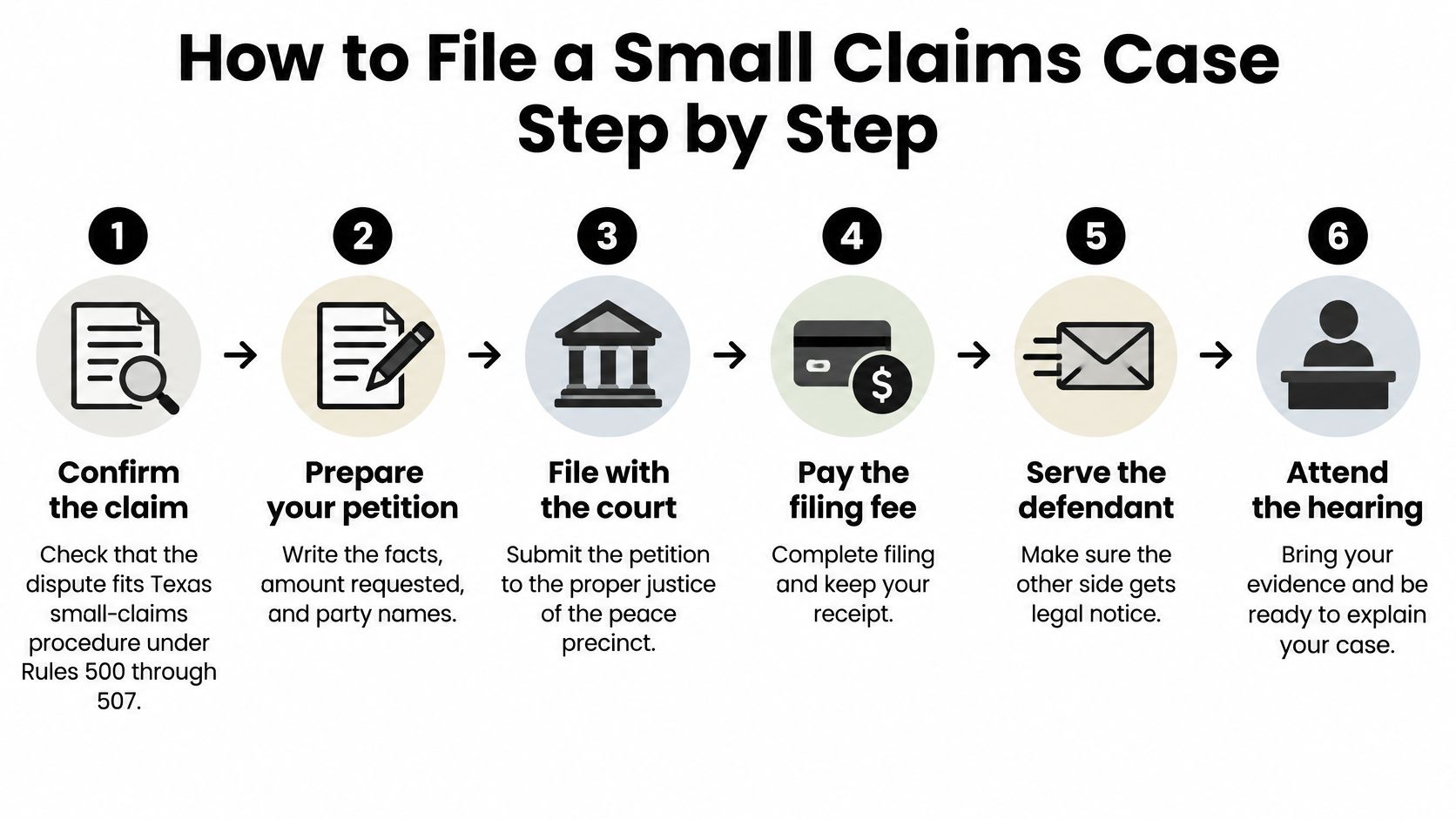
Complete the filing in a deliberate order
Confirm the claim type, amount, and venue. Identify what legal obligation the defendant allegedly failed to meet and what remedy you want. A common mistake is assuming every disagreement involving money belongs in small claims.
Obtain the current petition. Ask the precinct clerk which small-claims form and filing method the court accepts. Don't use an eviction or debt-claim form merely because its title sounds close to your problem.
State the facts and identify the parties accurately. Explain what happened, when performance was due, what went wrong, and how you calculated the amount requested. A trade name, incomplete legal name, or missing service address can delay notice to the proper defendant.
Pay the required fees or submit the affordability statement. Keep the filing receipt and a complete copy of everything submitted. Don't assume handing over paperwork means the court has accepted an incomplete filing.
Arrange service of citation. Request a constable or another method authorized by the court and applicable rules. Keep track of the return of service; your own statement that the defendant knows about the case isn't a substitute.
Read the issued citation and later hearing notices. Record the defendant's answer deadline and any separately issued hearing date. The answer deadline isn't automatically the trial date, and a defendant who misses the answer deadline may face a default request.
Maintain a case calendar. Record every notice, response requirement, mediation setting, and hearing. Update your contact information with the court so an address change doesn't leave you unaware of a setting.
Build a complete case file
Service timing isn't predictable from the filing date alone. An incorrect address, unsuccessful service attempt, or need for an authorized alternative can change the schedule.
Plan around the deadline stated in the citation and the court's actual notices. Don't assume a hearing has been scheduled just because the answer deadline has passed.
Keep a working packet containing:
- Filed petition: Include the accepted copy and copies for each defendant.
- Service documents: Add the citation and return of service when available.
- Evidence index: Identify each agreement, payment record, message, photograph, and witness.
- Court correspondence: Preserve notices and a dated record of procedural communications.
The clerk can confirm form versions, filing hours, and scheduling procedures. Legal advice about whom to sue or which claim to bring must come from an attorney.
Preparing Evidence and What Happens at the Hearing
At the hearing, the justice of the peace will listen to the parties, review admissible evidence, and may question witnesses directly. Texas law permits an informal hearing process and limited discovery, as described in Texas Government Code section 27.060.
Informal doesn't mean unprepared. You still need to connect the defendant's obligation, the alleged failure, and the amount you're asking the court to award.
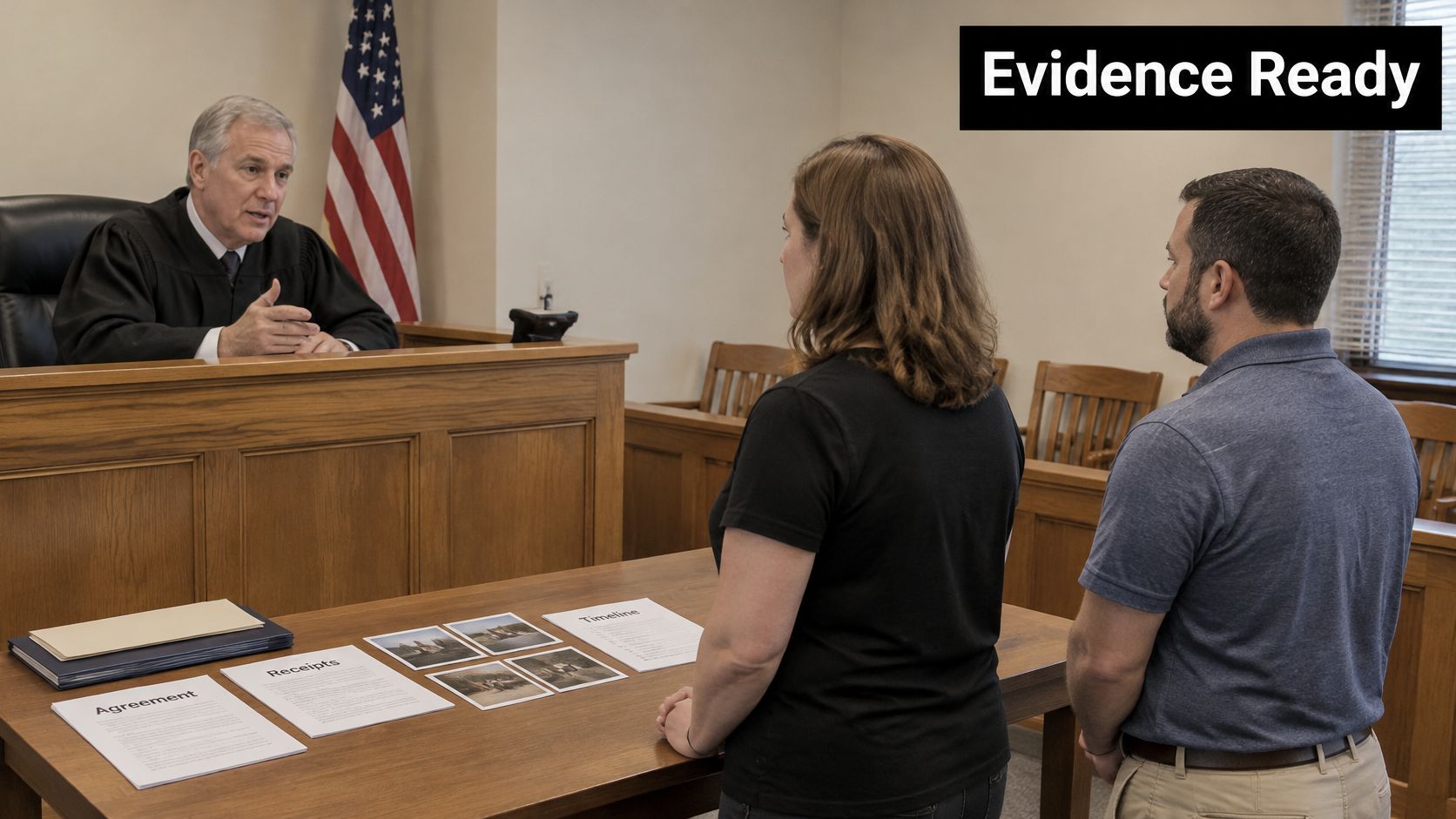
Arrange exhibits in the order they prove your case
Start with the document establishing the agreement, then show payment, performance problems, communications, and damages. A short timeline helps the judge follow events without searching through your phone.
- Agreement or invoice: Highlight the parties, promised work, price, and relevant completion terms.
- Payment proof: Include receipts, canceled checks, or relevant bank entries.
- Messages: Preserve dates, sender information, and enough surrounding conversation to provide context.
- Photographs and estimates: Explain who took the photographs and what the estimate measures.
- Witnesses: Choose people with firsthand knowledge, not just people who support your position.
For the Spring contractor-deposit scenario, the homeowner could present the signed agreement, deposit receipt, messages requesting completion, photographs of unfinished work, and a repair estimate. The explanation should distinguish returning the deposit from paying for additional corrective work so the requested damages don't overlap.
For practical organization guidance, review how to present evidence in court. Prepare separate exhibit sets for yourself, the judge, and the opposing party, and follow any advance-exchange instructions.
Prepare for attendance problems and disputed facts
Ask about subpoenas early when a necessary witness won't attend voluntarily or records aren't available. A subpoena request made immediately before the hearing may not leave enough time for issuance and service.
If the defendant doesn't appear, a default judgment isn't an automatic award of everything requested. The court must address proper service and the proof required for the claim and damages.
Avoid relying on memory for important dates, surprising the other side with exhibits contrary to court instructions, or requesting relief absent from the petition.
Day-before-hearing checklist
- Confirm attendance details: Verify the time, location, and remote-access instructions if applicable.
- Pack identification and exhibits: Put documents in the same order as your explanation.
- Practice a short summary: State the agreement, breach, and requested remedy without arguing every message.
- Review the weak points: Be ready to address partial work, refunds, or contradictory communications openly.
Collecting the Judgment and Deciding on an Appeal
Winning doesn't guarantee payment. After a judgment, the defendant may pay, agree to installments, challenge the result, or lack property available for collection. A judgment is the court's decision, not a payment order that automatically puts money in your hands.
Start by obtaining the signed judgment and checking that the names and amounts are correct. You can send a written payment request or document an installment arrangement. Keep a record of what is agreed, and avoid accepting terms you do not understand.
Start with payment, then evaluate assets
If payment does not follow, look for lawful ways to learn what property may be available. Business filings and county property records can help identify ownership. Permitted post-judgment questioning may also provide information about assets. The key distinction is whether property exists and whether the law allows it to be reached.
Common enforcement tools include:
- Abstract of judgment: Recording an abstract can create a lien on qualifying, non-exempt real property. It does not make protected homestead property available for seizure.
- Writ of execution: An authorized officer may seize qualifying non-exempt property under a valid writ. You cannot take the defendant's belongings yourself.
- Writ of garnishment: A qualifying proceeding may reach certain funds held by a third party, such as a bank. Ordinary Texas small-claims creditors generally cannot garnish current wages through an employer.
- Turnover relief or post-judgment discovery: These procedures may help locate assets or reach qualifying property, subject to exemptions and procedural requirements.
Collectible funds depend on ownership, exemptions, and where the money came from. A bank balance alone does not establish that the funds may be taken. Before paying for an enforcement step, consider whether the likely recovery justifies its cost and effort.
Collection caution: Do not threaten arrest, seize property yourself, or assume a judgment overrides exemption laws. Use authorized court procedures.
A judgment-enforcement attorney can help assess whether a proposed remedy is legally available and financially sensible.
Check appeal requirements immediately
A losing party has a short period to appeal. Texas justice-court rules generally provide 21 days after the judgment is signed to perfect an appeal. The required filing is ordinarily an appeal bond, cash deposit, or qualifying inability statement, rather than a notice of appeal.
An appeal generally sends the dispute to county court for a new trial. Ask the clerk promptly which deadline and documents apply to your case. A post-judgment motion or unusual circumstance may affect timing, so seek legal advice if either is involved.
Record the date the judgment was signed and calendar the appeal deadline. Keep enforcement expenses separate from the damages in your original claim. That separation helps you judge whether pursuing collection is worthwhile without confusing the amount awarded with the cost of trying to recover it.
Decide Whether to Hire a Lawyer Before You File
A clear written agreement and payment record may make a straightforward unpaid balance manageable without a lawyer. For example, if a customer disputes a balance despite signed terms that state the amount due, the key question may be how the agreement applies to the payment history. A breach-of-contract lawyer in The Woodlands can assess the contract and potential defenses when the meaning of its terms is disputed.

Consider legal advice if the claim approaches the jurisdictional ceiling, the defendant has counsel, several parties may share responsibility, or a counterclaim could expose you to liability. A counterclaim changes the risk: you may have to defend against the other party's demand as well as prove your own. Difficulty obtaining or explaining evidence is another reason to ask for help.
Some disputes belong in a different court. Child-support establishment, modification, and enforcement involve the Texas Family Code and family-court orders, not an ordinary small-claims petition. A Child Support Attorney in The Woodlands handles those matters in Montgomery County.
Before deciding, ask yourself: Can I explain the written terms and payment record clearly? Is the other side represented or likely to bring a counterclaim? Could a judgment expose me to liability beyond the amount I am seeking? If any answer raises concern, discuss the specific dispute with a Texas attorney.
This is general education, not legal advice. The Law Office of Bryan Fagan serves families in The Woodlands and Montgomery County and offers consultations to discuss legal options. Bring the agreement, payment records, defendant's address, and damages calculation. Visit The Law Office of Bryan Fagan to schedule a consultation.
