 Skip to content
You filed your divorce petition online from your home in The Woodlands. You can see the case in the court system, but your spouse hasn't signed anything, and no constable has appeared at the door. That gap causes many Montgomery County divorces to stall.
Filing the case and serving the respondent are separate legal steps. The Montgomery County District Clerk handles the filing and issues the citation. An authorized constable, sheriff, or private process server handles delivery. If you send the papers to the wrong office, provide an outdated address, or assume an informal message counts as notice, the case may not move forward as expected.
Understanding the Filing and Service Distinction
E-filing an Original Petition for Divorce starts the court case. It doesn't automatically notify your spouse in the legally required way. The clerk's acceptance of your petition creates a case record, but it doesn't prove that the respondent received a valid citation and petition.
Texas treats service of divorce papers as a formal civil-process requirement. Under Texas Family Code Section 6.408, citation on the original petition for dissolution of marriage must be issued and served in the same manner used in other civil cases. That means the process must comply with the applicable civil rules, not with what seems fair or practical between the spouses.
The clerk's role and the constable's role
The District Clerk issues the citation after the petition is filed. The citation is the formal document that tells the respondent a divorce case exists and identifies the required response. The clerk doesn't usually walk the citation to the respondent's home.
The authorized server performs that delivery. In The Woodlands and nearby Montgomery County communities, that may involve a constable, sheriff, or authorized private process server. Montgomery County Constable Precinct 3 identifies its office at 1520 Lake Front Circle in The Woodlands and states that constables have county-wide and contiguous-county-wide authority to execute civil process. That makes the local constable an important option when the respondent's address falls within the applicable service jurisdiction.
The distinction matters because jurisdictional authority and procedural deadlines depend on valid service or a formal waiver. Your spouse might know about the divorce from a text message, a phone call, or a conversation at home. That informal knowledge doesn't necessarily establish completed service.
Practical rule: Treat “my spouse knows” and “my spouse was legally served” as two different facts.
A respondent can also sign a formal waiver in a qualifying situation. A waiver isn't a text message or a private promise not to contest the case. The Texas Courts' uncontested-divorce instructions identify service, a respondent's waiver, and an answer as distinct ways a spouse may receive notice or participate in the case.
Why this step affects the rest of the divorce
A defective service attempt can create delays at the hearing stage and may undermine a requested default judgment. The court needs a legally sufficient return or other proof showing how notice was provided. E-filing alone doesn't supply that proof.
For a practical overview of the filing side, see filing for divorce in The Woodlands. Keep the roles separate in your records: the clerk files and issues, while the authorized server delivers and documents.
Preparing Documents and Identifying the Correct Precinct
A divorce case can be properly filed and still stall because the service packet went to the wrong office or contained incomplete information. Begin with the documents and the respondent's actual location. A constable's civil-process unit needs usable paperwork and a service address, not merely confirmation that a divorce petition was filed.
The packet generally contains the filed petition, the issued citation, and any civil-process forms the receiving office requires for delivery. Confirm that the citation has been issued before requesting service. A file-stamped petition without an issued citation generally will not support ordinary personal service.
Verify the address before choosing the office
Use a specific, current address. Include the street number, apartment or unit, subdivision, gate information, building details, and lawful access instructions. Alden Bridge, Sterling Ridge, Panther Creek, Creekside Park, and other Woodlands communities can create different service problems even when they look close together on a map. A gated neighborhood, apartment complex, or address near a county boundary can affect which office should receive the request.
Montgomery County Constable Precinct 3 operates from The Woodlands and states that its constables can execute civil process county-wide and in contiguous counties. That stated authority does not answer every operational question. Confirm that Precinct 3 will accept the request for the specific address, particularly if the respondent lives outside Montgomery County or the address falls near another jurisdiction. The receiving office may impose its own submission process, service-area rules, payment requirements, or instructions for an address outside its normal workflow.
If you are unsure whether the case belongs in Conroe or The Woodlands, review this guide to the Conroe vs. The Woodlands family court venue. Venue and service jurisdiction are related questions, but they are not the same question.
Use this checklist before sending anything:
- Confirm the case number. Verify that the petition was filed and the citation was issued.
- Check the respondent's physical location. Determine whether the home is in Montgomery County, another county, or a nearby jurisdiction.
- Complete the service address. Add unit numbers, building information, gate procedures, and known access restrictions.
- Contact the civil-process office. Ask which documents, forms, and payment method it requires.
- Keep a delivery record. Save the submission confirmation, receipt, and any reference number.
The District Clerk files the case and handles clerk-issued documents. The constable's office handles service and records the attempt. Those functions are separate. The Texas State Law Library's divorce guide outlines available service channels, but call the local office that will receive the papers and follow its current instructions.
Fees and payment
Do not assume the service request uses the same fee structure as filing. The receiving office may require a separate service fee and may restrict accepted payment methods. Verified local materials do not establish one universal fee or payment method for every request, so confirm the current requirements before submitting the packet.
A workplace outside The Woodlands may still be a practical service location. Provide that information to the authorized server and confirm that the receiving office can act there. If the respondent lives in another county, ask whether the constable can execute the request under its authority or whether the papers must go to another authorized server.
Montgomery County's growth makes precise address verification more important. Historical census figures show growth from 293,768 residents in 2000 to 455,746 in 2010, an increase of 161,978 people, or approximately 55.1%. The same series records growth from 128,487 residents in 1980 to 182,201 in 1990, approximately 41.8%, and from 182,201 in 1990 to 293,768 in 2000, approximately 61.2%. Those figures do not measure service success, but they explain why spouses may move among subdivisions, apartment communities, and nearby county lines. Montgomery County's historical population series provides that local context.
After the divorce order is entered, enforcement becomes a separate issue if someone violates its terms. Enforcement of Court Orders in The Woodlands addresses enforcement of divorce decree and custody-order provisions in Montgomery County.
Execution Methods and Local Timelines
A constable's attempt usually begins with the address and information you supplied. Personal delivery remains the central method. The server must locate the respondent and deliver the required papers in a manner recognized by the governing civil-procedure rules.
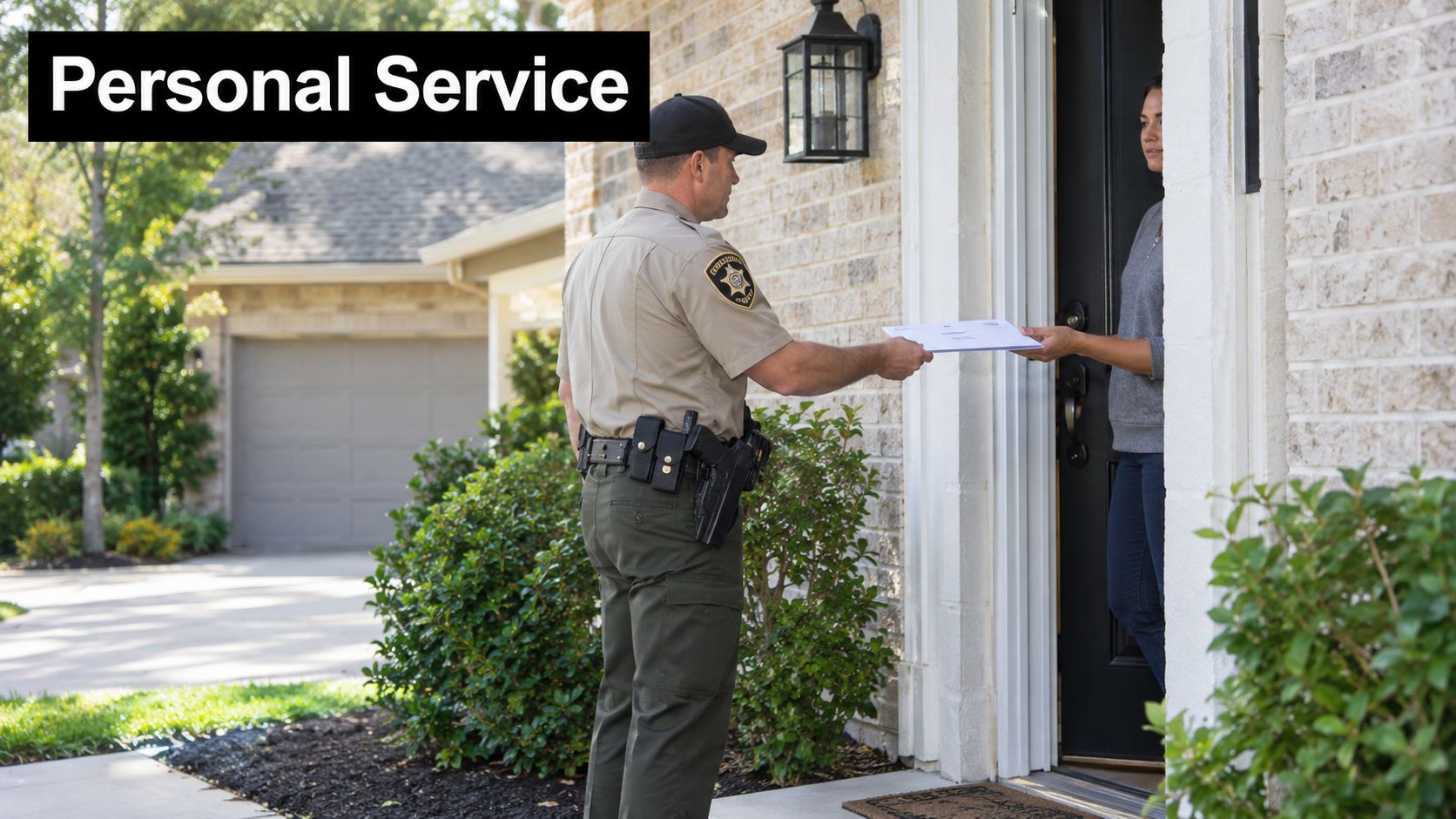
Consider a common Panther Creek scenario. You provide a home address, but the neighborhood has controlled entry and the respondent leaves for work before the server arrives. The first attempt may not result in service. That doesn't mean the process failed permanently, but it does mean you need better information, not speculation.
Give the server lawful, useful details such as:
- Vehicle information: A make, model, color, or license plate detail can help identify whether the respondent is present.
- Work patterns: A known workplace or approximate schedule may support a later attempt.
- Access conditions: Explain gate procedures, building access, apartment call boxes, and other relevant facts.
- Alternate locations: Supply a verified workplace or other location where personal delivery may be possible.
Don't direct the server to trespass, threaten anyone, or create a confrontation. A high-conflict divorce needs a controlled process, particularly when the respondent may react unpredictably.
What counts as a completed attempt
A process server's visit is not the same as completed service. The court needs legally sufficient proof of what happened, including the relevant address, date, method, and delivery details. The final return of service is the document that allows the court to evaluate whether service occurred.
Texas Rule of Civil Procedure 106 governs usual service methods, while the Family Code directs divorce citation to follow ordinary civil-case procedures. If ordinary personal delivery cannot be completed, don't assume that leaving papers at the door, mailing them, or sending them through social media automatically satisfies the law.
There isn't a reliable published percentage showing how often Montgomery County constable attempts succeed. Set expectations around procedural completeness, not an unsupported success rate. A valid citation, a complete packet, accurate location information, documented attempts, and a properly filed return matter more than a promised outcome.
A local office may have its own processing sequence and current workload. Ask how it wants the request submitted and how you can check the status. If the citation expires before service occurs, you may need a new citation rather than continuing to rely on the old paperwork.
For a visual explanation of how legal papers may be delivered and documented, review the following resource.
Don't confuse a difficult gated-community delivery with permission to bypass the rules. The right response is better location information, coordination with the authorized server, and a court-approved alternative when ordinary service cannot be completed.
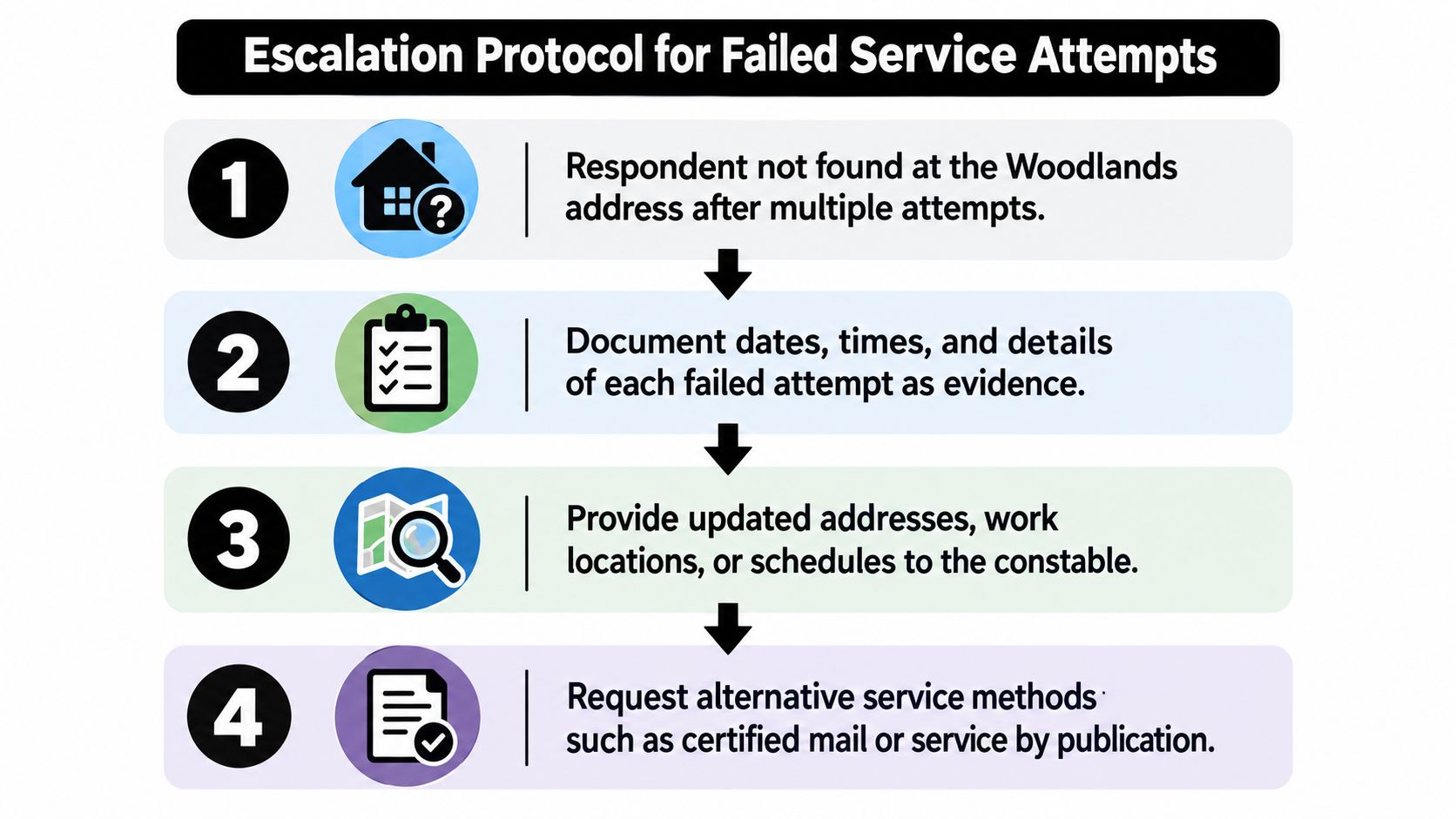
Escalation Protocol for Failed Service Attempts
A failed attempt should produce evidence. It shouldn't produce an immediate assumption that posting, mailing, or a social-media message is valid. If the respondent can't be found at the listed Woodlands address, work through the problem in an organized sequence.
Start with a complete attempt record
For every attempt, preserve the exact address, date, time, access conditions, vehicle information, and legitimate observations. A note that says “not home” is weaker than a detailed record showing the server arrived at the correct address, encountered a locked gate, observed a particular vehicle, and received specific information from a lawful source.
Then confirm whether the respondent moved. Check the address you supplied against current information, review known Montgomery County and nearby locations, and provide updated details to the authorized server. The county's long-term population growth means that relocated spouses and changing residential patterns are common practical obstacles, even though population data doesn't establish the outcome of any individual service request.
If the respondent works elsewhere, provide the workplace and ask whether service there is appropriate. If the respondent has moved outside Montgomery County, find out whether the original office can act in the new location or whether the papers need to go to another authorized process channel.
Reissue when the paperwork changes
A citation has a usable period, and a new citation may be needed if it expires. Reissuance may also be necessary if the petition is amended. An amended petition generally requires a new citation and service packet because the respondent must receive the operative pleading, not an outdated version.
Don't keep handing an old packet to a server after the petition has changed. Confirm with the District Clerk what must be reissued and make sure the server receives the correct documents.
Seek authorization before using an alternative
If diligent attempts don't locate the respondent, request the court's authorization for an alternative method. Texas Law Help's guidance on serving initial divorce papers discusses court-ordered substituted service and social-media service as possible methods. It also explains that citation by posting generally requires a diligent-search affidavit, a motion, a last-known-address certificate, and, where required, an order. In the relevant no-children divorce procedure, posting is described as lasting seven days at the courthouse.
Those requirements are not interchangeable. A no-children posting procedure shouldn't be used in a case involving children, where different safeguards may apply. Publication is another statutory alternative. Texas Family Code Section 6.408 permits service by publication under the rules governing other civil cases, with the divorce notice published one time.
Don't substitute proof of mailing for proof of service. A certified-mail receipt, a process-server attempt, or a text exchange may help show what you tried, but it doesn't automatically establish completed personal service.
The court needs the required affidavit, motion, order, and return when the chosen method calls for them. If you skip that paperwork, you may create another delay instead of solving the first one.
Evaluating Constables Against Private Process Servers
The Montgomery County constable is often the sensible starting point for a routine, well-documented service request. A private process server may make more sense when the respondent is evasive, moves frequently, works irregular hours, or presents a safety concern.
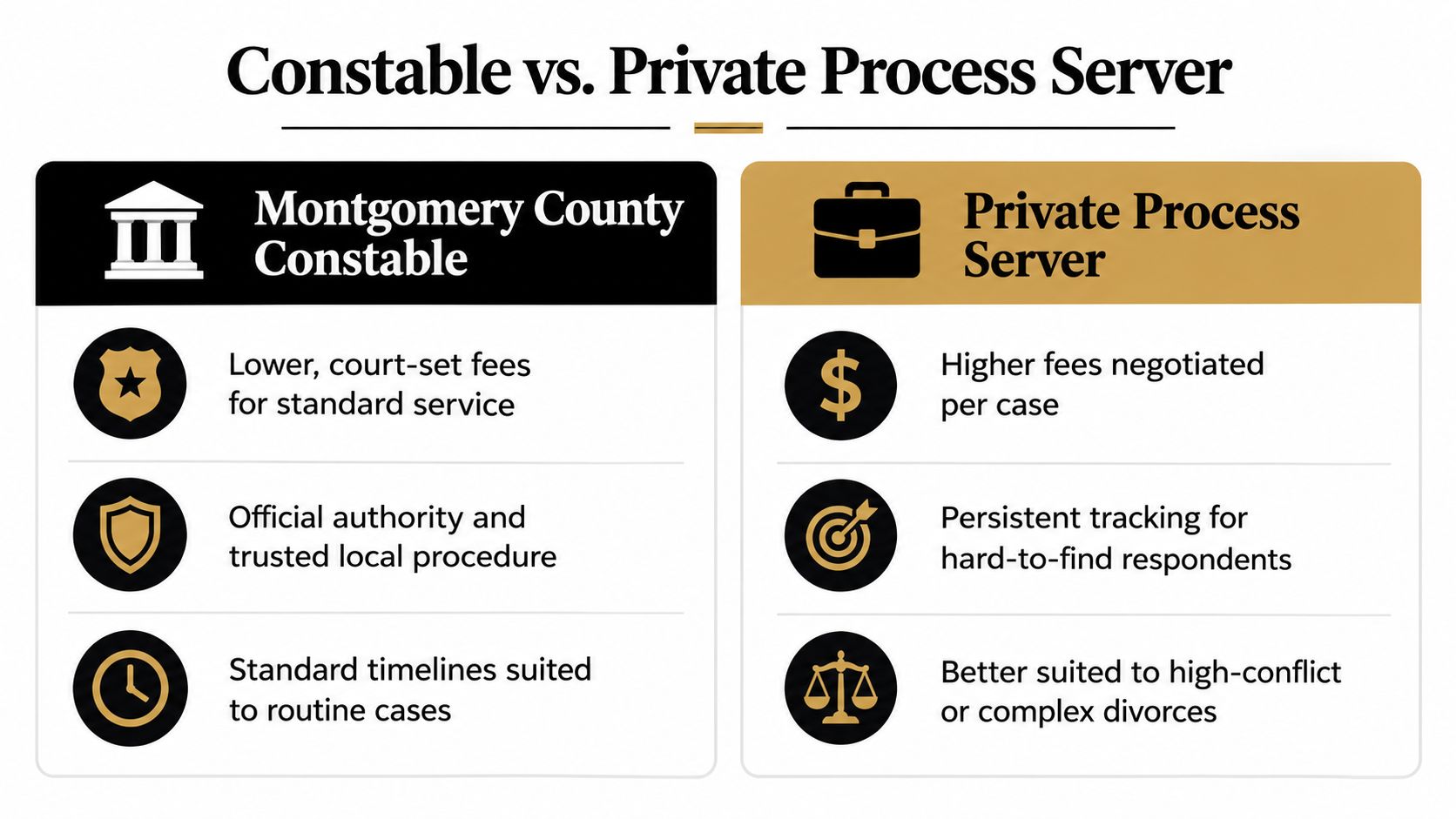
| Consideration | Montgomery County constable | Private process server |
|---|---|---|
| Routine service | A practical option for a confirmed Montgomery County address and ordinary delivery | Useful when you want a privately managed service request |
| Cost structure | Fees are set through the public office's current process | Fees are negotiated according to the provider and assignment |
| Location flexibility | Jurisdiction and office procedures control where the request can be executed | A provider may coordinate service across locations, subject to legal authority |
| Hard-to-find respondent | May require updated information from the petitioner | May offer persistent location work and skip-tracing services |
| High-conflict situation | Official civil-process channel with established procedures | May offer scheduling flexibility and tailored safety planning |
The constable's advantages are formal authority and a familiar local process. Precinct 3's stated county-wide and contiguous-county-wide authority can be especially useful when a respondent's location changes within the relevant region. You still need to confirm that the particular office accepts your request and has the documents it needs.
A private server may be worth considering when timing, location, or respondent behavior creates complications. For example, a spouse who leaves the Alden Bridge home before dawn and works at a changing job site may require more targeted scheduling than a routine home attempt. A private professional may be able to coordinate a specific time or conduct location research, but you should verify the provider's qualifications, methods, reporting practices, and total fee before retaining them.
High-conflict cases need a safety plan
Don't turn service into a personal confrontation. If your spouse has threatened you, monitor the interaction through counsel and the authorized server rather than attempting delivery yourself. Give the server relevant safety information, but don't encourage conduct that could violate privacy, trespass restrictions, or other legal boundaries.
Cost alone shouldn't control the decision. A cheaper first attempt can become expensive in time and delay if the address is weak or the respondent is deliberately avoiding service. Conversely, a private server isn't automatically better, and paying for aggressive location work doesn't authorize an invalid service method.
Choose based on the facts:
- Use the constable first when the address is current, the respondent follows a predictable routine, and the matter is low conflict.
- Consider a private server when you have a verified workplace, a moving respondent, unusual access problems, or a need for targeted scheduling.
- Get legal guidance early when children, significant property, safety concerns, or a likely default judgment are involved.
Finalizing the Return of Service and Next Steps
Service isn't complete for your practical purposes until the proof reaches the court file. Ask whether the constable or private server will file the return of service with the Montgomery County District Clerk or return it to you for filing. Don't rely on a verbal report that delivery occurred.
Review the return for the correct respondent, address, date, method, and documents served. If anything appears inaccurate or incomplete, address it promptly. A defective return can create problems later, especially if the respondent doesn't answer and you seek a default judgment.
The respondent may file an answer, sign a formal waiver where appropriate, or participate in the case through another permitted notice option. Settlement discussions don't eliminate the need to protect the procedural record. If you were served yourself, what to do after being served with divorce papers in The Woodlands can help you identify immediate procedural concerns.
What to do next
- Confirm filing: Verify that the Original Petition for Divorce was accepted and assigned a case number.
- Obtain the citation: Make sure the District Clerk issued the citation and that the service packet is complete.
- Verify location: Check the respondent's Woodlands, Montgomery County, workplace, or out-of-county address.
- Confirm the office: Ask the appropriate constable precinct or private server about jurisdiction, submission requirements, payment, and status tracking.
- Document attempts: Keep exact dates, times, addresses, access conditions, vehicle details, and other lawful observations.
- Reissue when needed: Request updated citation and service documents if the citation expires or the petition is amended.
- Use alternatives properly: Seek a court order before relying on substituted service, posting, social-media service, or publication.
- Check the return: Confirm that legally sufficient proof of service or waiver is filed with the court.
This article provides general procedural information and is not legal advice. Service rules can depend on the case, the respondent's location, whether children are involved, and the method the court authorizes. Speak with a Texas family-law attorney before relying on a particular service method or pursuing a default judgment.
The Law Office of Bryan Fagan helps clients address divorce filing, service problems, contested family-law disputes, and Montgomery County court procedures. To discuss the correct constable or private-server strategy for your situation, visit The Law Office of Bryan Fagan and schedule a consultation.
