 Skip to content
A process server shows up at your home in The Woodlands, or you open certified mail and see court papers with your name on them. Your stomach drops. At that moment, individuals are not typically thinking about procedure. They're thinking about their kids, the house, the bank account, and whether they're already behind.
That reaction is normal.
The hard part is that Texas divorce procedure starts moving whether you feel ready or not. If you're searching for what to do after being served divorce papers The Woodlands, the first priority is not telling your whole side of the story. It's protecting your right to participate before the court starts making decisions without you.
A common local scenario looks like this. A spouse in Alden Bridge gets served on a weekday afternoon, talks to friends over the weekend, and assumes there's plenty of time because no hearing has happened yet. Then they learn the first real milestone was the response deadline, not mediation or trial. That misunderstanding causes problems fast in Montgomery County cases.
You've Been Served Divorce Papers in The Woodlands Now What
Start with this. Don't ignore the papers, don't panic, and don't retaliate.
Being served means a case has already been filed. It does not mean you've lost. It does mean the court expects a timely response. In Montgomery County, that early window matters because temporary issues can arise quickly, especially when children, paychecks, accounts, or the family home are involved.
If you live in The Woodlands, Conroe, Magnolia, or another nearby community, think of this as a first-aid stage. You need to identify what court the case is in, whether a hearing is already set, and what restrictions may already apply to your conduct.
Practical rule: The date that matters is the date of formal service, not the date you first heard your spouse was “filing.”
Under the Texas Family Code, divorce cases often involve immediate questions about conservatorship, support, use of property, and temporary restraints while the case is pending. You don't need to solve all of that today. You do need to get organized today.
Here's the calm, practical way to approach the next steps:
- Read every page carefully. Look for the court name, cause number, and any hearing date.
- Set aside emotion for one hour. Use that time to sort papers, take notes, and calendar deadlines.
- Preserve the status quo. Don't move money around, sell property, or make major parenting changes without legal advice.
- Get legal guidance early. A short consultation early usually helps more than a rushed fix later.
This article is general information, not legal advice, but it will help you understand what usually works, what often backfires, and how Montgomery County procedure can affect your next move.
Your First 24 Hours Understanding the Divorce Papers
Your first job is simple. Read the documents right away. Texas Law Help's guidance on responding to a divorce says to read the papers immediately, note any hearing dates, and use the state's response forms. It also warns that if you don't file in time, your spouse can obtain a default judgment.
Identify the core documents
Individuals served in a Texas divorce will receive a Citation and an Original Petition for Divorce. The Citation is the formal notice from the court. The Petition tells you what the filing spouse is asking the judge to do.
You may also see other documents attached. Those can include requests involving children, property, temporary restraints, or a hearing notice.
Look for these items first:
- Court information. The court name tells you where the case is pending.
- Cause number. You'll need this on almost every filing.
- Names of the parties. Make sure your name and your spouse's name are correct.
- Any hearing setting. If a hearing is listed, treat it as urgent.
- Requests for relief. It indicates what your spouse is asking for regarding property, children, support, or possession of the home.
Don't assume all service works the same way
One overlooked issue in The Woodlands divorce cases is how service happened. Texas guidance on serving divorce papers explains that service can occur in several legally distinct ways. It also explains that if a respondent can't be located, a petitioner may seek substitute service by posting or publication only after swearing to diligent search efforts.
That matters because people often say, “I was served,” as if every case starts identically. It doesn't. Personal service, mailed service, and alternative service can affect how the case proceeds and whether notice may later become an issue.
If you think service was defective, don't guess. Get legal advice before deciding whether to challenge service, file an answer, or do both.
Watch for restrictions in the papers
Some divorce papers include temporary restraints or immediate requests that affect what you can do while the case is pending. In plain English, that can mean restrictions on moving money, changing insurance, taking children out of school, or disposing of property.
Under the Texas Family Code, temporary orders can address possession of children, support, property preservation, and attorney's fees while the divorce is ongoing. The exact language in your papers matters more than assumptions.
What usually works in the first day is quiet, organized review. What doesn't work is texting threats, draining accounts, posting online, or relying on verbal side agreements.
The Critical Deadline Filing Your Answer in Montgomery County
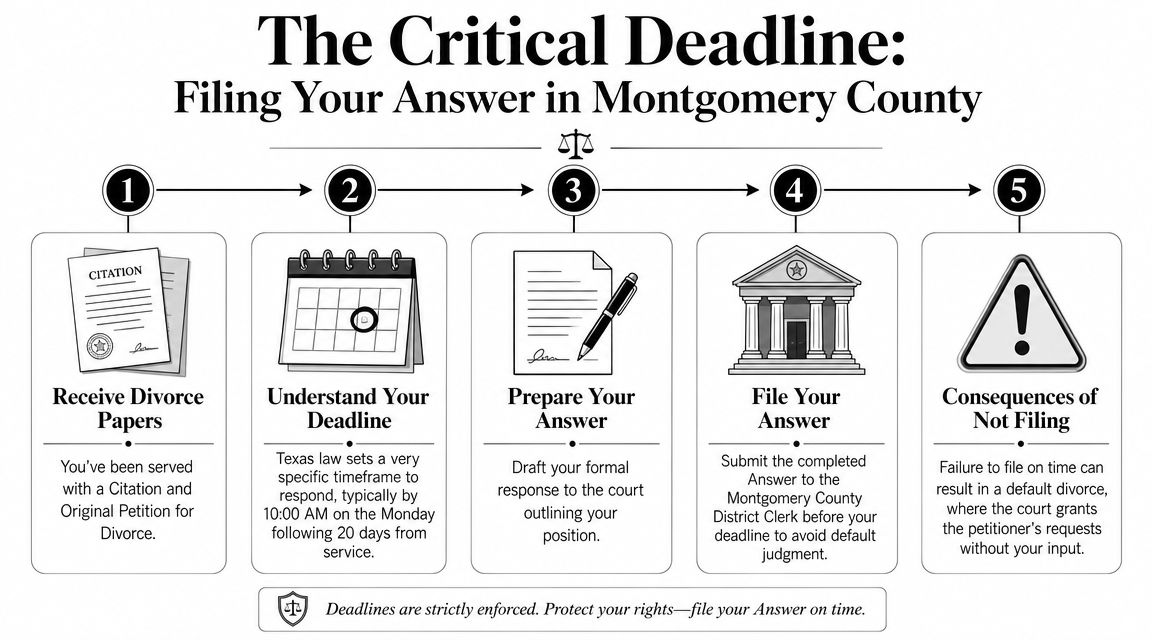
The most important immediate step after service is filing your Answer. In Texas, the answer deadline after formal service is 10:00 a.m. on the Monday following 20 days after service. If you miss that deadline, the case can move toward default.
What an Answer does and does not do
An Answer is not your life story. It is not the place to attach every grievance from the marriage. Its core job is much narrower. It tells the court that you have appeared in the case and intend to participate.
That matters because once you appear, it becomes much harder for the other side to get relief without your involvement.
A lot of people lose time because they think, “We're still talking, so I don't need to file yet.” That is one of the most common mistakes. Informal discussions do not replace a filed response.
What default means in real life
Default is not just a technical court word. It has practical consequences. If no response is filed, the court may proceed without that spouse's participation and may grant relief requested by the filing spouse, as discussed in guidance on what happens after being served divorce papers.
In a Montgomery County divorce, that can affect issues such as:
- Property division. The court may hear only one side's evidence about assets and debts.
- Parenting arrangements. Temporary or final terms may be shaped without your input.
- Support requests. Financial obligations can be addressed before you've presented your position.
For a local overview of where divorce cases are handled, this guide to Montgomery County divorce court procedures can help you understand the court setting.
The practical filing sequence
Here's the cleanest way to think about the process:
- Confirm the date of formal service. Don't estimate.
- Calculate the answer deadline immediately. Put it on your calendar and set reminders.
- Prepare the Answer. Keep it proper and timely.
- File it with the clerk. Make sure the case information is correct.
- Send a copy to the other side or their lawyer. Preserve a clean record.
Filing late and hoping for grace is a poor strategy. Courts run on filed paperwork, not good intentions.
If you're unsure whether the papers include only a Petition or also temporary requests, don't wait to sort that out on your own. File the Answer on time, then address the broader strategy.
Protecting Your Family and Finances with Temporary Orders
Filing an Answer keeps you in the case. Temporary orders help stabilize life while the case is pending. In many Montgomery County divorces, substantial pressure frequently starts.
Temporary orders can address who stays in the house, who pays which bills, how parenting time will work, whether support will be paid, and what each spouse may or may not do with assets. Under the Texas Family Code, temporary orders are often the tool the court uses to preserve property and protect children while the divorce is ongoing.

Why waiting is risky
If your papers include a hearing date, treat that as a serious event. Washington Law Help's explanation of receiving divorce papers notes that if the papers include a hearing date, you should plan to attend because a judge can make temporary orders about money, property, and children without your input if you fail to appear. For Woodlands and Montgomery County cases, the practical benchmark is to treat the first hearing as a rights-preservation event by compiling evidence on income, assets, and parenting immediately.
That lines up with what practitioners see every day. Early orders often influence the pace and posture of the rest of the case. Once routines are established for children or control of finances shifts, changing them can become harder and more expensive.
Delay can significantly harm individuals, not because delay looks bad, but because delay gives the other side a head start on the facts the judge hears first.
What to gather before the first hearing
Don't show up empty-handed. Bring documents that help the court understand the household and the children's day-to-day needs.
Focus on these categories:
- Income records. Pay stubs, recent deposits, and proof of other earnings.
- Monthly obligations. Mortgage or rent, utilities, insurance, loans, childcare, and recurring bills.
- Asset information. Bank balances, retirement account statements, vehicle information, and major personal property.
- Parenting evidence. School details, childcare routines, medical needs, calendars, and communications relevant to parenting issues.
Early hearings are not the time to say, “I can get that later.” Bring the records now.
If you need a better sense of how these hearings work locally, this page on temporary orders hearings in Montgomery County divorce cases gives useful local context.
Real world scenario in Creekside Park
A short example shows why this matters.
One spouse in Creekside Park is served and focuses only on the Answer. They do file it, which is good. But they ignore a near-term hearing notice because they assume temporary issues can be sorted out informally. Meanwhile, the other spouse arrives with pay records, account statements, a proposed parenting schedule, and a list of monthly expenses.
The result is predictable. The prepared spouse shapes the first court orders.
| Real-World Scenario: Temporary Orders in Creekside Park | Details |
|---|---|
| Immediate issue | Parents disagree about who stays in the home and how bills get paid |
| Prepared approach | One spouse brings organized records on income, expenses, and the children's school routine |
| Unprepared approach | The other spouse relies on verbal explanations and incomplete financial information |
| Likely court impact | The judge has clearer evidence from one side when making temporary decisions |
| Better takeaway | File the Answer, then prepare for temporary orders as if the first hearing will shape the rest of the case |
What works is preparation with documents, a workable parenting proposal, and a realistic budget. What doesn't work is assuming fairness will sort itself out.
Preparing to Meet Your Woodlands Divorce Attorney
A good first consultation is not about telling the longest story. It's about giving the lawyer a usable file. When clients prepare well, they usually get better advice faster because the legal issues become clearer right away.

Bring documents that answer the court's practical questions
The court will care about children, money, property, and immediate stability. Your attorney needs enough information to assess all four.
Start with the basics:
| Checklist: Documents and Questions for Your Initial Consultation | |
|---|---|
| Category | Item/Question |
| Financial records | Bank statements, pay stubs, tax returns, credit card statements |
| Assets | House information, vehicles, retirement accounts, investment accounts |
| Debts | Mortgage, car notes, credit cards, student loans, personal loans |
| Child-related information | School schedules, medical information, childcare arrangements, proposed parenting routine |
| Court papers | Citation, Petition, hearing notices, any temporary restraining language |
| Key question | What must be filed first to protect my rights in this case? |
| Key question | Do I need to request or respond to temporary orders immediately? |
| Key question | Are there service issues or notice issues I should know about? |
| Key question | What documents should I gather next if property or custody will be contested? |
A simple timeline also helps. Include dates such as marriage, separation, major moves, job changes, and any recent disputes involving the children or finances.
Ask better questions in the consultation
Not every consultation question is equally useful. “How much will my divorce cost?” is understandable, but early on it often produces a range so wide that it doesn't help much. Better questions focus on decisions you control now.
Consider asking:
- What is the immediate court deadline in my case?
- Is a basic Answer enough for now, or do I also need a counterpetition or hearing response?
- What temporary orders should I be thinking about for my children or finances?
- What should I stop doing today so I don't damage my case?
- How do Montgomery County judges typically expect parties to be prepared at early hearings?
For a practical discussion of selecting counsel, this resource on how to choose a divorce lawyer in The Woodlands is worth reviewing.
A short video can also help frame what to bring and what to expect in an initial meeting.
Don't hide bad facts
Clients sometimes hold back information because they're embarrassed, angry, or afraid it will make them look bad. That almost always makes representation harder. If there was a troubling text exchange, a large withdrawal, a new relationship, or a parenting conflict, your lawyer needs to know.
The legal system deals with imperfect facts every day. Hidden facts are usually more dangerous than bad facts.
One option for people looking for local family-law representation is The Law Office of Bryan Fagan, which handles divorce and related family-law matters in Montgomery County.
Bring the papers you have, not the papers you wish existed. A lawyer can work with a messy file. A lawyer can't work with missing facts.
Your Path Forward After Being Served
Being served with divorce papers in The Woodlands feels personal because it is personal. But your next steps need to be procedural and steady. Read the papers carefully. Identify the court and any hearing date. File your response on time. Then turn quickly to the temporary issues that affect your children, your home, and your finances.
The people who protect themselves best at the start of a Montgomery County divorce usually do three things well. They get organized early, they respect deadlines, and they stop making decisions based on emotion alone. That doesn't remove the stress, but it does give you back some control.
If you're dealing with what to do after being served divorce papers The Woodlands, remember that the first phase of the case often shapes the rest. A missed deadline can create avoidable problems. A prepared response can preserve options.
What to do next
- Read everything today.
- Calendar your answer deadline immediately.
- Check for any hearing date or temporary requests.
- Gather financial and parenting records.
- Schedule a consultation before the case gets ahead of you.
Disclaimer: The information provided in this article is for general informational purposes only and does not constitute legal advice. You should contact an attorney to obtain advice with respect to any particular issue or problem.
If you've been served with divorce papers in The Woodlands or anywhere in Montgomery County, a focused legal review can help you understand what the court expects and what steps make sense for your situation. Scheduling a consultation is often the best way to move from panic to a plan.
If you need help after being served with divorce papers in The Woodlands, The Law Office of Bryan Fagan can review your documents, explain the immediate deadlines, and help you prepare for the next stage of your Montgomery County case.
