 Skip to content

The decree is signed, the judge has moved on to the next case, and the retirement account your spouse spent eighteen years building is still untouched. The paperwork awards you a share, yet the plan administrator has not recognized your right to receive it. Both can be true until a Qualified Domestic Relations Order, or QDRO, completes the process.
A judge's signature is an important milestone, but the order still has another gate to clear. A QDRO moves through two stages: the court enters it, then the retirement plan's administrator reviews it under the plan's terms. The first stage involves the divorce court and clerk. The second is handled by the plan, on its own schedule, and may send you back to court for a correction. Treating court entry as the end of the process can leave the benefit unpaid while the order is being reviewed or revised.
Here is the route, with the document or record to keep at each stage.
| Stage | Who Handles It | What Happens | Output to Keep |
|---|---|---|---|
| 1. Confirm the award | Party or attorney | Check the decree's exact percentage or formula and the named plan | Notes on the award language |
| 2. Identify the plan model | Party or attorney | Select the plan's model order, such as TRS active-member or retiree | Chosen plan model |
| 3. Draft the order | Attorney | Draft the order to match the signed decree | Draft QDRO |
| 4. Judge signs and dates | Assigned judge in the divorce court | Court enters the order | Signed and dated QDRO |
| 5. Clerk certifies | Montgomery County District Clerk | Original is certified and retained by the clerk | Certified copy |
| 6. Send to plan administrator | Party or attorney | Send the certified QDRO and final decree to the plan | Proof of delivery |
| 7. Plan qualifies order | Plan administrator | Conduct an independent review, with possible notice or request for an amended order | Written qualification decision |
Stages four and five take place at the courthouse. Stage three is the attorney's drafting work, while stages one and two involve identifying the award and plan requirements. The final two stages happen outside the courthouse, and the administrator's decision is not controlled by the parties.
The court-side steps in order
Copy the court and cause number from the final decree. Use the court, cause number, and case style shown on the decree. A post-divorce QDRO generally returns to that existing case rather than opening a new one.
Check the judge's signature and date on the order. The clerk needs a signed and dated order to certify. Review the signature block before filing so a missing date does not hold up intake.
Confirm the clerk's current fee and e-filing rules. Ask what applies to the specific document you plan to submit. The charge may depend on whether the request is filed within the existing civil case or opened as a separate matter.
Submit the order to the Montgomery County District Clerk for certification. Keep track of the version submitted and request the certified copy needed for delivery to the plan.
Request certified copies and keep them distinct from photocopies. The Texas Employees Retirement System QDRO FAQ) explains that the copy must be stamped and signed by the clerk, not a photocopy, and that the courthouse retains the original. Ask how many certified copies you need before submitting the request.
Keep the records together. Store the certified order, final decree, filing receipt, and delivery confirmation in one paper or digital file. That set makes it easier to answer questions from the plan and track what was sent.
These steps produce a court-certified order for the plan to review. They do not determine whether the plan will qualify it.
The court with authority to issue the QDRO is another point to check. Under Texas Family Code §9.101, the court that issued the divorce decree or final property-division order retains continuing, exclusive jurisdiction to issue an enforceable QDRO. The statute addresses divisible pensions, retirement plans, and other employee benefits, including private, state, and federal plans unless federal law provides otherwise. For a former spouse in The Woodlands or elsewhere in Montgomery County, the request generally goes back to the court that divided the benefit. The statute also directs courts to construe post-decree QDRO provisions liberally so benefits already divided can be paid.
Timing and fees you have to confirm yourself
The District Clerk's processing time and the plan administrator's review time are separate. Neither has a reliable published timeline here, so avoid relying on a single estimate for the whole process. Ask the clerk about court-side processing, then ask the plan how it receives and reviews orders.
The Texas Judicial Branch's district-court civil filing fee schedule lists a basic filing fee of $80 for actions within a Suit Affecting the Parent-Child Relationship, including a $35 local component and a $45 state component. That listed fee is not identified as a QDRO fee. The total for a QDRO request may depend on whether it is treated as a filing in an existing civil case, a separate district-court action, or includes other services. Call the clerk before e-filing and ask about the document you are submitting.
Timing to confirm: The court and plan follow separate schedules, and neither office is required to provide a projection. Set a reminder to follow up when you send the certified copy.
Consider a couple from Alden Bridge who divorced two years ago. Their decree awarded the wife 45 percent of the husband's 401(k) as of the divorce date, but no order was sent to the plan. The account therefore remained in his name. She filed a petition in the court that issued the decree, attached the plan's model order and the final decree, and obtained a QDRO that stated the 45 percent award and named the plan. The administrator then reviewed and qualified the order. The missing step was an order the plan could process, not a new lawsuit.
If you are unsure which court handled your decree, start with this guide to Montgomery County family courts and compare the court name with the paperwork from your case.
Two circumstances can change the route shown in the table. If the decree did not include an order, you may need to file a separate petition. If the plan requests changes after its review, the revised order may need to return to the same judge for signature.
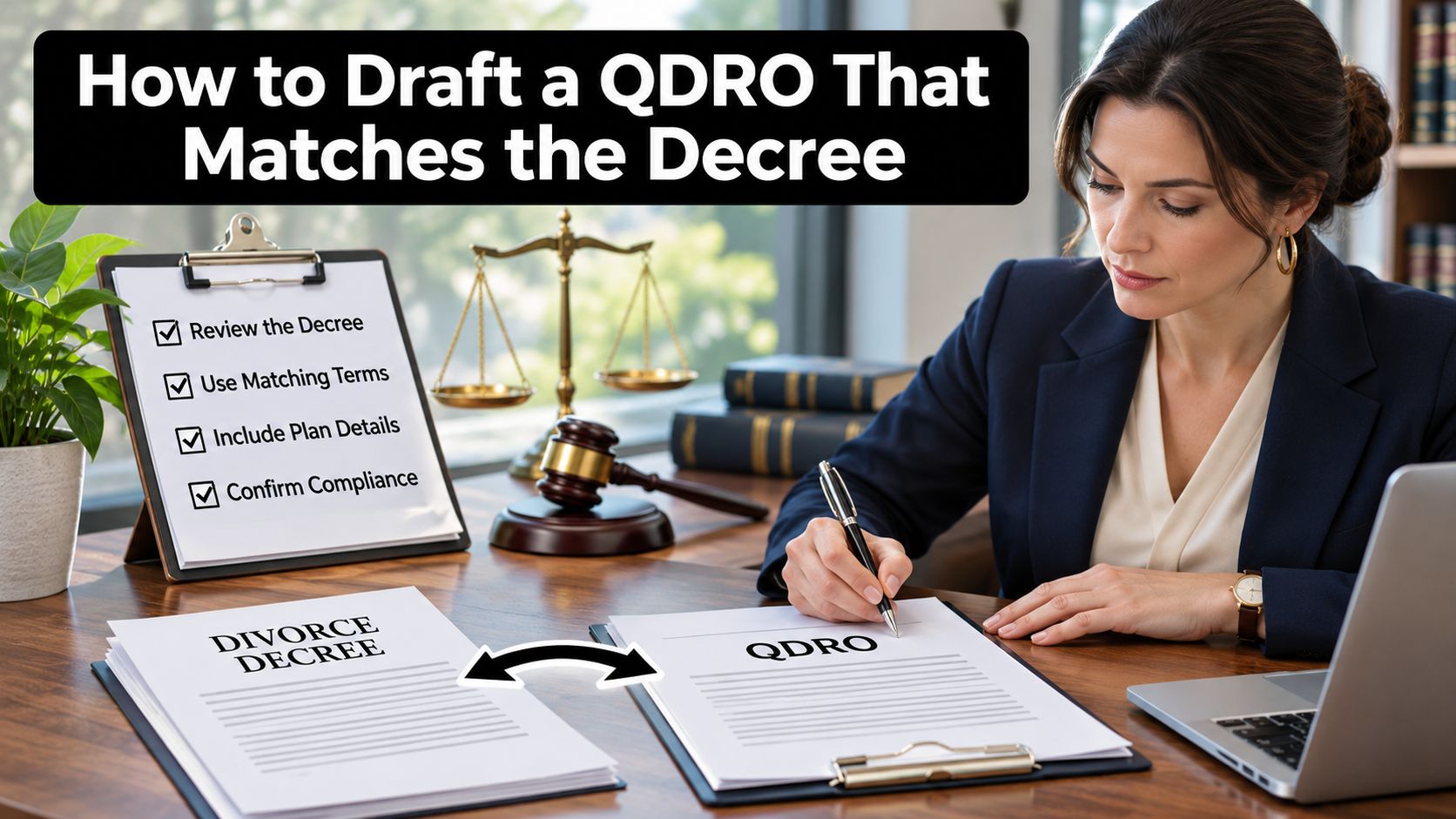
How to Draft a QDRO That Matches the Decree
A QDRO has two audiences, and it has to satisfy both. The judge reads it against the decree. The plan administrator reads it against the plan document. A draft that pleases one and fails the other gets signed and then rejected, which is the most expensive outcome available.
Start by assembling the source material before anyone writes a sentence of order language.
- The signed divorce decree. Not a draft. The final, file-stamped version with the property division as entered.
- The plan's model order or procedures. Most administrators publish a template and a submission checklist, and some refuse anything that deviates from it.
- The participant's identifying details. Full legal name, date of birth, Social Security number, and the plan's own account or contract number.
- The alternate payee's details. Same list, spelled exactly as they appear on identification.
- The exact percentage or formula. Copied word for word from the property division, not paraphrased from memory.
Three places drafts go wrong
The first trap is an order that doesn't make the administrator pay what the decree awarded. Texas appellate materials on QDRO validity make the point that validity doesn't turn on which lawyer presented the order or whether the administrator could work out the math alone. The order itself has to direct the precise amount the decree ordered. If administration ends up paying something different, the fix is a clarification, and you want to catch that before the money moves.
The second trap is identifying information that doesn't match plan records, which turns a substantively correct order into a returned envelope. The third is choosing the wrong model, which matters most for public plans that publish separate versions based on status at divorce.
Here's the smallest version of the drafting problem. Before: the decree says she gets half the account. After: the order says the alternate payee receives 50 percent of the participant's vested account balance as of the close of business on a stated valuation date, adjusted for gains and losses through the date of distribution, with the plan's required fields completed. Same award. One version survives review.
Before filing, read the draft beside the decree line by line. Every award term should use the same words, in the same order, with the same dates. If a phrase in the order can't be traced to a sentence in the decree, cut it or explain it.
In The Woodlands, property division work like this sits inside the broader family law practice, which covers divorce, child custody, property division, and child support modifications. When the retirement split is the contested piece, it helps to read up on dividing a 401(k) in a Woodlands divorce before drafting. A Divorce Lawyer in The Woodlands, TX can handle the divorce representation while the order language gets built to survive plan review.
Sending the Order to the Plan Administrator
ERS and TRS do not want the same packet, and a private plan wants something else again. The table is the short version of who gets what, and what form that packet has to take.
| Plan or Case | Model or Form Required | What to Send | Send To |
|---|---|---|---|
| ERS benefits | Order must match the signed decree | Certified QDRO and certified decree, no faxed copies | Employees Retirement System |
| TRS active member (not retired at divorce) | TRS active-member model | Certified copy of the signed order | Teacher Retirement System directly |
| TRS retiree (already retired at divorce) | TRS retiree model | Certified copy of the signed order | Teacher Retirement System directly |
| Other or private plans | Plan's own model order | Certified copy of the order and the final decree, sent the way the plan's procedures require | Plan administrator named in the plan documents |
The Texas ERS booklet on retirement benefits confirms the pattern: the order must match the signed divorce decree or child-support order, carry the judge's signature and date, and be certified by the county clerk in the county where the divorce was granted. ERS wants the certified QDRO and the decree for its own legal review. A faxed copy of the certified order does not count as a submission.
Where the two systems part ways
TRS adds a step that catches people who assume a model form does the thinking for them. For orders entered on or after January 1, 2015, TRS requires its model domestic relations order, and the parties have to complete the plan-specific fields, options, and special instructions before the judge ever signs. After signature, a party or attorney sends the certified copy straight to TRS, not to the school district and not to the employer's HR office. TRS then reviews the order on its own, tells the parties what it decided, and may send them back to court for an amended order. That review is the qualification decision, and a stamp from the clerk does not settle it.
The video shows that handoff: the certified order leaving the courthouse and going to the plan for its own review.
The contrarian point: using the plan's model order lowers your drafting risk. Rejection risk stays put. ERS and TRS keep independent review authority no matter how closely you follow their template.
Two habits separate a clean handoff from a loop. First, call the plan administrator before drafting and confirm the current model in writing. Templates get revised, and a stale version wastes a filing cycle. Second, keep proof of delivery for everything: the date, the address, and the tracking number. "We never received it" is a common answer, and a dull one to disprove without records. I would not mail the packet until both of those are done.
Common Problems and How to Fix Them
The most frequent problem isn't a hard legal question. It's a plan rejecting an order the judge already signed, usually with a one-page letter citing the plan's procedures. The order looks official, it has a signature and a stamp, and it still doesn't qualify.
Texas law gives you two routes back into court, and the right one depends on why the order failed. Under Texas Family Code §9.103, a party may petition for a QDRO when the final decree or other property-division order never included one authorizing payment to an alternate payee. Section 9.104 provides a separate route when the plan administrator determines that an earlier domestic-relations order fails to satisfy the plan's QDRO requirements. Same courthouse, different procedural posture.

Most rejections cluster into five patterns.
| Symptom | Likely Cause | Fix |
|---|---|---|
| Plan rejects a signed order | Wrong model or language that does not match the decree | Redraft to the plan model, get the judge's signature again and recertify |
| Payout differs from the decree | Percentage or formula is unclear | Seek a clarification order from the court that divided the benefit |
| Clerk will not accept the filing | Copy is unsigned or uncertified | Obtain the judge's signature and a certified copy from the clerk |
| Plan returns the order | Names or identifiers do not match plan records | Correct identifying details to match the plan's records and resubmit |
| No order was entered at divorce | The decree left out a QDRO | Petition for a QDRO in the same court that divided the benefit |
What to do when the plan says no
Read the plan's written reason before calling anyone. The letter usually names the defect, and the defect tells you which fix applies.
- Read the stated reason closely. "Does not meet plan requirements" is often followed by a specific paragraph citation or a highlighted field.
- Compare that reason with the decree line it targets. If the plan says the formula is ambiguous, check whether the decree was ambiguous too. The answer changes the fix.
- Decide between a redraft, a clarification, or a new order. A redraft fixes form. A clarification fixes ambiguity. A petition under §9.103 or §9.104 fixes a missing or failed order.
- Resubmit through the same channel and keep proof again. Track the second submission exactly as you tracked the first.
One limit holds across all of it. The court's role is to implement the division already made. A QDRO is not a vehicle to renegotiate the percentage or amount the decree awarded, and judges treat requests that drift in that direction as collateral attacks on a final order. If the clerk bounces your submission on formatting grounds, this walkthrough of Montgomery County e-filing rejections in a family case covers the common technical reasons and how to correct them without losing your place in line.
Your Pre-Filing Checklist and When to Call a Lawyer
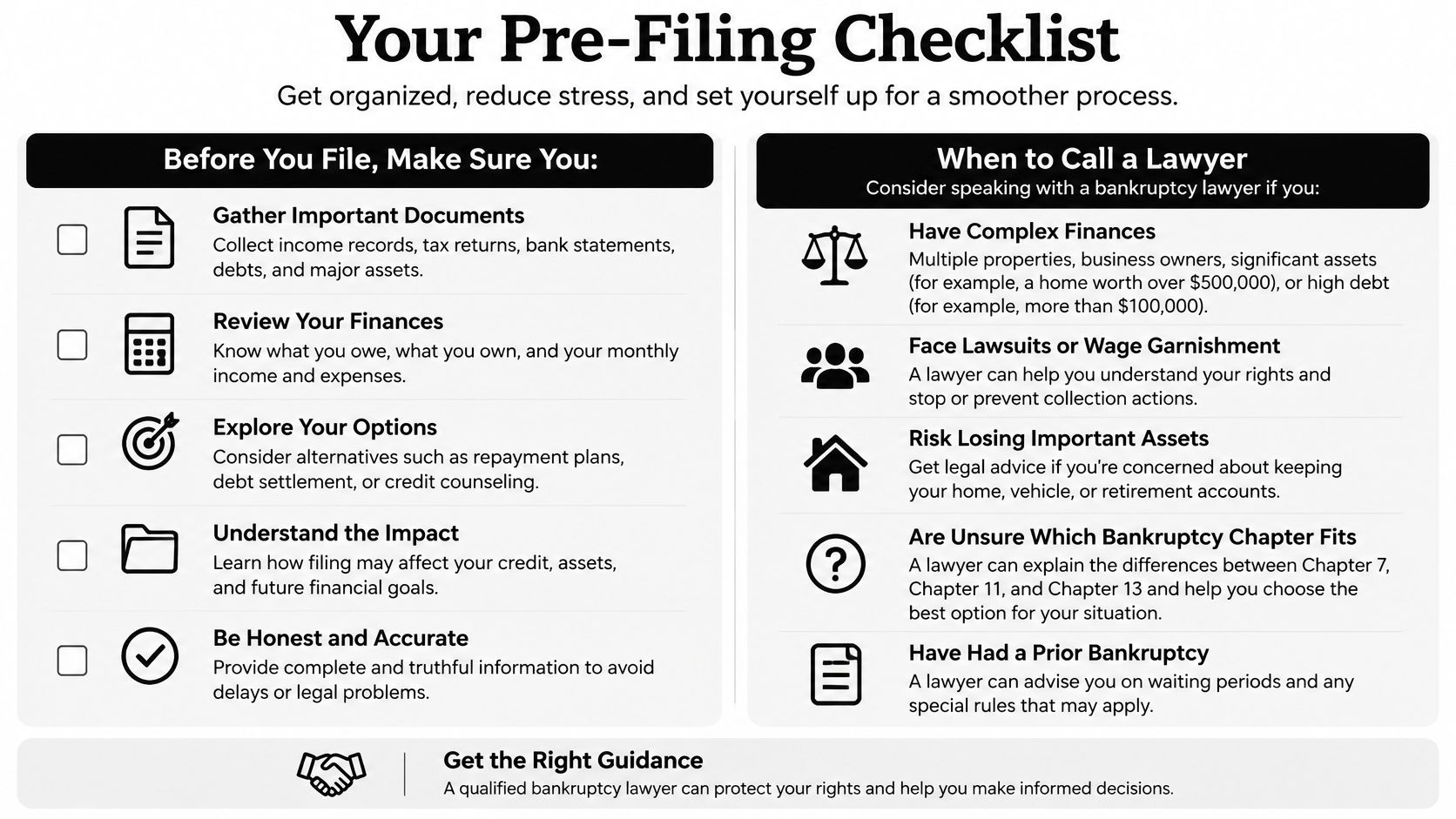
A judge's signature completes the court stage, not the entire QDRO process. The plan must still review and qualify the order. Before filing, check that the order reflects both the decree and the plan's requirements. A filing can be accepted by the court and still need correction before the plan will act on it.
What to Do Next
- Confirm the clerk's fee and e-filing rules for the specific document. Ask about the charge and submission requirements for the order itself, not for a divorce.
- Compare the draft with the decree line by line. Put the documents side by side and check that each award term matches. Pay particular attention to the benefit being divided and the terms that define the award.
- Verify the signature and date on the original. Check the document itself before submitting it.
- Set a follow-up reminder. Once the order is filed, check its status with the court and plan, and note any response that identifies a problem.
Careful review can catch preventable errors before they delay the order. A wrong date of birth or an outdated model order can trigger corrections even when the decree's award is clear. The judge's signature is only one stage. The plan's review determines whether the order meets its requirements and can be put into effect.
When a Consultation Earns Its Keep
Some problems call for legal advice rather than another round of edits. Consider consulting a lawyer when:
- The decree is silent about the retirement account. If the property division never addressed the plan, a separate court filing may be needed. Submitting an order that adds an award the decree did not make is not a substitute.
- The plan has rejected an order. Review the written reason and the decree language it identifies. The next step may be a redraft, clarification, or a new court order.
- The award uses an unclear formula. Language such as “a share of the marital portion” may need clarification before the plan can apply it.
- The divorce was high-asset or contested. Multiple plans, survivor benefits, or a mix of separate and community funds can make drafting more involved.
The Law Office of Bryan Fagan handles property division and other family law matters for clients in The Woodlands and across Montgomery County. Clients can schedule a consultation through the website form or by stopping by the Woodlands office. During the free consultation, the firm discusses your circumstances and legal rights confidentially under attorney-client privilege. If the order has already been signed, bring the decree, order, and the plan's letter so the discussion can focus on the issue that remains.
Each decree and plan has its own terms, so a filing that worked in another case may not fit yours. A Texas attorney can review the documents before you submit them and help identify whether the issue belongs at the court stage or the plan qualification stage.
If the plan qualifies the order but payment does not follow, the next issue may be enforcing the property award. This guide to enforcing a property division order in The Woodlands explains that separate step.
To discuss a decree that did not address a retirement account, or an order the plan has returned, visit The Law Office of Bryan Fagan to arrange a consultation.
