
A divorce decree is supposed to settle the property fight, but that's not always what happens in The Woodlands. A former spouse may leave a deed unsigned, refuse to refinance a house in Montgomery County, ignore a QDRO, or keep acting like the decree is optional. When that happens, enforcing a property division order in The Woodlands turns into a separate legal problem, and the remedy depends on whether you're chasing money, title transfer, or simple compliance with paperwork.
Texas law gives the court that rendered the decree power to enforce it, but not to rewrite it. Under Texas Family Code § 9.006, the judge may issue orders that clarify or specify how the division is carried out, yet the court cannot change the substantive split of assets or affect the decree's finality, and Texas law gives a 2-year window from the date the decree becomes final to file for enforcement of property division. That deadline matters because a delay can close the door on a court-enforced remedy even when the original decree was clear about who got what. The practical lesson is simple, enforcement is about implementation, not relitigation, and in Montgomery County that distinction drives every filing decision. See the statutory framework in Texas Family Code § 9.006 and the related chapter in Texas Family Code Chapter 9.
When a Final Decree Is Not the End in The Woodlands
A common Woodlands scenario starts the same way. The divorce is final, the decree says one spouse gets the house or a payout, and then the other side stalls. Maybe the deed never gets signed, the refinance never happens, or a retirement account transfer sits untouched while the ex keeps saying they'll “get to it.”
Why the decree still needs enforcement
Texas courts don't treat that kind of delay as harmless. If the decree already divided the property, the court can later enter orders to enforce that division, but only within the limits of the original award. That means a judge in Montgomery County can require someone to sign papers, deliver property, or follow the mechanics of the decree, but the judge can't go back and decide the asset split over again.
That matters in real life because property disputes after divorce rarely look dramatic at first. They usually look like missed signatures, unanswered emails, or a former spouse who won't cooperate with the paperwork. In a high-asset case, the delay can affect real estate, retirement accounts, brokerage accounts, vehicles, and business interests.
Practical rule: if the decree says the property is yours, the next fight is usually about getting the transfer done, not proving you deserved the property in the first place.
The local angle matters too. Montgomery County family courts see a lot of post-decree property disputes tied to homes, lender paperwork, and retirement documents, so the filing has to match the exact problem. A request aimed at a missed payment is different from a request aimed at a deed transfer, and the court will expect that distinction to be clear from the beginning.
If you're trying to understand the court process itself, Montgomery County Family Courts: A Local Guide is a useful local reference for how family law cases move through the courts serving The Woodlands.
Your Enforcement Options Under Texas Law
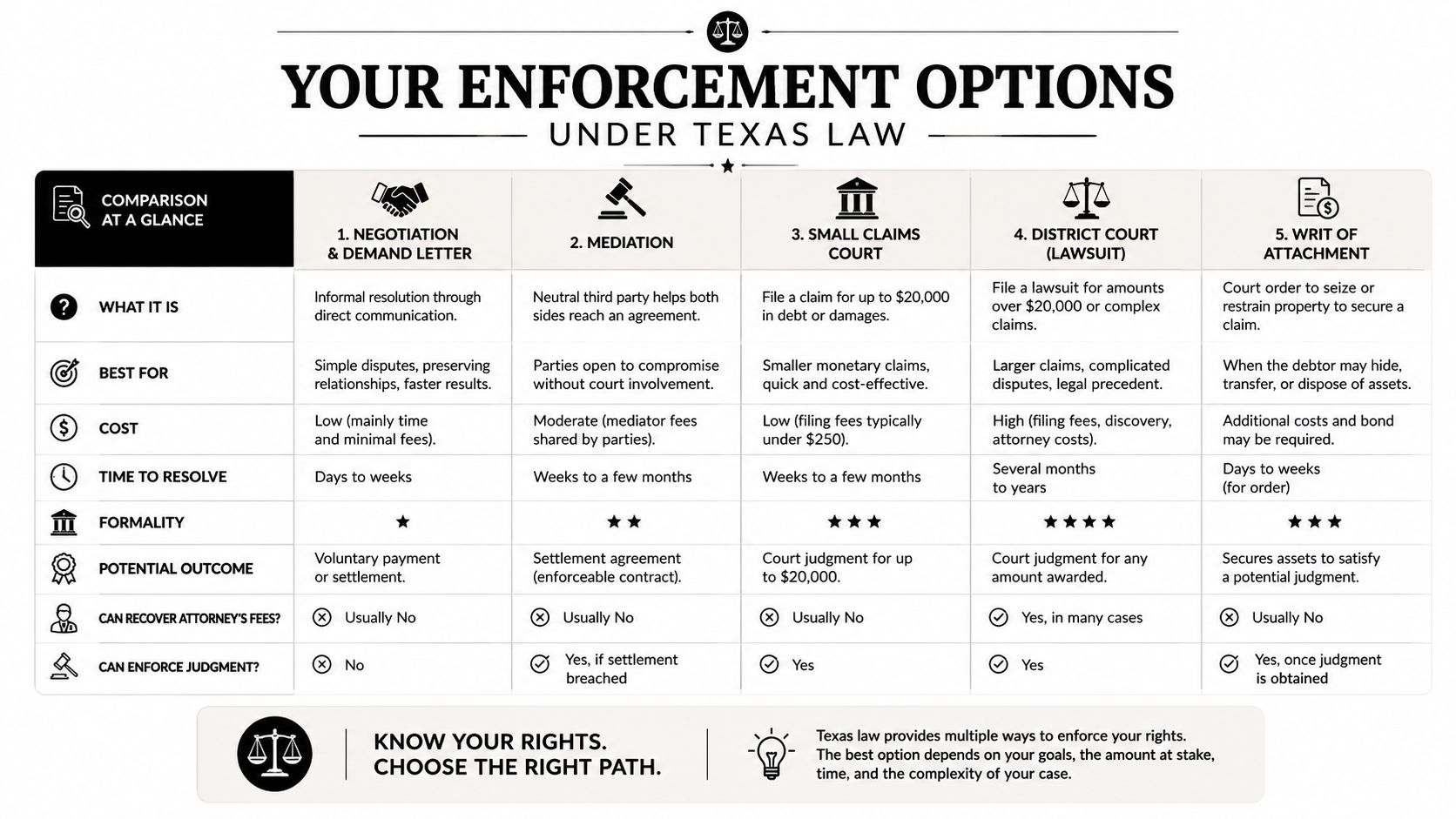
Texas gives you more than one enforcement path, but each one solves a different problem. The mistake I see most often is filing the right complaint under the wrong remedy, which slows the case down and gives the other side room to raise avoidable defenses.
Cash, compliance, and coercion are not the same thing
A buyout payment calls for collection tools. Depending on the decree and the asset involved, that can mean a writ of execution, post-judgment garnishment, or a money judgment tied to the decree. A refusal to sign a deed or complete account paperwork calls for a different approach, usually an order that requires the missing act or spells out exactly how the transfer must happen.
Contempt is its own remedy. Under Texas enforcement law, a court can respond to willful noncompliance with coercive sanctions, and Texas legal guidance notes that contempt can bring fines, attorney's fees, and even jail time in serious cases. That makes contempt a strong tool, but it does not fit every dispute. It works best when the decree is specific enough to show a clear failure to obey.
Other remedies fill different gaps. A turnover order can help the court reach particular property when ordinary compliance is not happening. An abstract of judgment or statutory lien can encumber real estate when the goal is to protect a property interest. Those remedies are not interchangeable, because each one reaches a different asset or addresses a different stage of noncompliance.
The Woodlands residents dealing with enforcement often need both tracks in mind at once. A home transfer may require deed language and refinance compliance, while a missed payout may call for a collection-style remedy. For a broader local overview, see Enforcement of Divorce Decree in Montgomery County, which covers how divorce decree and custody order provisions are enforced in Montgomery County.
How Enforcement Actually Works in Montgomery County
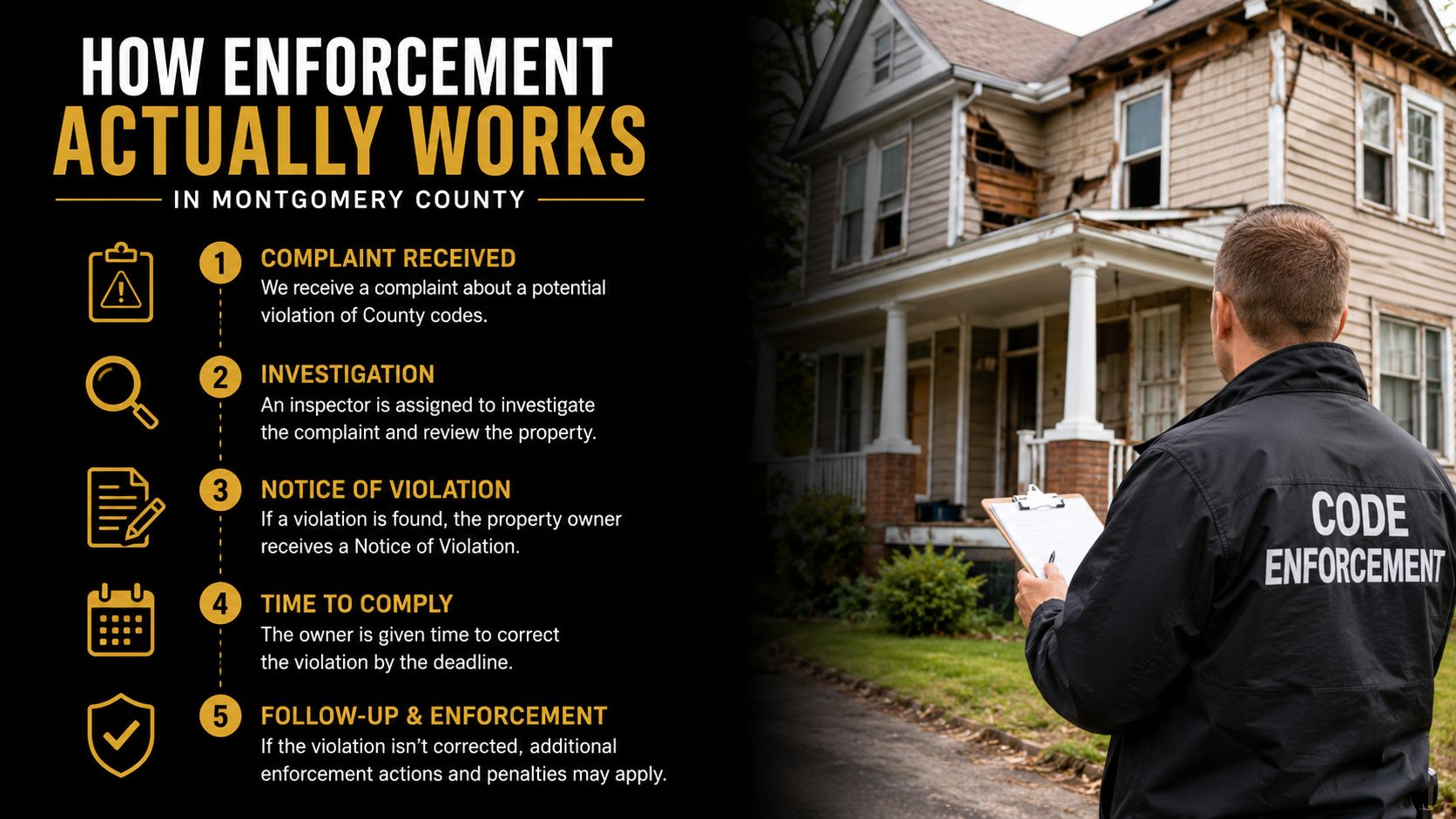
Montgomery County enforcement starts with the right court and the right paper trail. The petition goes back to the court that rendered the divorce, which is often one of the local district courts handling family cases for The Woodlands area. From there, the filing has to line up the decree language with the exact act that didn't happen.
Start with the decree, not the frustration
The file should show the specific obligation, the deadline or trigger in the decree, and the missed step. That can be a missing signature, a failed refinance, an account transfer that never happened, or a payment that stopped. If the record is fuzzy, the hearing gets harder than it needs to be.
Service still matters. The other side has to be properly brought into the enforcement case, and temporary orders can sometimes help stabilize the situation while the court is waiting to hear the full dispute. A spouse who keeps control of property or account access during the case can cause more damage if there's no interim request.
The strongest enforcement filings are built like a timeline, not a rant. Judges want dates, documents, and a clear link between the decree and the failure to comply.
The first hearing is usually not the end of the story. Courts may want additional proof, a clarified order, or more documentation before signing an enforcement order, especially where the requested remedy affects real estate or retirement paperwork. That's one reason local attorneys emphasize evidence before emotion, because oral explanations alone rarely carry a messy post-decree property dispute.
If the dispute involves a retirement account, a deed transfer, or another document-driven transfer, QDRO Attorney The Woodlands TX is the kind of focused local resource that fits the problem better than a generic divorce page.
Matching the Remedy to the Asset
The right remedy depends on what kind of asset you're trying to recover. A missed cash payment, a withheld deed, and a retirement transfer all sit in different lanes, even though they may come from the same decree.
Money owed versus property transfer
For money owed, the court may use collection-style remedies. That includes execution on assets, garnishment where available, and contempt when the decree is specific enough and the failure was willful. If the decree says a spouse owes a sum and doesn't pay, the court's enforcement tools look a lot like post-judgment collection.
For asset transfer, the better remedy is often document-based. Real estate usually needs deed execution or an order that authorizes the transfer mechanics. A lender won't be changed by the divorce decree alone, so a house in The Woodlands or nearby communities often ends up requiring refinance, sale, or a court order that forces the deed side of the transaction while the lender issue gets handled separately.
Retirement accounts are different again. A QDRO is the tool that often makes a retirement division work in practice, because it translates the decree into instructions the plan administrator can use. That's why retirement cases are rarely just “sign here” cases. They're paperwork cases with federal plan rules layered on top of state family law.
Business interests, professional practices, vehicles, and tangible personal property each bring their own friction point. The court can help with delivery, turnover, or execution of documents, but it can't make a bank, employer, or plan administrator ignore its own requirements. That's why the remedy has to fit the asset before the filing goes in.
The cleanest local approach is to sort the problem into one of two buckets. Is it cash and compliance, or is it title, paperwork, and transfer mechanics? Answering that first saves time and keeps the court focused on what it can order.
Building the Evidence and Paperwork File
A strong enforcement case usually wins or loses before anyone walks into the courtroom. The file needs to show what the decree said, what the other spouse was supposed to do, and what happened instead.
What belongs in the file
Start with the signed decree and highlight the exact property language. Add any agreed clarifying orders, a mediated settlement agreement if one controls the property terms, and a short written timeline showing each missed step. If you sent demand letters or texts asking for compliance, keep those too, because they show notice and noncompliance.
You also need the asset records themselves. Deeds, mortgage documents, account statements, retirement plan paperwork, vehicle title records, and business records can all matter, depending on the asset. If the other side is hiding information, business records subpoenas can help fill in gaps, but they work best when the request is narrow and tied to a specific transfer issue.
Keep this in mind: text messages and emails are useful, but they're strongest when they support an already-solid document record. A screenshot without context rarely carries the whole case.
Not every item needs to be sworn, but sworn affidavits help when you need to authenticate a timeline or explain a missing transfer. Exhibits can cover the underlying paperwork, while a declaration or affidavit can connect the dots. That distinction matters because hearsay objections can derail sloppy proof, especially if the case turns on who said what and when.
The deadline still controls everything. Under the Texas enforcement framework, the 2-year window for property division enforcement runs from the date the decree becomes final, and the court cannot use enforcement to change the substantive split. That means the file should focus on proving noncompliance, not trying to reopen the property division itself.
Costs, Timelines, and Common Defenses
Enforcement in Montgomery County isn't free, and it isn't fast. Filing fees, service costs, and the time needed to assemble a clean QDRO or enforcement packet can add up before the first hearing even happens.
What usually drives the cost
A contested case costs more when the decree is vague, the documents are missing, or the asset trail is messy. If the dispute involves a retirement account, the administrative work for the QDRO can also add to the bill. When the other side fights every step, the attorney time grows with the number of motions, revisions, and hearings required.
Texas law helps on fees in the right case. Under the enforcement framework, the court may award court costs and reasonable attorney's fees to a successful party seeking enforcement of property division. That doesn't mean every filing gets paid back, but it does mean a noncomplying spouse can face a fee award when the court grants enforcement.
Common defenses follow a familiar pattern. The noncomplying spouse may claim they couldn't pay, argue the original division was unfair, say the decree was ambiguous, or insist the property wasn't community property anymore. Those defenses can matter, but they don't automatically defeat enforcement if the decree was clear and the requested order stays within the original division.
If contempt is on the table, the issue gets more serious because the court is no longer just sorting paperwork. For Montgomery County readers trying to understand how that plays out, the firm's page on Contempt of Court Divorce The Woodlands fits this enforcement track well.
What to Do Next and When to Call a Local Attorney
What to do next
- Read the decree line by line. Find the exact property language and the exact missing act.
- Calendar the 2-year deadline. Texas law gives a limited window for property division enforcement.
- Gather proof of noncompliance. Save texts, emails, deeds, account statements, and payment records.
- Identify the asset class. Decide whether the problem is payment, title transfer, or a retirement division.
- Talk to a Montgomery County family law attorney. The remedy has to match the asset and the court's enforcement power.
A clean file can make a real difference. I've seen cases where a homeowner in The Woodlands got stalled for months because the ex refused to sign transfer papers, then the case moved quickly once the decree, demand letters, and account records were organized into a clear enforcement packet. The court didn't need a dramatic story, it needed a record that matched the order.
If you're in The Woodlands, Panther Creek, Alden Bridge, Sterling Ridge, Creekside, or anywhere else in Montgomery County, now is the time to get specific advice about your property division enforcement options. The right next move depends on the asset, the deadline, and the remedy that fits the dispute. This is not legal advice, and it isn't a substitute for a lawyer looking at your decree and your documents.
If you need help with a stubborn property division order, The Law Office of Bryan Fagan handles enforcement matters, divorce, and property division disputes for clients in The Woodlands and Montgomery County. Visit The Law Office of Bryan Fagan to schedule a consultation and discuss the enforcement path that fits your decree, your asset, and your deadline.