 Skip to content

The advice you'll hear most often about an unpaid divorce judgment in Montgomery County is short. Get a writ of execution, hand it to the sheriff, and let the levy do the work. It sounds clean, it's cheaper than a full enforcement suit, and sometimes it works exactly as advertised.
It's also the reason a lot of spouses spend three months chasing a piece of paper that was never going to move their case forward.
A writ of execution is a levy instrument. It reaches nonexempt personal property, the officer seizes it, it gets sold, and the proceeds come back to you. What a writ cannot do is rewrite a decree that ordered your ex-spouse to sign over the truck title, transfer the retirement account, or hand back the furniture. Those provisions aren't collected by a constable. They're enforced by a judge.
The wording of your decree, not the writ, chooses the route. Label the provision you're owed before you call anybody in Conroe. Here's how the obligations split apart.
Which Enforcement Tool Fits Your Divorce Judgment
Open the decree and read only the paragraphs that order your ex-spouse to do something, and only the ones still unpaid. That narrow strip of text decides which courthouse door you walk through.
A fixed money award is the friendliest target for a Montgomery County writ of execution on a divorce judgment. That means an equalization payment, a reimbursement award, or a sum the decree says one spouse owes the other by a date certain. You ask the clerk of the court that signed the decree to issue the writ, the writ goes to the sheriff or constable, and the officer levies property that isn't exempt. None of that requires the judge to reopen the divorce.
An owelty payment tied to the family homestead usually behaves the same way when the decree writes it as a fixed sum, and Texas Property Code Chapter 41 recognizes an owelty obligation from a court-ordered division of a family homestead as potentially enforceable. A writ is a legitimate first move. What the writ still can't do is force the deed itself across the table.
Then there's the category that breaks people's hearts. A transfer of a vehicle, a bank account, a household item or a retirement interest is not a money judgment, and a levy won't touch it. Texas Family Code Chapter 9 instead directs the party enforcing a decree's property division to file an enforcement suit in the court that rendered the decree, and that court can issue further orders clarifying how the division gets carried out without changing the substantive division. That distinction is the whole ballgame in Montgomery County, where a post-decree enforcement proceeding often has to come before anyone thinks about execution.
Why a clarification motion is sometimes the entire case
Plenty of disputes aren't about entitlement at all. The decree awards her "the retirement account," there are two accounts at the same custodian, and nobody wrote down which one. A request for clarification under Chapter 9 settles that. It doesn't reopen the division and it doesn't require proving bad faith.
Child support arrears belong in a separate lane. Family Code support enforcement runs on its own rules and its own remedies, so don't fold them into a property-division writ request and expect the same machinery to handle both.
| Unpaid decree provision | Usual enforcement route | Where it is filed |
|---|---|---|
| Fixed money award such as equalization or reimbursement | Writ of execution | Clerk of the court that signed the decree |
| Owelty payment on the family homestead | Writ of execution if it is a fixed money award | Clerk of the court that signed the decree |
| Transfer of a vehicle, account, household item or retirement interest | Enforcement suit under Family Code Chapter 9 | Court that rendered the decree |
| Vague or disputed implementation wording | Request for clarification under Family Code Chapter 9 | Court that rendered the decree |
| Child support arrears | Enforcement under Family Code child support rules, not the 10-year writ rule | Court with continuing jurisdiction over the support order |
One more route deserves a place on your list. When the value sits in Texas real estate rather than in a bank account the constable can reach, recording an abstract of judgment to enforce a decree can create a lien that outlives a failed levy.
So take a legal pad and give every unpaid line a label: money, property transfer, or clarification. That label is your route, and it costs nothing to write down.
Deadlines That Can Stop a Writ in Montgomery County
The clock that kills the most collection attempts isn't the ten-year rule everyone quotes. It's the two-year window almost nobody mentions.
If the thing you're owed is tangible personal property that existed when the decree was signed, enforcement generally has to be filed by the second anniversary of the decree's signing, or of finality after appeal, whichever comes later. A vehicle, a piece of equipment, a specific account balance sitting somewhere as of the decree date, all of that can fall outside the window faster than the more famous ten-year rule would suggest. That deadline can be more urgent than anything else in your file.
The longer clock runs on the money. Texas Civil Practice and Remedies Code §34.001 generally requires a writ of execution to be issued within 10 years after the judgment is signed, and if no writ issues during that period the judgment becomes dormant and execution generally can't proceed unless the judgment is revived. If a first writ does issue on time, a second writ generally has to issue within 10 years after the first, or the same dormancy risk returns. Those are two separate ten-year milestones, not one, and the second is the one people forget because the first one worked.
Child support changes the analysis. The ten-year dormancy rule doesn't apply to a judgment for child support under the Texas Family Code, so identify the judgment type before you count anything.
The practical rule: a former spouse who waits can lose the ability to collect without extra court steps, and revival is a judicial proceeding you have to pay for and win.
| Deadline | Length | Clock starts | If it passes |
|---|---|---|---|
| Earliest ordinary writ (TRCP 637) | 30 days | Final judgment signed | Clerk generally cannot prepare the writ yet |
| Early writ with affidavit (TRCP 628) | Before 30 days | Affidavit showing asset concealment | Requires sworn facts, not just a delay |
| First writ (CPRC 34.001) | 10 years | Judgment signed | Judgment becomes dormant and must be revived |
| Second writ (CPRC 34.001) | 10 years | First writ issued | Judgment can become dormant |
| Tangible personal property enforcement (Family Code Chapter 9) | 2 years | Decree signed or final after appeal, whichever is later | Enforcement suit must be filed by then |
Before you call the district clerk or the sheriff's civil division, write down two dates on a single sheet of paper: the date the decree was signed, and the date of every writ already issued in the case. If you can't find prior writs in your own files, ask the clerk to check the court file. Our office handles Enforcement of Court Orders in The Woodlands, which includes enforcing divorce decree and custody order provisions in Montgomery County, and that two-date check is the first thing worth getting right.
How to Request and Issue a Writ of Execution
The decree decides whether a writ of execution is the right request at all. A money award can be reduced to a dollar figure the clerk can place on the writ. An order to sign a deed, transfer title, or hand over a specific item cannot. I would not pay to issue a writ against a property-transfer paragraph just because the judgment is valid. The wording of that paragraph picks the tool.

Use the file-stamped decree, not the draft in your email. Highlight the money paragraph. That language, and only that language, is what belongs on the writ.
Under Texas Rule of Civil Procedure 637, the clerk generally may not prepare the writ until 30 days after a final judgment is signed, unless enforcement has been suspended under the appellate rules. Do not ask earlier unless you already have a proper early-writ affidavit on file.
- State a figure the writ can carry. Put the judgment balance, accrued interest, taxable costs, and expected execution costs on separate lines, each with its source. That total is the number printed on the writ and the number used when proceeds are applied. A rounded guess is how the writ leaves the clerk's office for the wrong amount.
- Name only property you can tie to the debtor. County appraisal district records and titles are the check. If you cannot show ownership, leave the asset off the request. Listing it only creates a fight over what the writ was allowed to reach.
- Ask the district clerk of the court that signed the decree to issue the writ. When the issued writ comes back, compare it with the judgment and the cost bill, line by line, before you hand it to anyone. The three should match to the dollar.
A one-page cover letter still earns its place. List the judgment date, the total due, the property you identified, and a contact for the officer's civil division. That sheet gives the clerk a chance to catch an error before the writ prints.
What a clean filing packet looks like
- The decree, money paragraph highlighted and signing date flagged
- The payoff ledger, with balance, interest, costs, and anticipated fees
- The proposed writ, matching the judgment to the dollar
- Ownership evidence for each asset you want levied
- A filing check for the correct court, clerk, and officer
Budget the clerk's filing fee, the sheriff's or constable's fee for receiving and executing the writ, and service or sale costs on top of those. Fee schedules change. Ask the Montgomery County district clerk and the sheriff's civil division for the current amounts, then enter every figure in the ledger before you file. Once the papers have to move through an officer, how the Montgomery County sheriff's civil division handles service of process is the companion to issuance, not a substitute for a writ that matches the decree.
How the Sheriff Levies and Sells Property
Once the writ is issued, the work moves to an officer who has no independent duty to hunt for your ex-spouse's assets. The writ authorizes a levy on nonexempt property you can identify, and only while the writ is still live.
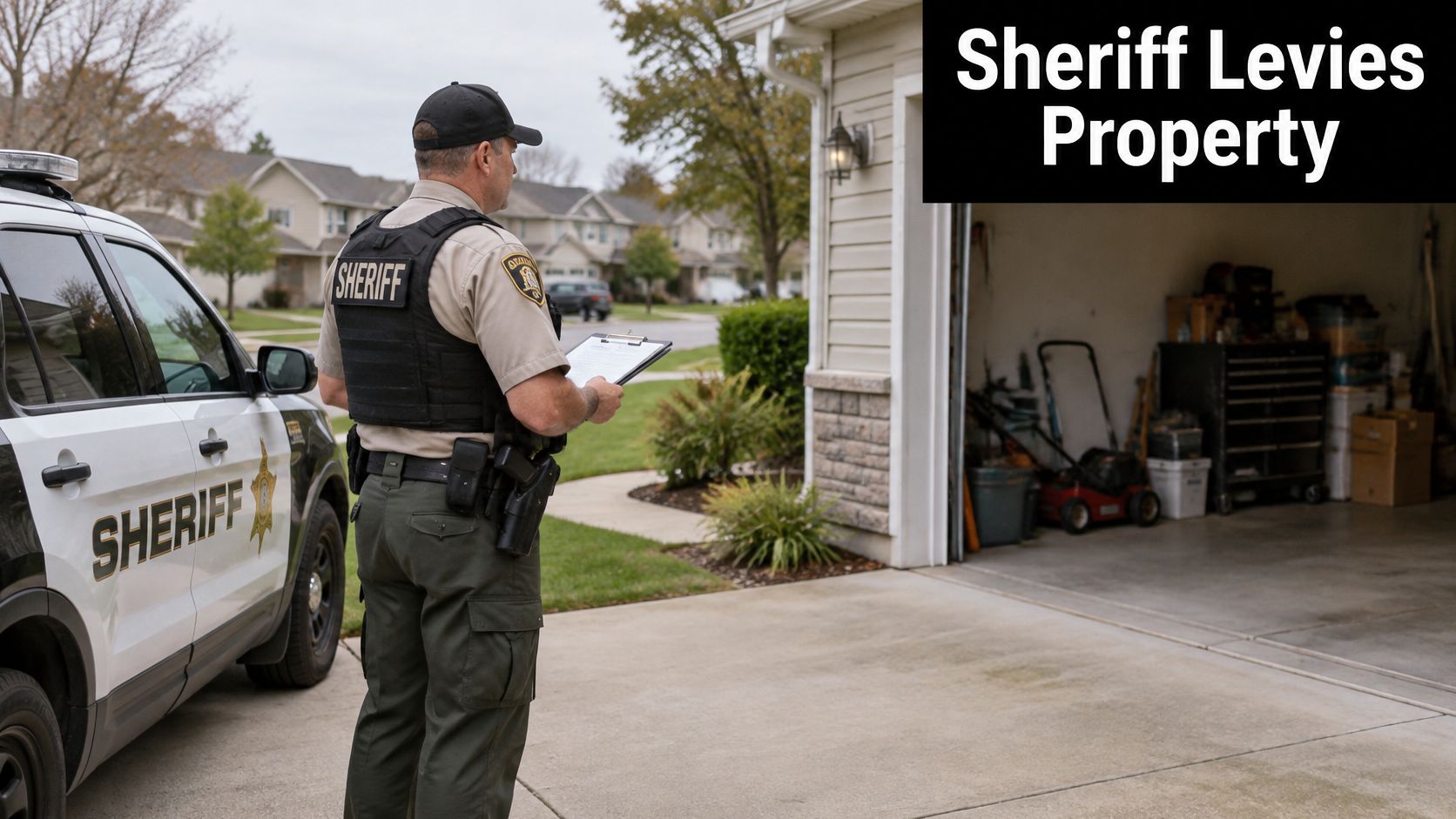
What the officer can and cannot take
Confirm what is protected before the writ goes out. Certain homestead and personal property is exempt under Texas Property Code Chapter 42, and an officer who seizes an exempt item cannot sell it. That levy costs money and produces nothing.
Bring the officer a working file: vehicle titles, account statements, addresses, and employer names, plus a note on which items you can prove belong to the debtor. A complete target list lets the officer go to a known location on the first visit instead of driving around on a guess.
Read the decree before you treat the writ as the whole plan. A definite money judgment can support a levy and sale. An order that the other spouse sign a deed or hand over a specific asset is a different job, and a writ will not force that transfer even when the judgment itself is valid.
- Deliver the writ with directions. Hand the issued writ to the Montgomery County sheriff or a constable along with a written list of where the debtor's nonexempt property sits. A writ with no target list tends to come back empty.
- The officer levies, and timing bends. An attempted levy can begin at any point during the writ's life, but the officer needs enough runway left to complete a sale before the writ expires. A writ you sit on for weeks shrinks what is realistic.
- A claim by a third party changes the forum. If someone who is not a party to the writ says the levied property is theirs, Texas law generally sends that dispute through a trial-of-right-of-property proceeding rather than an ordinary wrongful-levy lawsuit against the sheriff or constable. That is a hearing, and it can pause your sale.
- The officer may return the writ early. When you cannot identify additional executable property currently owned by the debtor, Texas law allows the officer to return the writ after the first levy or attempted levy. Plan for that outcome. It means the second levy never happens.
- Track the return in writing. The officer's return tells you what was seized, what sold, what was credited, and what remains outstanding. Read it, calendar a follow-up, and put your questions in writing so there is a record.
A levy is only as good as the property list behind it. The paperwork gets you to the driveway. The asset file is what fills the truck.
Once a sale closes, the proceeds are applied against the judgment, interest, and costs, and the officer's return shows the arithmetic. If a balance remains, decide whether a second levy is worth the fee.
The officer will levy what you identify, sell what is not exempt, and stop when the writ or the property runs out.
Pitfalls, Exemptions and Alternatives to a Writ
A spouse in Panther Creek is owed a $38,000 equalization payment, payable in monthly installments, and the payments stopped four months ago. The instinct is to walk into the district clerk's office and ask for a writ. Read the decree first. Three questions reorder the plan before the first dollar gets spent: does the ledger total $38,000 after credits and interest, does the ex-spouse own anything a constable can pick up, and does the payment clause say what the creditor thinks it says?
The decree's wording decides the enforcement route. The writ form does not. Execution is most directly suited to a definite monetary judgment rather than to every provision a decree contains, as this review of Texas post-judgment execution practice makes clear. A property-transfer order can be a valid judgment and still be a poor candidate for a writ of execution. When the clause orders delivery of an asset rather than payment of a sum, turnover or contempt usually matches the wording better than a levy.
Authoritative sources do not offer a reliable success-rate figure for these executions. Anybody quoting one is guessing.
The costly version of this mistake is paying fees before the file is ready. Asset verification, an exemption check, and a bankruptcy screening all come before a levy. I would not authorize a single fee until the items below are answered in writing.
- Arrears versus the face amount. Four missed installments are not automatically $38,000. Build the ledger with credits and interest before anyone types a writ amount.
- The wrong officer. Constables and the sheriff's civil division cover different territory and different procedures. Confirm who serves that address before you mail anything.
- Skipping the bankruptcy screening. A filing you never checked can stop the collection you just paid to start. The docket check belongs before the levy.
- No written follow-up after the return. The return closes a chapter, not the file. Silence after it is how cases go cold.
When a writ is the wrong tool, a different mechanism usually fits better.
| Tool | Use when | What it requires |
|---|---|---|
| Turnover order | Debtor holds nonexempt property or funds that levy cannot reach | Court order directing delivery to the creditor |
| Garnishment | A third party such as a bank or employer owes the debtor money | Notice to the holder and a writ directed to that holder |
| Abstract of judgment | Debtor owns Texas real estate the creditor wants to lien | Recording in county real property records |
| Contempt motion | Debtor willfully ignores a clear court order | Proof of willful violation and a court hearing |
Pick the tool by asking where the debtor's money actually sits, and by reading what the decree ordered. The answer, not habit, should decide.
Decide Whether to Hire a Montgomery County Attorney
A valid, unpaid divorce judgment does not automatically call for a writ of execution. The decree's wording decides the enforcement route. If the unpaid clause orders a property transfer rather than a sum of money, a writ can be the wrong tool even though the judgment itself is solid.
I recommend representing yourself only in a narrow lane: the decree states a fixed dollar amount, the payment is plainly overdue, you have confirmed one specific nonexempt asset, and no deadline is close. In that lane the request is mostly paperwork, and a lawyer mainly saves you time. You still have to match the writ to that asset and keep the judgment date and any earlier writ dates straight. Miss either one and the filing stalls while the debt sits unpaid.
Hire counsel when the order is harder to read than that. Unclear wording, or two provisions that seem to conflict, can send the case after a remedy the decree does not support. A transfer clause is a different problem from a dollar balance: spending a writ on it aims a levy at an order the sheriff cannot turn into a title or an account. A ten-year dormancy milestone, or the shorter window for tangible property, leaves little room for a rejected request. A third party who claims the levied property opens a separate proceeding. A debtor who is moving or hiding assets changes both timing and strategy.
Call the clerk or the sheriff last. Do it only after you know which court entered the judgment and which officer covers the address. An early call usually yields a form, not a decision about whether a writ fits.
The Law Office of Bryan Fagan handles complex divorce and child custody matters for clients in The Woodlands and across Montgomery County. The attorneys take time to understand each client's unique circumstances before taking action, starting with the decree: which items are money, which are property transfers, and which need clarification. A judgment enforcement attorney can say whether that wording supports a writ, an enforcement suit, or another route.
This article is general information about how post-decree enforcement works in Texas. It is not legal advice, and reading it does not create an attorney-client relationship. Your decree and your facts determine your options.
If you are in Alden Bridge, Sterling Ridge, Creekside, or elsewhere in the county and an ex-spouse has stopped honoring a court order, the firm can review the decree and map a realistic path. Call 281-819-1726 or visit The Law Office of Bryan Fagan to schedule a consultation.
