 Skip to content
In Montgomery County, you file through the County Attorney's Office, attend at least one preparation appointment and one court appearance, and a hearing is usually set within two weeks of filing. The process is civil, court-based, and requires you to prepare for testimony rather than submit paperwork and wait.
If you live in The Woodlands, perhaps in Panther Creek, Alden Bridge, Sterling Ridge, or Creekside, you may be trying to make a safety decision while also managing texts, custody exchanges, work, and housing. The hardest part is often understanding what happens after the application is started. A protective order can provide important court-backed restrictions, but filing an application is only the beginning.
Montgomery County's system moves applicants through intake, review, preparation, filing, service, and a hearing. It can help organize a case quickly, but the county attorney's review is also a gatekeeping step, and the order doesn't automatically eliminate every enforcement problem. That gap between asking for protection and obtaining a final, enforceable order deserves careful attention.
What the Montgomery County Protective Order Process Looks Like
A resident of The Woodlands may have messages showing threats, a recent incident at home, or repeated unwanted contact near a child's school. That person may know a protective order exists but still not know where to start, what the County Attorney's Office expects, or whether appearing in court is required.
In Montgomery County, protective orders are handled as civil court orders issued by a judge to stop family violence, not as informal agreements between the parties. The local process runs through the Montgomery County Attorney's domestic violence process, where the applicant provides information for review before the case proceeds.
The local sequence
The practical path usually includes these stages:
-
Application and questionnaire. You provide the facts supporting the request and identify the conduct you want the court to restrict. The county questionnaire addresses subjects such as threats, harassment, stalking, protected locations, pets, and firearms.
-
Preparation appointment. Montgomery County requires applicants to complete at least one preparation appointment. This is an important opportunity to organize the timeline, identify supporting evidence, and understand what testimony the court may need.
-
County attorney review. An Assistant County Attorney reviews the questionnaire by phone and decides whether the office will represent the applicant in the protective-order lawsuit. The office therefore does more than distribute forms. It evaluates the application before committing to representation.
-
Filing and hearing. After filing, the county materials state that a hearing is scheduled within two weeks. The applicant must attend at least one court appearance and be willing to testify against the respondent.
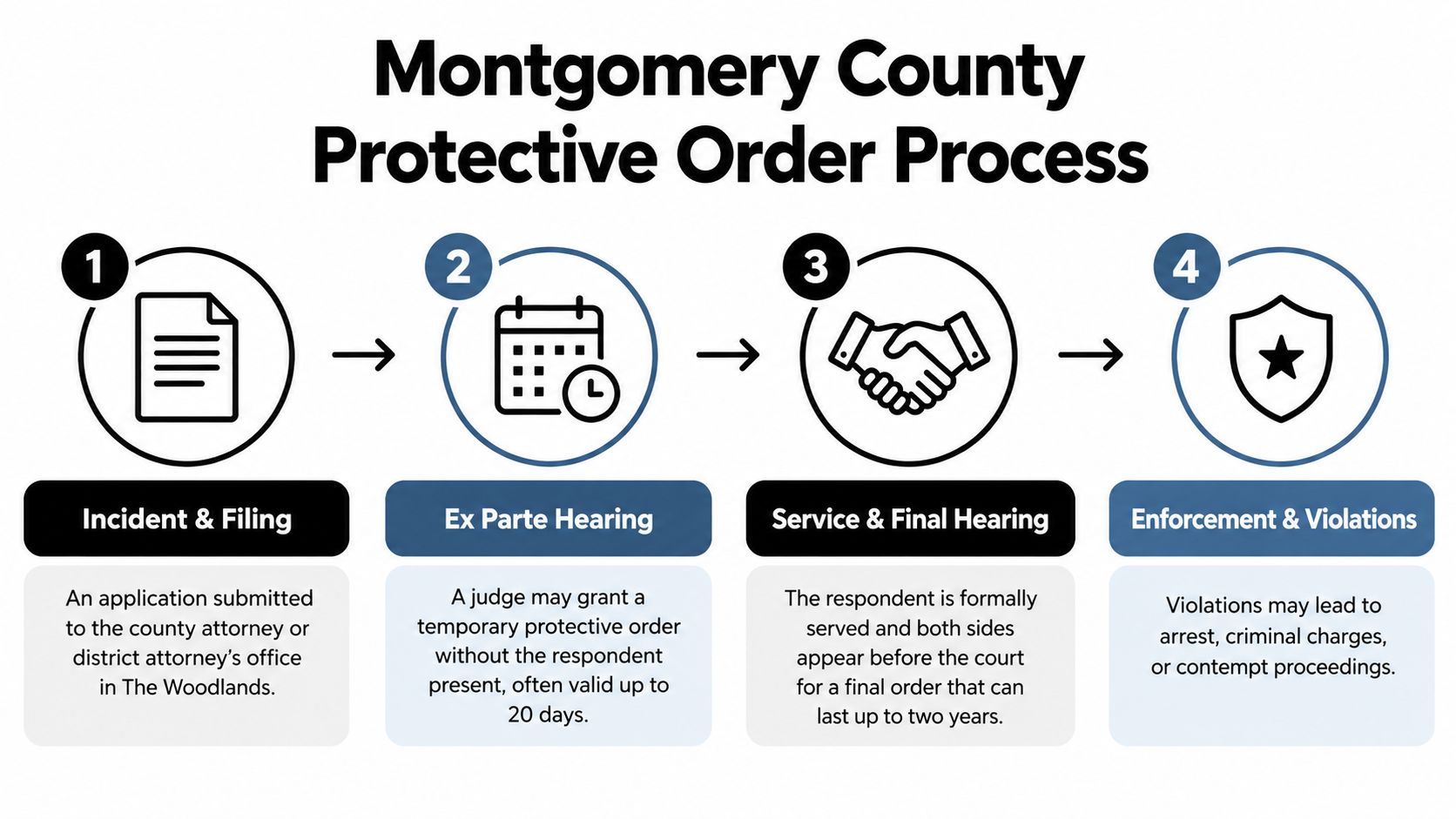
The time commitment matters. Someone expecting a paper-only solution may be unprepared for the preparation appointment, phone review, and open-court testimony. Someone facing ongoing danger may also need a safety plan for the period before a judge enters or law enforcement can verify a particular order.
Practical rule: Treat the first appointment as the start of trial preparation, not as a simple administrative meeting.
The county process can be a useful entry point, but it isn't the only source of guidance. If a divorce, custody case, or emergency family-court issue is already pending, review how the protective-order request fits with the existing case through resources such as an emergency family court order in Montgomery County. Those matters may overlap, but they aren't interchangeable.
Filing a Protective Order Through the County Attorney in The Woodlands
The intake process becomes clearer when viewed through a realistic example. Consider a hypothetical Alden Bridge resident who has received repeated threatening messages from a former partner and wants restrictions covering her home, workplace, and child-care location. She completes the Montgomery County questionnaire, attends the preparation appointment, and then speaks by phone with an Assistant County Attorney.
The phone review is not a promise that the office will automatically take the case. The attorney may ask what happened, when it happened, where the parties were, whether the conduct is continuing, what evidence exists, and whether the applicant is prepared to testify. The answers help the office decide whether it will represent the applicant in the protective-order lawsuit.
That review creates a practical trade-off. County representation can give an applicant a structured path into court, but the applicant still needs a coherent account and must participate personally. If the office declines representation, the applicant should promptly ask what filing alternatives exist and consider independent family-law advice rather than assuming the matter is over.
What to gather before intake
Organize evidence by incident instead of handing over an unstructured collection of screenshots. A short chronology is often more useful than a long narrative:
- Dates and locations: Record when each incident occurred and whether it happened at a residence, workplace, school, or another protected location.
- Exact communications: Preserve messages, emails, voicemails, and social-media content without editing the original material.
- Witness information: List people who saw the conduct, heard threats, observed injuries, or know what happened immediately afterward.
- Existing court papers: Bring relevant divorce, custody, visitation, bond, or prior protective-order documents.
- Safety concerns: Identify firearms, stalking, threats to pets, threats involving children, or conduct that has escalated.
Texas law provides several possible filing venues. The Texas State Law Library's protective-order guidance explains that an application may generally be filed in the county where the applicant lives, where the respondent lives, or where the offense occurred. County or district attorneys may help file and represent applicants in many counties.
For a person in The Woodlands whose former partner lives elsewhere, venue can affect convenience, court coordination, and access to witnesses. The local Montgomery County Attorney's process remains especially relevant when the applicant lives in Montgomery County, but venue should be checked against the facts of the particular case.
Filing is not the same as representation
Montgomery County's questionnaire materials state that applications are processed through the County Attorney's Office, that a hearing is set within about two weeks of filing, and that the applicant must be willing to testify in open court. The office's decision to represent someone is therefore a meaningful step in the workflow, not a formality.
A person seeking forms should also distinguish the county questionnaire from forms required in a related family case. The Montgomery County family-court required forms at filing may involve a separate filing or proceeding. For general local context, Protective Orders in The Woodlands addresses protective orders in domestic-violence and family-safety matters.
What Happens at the Hearing and What the Data Shows
A petitioner from The Woodlands can arrive with messages, photographs, and a detailed incident log, then leave without a final protective order. The hearing is the point at which the application must become admissible evidence. Before attending, review the Montgomery County 410th District Court family docket procedures to understand the local scheduling timeline and prepare for the court's process.
The applicant may testify under oath, offer documents or other admissible material, and answer questions about the incidents and requested restrictions. The respondent may appear, contest the allegations, and respond through counsel. The judge decides the case under the applicable legal standard, not because the County Attorney accepted the application for filing.
Under Texas Family Code Chapter 81, the court must render a protective order if it finds that family violence occurred. Preparation matters most when the parties give sharply different accounts. A credible presentation connects specific conduct to reliable supporting evidence instead of relying on broad descriptions of fear or conflict.
Why the county data should change preparation
Court Watch Montgomery reported that 54 percent of petitions resulted in a granted final protective order in 2015, falling to 42 percent by 2018. The figures appear in the organization's Montgomery County protective-order report.
Those figures cannot predict the outcome of an individual case in The Woodlands. They do expose the gap between filing an application and obtaining a final order. An initial filing may lead to a temporary order and a hearing, but those steps do not guarantee final relief. Temporary protection and a final order involve separate decisions.
Temporary orders can be granted even when final relief is later denied. Applicants should preserve evidence supporting immediate protection while preparing for the respondent's challenge at the final hearing. That distinction affects expectations, safety planning, and the decision to seek legal advice.
Evidence that helps the court understand the pattern
Judges need concrete facts. Organize each incident around its date, location, communication, witness, injury, police contact, or other supporting material.
- Show the conduct: Identify the words, acts, threats, or contact that caused concern.
- Explain the relationship: Establish why the parties fall within the family, household, or dating relationships covered by Texas law.
- Connect the request to safety: Explain why restrictions involving a residence, workplace, school, child-care facility, pets, or firearms are requested.
- Separate incidents: Describe events individually rather than blending them into one general allegation.
- Prepare for questions: Expect questions about prior contact, conflicting messages, witnesses, and existing family-court orders.
A dated incident log, preserved messages, photographs, and witness names give the court a clearer record than a phone containing hundreds of unsorted screenshots. Organization does not guarantee a final order, but it makes the evidence easier to evaluate.
The Family Code also permits the court to assess a $16 protective-order fee, along with service and court costs, against the respondent in most cases. That financial issue is separate from whether protection is granted and should not determine an applicant's safety decisions.
Opposing a Protective Order and Understanding Enforcement
A respondent shouldn't ignore a protective-order notice because the allegations seem exaggerated or because the parties have resumed friendly communication. The written order, service status, hearing date, and restrictions control what happens next.
A temporary ex parte protective order may be issued without notice in an appropriate case. Texas guidance describes requirements for an ex parte order excluding someone from a residence that include a sworn affidavit, in-person testimony, residence within the last 30 days, family violence within the last 30 days, and a clear and present danger of future family violence. The Texas guidance on temporary ex parte protective orders also distinguishes that emergency inquiry from the final-hearing standard.

Service and the right to respond
Service matters because a respondent needs notice of the proceeding and the order's terms. If service has not occurred, enforcement questions may become more complicated, but a respondent shouldn't assume that lack of personal knowledge makes every restriction irrelevant. The safest course is to obtain the actual paperwork, avoid contact with the applicant, and address service and hearing rights through the court or counsel.
A respondent can contest the requested final order at the hearing. That means reviewing the allegations, gathering relevant records, identifying witnesses, and complying with every temporary restriction while preparing a response. Directly contacting the applicant to explain, apologize, negotiate, or ask for permission can create additional problems if the order prohibits contact.
A common Panther Creek scenario involves a respondent who learns that a hearing has been set but hasn't been properly served with the complete documents. That person should not treat the service issue as permission to approach the applicant. The practical response is to verify the court record, determine what has been served, and raise the issue through the proper legal channel.
When the registry and world differ
Texas maintains a statewide Protective Order Registry containing applications, orders, and modifications. Most entries are required within 24 hours, and law-enforcement access has expanded since 2020, according to Texas guidance on enforcing protective orders.
Registry access helps officers locate and verify information, especially when an order crosses county lines. It doesn't guarantee that every responder will instantly know the order's terms, that service has occurred, or that the respondent will comply. The protected person should still keep copies of the order, understand the prohibited conduct, and use layered safety planning rather than relying on paperwork alone.
Enforcement reality: A registry entry improves access to information, but it isn't a substitute for immediate safety planning or a clear response to a violation.
The following video provides general context about protective-order proceedings. It doesn't replace a review of the actual Montgomery County order or case file.
Next Steps and When to Consult an Attorney in The Woodlands
A Creekside parent may arrive at intake with weeks of unwanted messages, photographs, and police records, yet still face a gap between filing an application and obtaining a final order. The county process can organize the request and provide a path to court. It does not guarantee that the evidence will support every requested restriction, that service will occur promptly, or that the respondent will agree to the allegations.
What to do next
Build the record before the appointment:
- Create an incident timeline: Record the date, location, conduct, people present, and immediate consequences for each event.
- Preserve communications: Keep texts, emails, voicemails, call records, and social-media messages in their original form.
- Identify protected places: List the residence, workplace, child-care facility, school, and any other location where restrictions may be needed.
- Collect supporting records: Gather photographs, medical records, police reports, witness information, and related family-court orders.
- Attend the preparation appointment: Montgomery County applicants must complete at least one appointment before the matter proceeds.
- Prepare for testimony: County materials require the applicant to attend at least one court appearance and be willing to testify.
- Address immediate safety first: If danger is active, go to a safe location and contact emergency services instead of waiting for the civil process.
A clear timeline helps the County Attorney's Office evaluate the request and gives the judge usable information. It also exposes weaknesses early. A missing date, unclear message, or disputed incident may matter at the final hearing, where the respondent can challenge the account and the court must assess the evidence.
When individual legal guidance matters
The county attorney route may fit a straightforward application. Personal counsel becomes more useful when the protective-order request overlaps with custody, divorce, support, or enforcement litigation. Allegations can affect temporary possession, parent communication, child exchanges, evidence presentation, and deadlines in the related case.
Consider consulting an attorney when:
- Emergency relief is needed: The facts may justify a prompt request for temporary ex parte protection.
- Service may be difficult: The respondent may avoid service, live outside Montgomery County, or move between communities.
- The parties have conflicting cases: Testimony in one proceeding may affect another.
- The evidence is extensive: Digital messages, photographs, witnesses, and prior court records need a coherent presentation.
- The respondent contests the allegations: A final hearing may involve cross-examination and challenges to credibility, context, or authenticity.
- Children or property are affected: Requested terms may address residences, schools, child-care facilities, pets, firearms, or exchanges.
Texas law generally places responsibility for filing with the county attorney or criminal district attorney, unless the district attorney has formally assumed that role. Under the relevant Texas Family Code provisions, the court must render a protective order when it finds that family violence occurred. The same statute permits a $16 fee, along with service and court costs, to be assessed against the respondent in most cases.
A lawyer cannot guarantee that the county will accept an application, that a judge will grant temporary relief, or that a final order will issue. Counsel can, however, identify procedural gaps, prepare testimony, coordinate related family cases, and explain what enforcement options remain if the order is violated.
This article is educational and is not legal advice. It cannot determine whether your facts meet statutory requirements, whether Montgomery County will represent you, or which restrictions a judge should enter. If you are in immediate danger, contact emergency services and reach a safe location before handling paperwork or contacting an attorney.
The Law Office of Bryan Fagan offers consultations about protective orders, custody conflicts, and related family-safety issues in The Woodlands and Montgomery County. To discuss the county attorney process, hearing preparation, or a related family case, visit The Law Office of Bryan Fagan and schedule a consultation.
