
A school nurse calls during your workday in The Woodlands. Your child has bruises. The other parent won’t answer. You’re not thinking about legal terminology. You’re thinking, “How do I keep my child safe tonight?”
That’s when online searches often make things worse. You type emergency family court order montgomery county and get results for Maryland or Pennsylvania. Those procedures are not the law in Conroe, The Woodlands, Magnolia, or Willis. Texas uses a different legal framework, and local action has to fit the Texas Family Code, not another state’s filing system or hearing rules.
In Texas, an emergency family court order is a fast, temporary court response meant to prevent immediate harm. It can involve emergency custody relief, a temporary restraining order, or related temporary orders depending on the facts and the type of case already on file. It is not a shortcut for every parenting dispute. It is a narrow remedy for urgent danger.
For law firms and professionals trying to organize fast-moving family cases, tools like Recepta.ai for family law professionals can help with intake and case communication. For a parent in crisis, though, the immediate priority is simpler. Get the facts together, act quickly, and use the right Texas procedure.
This article is for Montgomery County, Texas residents. It’s for educational purposes only and is not legal advice. If your child or another family member faces immediate danger, get legal advice specific to your facts as soon as possible.
Navigating a Family Crisis in Montgomery County Texas
A family emergency rarely arrives in a neat package. It usually starts with a call, a text, a missed pickup, a frightened child, or a report that something happened at the other parent’s home that can’t wait for the normal court calendar.
In Montgomery County, Texas, that matters because judges don’t treat every urgent-feeling situation as a legal emergency. A parent may feel panicked for good reason, but the court still needs sworn facts showing immediate risk. The law asks a hard question. Is there a real threat that justifies emergency intervention right now?
Why local law matters
A lot of search results mix up Montgomery County, Texas with Montgomery County in other states. That creates bad assumptions fast. Some online material talks about Maryland’s MDEC filing system, family duty judges, or county-specific procedures outside Texas. One source even notes that search results are dominated by Pennsylvania and Maryland material, even though Montgomery County, Texas operates under a different statutory framework, including Texas Family Code §105.001.
If you live in The Woodlands, Conroe, or nearby communities, that distinction isn’t academic. It affects where you file, what you ask for, what proof you need, and what the judge expects to see.
The fastest way to lose time in an emergency is to follow another state’s instructions.
What an emergency order is, and what it isn’t
An emergency order is usually temporary relief meant to hold things together until the court can hear more evidence. In custody cases, that often means short-term protection for a child while the case moves toward a fuller temporary orders hearing.
That’s the key trade-off. Emergency relief can move quickly, but it comes with a high burden. Courts move faster only when the facts justify bypassing the normal pace.
Defining a True Emergency for Texas Courts
Texas courts don’t grant emergency relief because co-parenting has become stressful. They grant it when the facts point to immediate and irreparable harm, imminent danger, or another urgent circumstance recognized under the Texas Family Code. In child-related cases, Texas Family Code §105.001 is part of the framework attorneys use when seeking temporary orders to protect a child.

Situations that may qualify
The strongest emergency filings usually involve specific, recent facts like these:
Credible abuse concerns
A child reports being hit, choked, threatened, or exposed to violent behavior, and there are supporting details such as photos, school reports, medical records, or witness statements.Serious substance-related danger
A parent is caring for the child while heavily intoxicated, driving with the child while impaired, or leaving the child in unsafe conditions because of drug or alcohol use.Risk of abduction or concealment
One parent makes concrete moves to take the child and disappear. That may include sudden travel plans, statements about never returning the child, or withholding the child in violation of an existing order under circumstances that suggest immediate danger.Dangerous household conditions
The home environment includes violent people, unsecured weapons, repeated chaos, or neglect serious enough that the child’s safety is at risk now, not just in theory.
Situations that usually do not qualify
Parents often come to court with real frustration, but frustration is not the same as an emergency. These problems may justify a standard modification or enforcement case, but not emergency relief:
- Schedule disputes over pickups, drop-offs, or weekend swaps
- School disagreements about enrollment, tutoring, or extracurricular choices
- Communication problems where the other parent is rude, uncooperative, or difficult
- General parenting style conflicts like bedtime rules, diet choices, or screen-time arguments, unless they tie directly to immediate danger
Practical rule: If your proof sounds like “I’m worried this could become dangerous,” you may not be in emergency territory yet. If your proof shows “this happened, here’s when, here’s who saw it, and the child isn’t safe today,” the court is more likely to listen.
What works in court
Judges respond to facts. They don’t respond well to labels.
A filing that says “the other parent is unstable” is weak. A filing that says “on Friday at 10:15 p.m., the other parent arrived at the child’s school event smelling of alcohol, could not stand steadily, and drove away with the child before police arrived” is stronger because it gives the court something concrete to evaluate.
What also works is restraint. If every conflict is described as life-threatening, the filing loses credibility. A focused affidavit with clear dates, names, and attached records is usually more persuasive than pages of anger.
What usually fails
Emergency requests often fail for predictable reasons:
- The facts are old. If the danger was real, the court will want to know why action waited.
- The affidavit is vague. Courts need sworn facts, not conclusions.
- The parent overreaches. Asking for broad relief without tight evidence can undercut the urgent parts of the case.
- The situation belongs in a regular hearing. Many custody problems are serious but not immediate.
A Real-World Scenario in The Woodlands
A mother in Alden Bridge gets a call from her child’s school counselor. Her elementary-age son came to school withdrawn and tired. Staff noticed bruising on his upper arm. During the conversation, the child said there were late-night parties at his father’s house and “grown-ups were yelling again.” He also said he couldn’t wake his dad this morning.
The mother starts calling the father. No response. She texts asking where the child slept, who was in the home, and whether alcohol was involved. Nothing back. She checks prior messages and sees a recent string of hostile texts, including one saying she’d “never see him again” if she kept “interfering.”
That’s not a routine disagreement over bedtime or homework. It points to possible neglect, unsafe supervision, and a current risk to the child’s physical safety. In a situation like that, a parent may need immediate legal help to evaluate whether emergency relief is appropriate and how to document the danger correctly.
A short explanation of the emergency process for local parents can be found in this discussion of an emergency custody order in The Woodlands. The critical point is that the mother’s fear alone won’t carry the case. The school report, photographs, prior threats, and the father’s disappearance from communication are what begin to turn fear into evidence.
In emergency court, the strongest statement is often the simplest one. “My child is not safe tonight, and here is why.”
How to Prepare and File Your Emergency Order
When the facts support emergency action, preparation matters as much as urgency. A rushed filing full of conclusions can fail even when the underlying situation is serious.
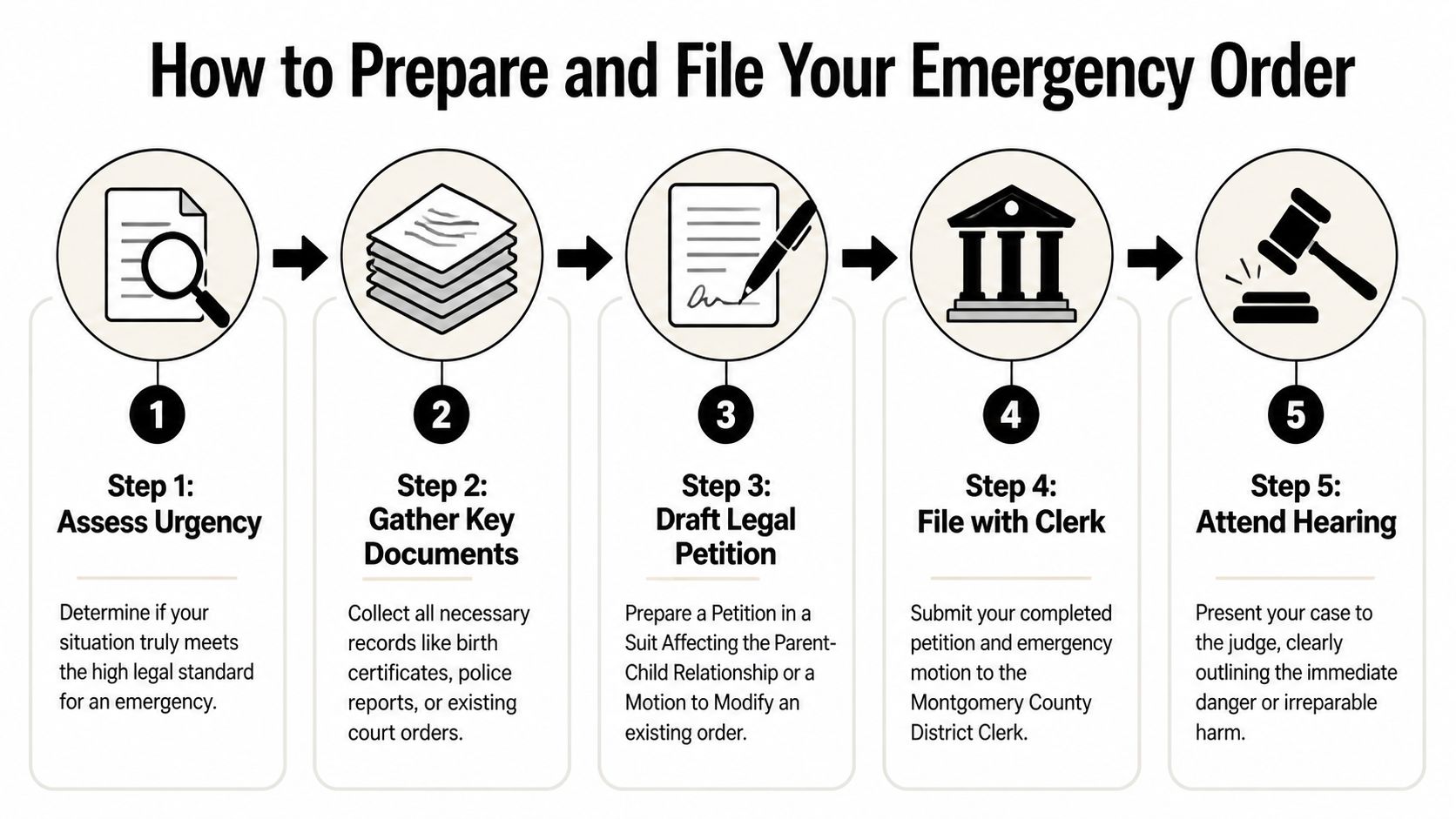
Start with the right pleading
The correct filing depends on whether there is already a court order involving the child.
If there’s no current case, the filing may begin with a Suit Affecting the Parent-Child Relationship. If there is already a final order, the emergency request often comes through a petition or motion to modify plus an application for immediate temporary relief. In many cases, the emergency piece is a request for a temporary restraining order supported by a sworn affidavit.
A separate but related hearing may later address broader temporary orders. If you want a practical overview of how those hearings fit into a family case, this page on a temporary orders hearing in Montgomery County divorce is a useful local reference.
Your affidavit is the center of the case
The affidavit matters more than most parents expect. It should read like a sworn timeline, not a personal essay.
Include:
- Specific dates and times when possible
- Exact places where events happened
- Names of witnesses such as teachers, relatives, neighbors, or officers
- What you personally saw or heard
- What the child said, stated carefully and accurately
- What documents you have to support the account
Avoid statements like “he’s a narcissist” or “she’s mentally unstable.” Those labels don’t prove immediate danger. Facts do.
A better affidavit sentence looks like this:
“On March 3, I picked up the child from school at 3:40 p.m. The school counselor told me the child reported that adults were drinking at the home the night before. I photographed bruising on the child’s right upper arm at 4:05 p.m.”
Gather the documents before you head to Conroe
Bring what supports the emergency and what helps the clerk and court identify the case:
- Existing orders if a divorce, custody, or child support case already exists
- Child’s identifying information and basic case details
- Photos, screenshots, emails, and texts
- School, medical, or police records if available
- Your affidavit, signed and sworn properly
If you need to send records quickly to counsel, a serviceable explanation of privacy considerations appears in this SendItFax guide to modern faxing. The larger point is practical. Use secure, organized transmission methods and keep clean copies of everything.
File in the right place, with the right expectations
For Montgomery County, Texas family cases, filing typically goes through the Montgomery County District Clerk’s Office in Conroe. Don’t rely on Maryland advice about MDEC electronic filing or family duty judges. That is the wrong county and the wrong state.
Bring enough information so your paperwork can be processed without confusion. If your case is already pending, use the correct cause number. If it’s a new case, make sure the pleadings are complete and internally consistent.
One option for handling the preparation and filing is to work with a local family law attorney. Another is to seek limited guidance and then file. What matters is that the pleadings match Texas procedure and the facts are presented in a disciplined way. The Law Office of Bryan Fagan handles emergency custody and temporary relief matters in Montgomery County family courts.
Small mistakes that cause big delays
A few problems show up again and again:
- Missing attachments that were referenced in the affidavit
- Wrong case number on one or more filings
- Inflammatory language instead of a sworn factual narrative
- No clear request for relief from the judge
- Confusion from out-of-state internet advice
Parents often think speed means fewer details. In reality, emergency filings usually need more precision, not less.
The Hearing Ex Parte vs Noticed Hearings
Most parents hear the word emergency and assume there is one hearing, one ruling, and one final answer. That’s not how this usually works in Texas family court.
There are typically two stages. The first is an ex parte request for immediate short-term relief. The second is a noticed hearing, where the other parent gets formal notice and a chance to respond.
What an ex parte hearing does
An ex parte hearing happens without the other side present. The point is narrow. You’re asking the judge to act quickly because waiting for regular notice could expose the child or family member to immediate harm.
In many cases, the immediate order sought is a temporary restraining order, which in Texas commonly lasts 14 days unless extended or replaced by further orders under the court’s process. At this stage, the judge is not trying to decide the entire custody case. The judge is deciding whether temporary emergency protection is justified based on the sworn papers and any brief testimony.
What a noticed hearing does
A noticed hearing comes next. The other parent must be formally served and given the chance to appear. This hearing is broader and usually more contested. The judge can hear both sides, review more evidence, and decide what temporary arrangements should remain in place while the case continues.
That matters because the ex parte stage is only the beginning. If you win short-term relief and then arrive unprepared for the noticed hearing, the emergency order may not lead to durable protection.
Emergency Hearings in Montgomery County A Snapshot
| Feature | Ex Parte Hearing (Initial TRO) | Noticed Hearing (Temporary Orders) |
|---|---|---|
| Who is present | Usually only the requesting party and counsel | Both sides may appear |
| Main purpose | Prevent immediate harm before regular notice can occur | Decide temporary arrangements after both sides are heard |
| Timing | Often sought as soon as filing is completed | Set shortly after the emergency relief process begins |
| Proof focus | Urgency, imminent danger, irreparable harm | Ongoing child safety, stability, and temporary management of the case |
| Relief available | Narrow short-term restraints and protective measures | Broader temporary orders on possession, access, and related issues |
| Practical risk | Weak affidavits get denied quickly | Poor preparation can undo earlier emergency gains |
Courtroom reality: Judges know some parents misuse “emergency” as a litigation tactic. If your evidence is thin, the court may view the filing as overreach instead of protection.
What to bring to each hearing
For the ex parte request, focus on the urgent facts. Bring the affidavit, supporting exhibits, existing orders, and a clear proposed order if one is being submitted.
For the noticed hearing, prepare for a fuller presentation. That may include witness testimony, authenticated records, a clean chronology, and a realistic temporary plan for the child. A judge is more likely to trust a parent who asks for workable, child-focused relief instead of trying to punish the other side.
Where modification fits in
If there is already a final custody order, the emergency request often sits inside a larger modification case. The long-term standards for changing conservatorship, possession, or related terms are governed more broadly by Texas Family Code Chapter 156. That chapter matters because emergency relief is temporary. Lasting changes usually require a proper modification path, not just a crisis filing.
After the Judge Rules Enforcement and Next Steps
A signed order helps only if it is enforceable and followed correctly. The first practical step after a judge rules is making sure service happens the right way.

Service is not a side issue
The other parent usually must be formally served with the lawsuit, the emergency filings, and the signed order through a constable, sheriff, or private process server as allowed by the rules. If service is defective, enforcement becomes harder and sometimes impossible.
That’s one of the most frustrating trade-offs in emergency litigation. You may get fast relief from the court, but the case can still stall if follow-through is sloppy.
A TRO is a Band-Aid, not the finish line
Emergency relief is temporary by design. The case then moves toward broader temporary orders or a final resolution through modification, divorce, or enforcement proceedings, depending on the underlying dispute.
If the other parent violates a signed order, enforcement may involve remedies under Texas Family Code Chapter 157. If you need a practical local overview, this page on enforcing a custody order in The Woodlands explains how post-order enforcement issues commonly arise.
A short video can also help orient families to the post-filing process:
The order you win in a crisis is often only the doorway into the larger case you still have to prove.
Your Montgomery County Emergency Action Checklist
When emotions are high, simple steps help. Use this checklist to keep yourself grounded and organized.

What to do next
Check the legal standard
Ask whether the facts show immediate danger or irreparable harm, not just a serious disagreement.Build a clean evidence file
Gather texts, emails, photos, school communications, medical records, police information, and existing court orders.Write a timeline
List events in order with dates, times, locations, and names. Stick to facts you can swear to.Avoid editorial language
Don’t fill your affidavit with diagnoses, insults, or speculation.Prepare for filing in Conroe
Make sure the pleading fits your case posture, whether that is a new SAPCR, a modification, or a request for emergency temporary relief.Think beyond the first hearing
Plan for service, the noticed hearing, and the larger custody case that may follow.Get legal guidance quickly
Emergency cases move fast, and small procedural errors can cost valuable time.
This article is not legal advice and doesn’t create an attorney-client relationship. Every emergency family court order montgomery county case depends on the exact facts, the existing orders, and the immediate risk involved.
If you’re dealing with a child safety crisis in The Woodlands, Conroe, Magnolia, or another Montgomery County community, The Law Office of Bryan Fagan can discuss your situation in a consultation and help you evaluate the right next step under Texas law.