 Skip to content

Montgomery County does have one statutory probate court, Probate Court No. 1, effective October 1, 2023, when former County Court at Law No. 2 was converted. Advice that Montgomery County has no statutory probate court is outdated, so families should use the current probate filing process rather than choose a general civil court.
For families in The Woodlands, that correction matters before anyone submits a will, requests letters, or responds to a dispute. The practical questions are which county is proper, which court has authority, and which clerk's office handles the paperwork.
Montgomery County Does Have a Statutory Probate Court
The Montgomery County Probate Court website confirms that County Court at Law No. 2 became Probate Court No. 1 on October 1, 2023, and identifies it as the county's only statutory probate court.
Where Montgomery County probate matters go in 2026
| Matter | Court or office now | What changed on October 1, 2023 |
|---|---|---|
| Routine will probate and letters | Probate Court No. 1 | Moved from County Court at Law No. 2 |
| Guardianship | Probate Court No. 1 | Heard in the new statutory probate court, with its guardianship program |
| Mental-health cases | Probate Court No. 1 | Included in the court's stated jurisdiction |
| Contested will or heirship | Probate Court No. 1, with possible bench exchange | A dedicated probate judge hears it; district or statutory county judges may sit when assigned |
| Ancillary civil matter tied to the estate | Probate Court No. 1 | Not a generic civil filing as the first stop |
| Certified letters and record copies | County clerk for Probate Court No. 1 | Clerk stayed the same; use current Conroe or East County Annex instructions |
The court and the clerk perform different jobs. The judge decides the case, while the county clerk maintains the court record and handles filing and certified-document services.
That distinction explains why an old packet can contain a familiar clerk's name but an obsolete court caption. The county clerk remains the clerk for the probate court; the continuity of that office doesn't make the old court designation current.
Why the old search phrase persists
Search results don't automatically remove an article when a court changes. A blog, downloaded checklist, or saved lawyer's letter may describe the earlier court structure accurately for its time but send a family in the wrong direction today.
Someone searching “Montgomery County has no statutory probate court what that means” is therefore starting with a stale premise. The useful question is which current forum applies to the particular estate, guardianship, or related dispute.
Don't assume an older document is useless, either. It may contain relevant information about the deceased person, an existing case, or a prior order. Keep it, but verify the current filing instructions before reusing its caption or submitting its forms.
Practical rule: Use an old packet to understand the history of a matter, not to choose today's filing court.
What the specialized court handles
Probate isn't limited to approving a simple will. The court's stated work includes probate, guardianship, mental-health matters, and ancillary civil matters.
Those categories aren't interchangeable. A deceased person's estate concerns administering property and obligations after death. A guardianship concerns a living person and requires a different application, evidence, and review process.
Similarly, a contested estate doesn't stop being a probate matter because family members disagree. A challenge to a will or a dispute about heirs calls for attention to pleading, notice, evidence, and jurisdiction, not an automatic switch to an unrelated civil lawsuit.
For residents of The Woodlands, Conroe, and New Caney, the court's current name is the starting point. The filing county, clerk's procedures, and kind of relief requested still need to match the facts.
How Probate Court No. 1 Differs From the County Court Fallback
A constitutional county court is a general-purpose court that may also handle probate. Montgomery County's statutory probate court is a specialized forum created by law for probate matters. The distinction helps explain why older advice about a “county court fallback” does not describe the current starting point for a Montgomery County estate.
A court created for specialized work
Texas Government Code section 25.1721(b) identifies Probate Court No. 1 alongside County Courts at Law Nos. 1, 3, 4, 5, and 6. Texas court materials list the probate court at 210 W. Davis Street, Suite 300, Conroe, Texas 77301.
Original jurisdiction is a court's authority to hear a matter when it begins. Exclusive probate jurisdiction means the law assigns probate proceedings to the statutory probate court rather than to a court selected for convenience.
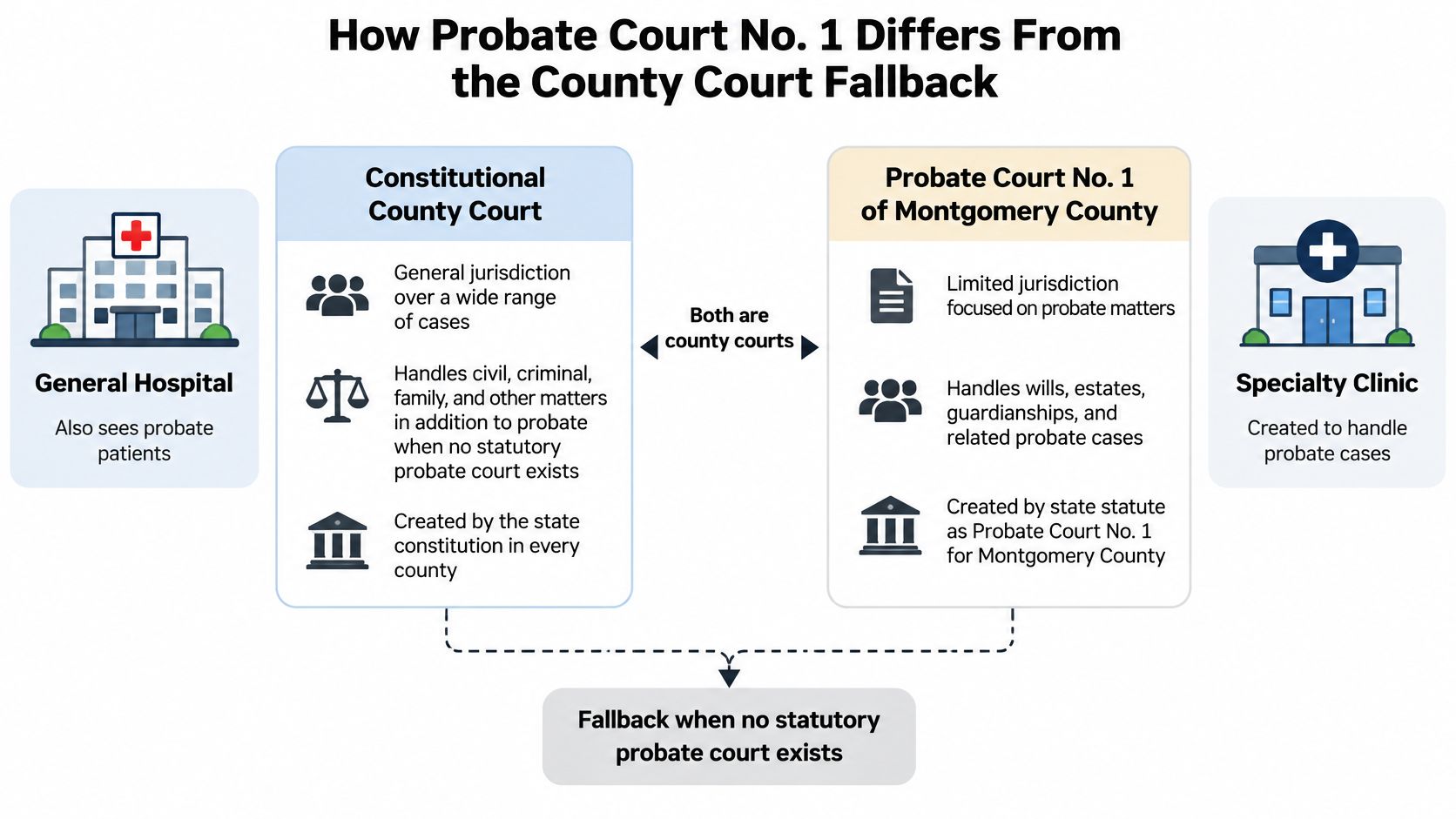
Admitting a will, appointing a personal representative, issuing letters, and administering an estate are probate functions. Letters testamentary establish an appointed executor's authority. Letters of administration serve the corresponding role for an administrator.
A specialized probate court does not automatically handle every lawsuit that mentions someone who has died. A related civil claim may raise separate jurisdictional questions, especially if it involves other parties, property interests, or a pending lawsuit. Classifying the claim before filing helps identify the proper court.
What happens in counties without this court
Under Texas Estates Code section 32.005, the county court fallback applies in a county with neither a statutory probate court nor a county court at law exercising original probate jurisdiction. If a county court at law does exercise that jurisdiction, it and the county court generally share concurrent original jurisdiction unless another statute provides otherwise.
In appropriate circumstances, a contested matter may involve assignment of a statutory probate judge or transfer to district court. This fallback framework explains older references to county courts, but Montgomery County's current probate court is the relevant starting point for a new proceeding.
A different judge doesn't necessarily mean a different court
Bench exchange allows judges to coordinate work. Montgomery County's probate provisions permit the probate judge and district or statutory county judges to act for one another in pending matters.
An assigned judge may preside without changing the court where the case belongs. The assignment answers who hears the matter; jurisdiction answers whether that court has authority over it.
A contested will doesn't automatically belong in district court. First identify the probate court's authority and the procedural rule that applies to the dispute.
If papers name the former county court at law, keep the original documents and case number. Ask counsel or the clerk how the existing matter is identified before opening a duplicate case.
Which Conroe Office Handles a Woodlands Estate
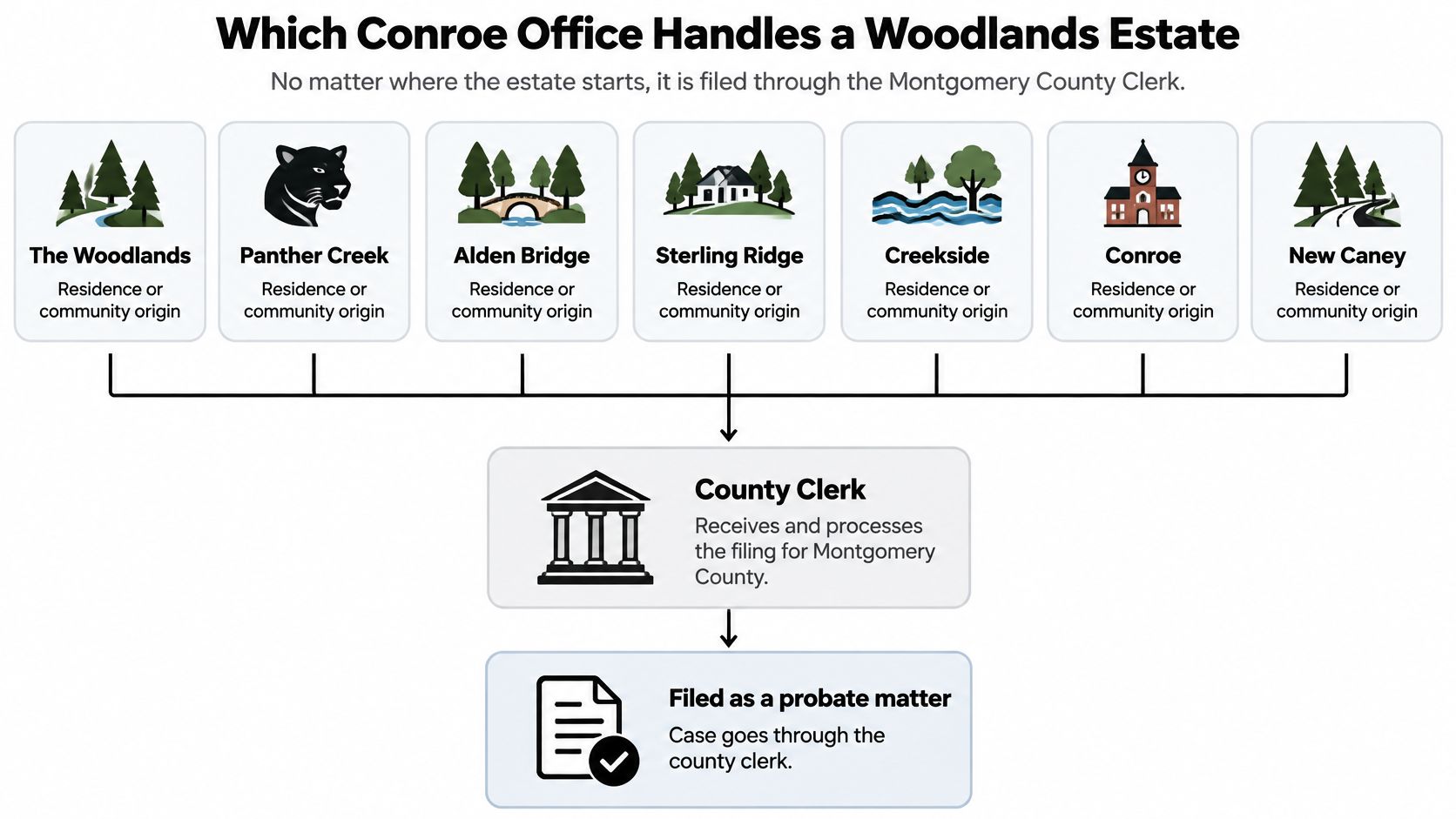
For an estate properly venued in Montgomery County, the filing path runs through the county clerk as clerk of the probate court. Meeting a lawyer in The Woodlands doesn't change the court that receives the case.
The same distinction applies to families in Panther Creek, Alden Bridge, Sterling Ridge, Creekside, Conroe, and New Caney. A neighborhood office is a place to get assistance, not a substitute probate court.
Match the office to the errand
Which office handles each Woodlands errand
| Errand | Where it is filed or requested | Practical note |
|---|---|---|
| Routine decedent estate opening | Probate Court No. 1 through the county clerk | Confirm current Conroe instructions and fees before filing |
| Guardianship of a living adult | Probate Court No. 1 guardianship program | Court investigators and a certified professional guardian review the case through the guardianship program |
| Certified letters and record copies | County clerk at the Conroe main office or East County Annex | Confirm which counter handles the document needed |
| Search an existing case | Montgomery County probate-records search | Search by the decedent's name or known case number before requesting copies |
| Ancillary proceeding for Texas land | Probate Court No. 1 | Addresses local land when the main estate is opened in another state and a Texas proceeding is needed |
Opening a case and requesting a copy are different transactions. An application asks the court for relief; a records request asks the clerk for a document already in the file.
Certified letters also aren't something the clerk can issue merely because a family brings in a signed will. The court must first appoint the representative, and the representative must complete the applicable qualification steps.
The routing illustration shows the clerk's role in receiving local filings.
Confirm the county before the counter
Venue means the proper county for the proceeding. For a Texas resident's estate, the starting question is generally where the deceased person had a domicile or fixed residence, not where a beneficiary lives or where the family hires counsel.
Many Woodlands estates belong in Montgomery County, but don't rely on a community name alone. Check the actual home address and county, especially for a Creekside address, before choosing the filing venue.
Guardianship needs a separate intake conversation. The local guardianship program includes court investigators and a certified professional guardian, so an application concerning a living adult shouldn't be prepared as though it were a deceased parent's estate.
Call before making a records trip
Montgomery County provides probate-record searches, certified-copy resources, and filing-fee information, with a main Conroe office and an East County Annex. Confirm the office's current services before assuming a particular counter can produce the document you need while you wait.
Have the decedent's full name, case number if known, and the exact document requested ready. Ask whether you need a certified copy, how the request is submitted, and how collection or delivery works.
For court-routing context, Texas Estates Code section 32.006 addresses contested-matter procedures in counties without a statutory probate court. For a local filing orientation, the guide to where The Woodlands families file Montgomery County probate matters helps separate court selection from clerk logistics.
A The Woodlands Estate From Death to Letters
Say a Woodlands resident dies with a signed will, a Montgomery County house, bank accounts, and a rental property. Her adult daughter finds an older article saying the county has no statutory probate court and nearly starts a general civil filing.
The daughter's better first step is to organize the estate documents before choosing an application.
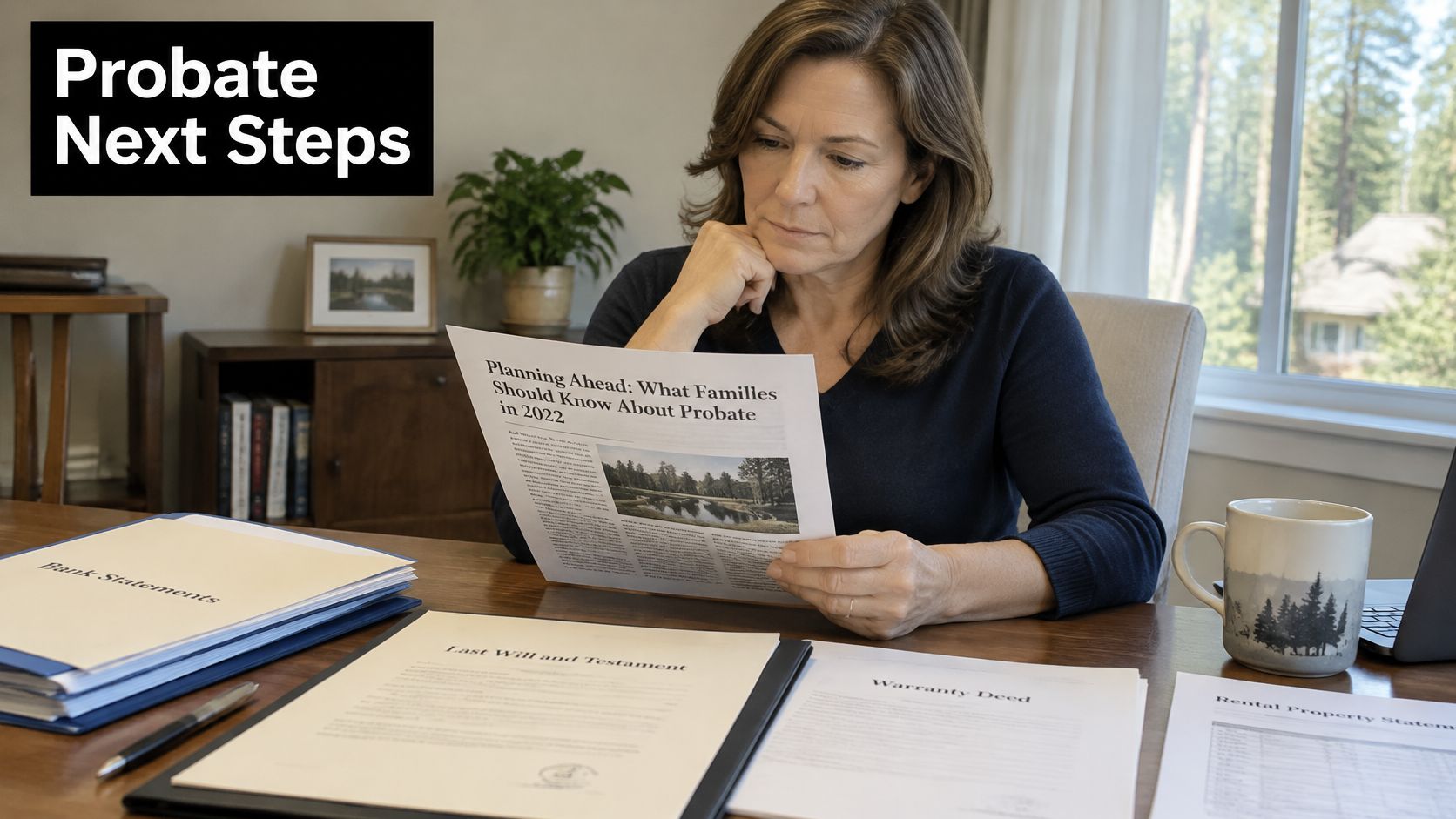
From a folder of papers to the right application
She confirms that her mother's permanent home was in Montgomery County. She locates the original will and death certificate, then prepares a list of heirs, named beneficiaries, major assets, and known debts.
Those lists serve different purposes. The will identifies intended beneficiaries, while heirship information helps counsel understand family relationships and notice issues. Asset records help distinguish property that requires estate administration from property that may pass through a beneficiary designation or another arrangement.
Next, she reviews the will with counsel to determine whether independent administration is available or whether dependent administration is appropriate. Independent administration generally involves less ongoing court supervision; dependent administration requires closer court involvement in estate management.
She checks the Montgomery County probate clerk's records and filing-fee information before submitting the application to Probate Court No. 1. The current instructions matter more than the court name printed on the article she found.
Appointment comes before access
Being named executor in a will doesn't, by itself, complete the court appointment process. The daughter shouldn't assume she can close estate accounts, sign estate contracts, or sell property solely because the will names her.
After the court admits the will and appoints the representative, the required qualification steps must be completed before letters are issued. The guide to letters testamentary in Montgomery County explains the document families commonly need when dealing with financial institutions and estate assets.
This video provides another way to approach the probate discussion.
When the household's facts become complicated
Suppose a sibling challenges the will or a creditor disputes how a claim should be treated. The daughter should bring that issue to probate counsel promptly so the proper pleading can be filed in the appropriate proceeding, rather than launching an unrelated lawsuit.
She should preserve communications, account statements, and documents relevant to the disagreement. A dispute about the will's validity requires different evidence from a disagreement about whether a debt was paid.
If her mother had instead lived outside Texas and the rental house were the only Texas asset, counsel would assess whether an ancillary Montgomery County proceeding or another authorized title procedure was needed. An out-of-state case doesn't automatically answer every Texas real-estate question.
Keep the facts together: Give counsel the will, family list, debt information, and property locations at the same time. A missing detail can change the appropriate application.
A Probate Lawyer in The Woodlands, TX can assist with probate administration and estate settlement in Montgomery County, including matching this fact pattern to current clerk instructions. That help is particularly relevant when the will, debts, or property location is unclear.
This household is an illustration of local procedure, not legal advice or a prediction of timing or outcome.
Delays From Old Advice and the Wrong Court
A filing can come back for correction if the application requests the wrong type of administration or leaves out information the court needs. A caption correction is different from a decision that the court lacks authority or that another county is the proper venue. Find out which issue applies before preparing another filing.
Different mistakes require different fixes
Filing mistakes that slow a Montgomery County estate
| Mistake | Why it happens | Practical result |
|---|---|---|
| Filing first in a generic civil or district court | The family assumes probate court handles only uncontested wills | Additional review of whether that court can hear the matter |
| Ignoring independent versus dependent administration | The will and family circumstances were not assessed | The application may need correction, and dependent administration involves more court supervision |
| Treating a guardianship like a decedent estate | The two matters use different procedures | Wrong forms and a separate investigator review |
| Relying on an out-of-state probate for a Texas house | A home-state probate does not resolve every Texas property question | Texas land may still require an ancillary Montgomery County filing |
Dependent administration is not a penalty for an incomplete application. The appropriate structure depends on the will, applicable law, and family circumstances. Those details should be reflected accurately in the filing.
Appointment isn't the same as finishing the estate
Appointment is one stage of probate. The process includes presenting the application, addressing required notices, attending a hearing, and, if the court approves the application, receiving letters that establish the personal representative's authority.
After letters issue, the representative may still need to collect assets, address debts and tax questions, sell property, and distribute the estate. A will contest, heirship determination, or creditor dispute can add court hearings in Conroe. The guide to how long probate takes in Texas explains the difference between appointment and the full administration.
When to get advice early
Get legal advice before filing if heirs disagree, the original will is missing, debts are unclear, or property sits outside Texas. Bring any lawsuit papers or hearing notices, even if you believe they were filed in the wrong court.
A deadline may still apply while the correct forum is being assessed. Counsel can review the response required and the court issue together.
What to Do Next Before You File in Conroe
A useful first conversation starts with the details that may affect the estate's administration, not with a stack of forms. Gather the records and write down the questions you need answered.
What to do next
- Gather the original documents. Keep the original will and death certificate together, along with any prior court papers.
- List the people and property. Identify heirs, beneficiaries, major assets, known debts, and land outside Texas.
- Flag the administration question. Note any will language about independent administration and ask counsel which procedure fits.
- Identify complications. Flag a will contest, guardianship, unclear debt, or out-of-state asset before choosing forms.
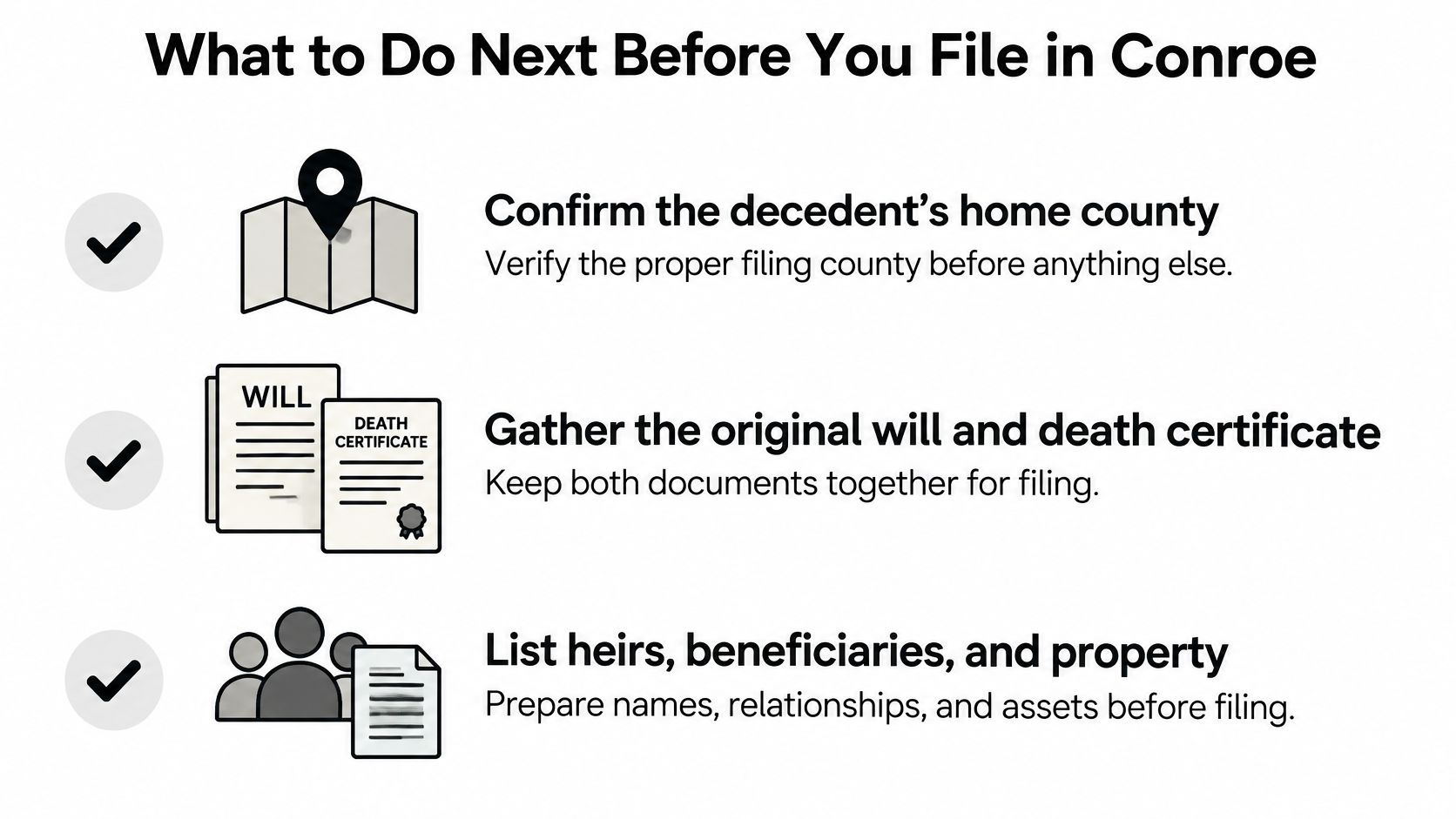
Bring questions as well as documents
Write down what you need to accomplish first, such as obtaining authority over an account, addressing a house, or responding to a family dispute. That helps counsel separate an immediate procedural need from the broader estate settlement.
Families in The Woodlands and nearby communities can contact the Law Office of Bryan Fagan to discuss a filing or contested estate and what to prepare. The firm's probate lawyer in The Woodlands page offers a starting point for that conversation.
