 Skip to content

The advice to take a serious family dispute to district court because a county court at law only handles small claims is misleading in Montgomery County. For families in The Woodlands, the court's name doesn't tell you how much authority the judge has over a divorce, custody dispute, or support order.
Why a Court at Law Can Hear Your Family Case
A parent in Panther Creek or Alden Bridge shouldn't assume a family case has landed in a lesser court just because the paperwork says County Court at Law. Montgomery County has five statutory county courts at law, numbered 1, 3, 4, 5, and 6, with no No. 2; those courts share family-law authority with district courts under the county's jurisdiction statute.
That matters whether you live in Sterling Ridge, Creekside, or another nearby community. A divorce or custody dispute isn't converted into a small-claims case by its assignment to a court at law. The judge applies the Texas Family Code to the family-law questions properly before the court.
Court assignment isn't a reduction in rights
Assignment changes the judge, the docket, and the procedures you must follow. It doesn't automatically shrink your parental rights, change the legal standards for support, or reduce the court's authority over marital property.
Still, an authorized court isn't necessarily the correct place for every new filing. An existing custody case, a transfer requirement, or a related proceeding may determine where you need to proceed.
Practical rule: Start with the order you want the judge to sign, not whether the court's name sounds more important.
A separate statutory probate court handles estate and guardianship proceedings. Ordinary money disputes follow another jurisdictional path, including a limited civil band shared with justice courts. These aren't interchangeable routes because the same relatives or property appear in each dispute.
For readers looking for Montgomery County Court at Law jurisdiction explained plainly, the key distinction is subject matter: what legal problem are you asking the court to resolve?
This is general information, not legal advice. Use the matching court table to identify the kind of relief you need before choosing a filing office.
Which Montgomery County Court Hears the Case
Montgomery County courts and what they hear
| Court | Matters it hears | Limit or shared power | Where to start |
|---|---|---|---|
| Justice court | Smaller civil claims and evictions | Over $200 and not over $20,000, exclusive of interest, when concurrent with a county court | Justice of the peace precinct |
| County Court at Law Nos. 1, 3, 4, 5, and 6 | County civil cases, justice-court appeals, and family cases shared with district court | Justice-concurrent civil band over $200 and not over $20,000, exclusive of interest; family cases aren't capped by that band; any higher civil ceiling is set by the applicable statutory grant | County Clerk or District Clerk by case type |
| District court | Larger civil suits, felonies, and family law | Family jurisdiction shared with the courts at law | District Clerk |
| Probate Court No. 1 | Probate, wills, guardianship, and related mental-health matters | Specialized probate court, separate from the family docket | County Clerk |
Start with the kind of order you need
Justice court is a common starting point for smaller money claims and eviction proceedings. An eviction concerns the right to possession of property, so don't assume that every landlord-tenant disagreement follows exactly the same rules as a claim for unpaid money.
Courts at law have statutory trial authority, not merely an administrative role. The Texas Government Code's Montgomery County court provisions establish County Courts at Law Nos. 1, 3, 4, 5, and 6 alongside a separate Probate Court No. 1 and provide authority for matters shared with justice courts.
A court at law may hear a case originally filed there or exercise an authorized appellate role after a justice-court decision. Those are different functions. Neither tells you, by itself, where an original divorce petition belongs.
District courts handle family cases as well as larger civil disputes. Their felony jurisdiction is a separate subject and doesn't determine the route for a divorce or estate proceeding. Similarly, misdemeanor jurisdiction in a court at law belongs to a different docket, not the path for family or probate relief.
The probate court is the specialized route for estates, wills, guardianships, and related proceedings assigned by law. Its separate identity matters when a family disagreement includes someone's death or incapacity.
Choose the filing office carefully
The County Clerk and District Clerk aren't interchangeable counters. A clerk's office maintains the filings and records assigned to that office; it doesn't gain authority over a case just because you submit papers there.
Before filing, identify:
- The proceeding: Is this a new divorce, an existing custody case, an estate administration, or a money claim?
- The existing record: Does a related case already have an assigned court and cause number?
- The receiving clerk: Which office accepts this particular filing?
- The assigned court: What court name must appear on the documents and hearing request?
Don't read the civil dollar band as a ceiling on family property division. A divorce involving valuable assets remains a family proceeding rather than an ordinary debt lawsuit.
Use the row that matches the relief you want, then examine the rules for that type of proceeding.
Family Cases Shared With the District Court
Concurrent jurisdiction means shared power, not a lesser version of divorce court. Each Montgomery County Court at Law has concurrent jurisdiction with the district court in family-law cases under the county's enabling statute, a structure consistent with the Texas Judicial Branch's jurisdiction overview.
That family-law authority can reach disputes involving spouses, parents, children, and certain third parties or entities. A trustee's involvement doesn't automatically make a dispute something the family court can't address, although the requested relief still needs a statutory basis.

What the family proceeding can include
A properly assigned family case may involve:
- Divorce and property division: Ending the marriage and deciding the treatment of marital assets and debts.
- Parent-child proceedings: Establishing conservatorship, possession schedules, and child support.
- Modification: Asking to change an existing custody or support order when the legal requirements are met.
- Enforcement: Asking the court to address noncompliance with an existing order.
- Related trust issues: Addressing an inter vivos trust, meaning a trust created during someone's lifetime, when the claim fits the statutory grant.
The Texas Family Code supplies the substantive rules for family orders. Filing in a court at law doesn't automatically reduce the judge's power to divide marital property, set support, or appoint conservators.
A court's authority is only part of the filing decision, however. If another court already has the related parent-child case, starting a new proceeding elsewhere may create a dispute about which court should act.
What changes in practice
Court assignment affects hearing calendars, document submission, and case management. Read procedures for the court named on your paperwork rather than borrowing instructions from a relative's divorce.
The firm's Montgomery County family courts guide offers a longer local filing overview. If your case is assigned there, the Montgomery County 410th District Court family docket procedures address that particular setting.
For an existing order, distinguish a request to change its terms from a request to make someone comply. The guide to enforcing orders in The Woodlands addresses the latter.
If you're comparing representation options, Divorce Lawyer in The Woodlands, TX describes divorce representation for clients in The Woodlands and Montgomery County. Bring existing orders to any attorney consultation so the lawyer can evaluate both the requested relief and the court already involved.
Civil Dollar Limits Next to Justice Court
The 2023 justice-court concurrent band in Texas Government Code §26.042 covered general county-court civil matters exceeding $200 but not exceeding $20,000, exclusive of interest, when concurrent with justice courts. That is a specific civil-jurisdiction rule, not a universal limit on everything a Montgomery County Court at Law can decide.
The date and scope matter. Don't treat that historical general provision as a substitute for checking the current statute and the particular court's enabling law before filing.
| Requested relief | How to evaluate the filing |
|---|---|
| Payment of a contractor bill | Examine the amount sought, the kind of claim, and the applicable civil-jurisdiction statute |
| Return of a security deposit | Identify the money claim and any additional relief before selecting the court |
| Divorce, custody, or support | Apply family-law jurisdiction rather than the ordinary money-claim band |
| Admission of a will or appointment of a guardian | Apply probate and guardianship jurisdiction |
| Relief involving a lifetime trust | Identify the trust claim, parties, and statutory authority |
Apply the amount test to the claim
For a contractor bill in The Woodlands, begin with the contract, invoices, payment records, and the relief requested. A demand letter's tone doesn't determine jurisdiction. The petition must identify what the plaintiff wants the court to award.
Exclude interest when applying the cited rule. Also distinguish a straightforward demand for payment from a request for additional remedies, such as an order requiring someone to act or stop acting.
A security-deposit dispute requires similar care. Identify the legal basis for recovery and the remedies sought rather than assuming the deposit alone describes the whole claim.
A money figure helps classify an ordinary civil claim. It doesn't classify a marriage, a parent-child relationship, or an estate proceeding.
A breach-of-contract lawyer in The Woodlands can assess whether a contractor dispute is a straightforward payment claim or involves additional issues affecting the filing route.
Recognize the subject-matter exceptions
Family cases aren't selected by the size of the bank account. Divorce, custody, and support proceed under a family-law grant of authority, not by squeezing the requested orders into an ordinary civil amount range.
A lifetime-trust dispute connected to spouses, parents, or children may also fit the family-related grant. That requires examination of the actual claim, not just the word “trust” on an account statement.
Conversely, asking to admit a will or appoint a guardian requires probate analysis. Those requests aren't ordinary small money claims, even if the property involved has modest value. Any broader civil ceiling for a court at law must be confirmed from the applicable law rather than inferred from this concurrent band.
When Probate Court No 1 Takes the Dispute
The same family facts can require separate courts. A divorce can involve an inherited house without giving the divorce judge authority to perform every task associated with the deceased owner's estate.
Montgomery County's only statutory probate court handles estate and guardianship proceedings, as described by the county's probate court information. The Texas Estates Code is the central reference for those proceedings.

Identify the requested probate work
Probate work includes admitting a will, administering an estate, contesting a will, and establishing a guardianship. The court also handles mental-health proceedings assigned to it and specified related civil disputes.
The Texas statutory probate jurisdiction provisions recognize specialized concurrent authority in specified proceedings, including constructive-trust disputes, declaratory-judgment actions, and injunction-only actions. Those labels describe different remedies: addressing property allegedly held unfairly, declaring legal rights, or ordering conduct to stop or occur.
Don't assume that mentioning an estate gives the probate court unlimited authority over every disagreement among relatives. The proceeding and requested remedy must fit its statutory jurisdiction.
Use parties, relief, and subject as your tests
Ask these questions before combining claims:
- Who is asking? Identify whether the person acts as a spouse, parent, heir, estate representative, trustee, or proposed guardian.
- What order is requested? Separating marital property is different from admitting a will or appointing an executor.
- What is the subject? Determine whether the dispute concerns the marriage, a child, a deceased person's estate, or an allegedly incapacitated person.
A divorce judge can determine whether property is community or separate and divide the marital estate under the Texas Family Code. That doesn't mean the same judge can admit a parent's will, appoint the estate's executor, or establish a guardianship within the divorce.
Likewise, a custody request and a guardianship petition may involve overlapping concerns without becoming the same proceeding. The parties must identify a statutory home for each requested order.
Before combining claims: Separate the family remedy from the estate or guardianship remedy, even when both arise from the same disagreement.
Putting every theory into a family petition can trigger a jurisdictional challenge and delay the case. An attorney reviewing probate matters in Montgomery County should examine the pleadings, existing appointments, and property records alongside any divorce orders.
The useful label is family, probate, or both. “Both” means coordinating authorized proceedings, not assuming a single judge can resolve everything.
How One Woodlands Family Splits Across Courts
Say a couple in Alden Bridge files for divorce. One spouse claims a house in Panther Creek was inherited and should remain separate property, while also wanting to contest a parent's will. A grandparent in Sterling Ridge needs a guardianship, and the couple's child-custody order is already disputed.
Those problems belong to the same household, but they don't all ask for the same judicial action. The documents supporting each request will differ, and the filings may need separate court assignments.
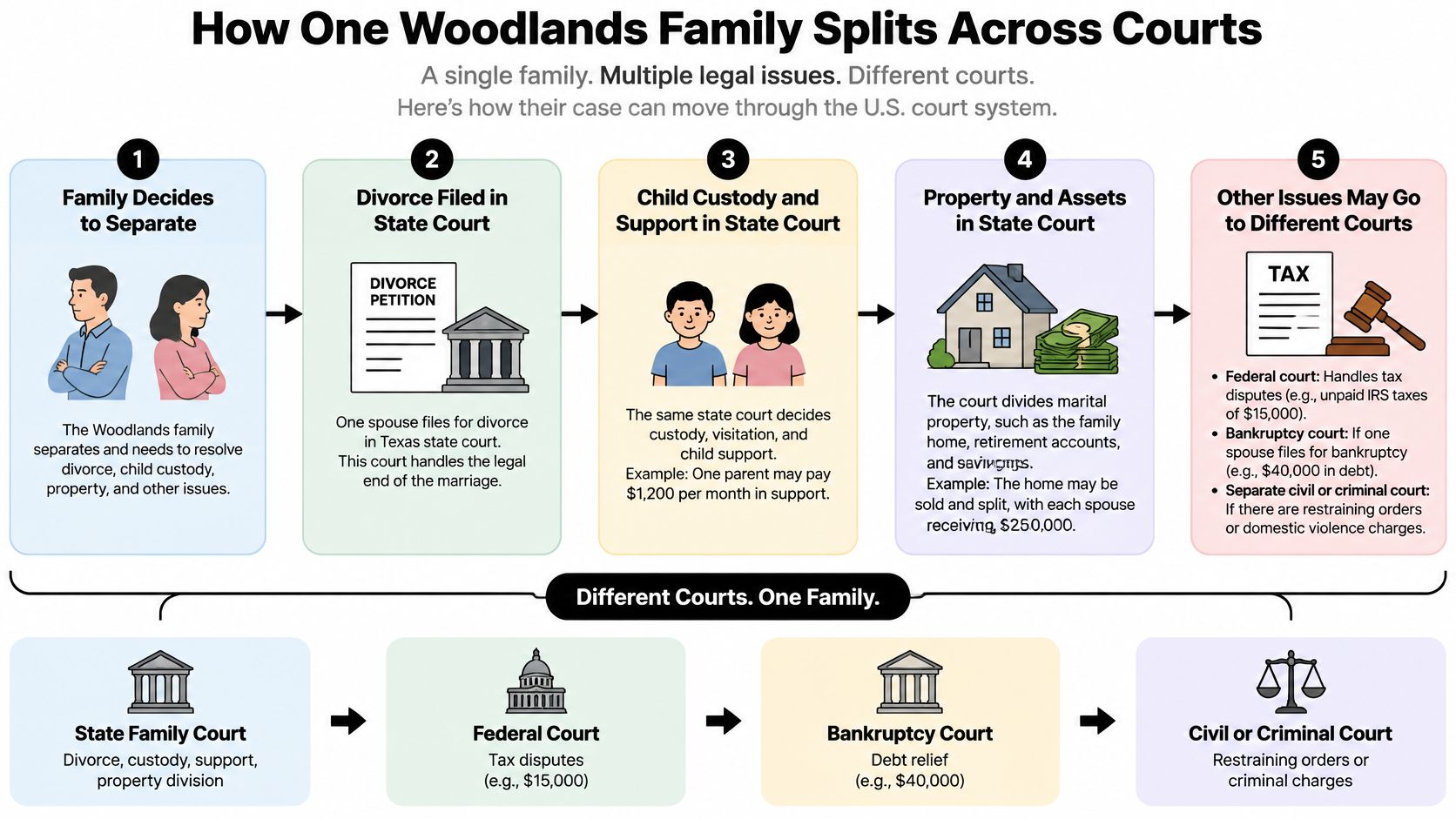
Follow the filing path
Identify the existing family case. Obtain the custody order and its cause number before filing anything new. A pending related case can control where a later request belongs.
Address the divorce and house characterization. The family court can consider the marriage, conservatorship, support, and whether the house is separate or community property under the Texas Family Code. Deeds and inheritance records matter more than a spouse's description of the house.
Separate the will challenge and guardianship. Those requests follow the probate route under the Texas Estates Code. The spouse shouldn't attach them to the divorce petition and assume the assigned family judge can grant them.
Evaluate any lifetime-trust claim individually. If the house is held in a trust created during the parent's lifetime, counsel should identify the requested trust remedy and determine whether it fits the family court's concurrent authority.
Confirm county and court procedures. Montgomery County may be the proper family venue when the applicable residency requirements are satisfied. A Woodlands mailing address alone isn't a substitute for checking the county, residency facts, and existing proceedings.
Manage hearings and appeals separately
The approved local court rules address civil, contested probate, contested guardianship, and family matters heard by a county court at law, including matters shared with a district court. Authority to hear a claim is therefore only the starting point; scheduling and filing procedures still require attention.
Keep each case's hearing notices, orders, and deadlines in a separate folder. Tell counsel about related proceedings so proposed orders don't create avoidable conflicts.
The appeal path is also separate from starting a new lawsuit. Civil appeals from justice court generally proceed to county court; a court-at-law judgment generally goes to the Ninth Court of Appeals rather than being refiled in district court. Confirm the proper appellate route and deadlines for the particular judgment immediately.
The lesson isn't that the family filed incorrectly because it received separate cause numbers. A household can have a family case and a probate case at the same time and be proceeding correctly.
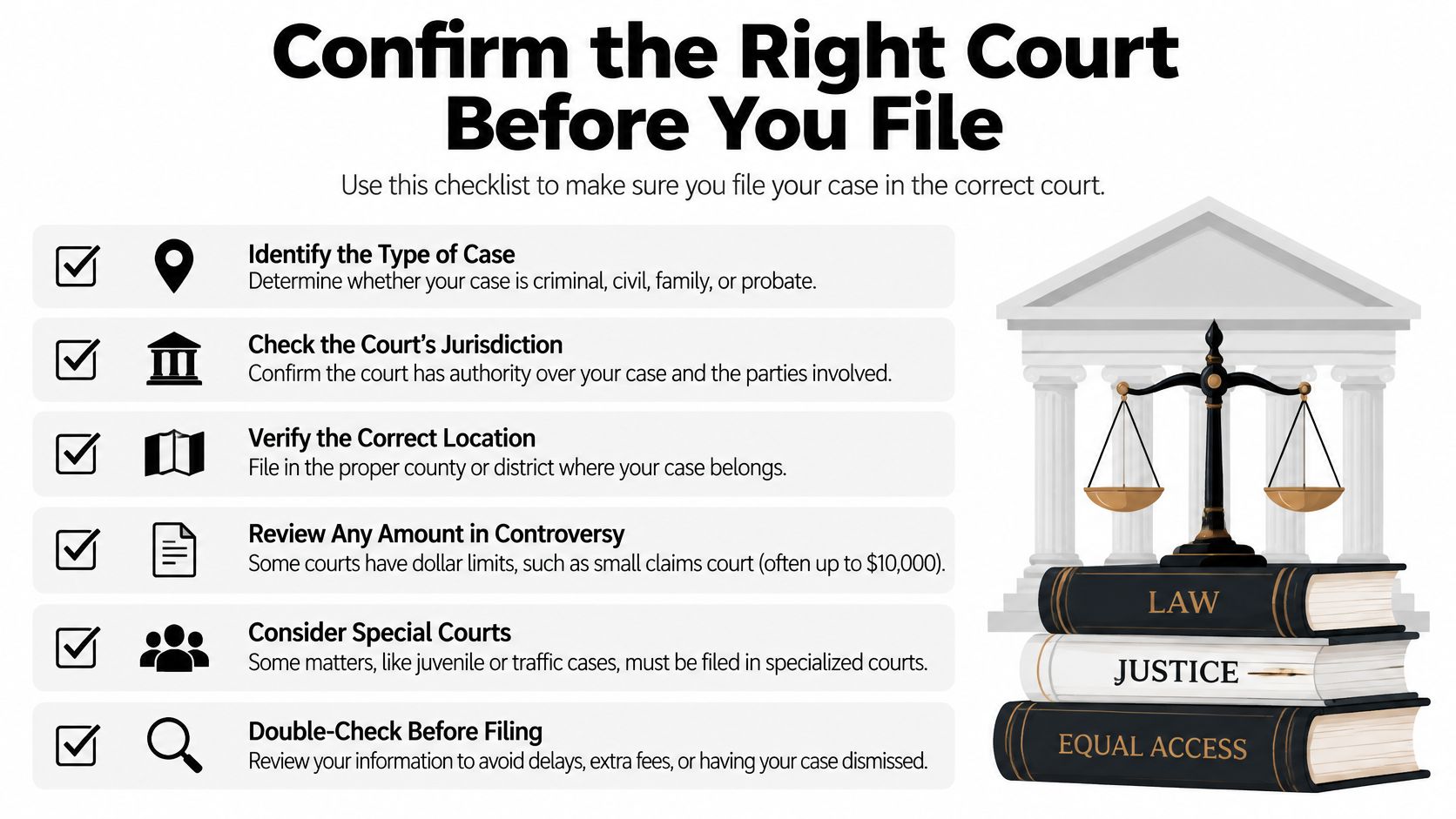
Confirm the Right Court Before You File
What to do next
Write the exact order you want. Use concrete terms such as divorce, custody, support, enforcement, probate, or guardianship. Bring that list rather than only a narrative about the disagreement.
Classify a money-only claim. Calculate the requested recovery without interest and check it against the applicable civil-jurisdiction band. Confirm current law before relying on an older statutory amount.
Search for pending proceedings. Look for Montgomery County cases involving the same family, child, estate, or proposed ward. Save copies of the docket information and signed orders.
Separate the requested remedies. Put family requests on one list and will, estate, or guardianship requests on another. Flag any trust issue for individual review.
Confirm the receiving clerk and assigned court. Ask whether the County Clerk or District Clerk accepts the filing and verify the complete court name. Don't assume a previous filing used the correct office for a different case type.
Read the applicable local procedures. Check hearing requests, document submission, and deadlines. Keep the actual notice or rule with your calendar entry.
Bring a consultation packet. Include cause numbers, existing orders, proposed requests, deeds, trust documents, and estate papers relevant to the dispute. Identify any approaching hearing or response deadline.
For further reading, the Montgomery County family courts guide and enforcing orders in The Woodlands guide can help you prepare focused questions about a new filing or an existing order.
This article explains jurisdiction for general education and is not legal advice.
The Law Office of Bryan Fagan represents families in divorce, custody, support, property-division, and probate matters in The Woodlands and Montgomery County. To discuss how your requested orders fit the local court system, visit The Law Office of Bryan Fagan and schedule a consultation.
