
A lot of people in The Woodlands end up in the same spot. A contractor stops showing up to a house in Sterling Ridge. A vendor misses deliveries to a Panther Creek business. A former partner says, “We had a deal,” but the money never arrives.
At that point, people aren't asking abstract legal questions. They want to know three things. Do I still have a claim, what can I realistically recover, and when should I talk to a lawyer?
That's where many online articles fall short. They give the broad rule, but skip the details that often decide whether a claim is worth pursuing in Montgomery County. Two of those details matter more than most realize. First, installment contracts can create separate filing deadlines for separate missed payments. Second, proving a breach doesn't automatically mean you'll recover meaningful money.
If you're looking for a breach of contract lawyer in The Woodlands, TX, you need more than a definition of breach. You need a practical way to sort through your documents, your timeline, and your options before you spend time and money on the wrong path.
When a Broken Promise Becomes a Legal Problem in The Woodlands
A broken promise becomes a legal problem when it moves from frustration to measurable harm.
Say you hired a contractor to renovate part of your home in Alden Bridge. The contractor started work, took partial payment, then stopped returning calls. You had to hire someone else, the project sat unfinished, and your costs went up. Or maybe you run a small company in The Woodlands and a supplier failed to deliver goods your business needed to serve customers. You lost the benefit of the deal, and the disruption spread into other parts of the transaction.
That's when contract law starts to matter.
Why local facts matter
In Montgomery County, these disputes often come down to records. The signed agreement matters. So do text messages, email chains, invoices, change orders, payment records, and the date the problem first happened.
A busy homeowner may think, “The contract was signed a long time ago, so I'm probably out of time.” A business owner may think, “The other side clearly breached, so I'll obviously recover my attorney's fees.” Both assumptions can be wrong.
Practical rule: In contract disputes, the calendar and the paper trail often matter as much as the disagreement itself.
The Woodlands cases also tend to have a practical overlay. Many disputes aren't purely commercial. They overlap with family property issues, probate issues, or jointly owned assets. A contract to sell property, repay family funds, or divide responsibilities in a family-run business can quickly spill into estate or divorce-related questions.
What people usually need to figure out first
Most readers in The Woodlands and nearby communities like Creekside and Panther Creek need answers to a short list:
- Is there a real contract: Was there a binding agreement, or just ongoing discussions?
- Was the breach serious: Did the other side miss a core obligation, or was it a smaller problem?
- Can you prove loss: Can you show what the breach cost you?
- Is it still timely: Are you within the filing window for at least part of the claim?
Those questions shape what a lawyer can do for you. They also shape whether it makes sense to send a demand, negotiate, mediate, or file suit in Montgomery County.
How Texas Law Defines a Breach of Contract
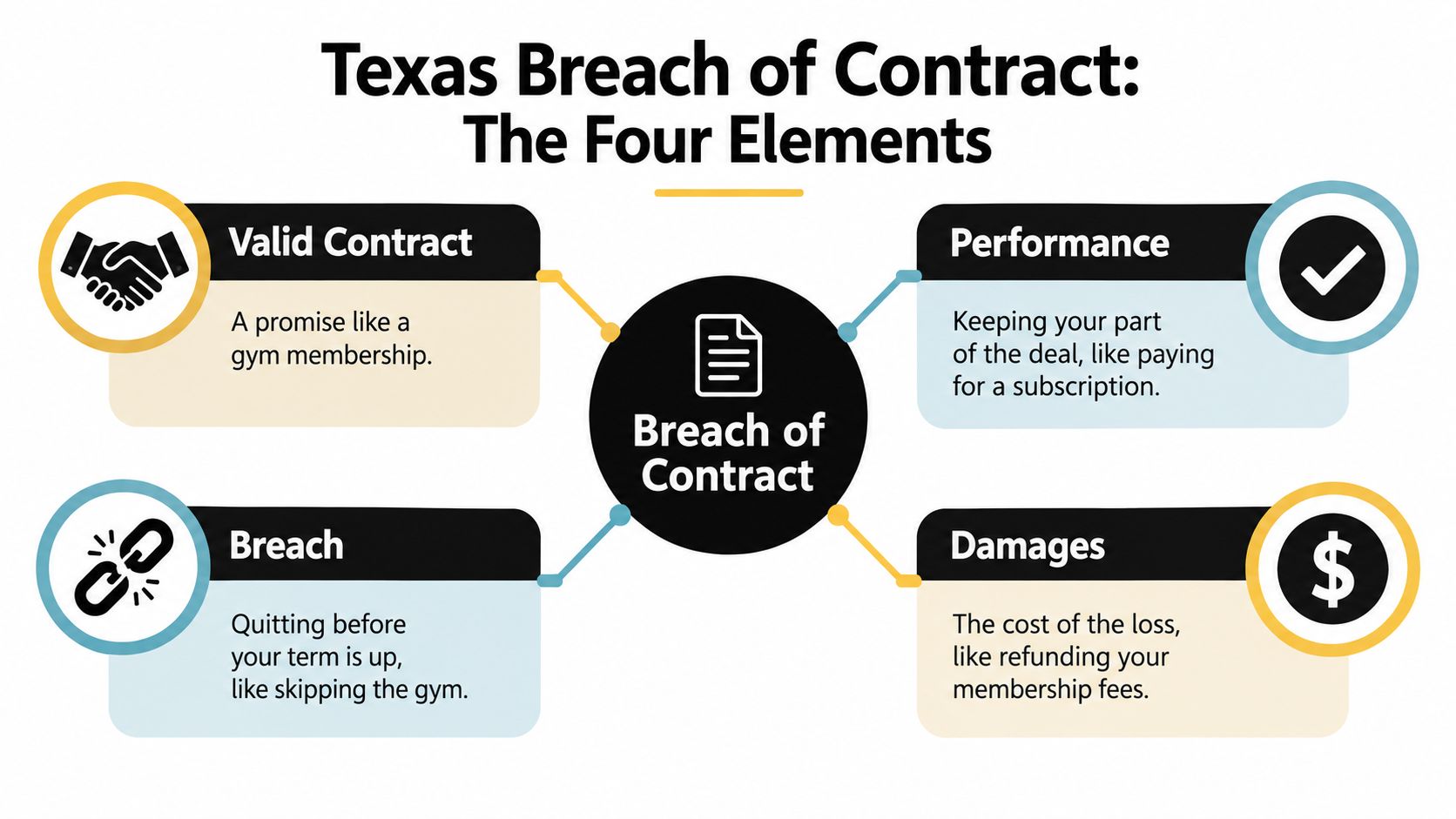
Texas courts generally look for four basic parts in a breach of contract claim. You need a valid contract, your performance or willingness to perform, the other side's breach, and damages caused by that breach.
That sounds simple, but people often get tripped up on the last part.
The four parts in plain English
Think of a contract like a clear set of exchanged promises.
If a homeowner hires a pool company, the company promises to build according to agreed terms, and the homeowner promises to pay according to agreed terms. If one side doesn't do what was promised, that may be a breach. But Texas law still asks whether the other side held up its own end and whether the breach caused actual harm.
Here's the everyday version:
- Valid contract: There was a real agreement, not just loose talk.
- Performance: You did what you promised, or you were ready and able to do it.
- Breach: The other side failed to do what the agreement required.
- Damages: That failure caused a real loss you can show.
A breach by itself usually isn't enough. You still need provable harm tied to that breach.
Minor problems versus serious breach
Not every disagreement becomes a lawsuit worth filing.
A material breach is a serious failure that goes to the heart of the deal. If a contractor abandons a project, that's very different from finishing the project but leaving a minor punch-list item unresolved. A business owner should treat those situations differently.
That distinction matters because an overreaction can create a new problem. If you stop paying or cancel performance too early, the other side may argue that you became the one in breach.
Written and oral agreements
Many people assume only written contracts count. That's not always true. Some agreements can still be enforceable even if they weren't fully reduced to writing, though proof gets much harder when the parties rely on memory.
That's why documentation matters so much. The strongest cases usually have a written contract, clear communications, and a clean sequence of events. In family wealth planning, for example, written agreements are often the whole point. Prenuptial & Postnuptial Agreements in The Woodlands involve drafting and review of marital property agreements for Woodlands clients, and that same clarity of terms is what makes later enforcement easier if a dispute develops.
A quick self-check
Before you call a lawyer, ask yourself:
| Question | Why it matters |
|---|---|
| Do I have the final signed agreement? | It helps show the exact terms. |
| What did I do to perform? | You may need to prove your own compliance. |
| What exactly did the other side fail to do? | Courts look for a specific broken obligation. |
| What loss followed from that failure? | Damages give the claim practical value. |
If you can answer those four questions with documents, your position is usually much clearer.
Texas Deadlines That Can Make or Break Your Claim
Time is one of the first things a lawyer will check.
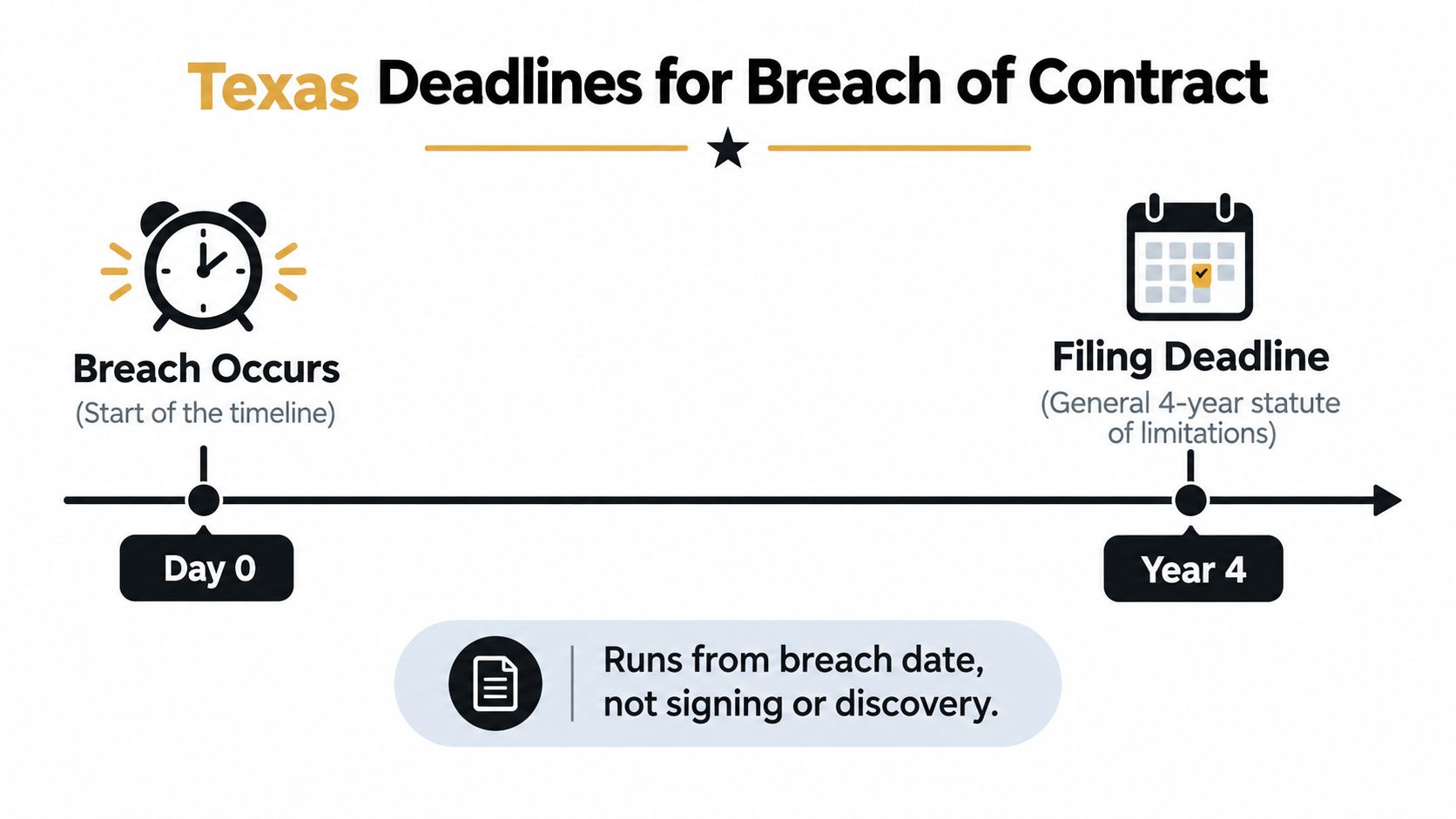
In Texas, a breach of contract claim generally must be filed within 4 years of the breach, and that deadline usually runs from the date of the breach, not the date the contract was signed and not when the problem is later discovered, as explained in this Texas contract limitations overview and in Texas Civil Practice and Remedies Code Section 16.004.
The deadline most people know
That general 4-year rule is the one you may have heard.
It matters in The Woodlands because many disputes sit too long before anyone gets legal help. A homeowner keeps waiting for the contractor to “make it right.” A business owner keeps accepting promises that payment is coming. By the time they act, the easy version of the timeline may no longer help them.
For sales contracts, Texas law also uses a 4-year limitations period after accrual, and the parties may shorten that period by agreement to no less than 1 year, but they may not extend it, under Texas Business and Commerce Code Section 2.725.
Here's a short explainer that helps frame the timing issue in plain language.
The installment contract trap
This is the part many pages miss.
Some contracts aren't broken all at once. They're broken in pieces. Think monthly payments, recurring service obligations, or installment deliveries. In those cases, separate missed payments can create separate limitation periods. That means some older missed payments may be time-barred while newer ones may still be actionable, as noted in this discussion of Texas breach claims and installment accrual issues.
That changes the analysis for a lot of The Woodlands disputes.
A simple example helps. If someone was supposed to make recurring payments and stopped over time, you may not have one clean all-or-nothing deadline. You may have a patchwork claim. Part of the loss may be too old to sue on, while more recent missed installments may still be within the filing window.
Older breaches can expire without wiping out every later breach in an installment arrangement.
Why acting early helps
A prompt review does more than preserve deadlines. It also protects evidence.
- Dates get clearer: Emails, invoices, and bank records are easier to organize while the events are still fresh.
- Claims get narrower: A lawyer can sort out which breaches are still viable and which may already be barred.
- Negotiation gets more realistic: The other side often takes a demand more seriously when the timeline is organized and still enforceable.
If your dispute also touches probate, timing can get even tighter. In estate matters, creditor notice and claim deadlines can affect contract-related recovery. For example, a personal representative has notice duties, and certain creditor claims can be barred if they aren't timely presented, as summarized in this Texas executor deadlines guide.
What You Can Actually Recover After a Breach
Winning the argument about breach and recovering something meaningful are not the same thing.
Texas contract law is built around compensation for the non-breaching party's loss. Texas appellate decisions recognize direct damages and, when properly supported, consequential damages, but courts still limit recovery to losses that are causally linked and legally foreseeable, as discussed in this Texas appellate analysis of contract damages and fee exposure.
Breach first, remedy second
A lot of clients come in focused on fault. That's understandable. But remedy drives value.
If you can show the other side broke the contract, the next question is what fix the law allows. In many cases, money damages are the main remedy. In some disputes, especially involving unique property or a specific promised act, a party may consider specific performance, which is a request for the court to require performance rather than just award money.
Texas consumer-facing content often skips this practical point. It also often misses that punitive damages are not available for a pure breach-of-contract claim, as explained in this Texas business law guide on breach remedies.
Bottom line: Proving liability matters, but remedy choice often decides whether a case is worth pursuing.
Choosing the Right Remedy for Your Breach
| Remedy | Best For | Key Requirement | Limitation |
|---|---|---|---|
| Money damages | Unpaid amounts, replacement costs, contract losses | You need provable loss tied to the breach | Weak records can limit recovery |
| Specific performance | Certain real estate or unique subject-matter disputes | The promised performance must be the right fit for court-ordered relief | It isn't the right tool for every contract |
| Attorney's fees | Cases with clear contract liability and measurable damages | Fee recovery depends on legal requirements being met | Fees are not automatic |
Attorney's fees can change the case
Texas fee recovery gets misunderstood all the time.
In breach-of-contract litigation, attorney's fees are generally recoverable only by a prevailing claimant who both wins on the contract claim and obtains damages. Texas's Chapter 38 framework also requires presentment and a 30-day failure to pay before fees become recoverable, which is laid out in this Texas Supreme Court filing discussing Chapter 38 fee requirements.
That affects settlement value in a big way. A claim with a written contract, a clear breach date, a proper demand, and measurable damages usually has more strength than a case built mostly on anger and assumptions.
If you're preparing for court, it helps to understand how documents and testimony carry these points. A practical guide to presenting evidence in court can help you think about what proof supports damages.
Your Options From Demand Letter to Courtroom in Montgomery County
Most contract disputes shouldn't start with a lawsuit. They should start with a sequence.
That sequence matters in Montgomery County because the order of steps can affect both negotiation and fee recovery. People who rush often miss a notice requirement, skip over the damages analysis, or file before they've assembled the documents they'll need later.
Start with the file, not the frustration
The first job is building the record.
Gather the signed contract, every amendment, invoices, payment confirmations, texts, emails, photos, and timeline notes. If the dispute involves a home project in Creekside or a vendor relationship in Panther Creek, include change orders, delivery records, and proof of what you had to do after the breach.
Then move through the steps
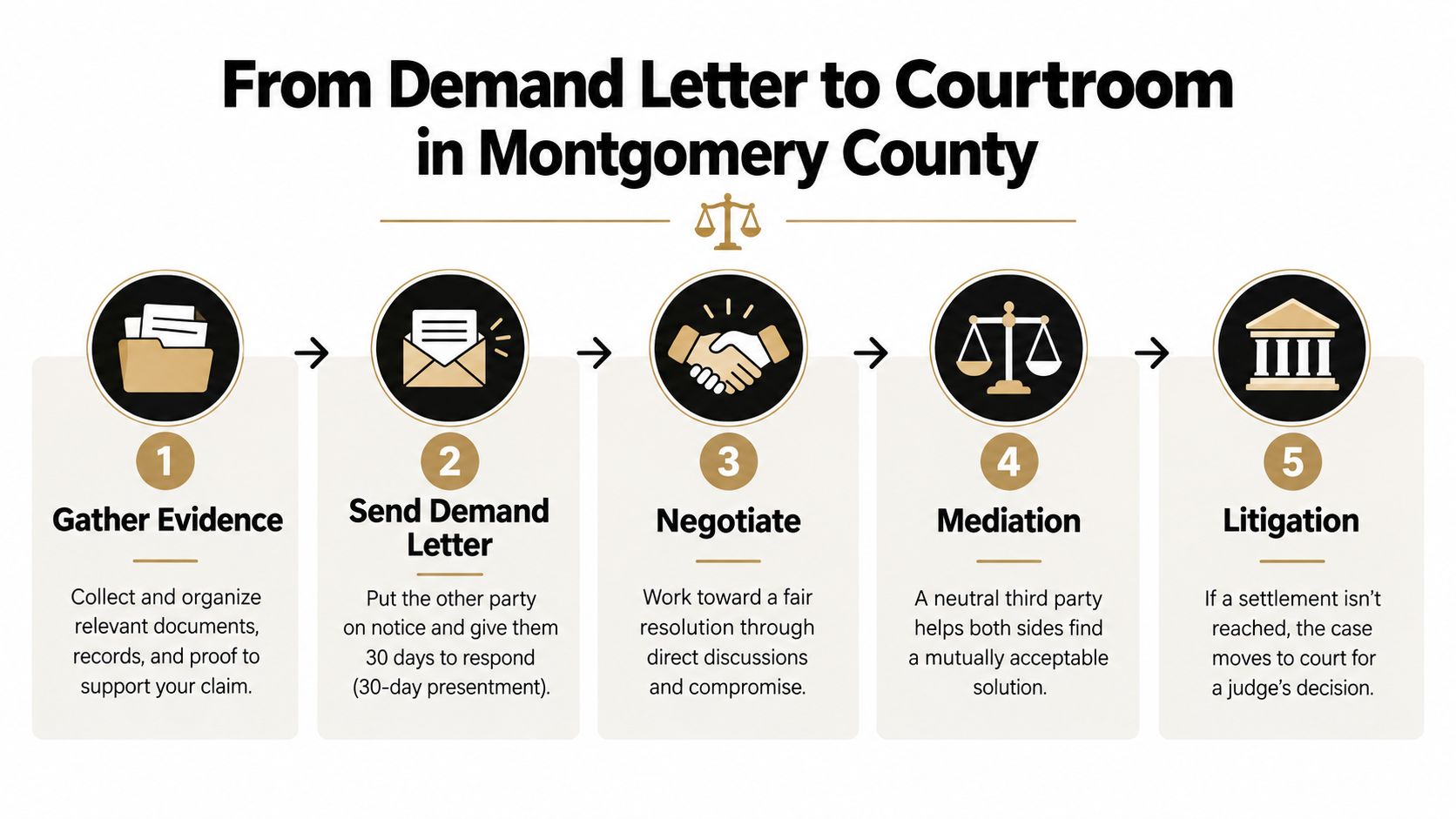
Gather evidence
Organize the contract and the timeline. Don't rely on memory if documents exist.Send a demand letter
A clear demand can define the breach, state what you want, and preserve the groundwork for fee recovery when the legal requirements are met.Negotiate
Some cases settle once the other side sees the paper trail and understands the exposure.Use mediation when useful
Mediation can make sense when both sides want control over the result and would rather avoid the delay and cost of fully contested litigation.File suit if needed
If the dispute won't resolve, the case may move into Montgomery County court.
Why the demand letter stage matters so much
The demand letter is more than a complaint on letterhead. It can shape the case.
A strong demand usually identifies the contract, the specific breach, the loss claimed, and the requested cure or payment. It also creates a cleaner record for later negotiations. In some matters, a lawyer may handle only the early demand and settlement stage. In others, the dispute may move into full litigation.
A well-timed demand often does two jobs at once. It invites resolution and prepares the file in case resolution fails.
Litigation is one option, not the only option
Some disputes need court involvement. Others are better resolved through negotiation after counsel gets involved.
For readers who are comparing options, civil litigation services in The Woodlands are one route when a case requires formal filing, discovery, and court orders. That won't fit every contract dispute, but it can matter when the other side refuses to engage, denies the agreement, or leaves no practical path to payment.
The point is sequencing. Pressure works better when it is organized.
How to Choose a Breach of Contract Lawyer in The Woodlands
Not every lawyer who handles disputes is the right fit for your contract problem.
If you're hiring a breach of contract lawyer in The Woodlands, TX, look for someone who can read a contract closely, build a timeline from documents, and explain your options without dressing everything up as a guaranteed win.

What to compare before you hire
A good comparison usually comes down to fit, process, and proof.
| What to evaluate | What to ask |
|---|---|
| Local familiarity | Has the lawyer worked with Montgomery County court procedure and scheduling? |
| Contract focus | Does the lawyer regularly handle document-heavy disputes? |
| Strategy | Will the lawyer talk through demand, negotiation, mediation, and suit, or jump straight to filing? |
| Communication | Will you get direct, understandable answers about risk and likely proof problems? |
| Fee structure | Is the work hourly, limited-scope, or staged by phase? |
Red flags people miss
Some warning signs show up early.
- Promises of easy outcomes: Contract cases usually turn on records, dates, and damages. Be cautious if someone speaks in absolutes before reading the documents.
- No interest in your paperwork: If the lawyer doesn't want the contract, amendments, invoices, and communications, that's a problem.
- No discussion of remedy: A lawyer should talk about what you can recover, not just whether the other side was wrong.
What to bring to the first meeting
Bring the materials that tell the story cleanly:
- The contract itself: Include every version, exhibit, and change order.
- Your timeline: List key dates in order.
- Proof of performance: Payments made, work completed, goods delivered, or steps taken.
- Proof of loss: Replacement costs, unpaid balances, repair invoices, or related records.
In The Woodlands, many disputes also overlap with family and probate concerns. A contract issue may involve spouses, inherited property, or a family-run venture. In those crossover matters, a firm like The Law Office of Bryan Fagan may be relevant as one option because it serves families in The Woodlands and surrounding Montgomery County communities in family law and probate matters, where contract-related issues can intersect with property division or estate administration.
If you live in Alden Bridge, Sterling Ridge, Creekside, or Panther Creek, local familiarity helps. The law is statewide, but procedure, scheduling habits, and the practical handling of cases are always local.
What to Do Next and How to Get Help
When a contract dispute lands on your desk, the smartest next move is usually not a fast move. It's an organized one.
What to do next
- Collect the full file: Pull the contract, amendments, invoices, payment records, emails, and texts into one folder.
- Write out the timeline: Focus on dates of performance, nonperformance, and your attempts to resolve the issue.
- Identify the loss: Separate frustration from actual financial harm you can document.
- Avoid informal side deals: Don't rewrite the dispute through rushed texts or verbal concessions without advice.
- Get legal input early: A short review can clarify whether to demand payment, negotiate, mediate, or file.
One short scenario
A Woodlands resident hired a service provider for recurring work on a property. Payments and performance broke down over time, and the resident assumed the whole claim was too old to pursue. After reviewing the contract and payment history, counsel identified a mixed picture. Some earlier issues were stale, but more recent breaches were still potentially actionable. That changed the conversation from “I guess there's nothing I can do” to a more focused strategy.
Family and estate overlap matters
Some contract disputes aren't stand-alone disputes. If the disagreement involves an estate, duties and deadlines under the Texas Estates Code claim rules for a personal representative who is also a claimant may matter. In a family setting, related property issues may also require review under the Texas Family Code, especially when an agreement affects marital property or divorce-related rights.
Important disclaimer
This article is for general educational purposes only. It is not legal advice. A contract claim can turn on the exact wording of the agreement, the dates involved, the type of loss, and whether probate or family law issues are part of the dispute.
If you're ready to talk through your situation, you can schedule a consultation and get a case-specific review.
If your contract dispute involves family property, probate questions, or a broader civil conflict in The Woodlands or Montgomery County, The Law Office of Bryan Fagan can help you sort out the documents, deadlines, and practical options. To learn more or set up a consultation, visit The Law Office of Bryan Fagan.