 Skip to content

A Montgomery County adoption home study in Texas typically takes 3 to 6 months and is a mandatory legal requirement under the Texas Family Code before adoption finalization. The process must generally be completed before approval, and the evaluator may be DFPS or a qualified evaluator appointed through the court, depending on the adoption pathway.
You may be sitting in a Woodlands kitchen with a stack of forms, wondering whether the evaluator will judge your parenting, your finances, or the condition of your home. That anxiety is normal. The practical answer is to treat the home study as a legal assessment of safety, stability, health, relationships, and readiness, not as a surprise inspection designed to find a reason to reject you.
Why the Montgomery County Adoption Home Study Matters
A family in Sterling Ridge begins the process after months of conversations, agency paperwork, and careful planning. The parents know the child they hope to welcome, but they don't yet know what a social worker will ask or whether an ordinary family home will satisfy Texas requirements. Their first mistake would be treating the study as a final housekeeping check.
Under Texas Family Code § 264.207, the adoption home study is a mandatory preapproval safeguard. DFPS must complete the study before an applicant is approved for adoption. In a non-DFPS case, the court may appoint a qualified individual, private entity, or domestic-relations office. DFPS may be appointed when it is the child's managing conservator. The statute provides the legal framework for the Montgomery County adoption home study The Woodlands process, but the actual coordinator depends on whether the case is private, foster-care, kinship, or court-ordered.

What the evaluator is deciding
The evaluator interviews the applicants and all household members, including children, and must conduct at least one home visit while every household member is present. The review covers more than whether the living room is tidy. It considers whether the residence is clean, safe, adequately spacious, equipped with smoke detectors, and free from obvious health, fire, or other hazards.
Applicants generally must be at least 21, financially able to support the household and child, healthy enough to parent, and able to accept and parent an adopted child. Those standards don't demand a perfect family. They require honest disclosures and a realistic plan for meeting the child's needs.
Practical rule: Don't perform for the evaluator. Show that your family understands the responsibility and can respond honestly when circumstances are difficult.
The home study protects the child, but it also protects prospective parents. A written assessment identifies unresolved safety problems, unrealistic expectations, or missing records before placement becomes more complicated. Texas law therefore treats the study as a cornerstone of approval, not an administrative formality.
Preparing Your Documents and Household Records
The most efficient families start with one indexed file before an evaluator requests documents. Use a physical binder, a secure digital folder, or both. Label each item clearly so the evaluator can verify information without chasing scattered records.
The workflow generally includes the application, household records, criminal-history and abuse or neglect checks for every required adult, references, marital or divorce documentation, health and financial information, required training, and the in-home assessment. DFPS identifies these requirements in its adoption and foster-care eligibility guidance.
Build the file in a useful order
Start with identity and household information. Include identification, proof of residence, information for every person living in the home, and records showing marital history where relevant. If you live in Creekside, Panther Creek, Conroe, Shenandoah, or another Montgomery County community, make sure the residence information is consistent across the application and supporting documents.
Then organize the financial and health material:
- Household finances: Prepare an income and expense summary that shows how you support the existing household and plan for the child's needs.
- Medical information: Complete requested medical forms and disclose conditions that affect parenting capacity or household safety.
- References: Select people who can discuss your relationships, judgment, stability, and ability to care for a child.
- Background authorizations: Complete the required criminal-history and abuse or neglect checks for every adult the evaluator identifies.
- Training records: Keep proof of required training, including PRIDE preservice training when the DFPS pathway requires it.
Don't hide an inconvenient fact because you think it will automatically disqualify you. Inconsistent interviews and incomplete disclosures can create more concern than the underlying issue. Explain the circumstance, provide the relevant records, and describe the safeguards you use now.
For court filing coordination, families may also need Montgomery County family court required forms prepared consistently with the adoption case. An Adoption Attorney in The Woodlands, TX may assist with adoption representation for families in The Woodlands, while the evaluator remains responsible for the assessment itself.
Prepare a written parenting plan
Write down practical answers before interviews begin. Address childcare, transportation, discipline, emergency medical care, school arrangements, work schedules, and appropriate relationships with birth relatives. If the child may have experienced abuse, neglect, loss, or trauma, explain how you'll seek support rather than assuming love alone will solve every behavioral challenge.
A clean index might include:
- Identification and residence
- Household members
- Marriage and divorce records
- Income and expenses
- Medical forms
- References
- Background-check authorizations
- Training certificates
- Parenting and emergency plans
That organization won't guarantee approval, but it will make missing items visible before they delay the visit.
What to Expect During the In-Home Visit
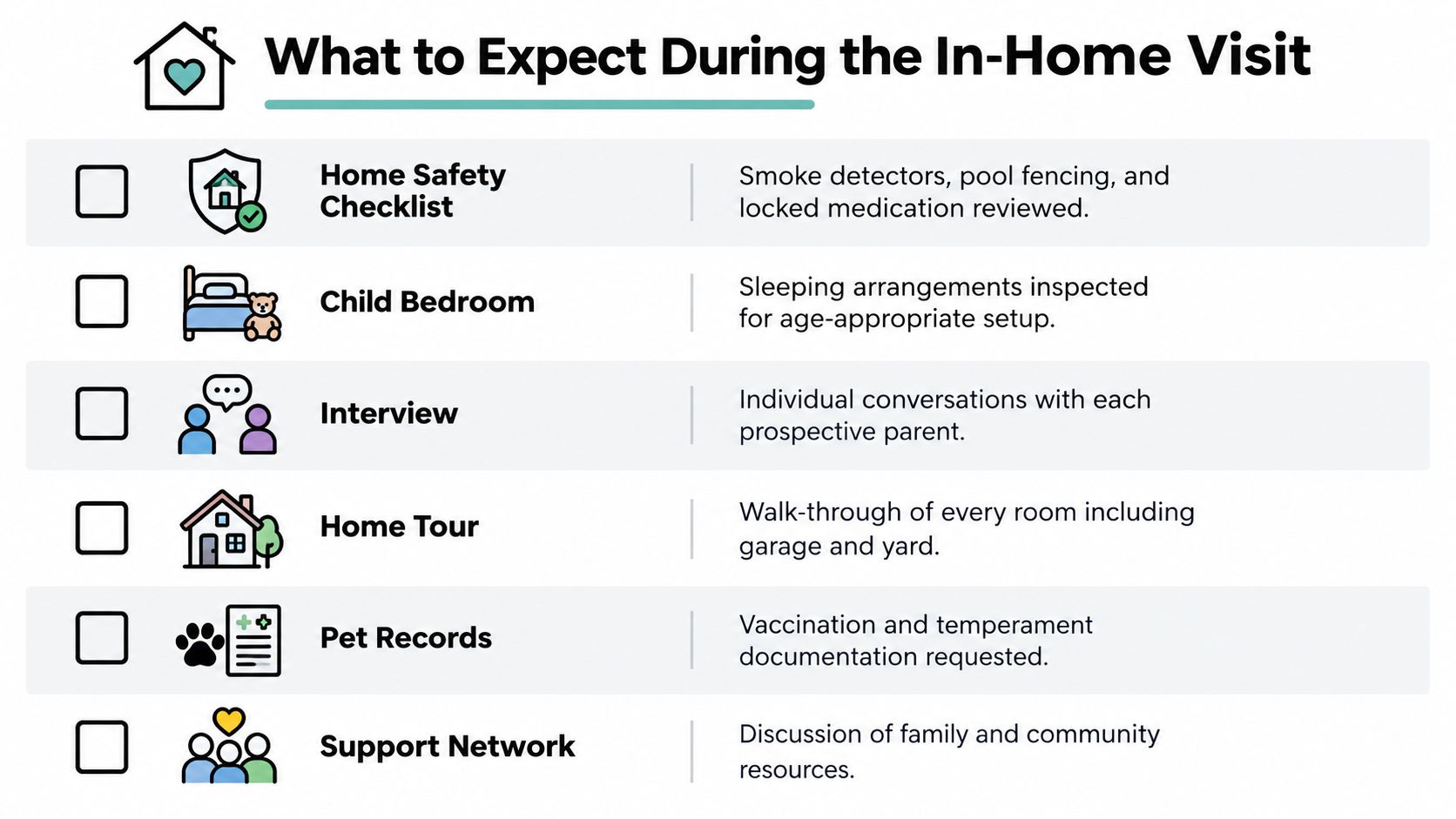
The home visit has two parts that evaluators consider together. The first is physical suitability. The second is emotional and relational readiness. A polished home with no realistic parenting plan is not enough, and a warm family with obvious safety hazards still has work to do.
Texas guidance directs evaluators to consider potential health and safety problems, cleanliness, obvious fire hazards, smoke detectors, and whether the home has enough space for the household and child. The evaluator may also ask about medication storage, firearms, sleeping arrangements, pets, emergency plans, and how the family uses indoor and outdoor spaces.
Expect conversation, not just a walkthrough
DFPS guidance includes questions about applicants' health, marital and family relationships, childhood experiences, discipline views, ability to work with children who have trauma or behavioral needs, and willingness to support sibling and birth-family relationships. A married couple may be interviewed together and separately. Children and other household members may also be asked how they understand the adoption.
A realistic scenario helps. Suppose a family in Alden Bridge has prepared a bedroom, installed working smoke detectors, and stored medications securely. During the interview, the evaluator asks what they would do if the child refuses contact with a birth relative or responds to ordinary correction with fear and aggression. The strongest answer isn't a rehearsed promise that the family will never struggle. It's a specific plan to use trauma-informed support, follow professional guidance, preserve appropriate relationships, and adjust discipline when the child's history requires it.
The evaluator isn't looking for a flawless answer. They're looking for insight, flexibility, and an accurate understanding of the child's possible needs.
The safest answer is an honest answer followed by a workable plan.
Walk through every area the evaluator requests, including bedrooms, common rooms, storage areas, garage, yard, and other spaces relevant to safety. Correct loose hazards, secure medications and firearms, confirm smoke detectors work, and remove obvious fire risks. Don't wait until the appointment to discover that a household member can't attend. Texas standards require the in-home visit to occur with every household member present.
The process may also bring up separate family-safety concerns. Protective orders in domestic violence and family safety matters are addressed through Protective Orders in The Woodlands, which is a different legal service from the adoption home study.
After the visit, the evaluator may verify documents, contact references and collateral sources, complete background checks, and prepare a report. The report should reflect the whole household, not merely the appearance of the property on one afternoon.
Understanding Costs and Legal Representation
The first cost question shouldn't be, “How cheap can we make this?” It should be, “Which pathway applies, who has authority to conduct the evaluation, and what does the court require in this case?” A DFPS home study doesn't carry a DFPS fee, although families may still incur ancillary costs during approval. Private evaluators, agency services, medical forms, records, training, background checks, and legal work may involve separate expenses.
Separate the evaluator's work from the lawyer's work
The evaluator assesses the home and family. The attorney handles the legal case, including the petition, required notices, consents or termination issues, court orders, and finalization strategy. Those roles overlap in timing, but they aren't interchangeable.
A family can lose time by hiring the wrong professional for the wrong task. An attorney can't turn an unsafe home into an approved home study, and an evaluator can't resolve a disputed biological parent's rights. In a private adoption, the court may appoint a qualified evaluator or private entity. In a DFPS-connected case, agency requirements and training may control the route.
For a stepparent or related case, the legal analysis may differ from a private agency adoption. A Stepparent Adoption Lawyer in The Woodlands can evaluate whether the case follows that specific path, while a Divorce Lawyer in The Woodlands, TX handles divorce representation for clients in The Woodlands and Montgomery County. Don't assume a prior family-law filing answers the adoption questions.
Why local coordination matters
A local attorney can help identify the correct court pathway, coordinate deadlines with the evaluator, review whether the report addresses the required household members, and flag changes that may require an update. That matters when the family is managing a move, a delayed placement, a change in household composition, or unresolved consent issues at the same time.
The emotional cost of a delay also deserves attention. Families may prepare a child, arrange work schedules, and make room in their home while waiting for approval. Clear responsibility assignments help: one person tracks records, another communicates with the evaluator, and counsel monitors court requirements.
Use written questions before paying for additional services:
- Authority: Who is legally authorized to conduct this evaluation?
- Scope: Is this a private, foster-care, kinship, or court-ordered assessment?
- Records: Which documents are missing or need updating?
- Timing: What event starts the placement clock?
- Changes: Who must be notified if the address or household changes?
Timeline Risks and Post-Approval Requirements
Approval is not a permanent permission slip. The most important hidden timing rule is tied to placement, not the date you feel finished with paperwork.
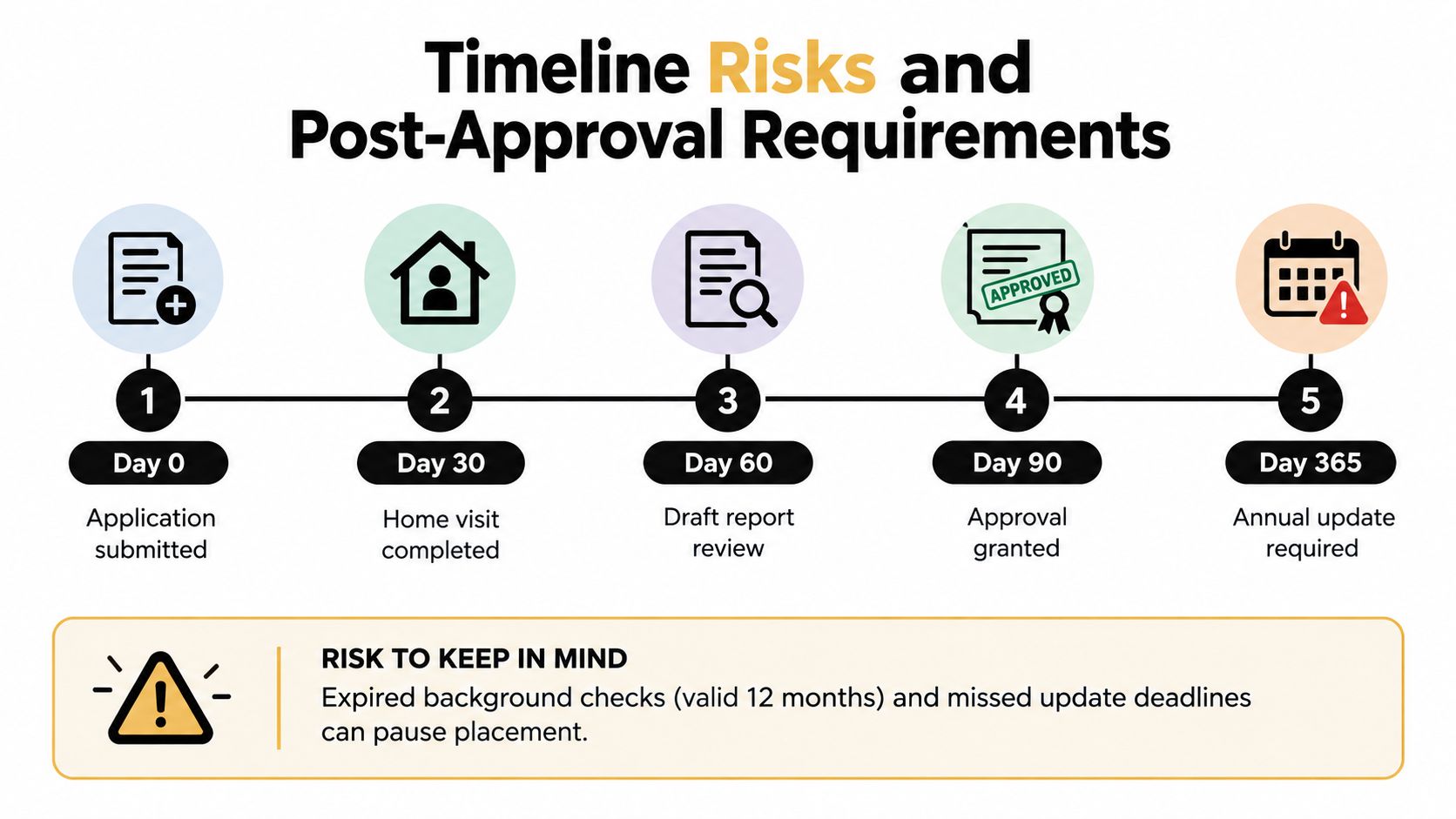
If the child doesn't move into the adoptive home within 6 months after the preplacement evaluation is completed, the evaluation must be updated within 30 days before placement. That rule appears in the Texas adoption guidance summarized by DFPS foster-adoption information. In foster-adoption recruitment, matching begins only after approval.
Treat major changes as reportable
Call the evaluator or agency before assuming an approved study remains current. A move within Montgomery County can change the residence being assessed. Adding an adult roommate, beginning care for another child, changing employment, experiencing a material health change, or renovating key areas can affect the evaluation.
The same caution applies when placement is delayed by fingerprints, medical forms, agency processing, or court scheduling. Ask whether the issue requires an update to the existing evaluation or a new study. Those are not necessarily the same thing, and the responsible evaluator or court should answer before placement planning continues.
Don't rely on the infographic's illustrative milestones as a legal deadline calendar. The controlling timing issue is the 6-month placement rule and the required update within the 30-day period before placement when that rule applies.
Approval starts the next phase. It doesn't end your duty to keep the file accurate.
Keep the evaluator informed about safety improvements completed after the visit. Document the change, ask whether another visit is needed, and preserve updated records. That approach is far safer than allowing an agency or court to discover a material change after placement has been scheduled.
Your Next Steps in the Adoption Journey
Start with the adoption type. A private domestic adoption, DFPS foster adoption, kinship placement, and court-ordered evaluation can involve different authorities and questions. Don't use a generic online checklist as a substitute for identifying the correct Montgomery County pathway.
What to do next
- Confirm authority: Ask whether DFPS, a licensed child-placing agency, or a court-appointed evaluator handles your study.
- Create the file: Gather identification, residence proof, financial records, medical forms, references, marital records, and background-check authorizations.
- Complete training: Confirm whether required training, including PRIDE preservice training, applies to your pathway.
- Prepare the home: Test smoke detectors, secure medications and firearms, address hazards, and plan for every household member to attend.
- Write your plan: Cover childcare, transportation, discipline, emergency care, trauma support, and appropriate birth-family relationships.
- Track placement timing: Record when the preplacement evaluation is completed and contact the evaluator before major household changes.
A Woodlands family in Creekside followed this order, disclosed a prior move, updated its residence records, and asked the evaluator whether a second visit was needed. That decision prevented the family from treating an old report as current when placement timing changed.
For a related legal filing or an adult adoption issue, families can review adult adoption attorney services in Montgomery County and confirm which Texas Family Code provisions apply.
This article is general information, not legal advice. Adoption requirements depend on the facts, the adoption type, the evaluator, DFPS involvement, and the court handling the matter. Speak with a Texas family-law attorney about your situation before relying on a checklist or signing a legal document.
The Law Office of Bryan Fagan can help families in The Woodlands and Montgomery County identify the correct adoption pathway, coordinate legal requirements with the home-study process, and prepare for court-related issues. Visit The Law Office of Bryan Fagan to schedule a consultation about your adoption plans and timing concerns.
