 Skip to content

Under Texas Family Code § 6.301, either spouse can qualify a Montgomery County divorce filing if one spouse has lived in Texas for at least six months and either spouse has lived in Montgomery County for at least 90 days. Living in The Woodlands alone doesn't automatically satisfy the requirement unless the residence is also in Montgomery County.
That distinction matters when you're deciding whether to file now, wait, or consider another Texas county. The Woodlands spans Montgomery and Harris Counties, so your neighborhood name isn't enough to determine venue. You need to identify which county the qualifying residence is in, whose residence counts, and whether the required periods had elapsed on the filing date.
The Scenario That Confuses Most Woodlands Residents
Suppose you live in a Panther Creek apartment and have decided that your marriage can't continue. You search for the Montgomery County 90 day residency requirement for divorce filing in The Woodlands and find two seemingly different answers. One says you must have lived in Montgomery County for 90 days. Another says either spouse's residence may qualify.
Both statements are incomplete without the rest of the rule.
You may have recently moved into The Woodlands from Harris County. You may still have records tied to your former county. Or your spouse may remain in Conroe while you live elsewhere. The question isn't straightforward: “Do I live in The Woodlands?” The critical questions are which county is involved, which spouse satisfies the requirement, and when each residency period began.
The community name can also create confusion because The Woodlands spans Montgomery, Harris, and nearby county areas. A home in Alden Bridge, Sterling Ridge, Creekside, or Panther Creek may be associated with The Woodlands, but the filing analysis turns on the county in which the residence sits.
Practical rule: Don't treat “The Woodlands” as a substitute for a county determination.
Consider a person who moved into a Montgomery County home recently but has lived in Texas for much longer. That person may meet the statewide Texas period while still lacking enough Montgomery County residence to file there based on their own residence. The answer could change if the other spouse has already lived in Montgomery County long enough.
This is why venue should be checked before preparing or submitting an Original Petition for Divorce. A useful local discussion of this issue appears in which venue applies in Conroe or The Woodlands, but your own dates and documents still control the analysis.
The safest starting point is to write down both spouses' addresses, the county for each address, and the date each person began living there. That simple timeline often reveals why an online answer seemed contradictory.
Understanding the 90-Day Residency Rule Under Texas Law
Texas applies a two-part residency test before a divorce may be filed in a particular county. Under Texas Family Code § 6.301, either spouse must have been domiciled in Texas for the six months immediately before filing, and either spouse must have lived in the county where the case is filed for the 90 days immediately before filing.
These requirements are separate clocks. One measures a spouse's connection to Texas. The other measures the connection to the filing county.
The six-month Texas requirement
Domicile generally means the place a person has established as home, rather than a temporary location. For example, a spouse may have made Texas home while living in another Texas county and later moved to The Woodlands. That move does not automatically restart the six-month Texas period.
The statewide requirement is separate from Montgomery County residence. Satisfying the Texas period alone does not establish eligibility to file in Montgomery County.
The 90-day county requirement
The second part concerns the filing county itself. If the divorce is filed in Montgomery County, the qualifying spouse must have lived in Montgomery County for the preceding 90 days. Time spent elsewhere in Texas does not count toward that county period.
The rule also applies to either spouse. A person who recently moved to Montgomery County may not yet satisfy the 90-day period through their own residence, even if they have lived in Texas for more than six months. The other spouse's Montgomery County residence may satisfy the county requirement instead.
Texas Family Code § 6.301 provides the framework for this analysis. The Texas State Law Library's divorce filing guidance explains the same structure in practical terms, including the possibility that either spouse may satisfy the applicable Texas and county periods.
Residence, domicile, and venue are different questions
Residence and domicile often overlap, but they answer different legal questions. Domicile concerns the established Texas home. Residence helps identify the county connected to filing. Venue identifies where the case may properly be filed.
For a Woodlands resident, a community name or mailing address does not settle venue by itself. The address must be connected to the correct county, and the relevant spouse's dates must be checked. A Divorce Lawyer in The Woodlands, TX can review those facts, and information about filing for divorce in The Woodlands may help organize the process. The filing decision still depends on the spouses' actual residences, domicile, and dates.
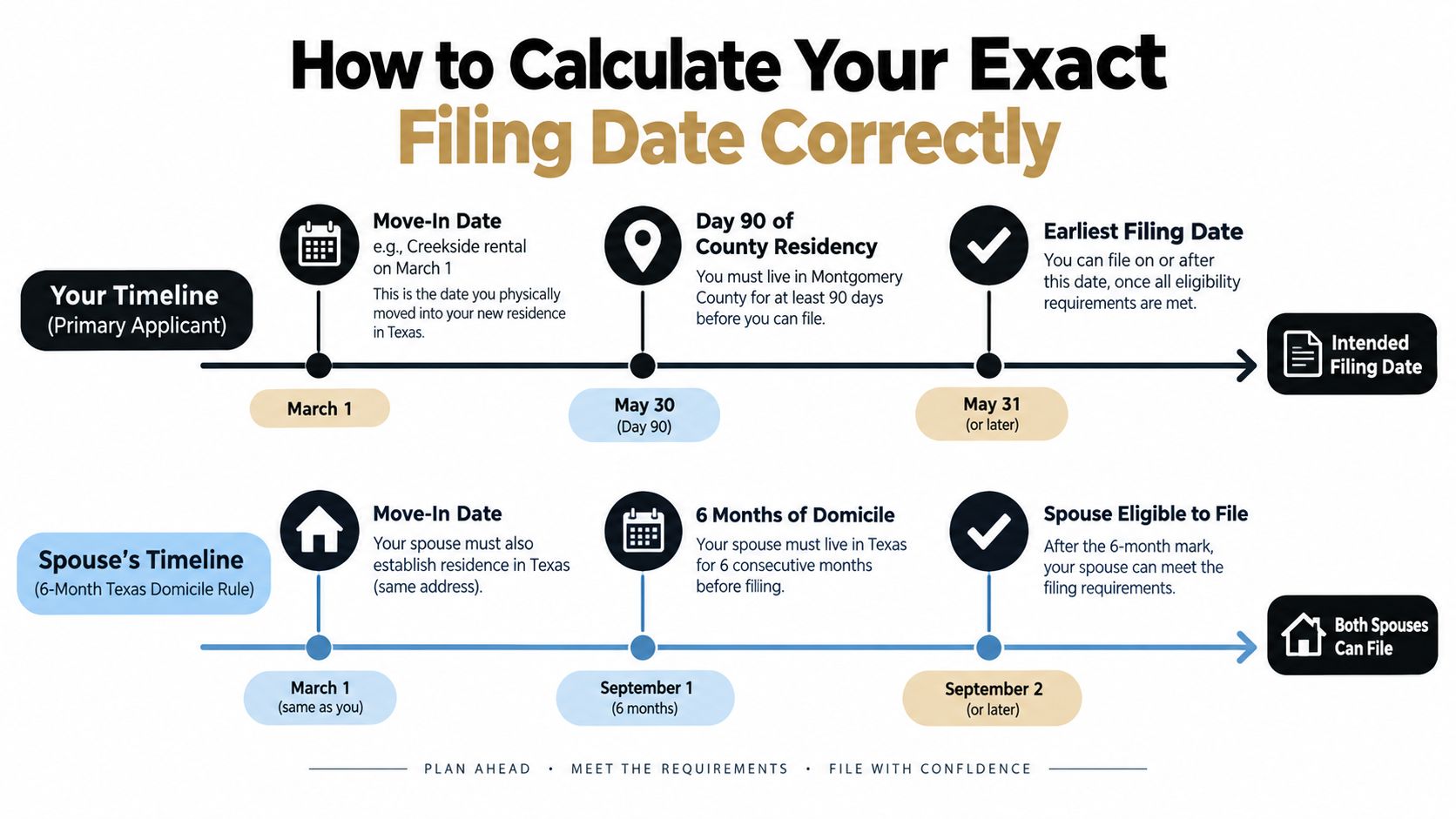
How to Calculate Your Exact Filing Date Correctly
The six-month and 90-day periods are measured as of the filing date. Texas Family Code § 6.301 refers to the preceding periods, so start with the date you hope to file and work backward through the qualifying spouse's history.
Use this process:
- Choose the proposed filing county. If you're considering Montgomery County, confirm that the relevant residence is in Montgomery County.
- Identify the qualifying spouse. The petitioner or respondent may supply the required residence.
- Find the Texas domicile date. Record when the qualifying spouse established a Texas home.
- Find the county residence date. Record when that spouse began living in Montgomery County.
- Compare both periods with the intended filing date. Both requirements must be satisfied when the petition is filed.

A Creekside move example
Assume a spouse moved into a Creekside rental on July 1. If that home is in Montgomery County, July 1 becomes an important starting point for that spouse's county-residence calculation. The spouse should count the required period forward and identify when the county requirement has elapsed, then confirm that either spouse also satisfies the Texas domicile requirement.
Don't assume that the move-in date is always obvious. A lease may begin on one date while actual occupancy starts on another. Utility records, a closing statement, driver-license information, and other consistent records may help show residence, although the court decides whether the evidence is sufficient.
A Sterling Ridge example
Now assume a spouse has lived in Sterling Ridge for three years, and that residence is in Montgomery County. That spouse's history may satisfy the county-residence component, assuming the residence continued and the other statutory conditions are met.
The other spouse's recent move doesn't necessarily prevent filing in Montgomery County. The county analysis may rely on the Sterling Ridge spouse rather than the person who submits the petition.
When spouses live in different counties
Different-county situations require extra care. A recent Woodlands arrival may not qualify through personal Montgomery County residence, but the other spouse's residence may support filing there. Conversely, if neither spouse satisfies the Montgomery County requirement, filing there may be improper even if one spouse currently works nearby or has family in the area.
Temporary travel also shouldn't be confused with a permanent change of residence. Keep a consistent record of where the qualifying spouse lived and preserve documents that support the timeline. If the dates are close, written legal guidance can prevent an avoidable filing challenge.
The Either-Spouse Loophole Most People Miss
Many people assume the filing spouse must personally have lived in Montgomery County for 90 days. That isn't the statutory structure. Under Texas Family Code § 6.301, either the petitioner or respondent may satisfy the county-residence requirement, as long as the Texas domicile requirement is also met by a qualifying spouse.

That matters for a person who recently moved to The Woodlands from another Texas county. It also matters when one spouse lives outside Texas but the other spouse remains in Montgomery County. The county where the case is filed is connected to the qualifying spouse's residence, not necessarily the current residence of the person who files the petition.
A short real-world scenario
A Woodlands resident recently moved into Montgomery County after living in Harris County. The spouse, however, has lived in Conroe for more than a year. The filing spouse may not yet qualify based on personal Montgomery County residence, but the spouse's established Conroe residence may support filing in Montgomery County, assuming the Texas domicile and other statutory requirements are satisfied.
That doesn't mean every case should automatically be filed there. The parties' actual addresses, the timing of each move, and the facts supporting domicile and residence still matter.
Why the distinction affects strategy
Relying on the other spouse's residence can expand filing options, but it can also create questions about whether the selected county is proper. A spouse may challenge venue or dispute the facts supporting residence. Filing in a convenient location doesn't replace the statutory test.
The rule also helps explain why living in a different county doesn't always eliminate a Montgomery County filing option. The Texas State Law Library explains the either-spouse county rule, including situations in which one spouse lives outside Texas and the Texas-resident spouse supplies the relevant connection.
Before filing, compare both spouses' timelines. Don't stop after asking where the petitioner lives. Ask where the respondent lives, how long that residence has continued, and whether that county is the one connected to the proposed filing.
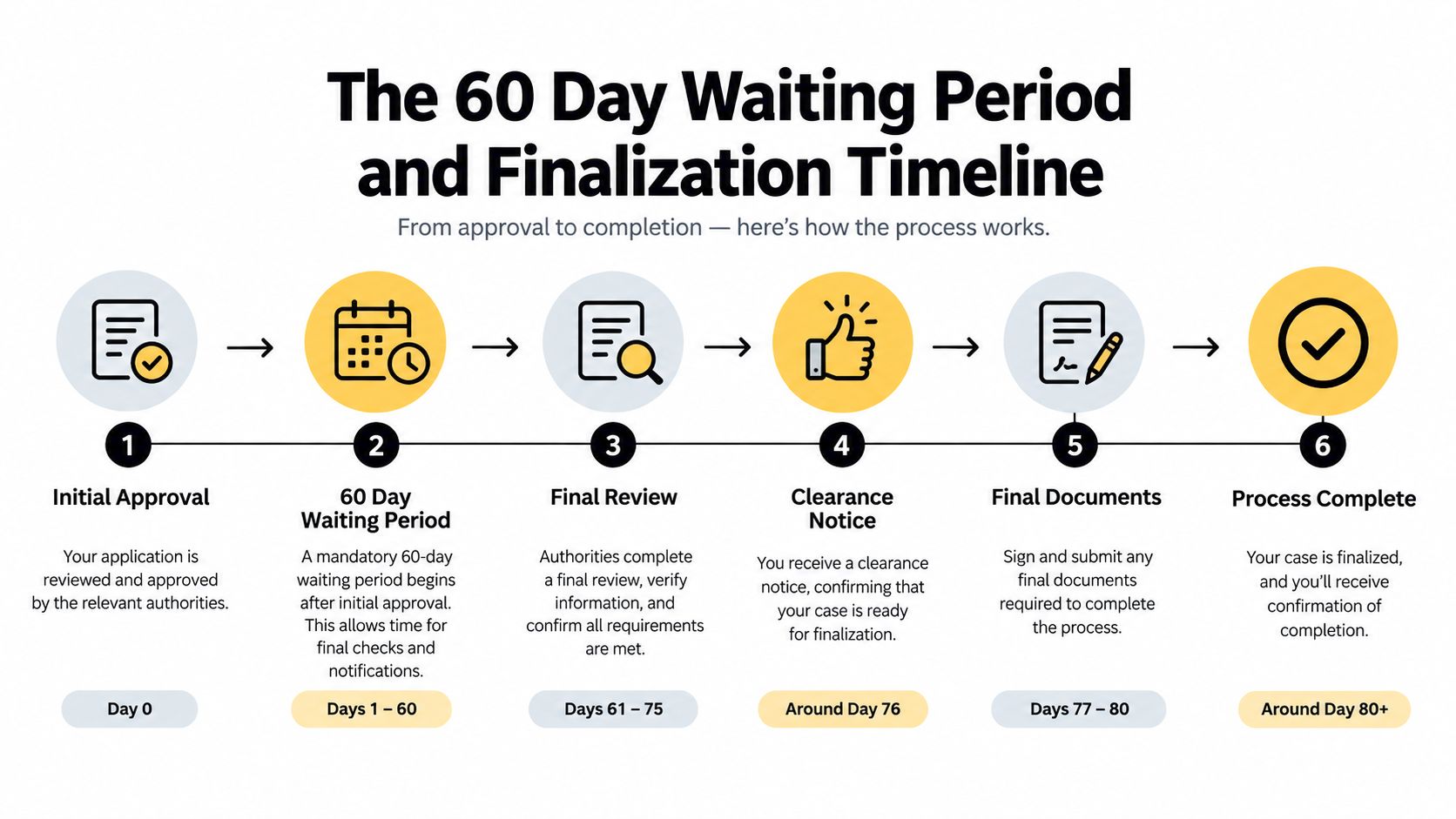
The 60 Day Waiting Period and Finalization Timeline
Reaching the 90-day county-residence requirement may allow a divorce to be filed in Montgomery County. It does not mean a judge can finalize the case that day. Texas uses a separate post-filing waiting period, so the filing date and finalization date run on different clocks.
Montgomery County's self-represented divorce materials state that the Original Petition for Divorce generally must remain on file for more than 60 days before finalization, except in limited family-violence circumstances. The Montgomery County District Clerk's resources distinguish this waiting period from the county-residency requirement.
| Requirement | What it measures | When it matters |
|---|---|---|
| 90-day county residence | Eligibility to file in the selected county | At filing |
| Six-month Texas domicile | Statewide residency eligibility | At filing |
| More than 60 days on file | Ordinary earliest finalization point | After filing |
The dates work like two separate timers. The county-residence timer must finish before filing. The finalization timer starts only after the petition is filed, not when someone moves to Montgomery County.
What happens after filing
The calendar alone does not complete a divorce. The petition must be filed correctly, and the other spouse must be served or provide an appropriate waiver. The parties may also need to complete financial disclosures and other required pleadings.
The proposed Final Decree of Divorce must resolve the issues involved in the case. Depending on the family, those issues can include property, debts, children, support, and other orders. The county's self-represented checklist indicates that a court date will not be provided until the required documents are properly filed.
Why the two timelines are easy to confuse
A person can become eligible to file after completing the Montgomery County residence period, yet still need to wait more than 60 days after filing before ordinary finalization. Completing the first period does not start the second one.
For example, a Woodlands resident who reaches the county threshold on a particular date may file then. The case still needs the separate post-filing period, proper service or waiver, complete paperwork, and a decree a judge can approve.
Limited family-violence circumstances may change the waiting-period analysis. Those exceptions depend on specific facts, so general conflict or fear does not automatically establish an exception. Relevant protective orders, findings, or criminal case outcomes should be reviewed before relying on one.
Montgomery County divorce cases proceed through the District Clerk because Texas divorce proceedings are filed in district court. The county lists its physical office at 301 N. Main Street, Suite 103, Conroe, Texas 77301. For additional context, review this Woodlands divorce timeline guidance, while treating the court's current procedures and the documents in your case as controlling.
Practical Next Steps and Local Court Guidance for The Woodlands Residents
Start by building a clean timeline rather than guessing from a search result. Include both spouses' Texas domicile dates, Montgomery County residence dates, addresses, and any moves between The Woodlands, Conroe, Harris County, or nearby communities.
What to do next
- Gather residence records: Collect leases, closing statements, utility records, driver-license information, and other consistent documents.
- Identify the county: Confirm whether the relevant Woodlands address is in Montgomery County, not just associated with The Woodlands.
- Compare both spouses: Check whether either spouse satisfies the Texas and county periods.
- Separate the clocks: Treat the 90-day filing rule and the post-filing waiting period as different requirements.
- Review the petition: Make sure service or waiver documents, financial disclosures, and proposed decree paperwork are complete.
- Get advice when the facts are close: Consider a consultation if the move dates are disputed, the case is high-conflict, or substantial property or parenting issues are involved.
Alden Bridge, Panther Creek, and Sterling Ridge are neighborhood names, not automatic venue decisions. The Montgomery County District Clerk's office is at 301 N. Main Street, Suite 103, Conroe, Texas 77301, and the county provides resources for people representing themselves.
This article is educational and isn't legal advice. Residency, domicile, venue, service, waiting-period exceptions, and finalization requirements depend on the facts and current court procedures.
The Law Office of Bryan Fagan helps families in The Woodlands and surrounding Montgomery County communities with divorce matters, including filing questions, contested cases, property division, and related family-law issues. Visit The Law Office of Bryan Fagan to schedule a consultation about your residency timeline and filing options.
