 Skip to content
Your divorce decree is final, the monthly spousal maintenance keeps hitting your account, and then life changes. In Panther Creek, that often looks like the paying spouse getting a call that the ex lost a job, or the receiving spouse suddenly facing a medical issue that changes the whole budget. That's when people start asking the same hard question, can the order be changed, or am I stuck with it?
The short answer is that Texas law does allow modification, but modifying spousal maintenance The Woodlands is not a sympathy exercise. Montgomery County judges want proof of a material and substantial change in circumstances after the original order, not just a story about stress or a tighter budget, and the court can only change payments that come due after the motion is filed under Texas Family Code § 8.057 (Texas Family Code § 8.057).
If you're in The Woodlands, Montgomery County, Conroe, Shenandoah, Oak Ridge North, or nearby, that distinction matters. Judges here read these cases the same way the statute does, with an eye on evidence, timing, and whether the change really happened after the divorce decree. This is general information, not legal advice, because your decree language, your facts, and your court history can change the outcome.
When Life Changes After the Divorce in The Woodlands
A man in Panther Creek signs a 2024 divorce decree and agrees to pay monthly maintenance. Six months later, his ex loses her job, and he starts wondering if he can cut the payment or stop it altogether. That's the pressure point. The law does care about post-divorce changes, but only if those changes fit the statutory standard in Texas Family Code § 8.057 (Texas Family Code § 8.057).
The mistake people make is thinking hardship alone wins the day. It doesn't. A Montgomery County judge is looking for evidence that something material and substantial changed after the order, and that the change matters enough to justify revisiting the original maintenance terms. That's the legal filter, and it's a strict one.
Practical rule: if the problem existed before the decree, or if you can't prove when it changed, you're walking uphill before you even get to the hearing.
The cleanest way to think about it is this. The court is not redoing the divorce. It is checking whether the facts that supported the old order have changed since the decree, and whether the requested modification stays inside the limits the statute allows. If you're asking for a reduction, suspension, or termination, your job is to prove the change with documents, not just frustration.
For people in The Woodlands, the first move is usually to gather the decree, the payment history, and every document that shows what changed and when. If you want background on how maintenance cases are handled locally, the firm's page on spousal maintenance in The Woodlands is a good starting point for the local framework. But don't confuse reading about the law with winning the motion. Judges want a real record.
What Texas Law Requires to Modify Maintenance
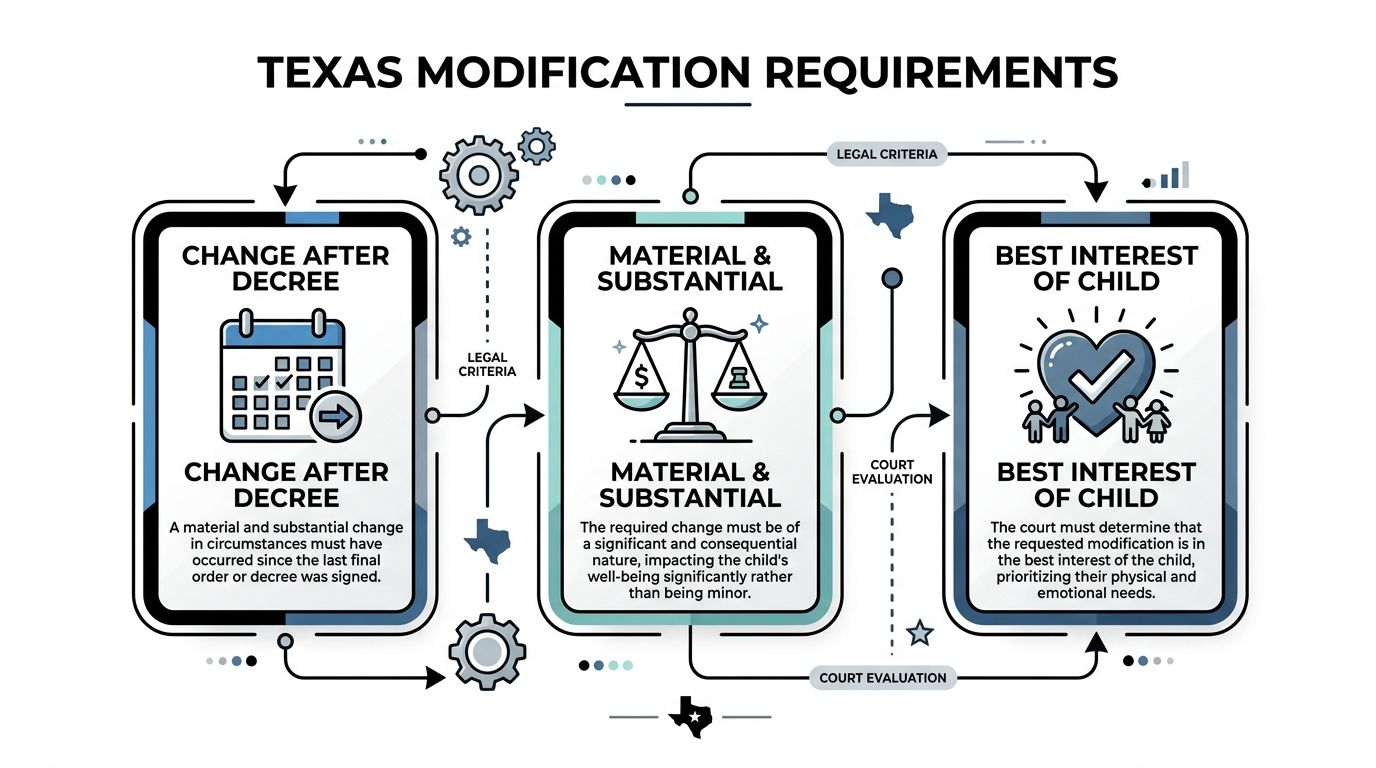
Texas law gives you a narrow lane, not a broad highway. To modify maintenance, you need a change after the original decree, that change must be material and substantial, and you have to prove it by a preponderance of the evidence in the court that issued the original order (Texas Family Code § 8.057, Texas alimony modification process and evidence package). That is the legal framework Montgomery County courts use whether the request is for a reduction, termination, or, in some situations, a suspension.
What usually qualifies
A documented job loss can qualify when it is real and happened after the order. A new medical diagnosis can qualify when it limits the person's ability to work. An involuntary pay cut can qualify if the records show it was not a choice. A cohabitation change can matter too, but only if the facts support the legal argument and the court is persuaded by the proof.
What usually fails
General frustration with the payment fails. A voluntary career change with no hard evidence fails. A problem that already existed at the time of the divorce fails. So does vague talk about inflation, stress, or a bad month, because those claims do not tell a judge what changed and when.
The statute also puts hard limits on the court's power. The judge cannot increase maintenance beyond the original amount or extend it beyond the original duration, and any change applies only to payments that come due after the motion is filed (Texas Family Code § 8.057). Timing matters as much as proof. If you wait, you may keep paying under the old order until the filing date locks in the new request.
If you see the phrase preponderance of the evidence and think that sounds fuzzy, it is not. It means your version has to be more convincing than the other side's. In practical terms, that means the judge needs documents, not drama.
You may also see maintenance capped under Texas law at the lesser of 20% of the paying spouse's average gross monthly income or $5,000 (Texas spousal maintenance cap). That cap matters when someone asks for a modification that would still have to fit inside the statutory ceiling. A successful modification request still has boundaries.
For local readers who want a plain-English reference point, Spousal Support Lawyer in The Woodlands covers spousal maintenance and alimony representation in The Woodlands. That is useful context, but the question is always whether your facts line up with the statute.
Building the Evidence Package Montgomery County Courts Expect
A good modification case starts long before the motion is filed. Judges in Montgomery County want a paper trail that shows exactly what changed, when it changed, and how that change affects the maintenance order. If you walk in with nothing but a complaint, you're wasting everyone's time.
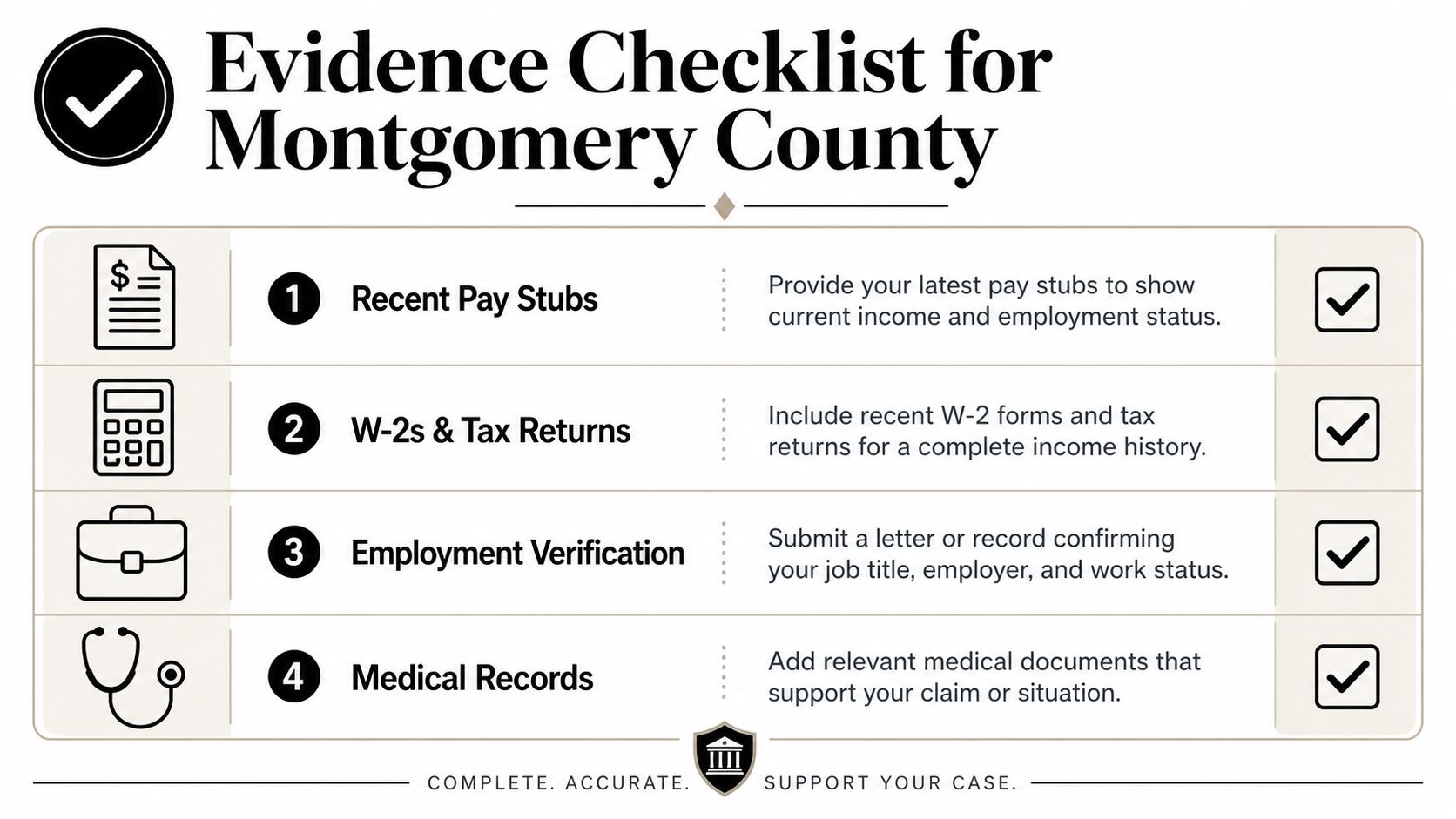
The strongest file usually includes recent pay stubs, tax returns, W-2s, employer letters, unemployment records, medical records, provider statements, bank statements, and anything that proves a change in household income or cohabitation (Texas alimony modification process and evidence package). The point isn't to dump a stack of paper on the court. The point is to connect the dots.
What helps a judge most
- Recent pay stubs: These show current income instead of old assumptions.
- W-2s and tax returns: These help prove income history and whether the new numbers are real.
- Employment verification: A letter from the employer can confirm termination, reduced hours, or a new role.
- Medical records: These matter when health changed and work ability changed with it.
What frustrates a judge
- Screenshots with no context: They're easy to misread.
- Handwritten summaries: They don't replace records.
- Missing date stamps: If the timeline is fuzzy, the argument gets weaker.
- Unsorted bank statements: A judge should not have to build your case for you.
A practical way to prepare is to separate documents into three folders, income, health, and household changes. If the issue is cohabitation or another household shift, get proof that shows who lives where and who pays what. If the issue is unemployment, show the layoff date, the search for work, and the income drop.
A Montgomery County family law attorney will often ask for these records before filing because the strength of the motion depends on them. If you're also dealing with divorce-related issues at the same time, the Divorce Lawyer in The Woodlands, TX resource is a useful local reference for clients in The Woodlands and Montgomery County. It's not about piling on more paper. It's about giving the court a clean story it can verify.
What to bring first
- The decree and maintenance order
- The last several pay stubs or income records
- Any termination, layoff, or medical paperwork
- Bank statements that show the change in real time
- Anything that proves the change happened after the order
How to File the Motion in Montgomery County
File in the same court that signed the original divorce decree. That is not a suggestion, it's the rule under Texas Family Code § 8.057 (Texas Family Code § 8.057). In Montgomery County, that usually means the same district court that handled the divorce case. If you file in the wrong place, you've just bought yourself delay.
The basic filing path is straightforward. You prepare the motion to modify, file it with the district clerk, have the other spouse served with citation, and track the answer deadline. The statute requires service of citation and gives the responding party an answer deadline of 10 a.m. of the first Monday after 20 days from service (Texas Family Code § 8.057). That deadline trips up a lot of unrepresented people.
The counter workflow matters
At the Montgomery County District Clerk's office, expect to file the motion and related papers, then make sure service is handled correctly. The clerk can process the filing, but the court will not move forward just because paperwork was dropped off. Service has to be done right, and the proof of service has to be filed. If the other side doesn't answer on time, that may affect the case posture, but you still have to follow the procedure.

Here's the part people miss. The motion only affects payments that come due after it's filed (Texas Family Code § 8.057). So if you wait to act, you may keep paying under the old order longer than you wanted. That is why I tell clients to calendar every deadline the same day the case is filed.
The modification filing often sits alongside requests for temporary orders, especially when the financial picture is changing fast. That doesn't guarantee relief, but it can keep the case from spiraling while the court waits for a hearing. If you want a local procedural reference point, modification of divorce decree in The Woodlands is the right kind of local resource to review before you step into the courthouse.
What Happens Inside the Montgomery County Courtroom
A contested hearing in Montgomery County is usually less dramatic than people fear and more exacting than they expect. The judge calls the docket, asks who's ready, and then moves into the evidence. If the case has a pre-trial conference or mediation requirement, that usually happens before anyone testifies. The courtroom is not a place for speeches. It's a place for proof.
Here's a typical scenario. The paying spouse says the ex's job loss should lower maintenance. The receiving spouse says the layoff was temporary, benefits are still coming in, and the paying spouse is exaggerating the numbers. The judge doesn't care which side sounds more upset. The judge cares which side brought records that line up with the law.
What judges usually focus on
- Credibility: If your story shifts, the court notices.
- Timing: The judge wants to know when the change happened.
- Documents: Pay records, medical records, and employer statements often matter more than emotion.
- Consistency with the decree: If the order already addressed the issue, the court will follow that language.
Different Montgomery County district courts, including the 410th, 411th, 418th, 422nd, and 457th, each have their own docket habits, but the basics don't change. The judge wants a clean theory, a supported timeline, and a request that fits the statute. If the facts are disputed, discovery can push the case out for months. If the parties settle early, it can move much faster.
Judges in family court respect the person who brings organized proof and answers directly. They have very little patience for excuses dressed up as evidence.
Temporary orders hearings can matter when the financial pressure is immediate. Mediation often matters too, because many modification cases resolve there once both sides see the weaknesses in their positions. But don't assume settlement is easy. If one side refuses to show the documents, the case gets harder, not easier.
Settlement, Enforcement, and Costs to Plan For
You do not have to treat trial as the default. Many maintenance disputes end through an agreed modification, a mediated settlement, or a Rule 11 agreement that narrows or resolves the issues without a full hearing. That's often the smarter move when both sides can live with a middle ground. It's also the cheaper move.
If the other spouse stops paying after a court order is in place, enforcement becomes a separate issue. A contempt route or wage withholding may come into play depending on the order and the facts, and Montgomery County courts do enforce support obligations when the proof is strong (enforcement of divorce decree in Montgomery County). If someone hides income or ignores the order, the court can respond. But you still need evidence.
| Common Modification Paths Compared | Typical Timeline | Cost Level | Control Over Outcome |
|---|---|---|---|
| Agreed modification | Usually the fastest | Lower | High |
| Mediation | Often quicker than trial | Moderate | Medium to high |
| Contested hearing | Usually slower | Higher | Lower |
The cost question is simple, even if the answer isn't pleasant. Contested litigation costs more because it takes more time, more documents, and usually more attorney work. Filing fees, service costs, and mediation expenses can also add up. If the financial change is small, a long fight may cost more than the adjustment is worth.
That's why the decision isn't “Can I file?” It's “What outcome makes financial sense?” Sometimes the answer is a negotiated reduction. Sometimes it is a hard-fought hearing. Sometimes it is enforcing the order instead of modifying it. A smart client compares all three before making the first move.
Your Next Steps and Questions Answered
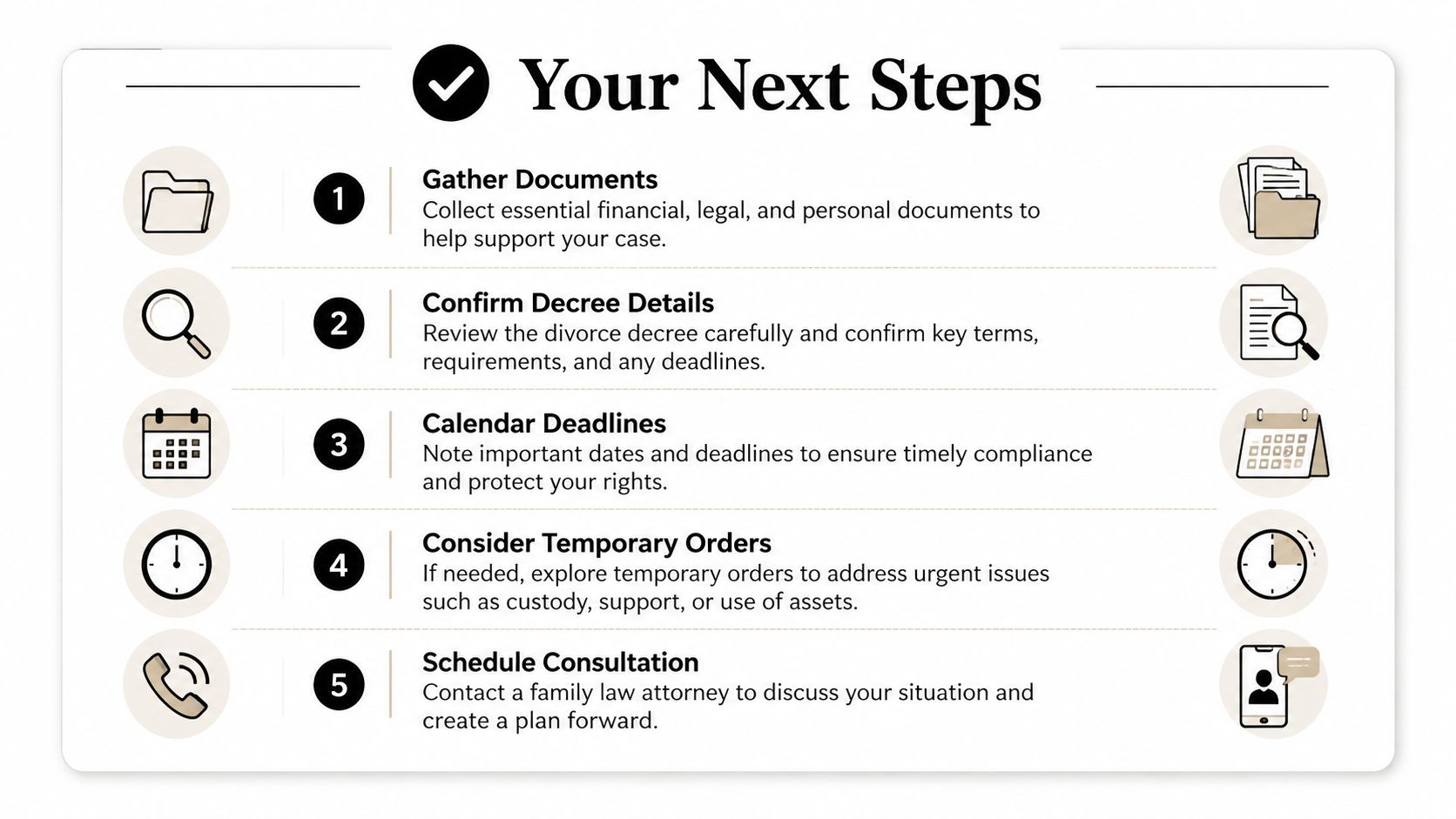
What to do next
- Gather your documents. Pull together the decree, payment records, income proof, and medical or employment records.
- Confirm the decree details. Read the original order carefully and look for any clause that controls modification.
- Calendar deadlines. File dates and answer dates matter immediately.
- Consider temporary orders. If money is tight now, ask whether interim relief makes sense.
- Schedule a local consultation. A Woodlands family law attorney can tell you whether the case is strong enough to file.
Common questions
Do the changes have to be involuntary? Not always, but voluntary changes are harder to sell. A judge wants to see a real, material shift, not a self-inflicted problem.
How long does a modification case usually take? It depends on whether the case is agreed or contested. Contested cases often take longer, especially when discovery is fought over.
Can maintenance be terminated instead of reduced? Yes, if the facts support termination and the statute allows it. The court still needs proof.
Does the court care about what happened before the divorce? No. The change has to happen after the original order or decree, and that's where many weak cases fall apart (Texas Family Code § 8.057).
This is not legal advice. It's a practical overview for people in The Woodlands and Montgomery County who need to know what the court wants before they file.
If you're dealing with a spousal maintenance order in The Woodlands, The Law Office of Bryan Fagan helps clients evaluate whether modification, enforcement, or settlement makes the most sense under Montgomery County court practice. Visit The Law Office of Bryan Fagan to talk through your decree, your evidence, and the next move before you file anything.
