 Skip to content
If you're sorting out a divorce in The Woodlands or somewhere else in Montgomery County, Social Security usually becomes the part nobody planned for. One spouse looks at the house, the 401(k), and the pension, and assumes everything can be split the same way. Then the question comes up about future retirement checks, and the rules suddenly look very different.
That confusion is normal. Social Security is controlled by federal law, while Texas divorce law controls most of the property division in the case. So a Montgomery County judge can divide community property, but the Social Security Administration, not the court, decides who gets benefits on a work record. The result is a case that looks straightforward on paper and much more complicated when you get to retirement planning.
The practical job is simple even if the law is not. You need to know whether you qualify for ex-spouse benefits, compare those benefits to your own record and possible survivor benefits, protect the rest of the marital estate in the decree, and then take the right steps before anyone signs. Texas divorce cases move through a busy system too, with 108,486 new family cases in FY 2023, and divorce made up about 40% of those cases, so this is a real planning issue, not a side topic (Texas judiciary FY 2023 report).
Why Divorce and Social Security in Texas Feels Confusing
Many Woodlands-area clients enter a divorce expecting the decree to divide everything by the same rules. The house gets one split, the retirement account gets another, and Social Security should follow the same pattern. That assumption makes sense until the case reaches the point where Texas community property law ends and federal benefit rules begin.
The key split is federal versus state control
Texas law handles property division, support, and the wording of the decree. Social Security is different because federal law keeps the benefit itself out of the marital property division. A Texas court cannot cut a future Social Security check in half the way it can divide a bank account or a retirement plan. The Social Security Administration makes the eligibility decision later, under its own rules.
That divide changes real outcomes. One spouse may receive a larger share of a pension through the divorce paperwork, while the other spouse may still have a possible divorced-spouse claim through SSA. The court can record the rest of the settlement, but it cannot rewrite federal eligibility rules.
Texas family cases show why people should treat this as a planning issue, not a side issue. In FY 2023, the Texas judiciary reported 60,755 divorce cases without children and 47,731 divorce cases with children, and new divorce filings declined year over year by 5% for divorces without children and 6% for divorces with children (Texas judiciary FY 2023 report). In a system that busy, retirement income should be addressed while the decree is being drafted, not after the paperwork is signed.
Practical rule: If the issue is Social Security, the decree can preserve the marriage record and support the rest of the settlement, but it cannot order SSA to split the benefit itself.
A Montgomery County judge can divide a pension accumulated during marriage. TexasLawHelp explains that retirement benefits usually need a QDRO, while Social Security is handled through SSA eligibility rules instead (TexasLawHelp on dividing retirement benefits). A lawyer who handles family court in the area, such as through Montgomery County Family Courts: A Local Guide, has to keep that difference in view when drafting settlement language.
Who Qualifies for Ex-Spouse Social Security Benefits
A divorce can leave people focused on property division, support, and who keeps the house. Social Security follows a different rulebook. In a Texas case, the divorce court can divide retirement assets and document the marriage, but SSA decides whether a former spouse qualifies for benefits.
The three eligibility requirements
A divorced spouse generally has to meet three basic conditions. The marriage must have lasted at least 10 years. The claimant must be at least 62. The claimant must be currently unmarried (Coker Legal, Brett Pritchard Law).
A short marriage usually ends the inquiry. Remarriage can also interrupt the claim if it happens before the person qualifies under SSA rules. A divorce decree cannot create eligibility that federal law does not allow.
A simple example helps. If your ex-spouse's full retirement benefit would be 2,000 dollars, a qualifying divorced-spouse benefit can reach up to 50% of that amount, or 1,000 dollars, when you claim at full retirement age (Coker Legal). Your claim does not reduce the ex-spouse's payment. SSA treats the two benefits separately.
Why age and timing matter
For people born in 1960 or later, full retirement age is 67 (Coker Legal). That matters because claiming before full retirement age usually lowers the monthly amount. A person who claims at 62 gets earlier access, but the smaller payment can follow that person for life.
A second marriage can change the picture quickly. If someone marries before age 60, the divorced-spouse route usually stops unless later SSA rules restore eligibility.
The last decision still belongs to SSA. A decree can preserve the marriage dates and the retirement facts, but the agency decides whether the benefit is paid.
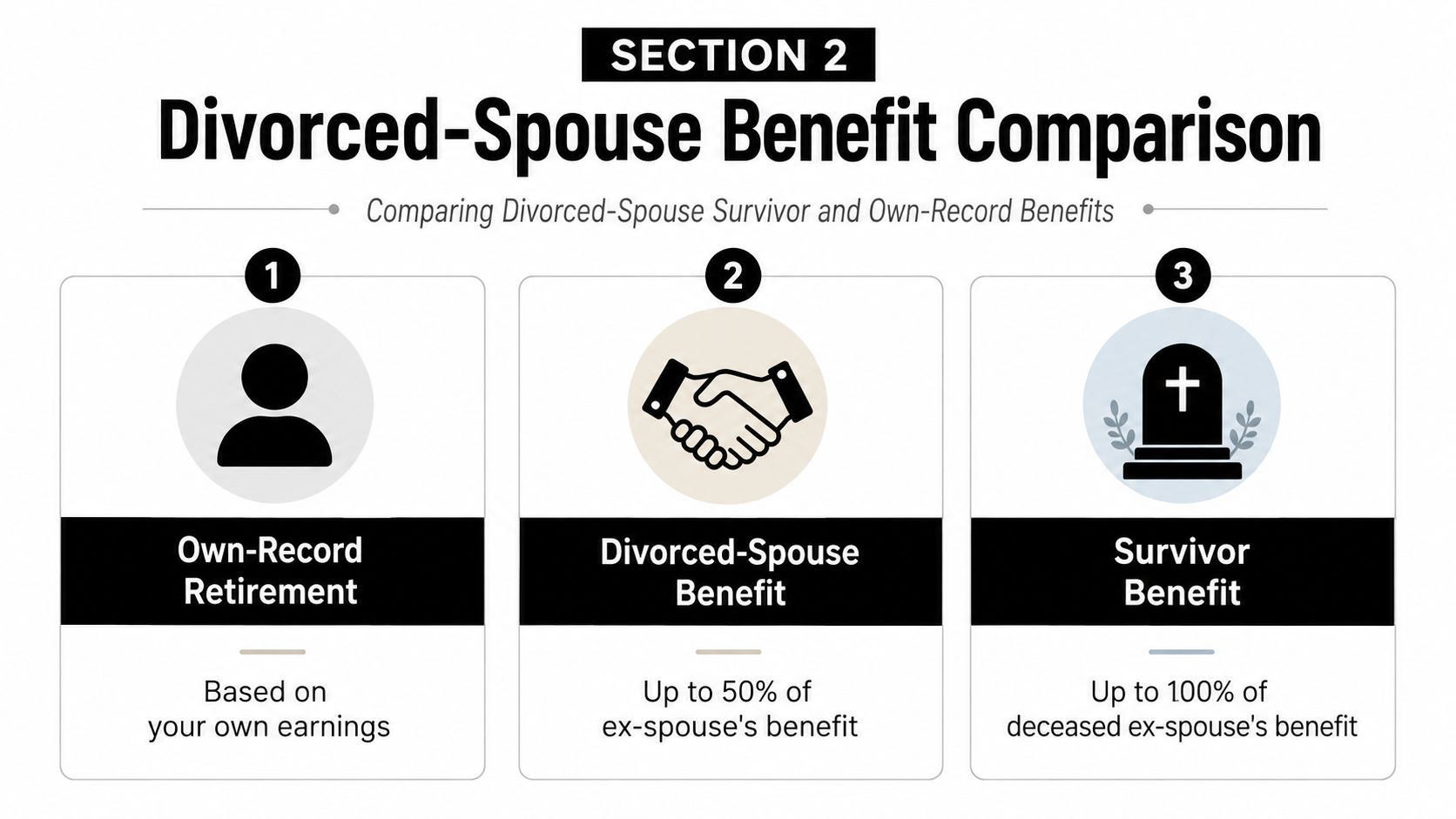
Comparing Divorced-Spouse Survivor and Own-Record Benefits
Planning errors often come from comparing only one benefit number. That leaves out the key choice a divorced Texan has to make. A person may qualify for an own-record retirement benefit, a divorced-spouse benefit, and, after a former spouse dies, a survivor benefit. The better path depends on which option pays more at the age you file, and on what you can preserve in the decree for later.
The three paths are not interchangeable
Your own-record retirement benefit is based on your earnings history. If you built a steady career in healthcare, education, energy, or another field, that check may be the strongest option because it reflects what you earned on your own work record. A divorced-spouse benefit comes from the ex-spouse's record and can go up to 50% of that full retirement benefit if you qualify.
Survivor benefits work differently. If the ex-spouse dies, a qualifying former spouse may receive up to 100% of the deceased ex-spouse's amount under SSA rules. That can be the better number, especially when the former spouse had the stronger earnings history. The practical question is not whether the benefit exists. The question is whether it beats what you can claim on your own record, or whether it makes sense to wait.
The timing rule that often matters most
The biggest mistake is claiming too early without comparing all three paths. A widow or widower who is still below full retirement age may find that survivor benefits work better for the short term. Later, if the person's own record is higher, a different filing strategy may make more sense under SSA rules.
| Benefit path | Basis | Common planning point |
|---|---|---|
| Own-record retirement | Your work history | Best when your earnings record is strong |
| Divorced-spouse benefit | Ex-spouse's work history | Helpful if the ex's record is stronger |
| Survivor benefit | Deceased ex-spouse's record | Can be higher after the ex's death |
That comparison belongs in the planning stage, not after the decree is signed. A person can use an SSA account to test the numbers before filing, which is far easier than trying to sort it out after retirement timing choices are already fixed. If the divorce also involves a retirement account, a guide to dividing a 401(k) in a Woodlands divorce shows the separate court process that applies to community property, unlike Social Security.
How Texas Community Property Splits Retirement but Not Social Security
Texas community property law and federal Social Security law work differently, and that difference matters the moment a couple in The Woodlands has both a retirement account and a future Social Security check in the same divorce file. A Montgomery County judge can divide one. The judge cannot divide the other.
What Texas courts can divide
Texas family law treats retirement and pension benefits earned during marriage as divisible community property. In practice, that means a judge in Montgomery County can divide a 401(k) or pension accumulated during the marriage, usually through a QDRO, which is the order used to tell the plan administrator how to carry out the division.
That is the part that catches people off guard in career-heavy households. A teacher in The Woodlands may see a pension divided because it was earned during marriage, while an energy professional may also have a retirement plan that gets split through the proper court paperwork. If you need a practical example of how that works with a retirement account, the local resource on dividing 401(k) in The Woodlands divorce fits the same general framework.
What Texas courts cannot divide
Social Security is handled under federal law, so it sits outside Texas property division. A Texas court cannot order one spouse to share the benefit the way it can with a pension or bank account, and that rule matters whether the marriage was short or long.
That difference changes settlement talks, retirement expectations, and the language that belongs in the decree. If one spouse assumes Social Security will be split the same way a 401(k) is split, the whole negotiation can start on the wrong foot.
Texas family law still matters because it controls the rest of the property division. The Texas Family Code gives the court authority over the marital estate, and the decree has to reflect the retirement pieces accurately. It just cannot force SSA to pay a future benefit the way a Texas court can order payment of a divided retirement asset. If safety issues are part of the case, a separate local tool like Protective Orders in The Woodlands may matter, but that is a different issue from Social Security.
Bottom line: A QDRO belongs in the paperwork for the retirement plan. Social Security belongs in your planning, not in the property division clause.
That is why divorce and Social Security planning in Texas has to be handled together. The decree can protect the marital estate, but SSA controls the federal benefit.
Drafting the Decree to Protect Future Social Security Options
A good decree doesn't try to order Social Security the way it orders other assets. It does the opposite. It leaves room for the SSA rules to work while making sure the rest of the settlement is clean, enforceable, and easy to administer. That's especially important when the case includes both property division and support issues.
Clauses that belong on the lawyer's checklist
The first item is precise retirement language. If there is a private pension or 401(k), the decree should clearly identify the account and signal that a separate QDRO will divide it. That protects the community property portion and keeps the retirement administrator from guessing later.
The second item is timing language if the spouses want to preserve the possibility of a stronger future divorced-spouse benefit. That may include offset language in the settlement discussion, especially if one spouse agrees to claim later or coordinate income in a way that improves the long-term retirement picture. The decree should be careful not to promise what SSA controls, but it can record the parties' agreement about how they will handle the rest of the financial picture.
The third item is support language. Texas spousal maintenance is handled under the Texas Family Code, and the local spousal-support discussion is one reason people confuse support with retirement rights. A useful reference point is the local page on spousal maintenance in The Woodlands, TX, because support and Social Security are often discussed in the same meeting even though they are not the same thing.
Child support, federal debts, and survivor planning
Social Security is generally not treated like ordinary wages for child support collection, though certain federal debts can create different consequences. That's another reason the decree should be drafted with care if support obligations are part of the family budget. The point is to avoid assumptions that a benefit stream will be garnished or protected in every situation.
Survivor planning also deserves attention. The Texas Estates Code matters when a former spouse dies because beneficiary designations, wills, and trust language can affect the rest of the estate plan even though Social Security itself follows federal rules. A divorce may change some estate documents automatically, but not every beneficiary designation updates itself.
If you want help getting the decree language right, a local Divorce Lawyer in The Woodlands, TX can coordinate the property division, support provisions, and retirement paperwork in the same file. That's the practical way to avoid having one sentence in the decree create a problem later.
A Real Woodlands Scenario Walkthrough
A couple in Panther Creek divorces after 22 years of marriage. She works in healthcare, he works in energy, and both are in their late fifties when the case starts. They own a home, each has retirement savings, and both assume their future Social Security is just another asset to split.
How the numbers and rules play out
The marriage length clears the 10-year federal threshold for divorced-spouse benefits. That does not mean either spouse receives benefits automatically, but it does keep the SSA eligibility question open. If one spouse claims at 62, the benefit is reduced from the full-retirement-age amount, so the timing choice matters more than either person expected.
Their retirement account division is separate. The healthcare pension is handled through the decree and the QDRO process, while his future Social Security remains outside the property split because federal law keeps it out of marital division. As discussed earlier, that can feel uneven to the spouse who receives less of the retirement account, but Texas courts still have to work within that federal boundary.
The most useful planning tool for both of them is the SSA's my Social Security account. Each spouse can check a personal earnings record, compare projected benefits, and decide whether preserving a divorced-spouse claim makes sense before the decree is signed. That is a practical decision point, not an abstract retirement exercise.
If the decree needs to preserve room for future retirement choices, that work belongs in the drafting stage. A lawyer can use the divorce paperwork itself to keep property issues, support terms, and retirement planning aligned, instead of leaving the couple to sort out a mismatch later. For that reason, many people ask a Montgomery County divorce attorney near The Woodlands to review the language before anything becomes final.
With divorce filings staying a regular part of Montgomery County practice, this kind of retirement planning comes up often. A case like this is exactly why the decree needs careful drafting before anyone signs.
What to Do Next for The Woodlands and Montgomery County Residents
A divorce decree can settle property division and support, but it does not control Social Security benefits. Those benefits come from the federal record at the Social Security Administration, so the first step is to separate what the Texas court can divide from what it cannot.
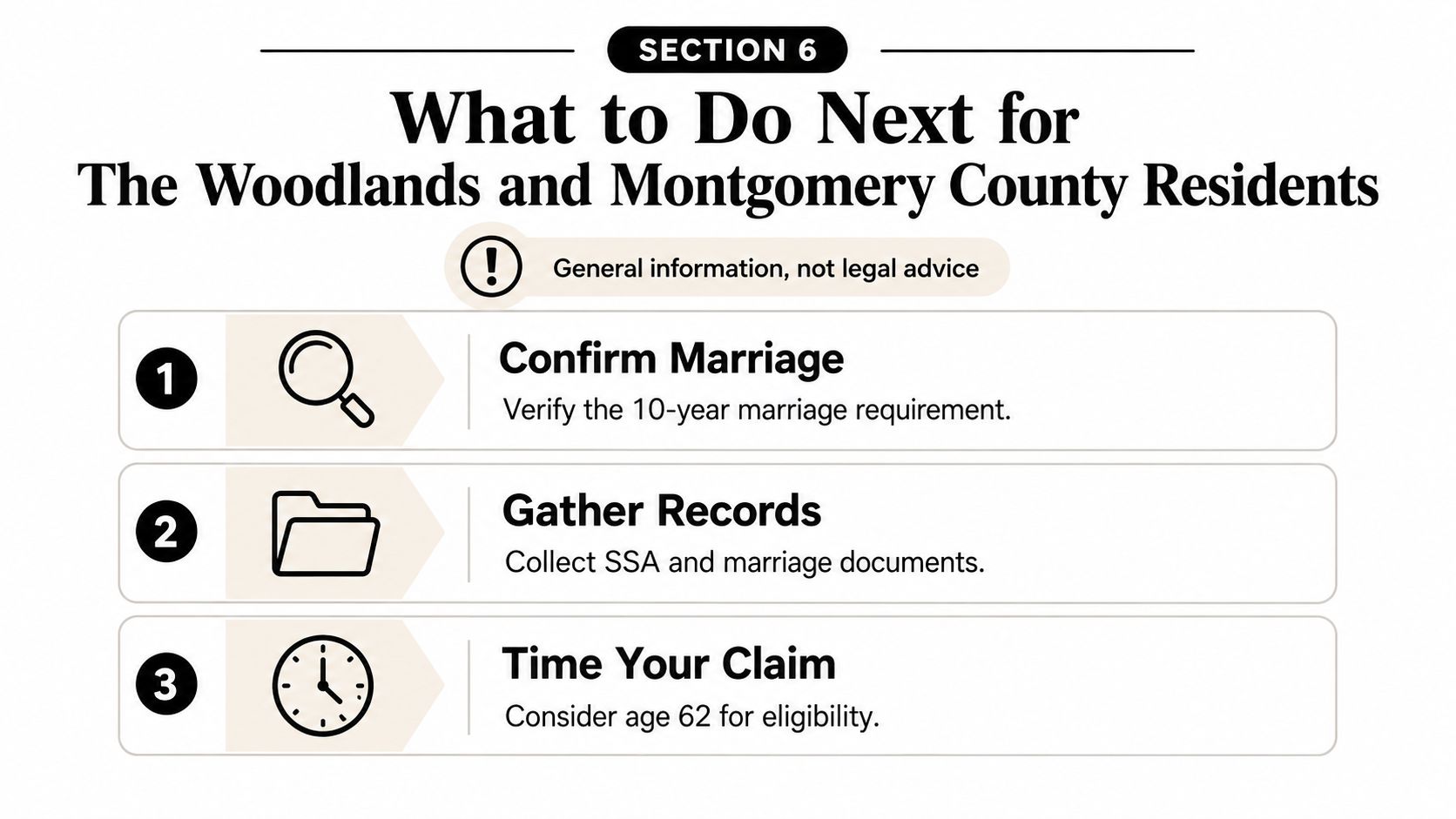
Action step: Spend the next two weeks gathering the records that actually affect your options.
- Confirm the marriage length. If you want divorced-spouse benefits to stay on the table, the marriage must have lasted at least 10 years.
- Set up your my Social Security account. Review your earnings record and compare the benefit paths that may be available before you make a claiming choice.
- Gather decree and retirement paperwork. Keep the final decree, marriage certificate, and any QDRO documents for private retirement accounts together in one place.
- Ask about offset language. If the timing of retirement matters to you, have the drafting lawyer explain whether the decree should leave room for later SSA choices.
- Review survivor-benefit wording. If estate planning matters, make sure the decree and related documents do not leave avoidable gaps.
A practical review now can save a bad surprise later. If you live in The Woodlands, Conroe, Oak Ridge North, Shenandoah, or another Montgomery County community, the next move is to have the decree language checked before anyone signs. Visit our page on finding a divorce attorney near The Woodlands, Texas to schedule a consultation and get help tailoring your decree, retirement orders, and Social Security planning to your situation. If you want to speak with a local firm, contact The Law Office of Bryan Fagan for a consultation.
