 Skip to content
Your ex said they would refinance the house within the deadline in the decree. They didn't. Or maybe they were supposed to reimburse uninsured medical costs, transfer retirement funds, keep the children on health insurance, or follow the possession schedule, and now they're acting like the decree was just part of the divorce paperwork.
It wasn't.
For families in The Woodlands, Conroe, Magnolia, Montgomery, Willis, and nearby communities, the enforcement of divorce decree Montgomery County cases usually start with the same problem. One side assumes the case is over, so the rules no longer matter. The court sees it differently. A final decree is a court order, and when someone ignores it, there are legal ways to force compliance.
The hard part is that enforcement is rarely self-executing. The judge won't step in until someone files the right request, in the right court, with the right proof. That is where many people lose time. They know their ex violated the order, but they don't yet know which violations are enforceable, what remedy fits the problem, or how Montgomery County's filing system and courtroom process work.
This guide stays focused on Montgomery County, Texas. Not Ohio. Not Pennsylvania. The local courts, the state statutes, and the filing rules matter.
Your Divorce Decree Is a Court Order Not a Suggestion
A divorce decree settles more than the end of a marriage. It sets rules people must follow after the case closes. Those rules often cover property transfers, mortgage obligations, child support, spousal maintenance, medical expense reimbursements, possession schedules, and insurance coverage.
When one person stops following those terms, the other person usually feels two things at once. Anger, because the order is being ignored. Uncertainty, because they don't know whether the court will do anything about it.
The answer is yes, if the order is specific enough and you follow the enforcement process correctly.
In Montgomery County, judges don't treat a decree as a loose agreement. They treat it as a binding order signed by a court. If your former spouse was ordered to sign a deed, turn over a vehicle, pay support, or comply with a parenting schedule, the court can hear an enforcement case and decide what consequences should follow.
A lot of post-divorce conflict isn't about what the decree says. It's about one side betting the other won't spend the time or money to enforce it.
That bet often fails when the moving party comes to court organized.
What usually does not work is waiting, arguing by text, or trying to renegotiate a signed order through informal side deals. If the decree says the home must be listed for sale, months of text messages about "next week" don't replace the written order. If it requires payment by a certain date, excuses don't amend the judgment.
What local clients usually need to hear first
- You are not overreacting: If the decree was violated, this is a court matter.
- Specific language matters: Broad complaints are weak. Exact decree language is strong.
- Delay can hurt you: Some enforcement claims have deadlines, especially property-related claims.
- Procedure matters almost as much as proof: Strong facts can still get delayed if the filing or service is handled poorly.
That practical mix of urgency and precision is what drives a successful enforcement case in Montgomery County family court.
Identifying Enforceable Violations in Your Decree
Before filing anything, read the decree like a judge would. Not like a frustrated ex-spouse. Enforcement works best when the order is clear, specific, and measurable.
A court can enforce what it can identify. "Be reasonable about the kids" is not as enforceable as a possession schedule with dates and exchange times. "Pay your share of expenses" is weaker than a decree that says who pays, how much, and by when.
Property division violations
Property enforcement often comes up after the dust of the divorce settles. One spouse still has control of an asset, title document, account, or house, and then refuses to complete the final transfer.
Common examples include:
- Failure to sign closing documents: The decree says the marital home must be sold, but one spouse won't cooperate.
- Failure to transfer title: A car, boat, or other asset remains in the wrong name.
- Failure to turn over awarded property: Personal property, account funds, or business records aren't delivered.
- Failure to refinance debt: One spouse was ordered to remove the other from a mortgage or loan and didn't do it.
Under Texas Family Code Chapter 9, property division enforcement must be pursued within two years of the final decree being signed, and the same source notes that an estimated 15-20% of self-represented people in Texas suburban counties miss that deadline. That is one reason delay is so dangerous in property cases.
Practical rule: If the violation involves property, calendar the decree date first. Then talk about strategy.
In high-conflict divorces, digital income and hidden platforms can complicate property tracing. If your divorce involved subscription income, creator accounts, or undisclosed online earnings, a resource on handling Onlyfans in divorce can help you understand why post-decree enforcement sometimes turns on digital records, not just bank statements.
Support-related violations
Support issues are often the most urgent because the missed payment affects daily life. These cases can involve:
| Violation | Typical proof | Common issue |
|---|---|---|
| Child support not paid | Payment ledger, bank records, decree or support order | Arrearage grows while the other side stalls |
| Spousal maintenance not paid | Decree language, due dates, payment history | The paying spouse claims a side agreement changed the deal |
| Medical support or reimbursement not paid | Bills, proof of payment, written notice sent to other side | Disputes over notice or deadline compliance |
Support enforcement tends to be cleaner when your records are organized. Dates matter. Amounts matter. Proof that you gave notice matters.
If your problem is really about possession or conservatorship violations rather than unpaid money, a separate guide on enforcing a custody order in The Woodlands may fit your situation more closely.
Possession and access violations
A decree can also be enforced when a parent denies court-ordered possession or access. These cases often produce strong emotions and messy evidence. The court still wants specifics.
Use a dated log. Note the exchange time, location, what the order required, what occurred, and any communication tied to the denial. Avoid editorial comments. Judges usually trust timelines more than conclusions.
What is often not enforceable as written
Some complaints are real but not suited for enforcement. A few examples:
- Vague decree language: If the order isn't specific, the court may say it can't enforce that exact provision.
- A need for changed terms: If the problem is that the current arrangement no longer works, you may need a modification, not enforcement.
- Informal side deals: Text-message agreements after divorce don't automatically replace the decree.
That distinction matters. Enforcement asks the court to make someone follow an existing order. Modification asks the court to change the order because circumstances changed.
Your Legal Toolkit Remedies for Non-Compliance
Once you've identified a real violation, the next question is tactical. What should you ask the court to do about it?
Different remedies solve different problems. Some are designed to force action. Others punish disobedience. Some focus on collecting money. Others are aimed at property or custody compliance.
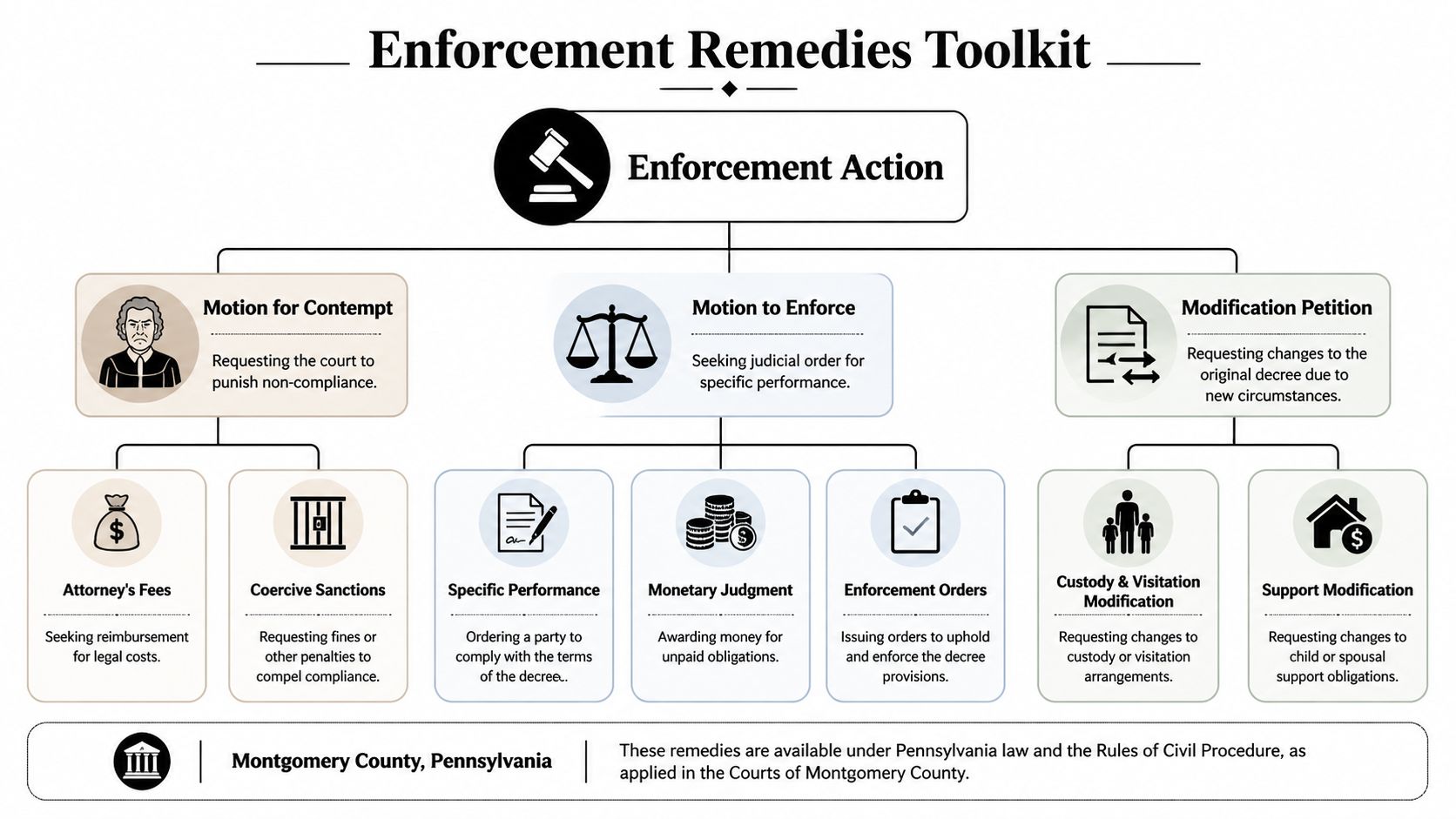
Motion to enforce
A motion to enforce is the standard starting point. It tells the court what order exists, how the other party violated it, and what relief you want.
This remedy works well when you need the judge to:
- order payment of a specific obligation
- confirm the amount owed
- compel transfer or delivery of property
- clarify steps needed to complete what the decree already required
A motion to enforce is often the right tool when the problem is practical nonperformance. The house wasn't listed. The deed wasn't signed. Reimbursements weren't paid.
Motion for contempt
Contempt is more serious. It asks the court to punish willful disobedience of a prior court order.
In Texas, if a judge finds an ex-spouse in contempt for failing to pay child support, the court can order jail time for up to six months for each violation, and statewide post-judgment family enforcement actions make up nearly 25% of such family filings according to the Texas Office of Court Administration annual statistical reports. That tells you two things. These cases are common, and judges are used to hearing them.
Contempt is powerful, but it isn't always the best first move. If the order is vague, the contempt request may fail even if the other side acted badly. Courts require a high level of specificity before punishing someone for violating an order.
For a deeper look at the contempt side of these cases, see this guide on contempt of court after divorce in The Woodlands.
Contempt gets attention fast, but only when the underlying order is precise and the proof is clean.
Wage withholding and money-collection tools
For support obligations, wage withholding is often more efficient than repeated arguments over missed payments. If the issue is recurring nonpayment, automatic withholding can turn a chronic dispute into an administrative process.
Other money-focused remedies may include:
- Judgment for unpaid sums: Useful when the amount owed can be calculated from the decree and records.
- Liens tied to unpaid obligations: Sometimes appropriate when property is involved.
- Attorney's fee requests: Especially important when the violation forced the other side to return to court.
Property-specific enforcement options
Property cases often need a more surgical approach than support cases. The remedy depends on what the person failed to do.
| Problem | Better remedy | Why |
|---|---|---|
| Ex won't sign deed or closing papers | Motion to enforce with request for specific performance | The court focuses on finishing the transfer |
| Ex kept awarded property | Enforcement plus turnover-style relief where appropriate | The goal is possession, not just punishment |
| Ex ignored debt-refinance obligation | Enforcement with evidence of decree terms and lender status | The court looks at what was ordered and what remains undone |
In some cases, asking only for contempt is a mistake. If what you really need is a signature, title transfer, or sale process completed, the filing should be drafted around that outcome.
When modification is the better path
A surprising number of people ask for enforcement when the actual issue is that life changed after the divorce. If income dropped, schedules shifted, or a child now has different needs, the decree may need to be modified instead of enforced.
That is where legal judgment matters. Filing the wrong kind of case can waste time, raise costs, and inflame conflict.
Some people hire private counsel for this analysis. Others start with limited-scope advice. Some turn to firms that regularly handle Montgomery County family enforcement work, including The Law Office of Bryan Fagan, for property division and court-order enforcement matters in this area. The point isn't brand loyalty. The point is making sure the remedy matches the violation.
Preparing Your Case and Filing in Montgomery County
Strong enforcement cases are built backward. Start with what you must prove, then gather only the documents that prove it.
Don't walk into this process with a phone full of screenshots and no structure. Judges and clerks don't sort your evidence for you.

Build an evidence file that actually helps
For most enforcement of divorce decree Montgomery County cases, the basic evidence file should include:
- The signed final decree: Not your memory of it. The actual order.
- A violation timeline: Dates, obligations, missed deadlines, and what happened instead.
- Payment proof: Bank statements, canceled checks, payment histories, invoices, or reimbursement records.
- Communication records: Texts, emails, and messages that show notice, refusal, or delay.
- Property documents: Deeds, titles, refinance applications, closing correspondence, account statements, or transfer instructions.
Organize these by issue, not by document type. If the case involves missed medical reimbursements and refusal to sell a property, create one packet for each. Mixing everything together is a common reason good facts get presented badly.
Drafting and e-filing in Montgomery County
All civil filings in Montgomery County, including divorce decree enforcement matters, must go through the Montgomery County District Clerk and the eFileTexas system. That same source notes that filing errors, such as choosing the wrong document type or mishandling the fee, can trigger an automatic rejection, and an initial motion filing fee is typically around $30-$50.
That sounds minor until it costs you hearing time.
Common e-filing mistakes include:
- Wrong case number: The enforcement must be filed in the correct underlying case.
- Wrong filing code: Clerks may reject filings that are miscoded.
- Missing attachments: The decree or required exhibits aren't included.
- Fee problems: The filing won't move forward if payment isn't handled correctly.
- Incomplete service information: The case stalls because the other side can't be properly served.
If your dispute centers on unpaid support, this guide on enforcing child support in Montgomery County may help you narrow the evidence and remedy before filing.
Filing is not just uploading a PDF. It is choosing the right pleading, in the right case, with the right requested relief.
Service and notice are where many cases bog down
After filing, the other party must be served or otherwise given proper legal notice in a way the rules allow. This step matters more than many self-represented litigants expect.
A party can have terrible facts and still delay the case by objecting to bad service. That means a clean filing can still turn into wasted weeks if service isn't handled correctly.
Use a simple pre-filing checklist:
- Match each violation to the exact decree paragraph
- List every missed date in order
- Attach only exhibits that prove those points
- Confirm the requested relief fits the violation
- Verify filing code, fee, and service details before submission
That discipline saves time in Montgomery County court.
What to Expect in a Montgomery County Family Court
Most clients feel better once they know what the court process looks like. Enforcement hearings are formal, but they are usually more focused than people expect. The judge is trying to answer a short list of questions. What did the decree require. What did the other party do or fail to do. Was the order specific enough to enforce. What remedy fits.

From service to hearing day
After filing and service, the case gets set for hearing according to the court's procedures. In Montgomery County, that usually means waiting for the court's scheduling process, preparing exhibits, and making sure witnesses are available if needed.
On hearing day, expect the judge to care less about the divorce story and more about the wording of the decree. A party who spends ten minutes describing how selfish the other side has always been usually loses the court's attention. A party who identifies paragraph 14.3, the due date, the missing payment, and the bank record gets heard.
Many Montgomery County family matters are heard in district courts that regularly handle divorce and post-decree disputes. Local practice, courtroom expectations, and how a judge wants exhibits organized all matter.
Defenses you may hear from the other side
The other party usually won't walk into court and say, "Yes, I ignored the decree." They will frame the issue differently.
Common defenses include:
- Inability to pay: Often raised in support and reimbursement cases.
- Lack of clarity in the decree: Common in property disputes and vague parenting terms.
- Compliance already happened: The other side claims payment or transfer was made.
- Waiver or side agreement: They argue you agreed to something different after divorce.
- No willful violation: Especially important in contempt proceedings.
Some of those defenses have real force. Some don't. The result often depends on documents created before the hearing, not testimony improvised at the podium.
Attorney's fees can change the leverage
Under the Texas Family Code, if the court finds a party failed to comply with the decree, it shall order that party to pay the other side's reasonable attorney's fees and court costs. That makes enforcement riskier for the person ignoring the order and often increases settlement pressure before the hearing.
This is one reason informal stalling can backfire. A spouse who could have fixed the issue early may end up paying not only the underlying obligation, but also the legal cost of forcing compliance.
If you can prove a clear violation, fee exposure often becomes the conversation that finally changes the other side's position.
How to present yourself well in court
This sounds basic, but it matters:
| Better approach | Poor approach |
|---|---|
| Bring a marked copy of the decree | Assume the court will find the right paragraph for you |
| Use a dated exhibit list | Hand the judge loose papers |
| Answer the question asked | Add speeches and side complaints |
| Focus on the remedy you need | Focus only on anger |
Judges in Montgomery County see conflict every day. They usually respond best to clarity, restraint, and a tight connection between the decree and the requested relief.
A Real-World Scenario and Your Next Steps Checklist
Sarah lives in The Woodlands. Her decree required her ex-husband to reimburse part of their child's uninsured medical expenses after she sent proof of payment. It also required both parties to cooperate in selling a vacation property awarded for sale in the divorce.
At first, she tried to handle it informally. She sent receipts. She followed up by email. She asked him to sign listing paperwork. He replied just enough to drag things out, but not enough to comply.
What changed the case was organization.
Sarah stopped arguing and started building proof. She pulled the decree, highlighted the reimbursement language, gathered the medical bills, proof of payment, and the emails showing notice. For the property issue, she collected the listing documents, messages showing refusal to sign, and the deadline language from the decree.
Her enforcement filing didn't accuse him of being impossible. It identified the exact decree provisions, the dates of noncompliance, and the relief requested. At hearing, the court had a straightforward record. Here is the order. Here is the missed obligation. Here is the evidence.
That is what makes these cases winnable.
What to do next
If your ex isn't following the decree, use this checklist:
- Read the decree line by line: Mark the exact paragraphs that were violated.
- Separate emotion from proof: Build a timeline with dates, amounts, missed exchanges, or unsigned transfer documents.
- Save supporting records: Keep invoices, bank records, texts, emails, screenshots, deeds, title papers, and notices.
- Check whether the issue is enforcement or modification: If the order is being ignored, that is one path. If circumstances changed, that may be another.
- Move quickly on property issues: Delay is especially risky when the violation involves division of property.
- File in the correct Montgomery County case: Post-decree relief has to be tied to the right underlying divorce file.
- Handle service correctly: A strong claim can still get delayed by bad notice.
- Prepare for settlement and hearing at the same time: Some cases resolve after the motion is filed. Others need a full hearing.
- Get legal advice if the decree is vague or the asset is complex: Business interests, homes, retirement funds, and repeated custody violations usually justify customized strategy.
A practical mindset helps here. The goal isn't to "win the breakup." The goal is to force compliance with a signed court order and protect your finances, parenting rights, or property.
Frequently Asked Questions About Decree Enforcement
How long does an enforcement case take in Montgomery County
Many straightforward enforcement cases in Montgomery County resolve in 3-6 months, while highly contested matters, especially those involving business assets common in places like The Woodlands, can take a year or more. Judges also frequently send family law disputes to mediation, and Texas court activity statistics report over 60% success in resolving Texas family law disputes without trial.
That means speed depends on the issue, the court's docket, service, and whether the other side decides to fight every point.
Can I really get my attorney's fees paid for
Yes, fee recovery can be available in enforcement matters when the court finds noncompliance. Whether you recover all requested fees depends on the facts, the pleading, and the proof presented. Fee exposure is one reason many enforcement cases settle after filing but before a final hearing.
What if my ex-spouse lives in another state now
Interstate enforcement is still possible in many situations, but procedure becomes more important. Service, jurisdiction, and the type of order being enforced all matter. If you are dealing with foreign-language documents, overseas records, or a decree that needs to be used across borders, obtaining a certified legal divorce document translation may be part of getting the paperwork accepted where it needs to go.
Do I need a lawyer for enforcement of divorce decree Montgomery County cases
Not every case requires full representation, but many enforcement matters become technical fast. That is especially true when the decree language is imperfect, the other side raises defenses, or the issue involves real estate, retirement assets, business interests, or repeated custody problems.
Is this article legal advice
No. This article is for general informational purposes only. It is not legal advice, does not create an attorney-client relationship, and should not replace advice based on your specific decree, court file, and facts.
Enforcement can feel personal because it usually starts with broken trust. The court, however, looks for something more concrete. A written order, a clear violation, and proof. If you're overwhelmed, that is normal. It also means this is the right time to get focused help.
If you're dealing with a former spouse who won't follow a court order in The Woodlands or anywhere in Montgomery County, a consultation can help you identify the exact violation, the right remedy, and the fastest practical path forward. You can contact The Law Office of Bryan Fagan to discuss your decree, your evidence, and what enforcement options may fit your case.
