 Skip to content
Your divorce decree may be final, but life in The Woodlands rarely stays still.
A parent in Alden Bridge loses a longtime job in the energy industry. A child in Panther Creek starts needing ongoing medical care. An ex-spouse takes a new position closer to Houston and suddenly the old possession schedule no longer fits real life. Those are the moments when people start searching for modification of divorce decree the woodlands and trying to figure out what Texas law permits.
The short answer is yes, some parts of a divorce decree can be changed. Some parts can't. The hard part is knowing the difference, filing in the right court, and showing a Montgomery County judge enough credible evidence to justify the change.
Life After Divorce Changes Can You Modify Your Decree in The Woodlands
A few years after divorce, life in The Woodlands often looks nothing like it did on the day the decree was signed. A parent changes jobs, a child develops new medical or school needs, or the week-on, week-off routine that once worked starts breaking down. That is usually when people realize a final decree is not always the final word on child-related terms.
Texas law does allow modification of certain parts of a divorce decree. For child custody, visitation, and child support, the court generally requires proof of a material and substantial change in circumstances since the last order. Texas Family Code Section 156.401 sets that standard, as reflected in the Texas Legislature's text of the statute. In real terms, a Montgomery County judge wants specific facts, not a general sense that the current arrangement has become frustrating.
Local procedure matters as much as the legal standard. In Montgomery County, modification cases are usually decided by the court that signed the current order, and judges expect the pleadings and requested relief to match the facts closely. In courts such as the 410th District Court, broad complaints about co-parenting problems rarely get much traction unless they are tied to records, dates, school issues, medical evidence, pay information, or a clear change in a parent's circumstances.
Some parts of a decree can be changed. Some usually cannot.
Child custody, possession schedules, and child support are the most common targets for modification. Spousal maintenance may also be modified in limited situations, depending on the terms of the order and the current facts. Property division is different. Once the divorce is final, the division of assets and debts is generally meant to stay final, absent a separate and valid basis such as a timely appeal or a true post-judgment issue the court can still address.
That distinction causes confusion all the time. A parent may say, "I need to modify my decree," when the actual problem is that the other side is ignoring the existing order. In that situation, an enforcement action may be the better tool than a modification. Choosing the wrong one costs time, filing fees, and sometimes credibility with the court.
If you are not sure which path fits your facts, it helps to have the decree reviewed by a lawyer who regularly handles The Woodlands divorce cases. That early review often identifies whether you have a true modification claim, an enforcement problem, or both.
What Qualifies as a Material and Substantial Change
A modification case usually turns on one question. What changed since the last order, and can you prove it in a way a Montgomery County judge will accept?
In practice, broad frustration is not enough. Judges in Conroe, including those handling heavy family dockets, want a specific change tied to dates, records, and a request the court can enforce. If the facts are thin, the case often stalls before it gains momentum.
Child-related changes judges take seriously
For families in The Woodlands, the strongest child-related cases usually involve changes that affect the child's daily routine, safety, health, education, or financial support. Common examples include a parent relocating, a serious shift in work hours, new medical or educational needs, repeated possession problems that affect school attendance, or a parent losing the ability to provide stable care.
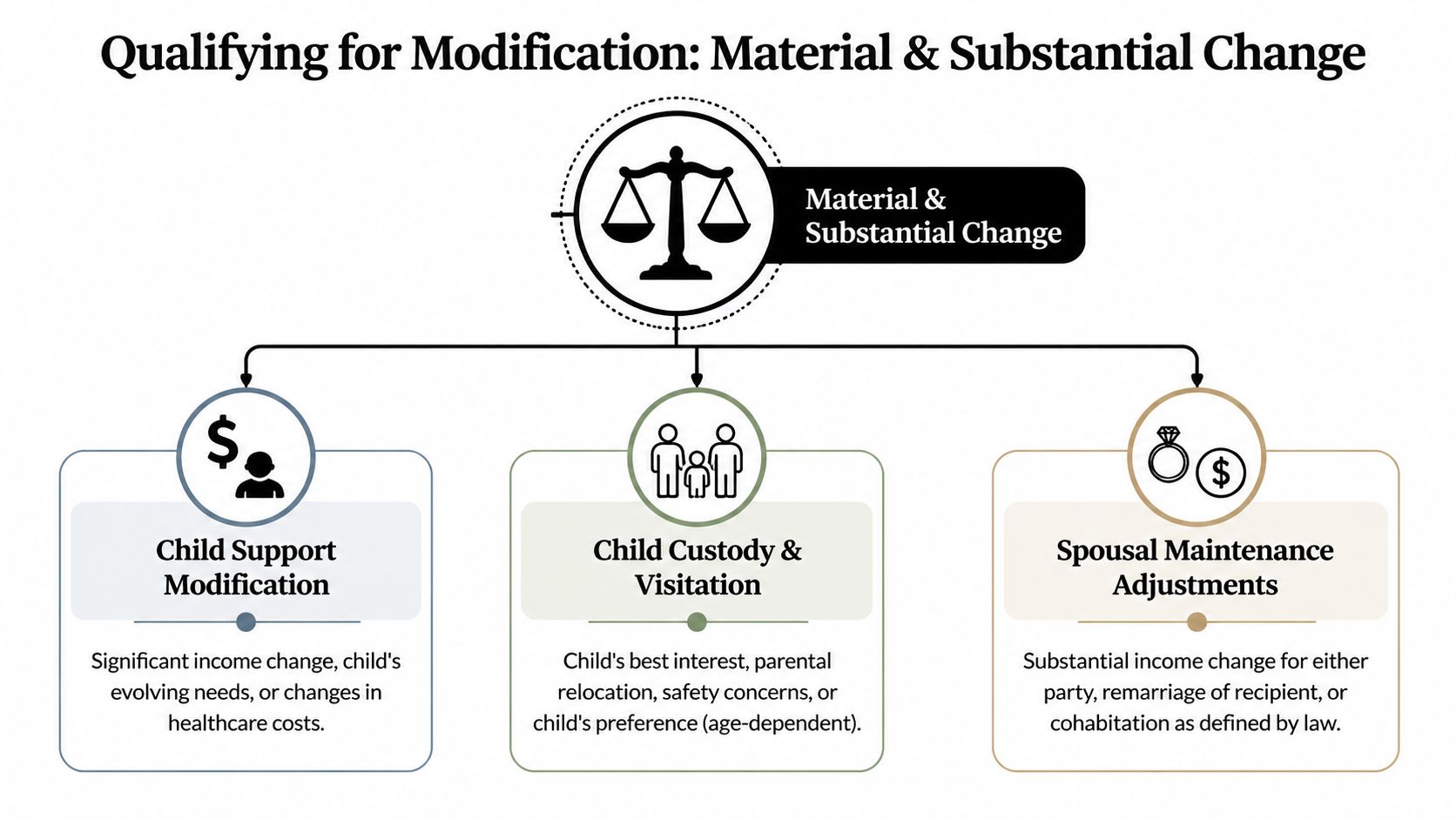
This framework helps sort out what can be changed and what usually cannot:
| Type of Order | Is it Modifiable? | Primary Legal Standard | Common Triggers |
|---|---|---|---|
| Child custody | Yes | Material and substantial change, plus the child's best interest | Relocation, safety concerns, schedule breakdowns, new health or educational needs |
| Visitation | Yes | Material and substantial change, plus the child's best interest | Repeated conflict, school demands, travel burdens, changed work schedules |
| Child support | Yes | Material and substantial change, or the statutory support standard when applicable | Income changes, health insurance changes, child's increased needs |
| Spousal maintenance | Sometimes | Substantial change under applicable maintenance rules | Income changes, changed financial need, remarriage or cohabitation issues as defined by law |
| Property division | Usually no | Final after decree except limited appeal or fraud-based issues | Rare post-judgment challenges tied to legal error or fraud |
The distinctions in the table are important because a decree is not reopened from top to bottom just because one part of life changed. The court looks at the exact provision you want changed and applies the standard for that provision only.
Child support changes need proof, not assumptions
Child support cases often start with a simple statement. A parent lost a job, got a raise, changed insurance, or took on care for another child. The legal analysis is rarely that simple.
Texas law allows modification based on a material and substantial change, and in some cases a child support review may also be available if enough time has passed and the guideline amount would differ from the current order. Recent updates to Texas Family Code § 154.066 have also become important in local support cases. Courts can look closely at a parent's recent work history when deciding whether to use actual earnings or to impute income.
That issue comes up often in Montgomery County. A layoff supported by employer records, severance papers, and a serious job search is very different from a parent who leaves a higher-paying position and then asks the court to reduce support. If the judge concludes the parent is voluntarily underemployed, support may be calculated on earning ability instead of current claimed income.
The proof usually matters more than the story. Pay stubs, tax returns, insurance costs, W-2s, medical bills, and daycare records carry weight. General claims that money is tight usually do not.
Custody and visitation changes rise or fall on the child's best interest
For custody and possession, proving a change in circumstances is only the first step. The judge also has to find that the requested change serves the child's best interest.
That is where many cases in The Woodlands weaken. A parent may have a legitimate complaint, but if the requested fix is too broad, too punitive, or poorly supported, the court may deny it or narrow it sharply. In Montgomery County courts, judges often respond better to focused requests that solve a real problem. Examples include adjusting exchange times to fit a school schedule, revising summer periods after a move, or changing decision-making terms when medical issues have become more serious.
The questions are practical:
- How does the change affect the child's day-to-day life?
- Is the problem ongoing rather than temporary?
- Is there a narrower fix than changing primary custody?
- Do school, medical, counseling, or attendance records support the claim?
Parents comparing their facts to a real-world example often start with custody modification options in The Woodlands and then measure that against the language in their current order.
Spousal maintenance can change more easily than property division
Spousal maintenance and property division are treated very differently after divorce. If maintenance was ordered and finances changed substantially, the court may consider modifying that support. Property division is usually final.
That distinction saves clients from filing the wrong case. If the problem is support, gather income and expense records. If the underlying complaint is that the asset split now feels unfair, modification is usually not the answer.
Navigating the Montgomery County Modification Process
A typical call from The Woodlands sounds like this: one parent changed jobs, the school schedule no longer fits the old exchange times, and the current order is turning every week into an argument. At that point, the legal question is not abstract. The question is whether the court can enter a workable new order, and how to get that done in Montgomery County without creating delay you did not need.
If your prior case was filed in Montgomery County, the modification usually stays there unless a transfer is required by law. For families in The Woodlands, that often means filing in Conroe and dealing with the local district court that signed the existing order. The statewide rules matter, but local practice matters too. Judges in this county generally expect the pleadings to be specific, the paperwork to be clean, and the requested relief to match the actual problem.
Filing in the original court
A modification case starts with a new petition under the same cause number family, or at least tied to the same prior order. In custody and visitation disputes, that is often a Petition to Modify the Parent-Child Relationship. The Texas judicial branch explains the basic filing framework for modification cases in its modification case resources for Texas families.
In Montgomery County, a vague petition creates trouble early. A good one identifies the exact order to be changed, states the material facts that changed after that order was signed, and tells the court precisely what new language you want. Judges do not want to guess what problem you are trying to solve.
That level of detail helps for practical reasons:
- It puts the dispute in a manageable box. A request to change Thursday exchanges from 6:00 p.m. to after school is easier to evaluate than a claim that the whole schedule is "not working."
- It keeps your proof focused. If the issue is missed school, bring attendance records. If the issue is income, bring pay records and tax documents.
- It improves the odds of settlement. Specific relief gives both sides something concrete to discuss.
In the 410th District Court and the other Montgomery County family courts, lawyers who file broad, emotional pleadings often end up narrowing the case later anyway. It is better to start narrow if a narrow fix will do the job.
Service, deadlines, and early procedural mistakes
After filing, the other side must be served unless there is a valid waiver. Service problems waste time and money. I see delays from the same issues over and over. An outdated address. A return of service with defects. Pleadings amended after service without making sure the papers match.
Under Texas Rule of Civil Procedure 99, a respondent generally must file an answer by 10:00 a.m. on the Monday next following 20 days after service. That deadline matters, but a missed answer does not mean the judge will sign anything requested without proof. The court still expects admissible evidence, a proper proposed order, and compliance with local procedure.
Paperwork discipline matters here.
A modification case can lose momentum before anyone argues about the child or the money.
Mediation usually decides the outcome
Many Montgomery County modification cases resolve in mediation rather than at trial. Courts across Texas regularly use alternative dispute resolution in family cases, and Texas Family Code Chapter 153 recognizes mediated settlement agreements in suits affecting the parent-child relationship. In practice, mediation works best when each side arrives with organized records and a proposal that a judge could realistically sign.
For The Woodlands parents, that usually means bringing the documents that show daily life, not just frustration:
- Income records if child support or maintenance is at issue
- School, counseling, or medical records if the request affects the child’s routine or care
- A calendar or timeline showing missed visits, late exchanges, or schedule conflicts
- Draft terms that solve the problem without rewriting parts of the decree that still work
Montgomery County judges often respond well to practical fixes. If the problem is transportation, propose a transportation fix. If the problem is a parent’s new work rotation, propose a possession schedule built around that rotation. Requests that look punitive tend to lose force in mediation and in court.
Temporary orders and court intervention before final resolution
Some cases cannot wait for a final hearing. If a child is at risk, if one parent has cut off possession, or if support problems are creating immediate harm, temporary relief may be necessary while the case is pending. In the most serious situations, parents in The Woodlands may need to pursue an emergency custody order in The Woodlands rather than wait for the ordinary modification track to play out.
Temporary orders can shape settlement. They also shape expectations. If a judge grants short-term relief after seeing the early evidence, both sides usually get a clearer picture of where the case is headed.
If the case does not settle, the court sets it for a final hearing or trial. Credibility matters, but credibility alone is not enough. Montgomery County judges compare testimony against records, prior orders, school calendars, medical recommendations, and the practical routine of the child. A parent who is organized and realistic usually presents better than a parent who is angry and overreaching.
What tends to help in Montgomery County courts
Local courts reward preparation and restraint. They also notice when a party is using modification to replay old divorce grievances.
What generally helps:
- Requests tied to a specific problem
- Records that line up with the allegations
- A proposal that preserves stability where possible
- Compliance with the current order until the court changes it
What regularly hurts:
- Asking for a major custody change without current, concrete proof
- Treating informal side agreements as if they changed the decree
- Filing first and gathering evidence later
- Using the case to punish the other parent
The process is formal, but the court is deciding real-life logistics. In Montgomery County, the strongest modification cases are usually the ones that present a limited problem, a documented reason for change, and a workable solution the judge can enforce.
Responding to a Modification and Handling Emergencies
Not everyone is the person filing. Many clients come in because they were just served and don't know whether the request is serious, strategic, or flatly weak.

If you're responding, start with the facts
A good response begins with one question. Has there really been a material and substantial change, or is the other side repackaging an old complaint?
Common defenses include:
- The change is temporary: a short gap in employment or a brief schedule disruption may not justify a permanent court order.
- The request isn't in the child's best interest: even if facts changed, the proposed solution may create more instability than it solves.
- The proof is thin: unsupported accusations rarely carry much weight.
- The case was filed in the wrong place: venue and jurisdiction issues can slow or redirect the case.
Venue matters more than many people realize in modification cases involving relocation. Under Texas Family Code § 155.003 and this Montgomery County venue discussion, a case may be transferred if the child has lived in the new county for six months. That same source states that 15% of modifications involved inter-county moves, and 22% of those were contested on venue grounds, causing delays of 4 to 6 months.
That issue comes up often for Woodlands families because one parent may move toward Harris County while the other stays in Montgomery County. If your ex now lives in Houston, don't assume the filing location is obvious. Check venue early.
A weak modification request sometimes survives longer than it should because the responding party ignored a venue problem or waited too long to raise it.
Emergency cases are different from urgent cases
People use the word "emergency" loosely. Courts don't.
A true emergency usually involves immediate risk to a child's physical safety or emotional well-being. That might justify emergency relief, including temporary restraining orders or emergency custody-related requests. But inconvenience, conflict, or ordinary schedule frustration usually won't.
For a closer look at those urgent situations, families often review emergency custody orders in The Woodlands.
Here is a short video that helps frame the issue:
What judges want to see in an emergency filing
Emergency requests need tight, credible proof. In Montgomery County, that usually means dates, specifics, and documentation, not broad fear.
Useful emergency evidence may include:
- Medical or school records showing immediate harm or serious disruption
- Police or CPS-related records if they exist
- Screenshots or messages that are authenticated and relevant
- Affidavits with clear facts rather than conclusions
If you are defending against an emergency filing, the same rule applies. Judges want specifics. If the allegations are exaggerated, the response should be calm, document-driven, and focused on the child's actual condition and routine.
The practical point is simple. If the situation is dangerous, move fast. If it isn't, don't label it an emergency just to skip the ordinary process. That approach often backfires.
What to Expect for Timelines and Costs in The Woodlands
A Woodlands parent files expecting a quick reset of child support or possession. Then the case sits longer than expected because service takes time, records are incomplete, or the other side turns a narrow issue into a broader fight. That is usually what changes the timeline in Montgomery County, not the caption on the pleading.
The two questions clients ask first are still the right ones. How long will it take, and what will it cost? In practice, both turn on the same factors: whether the case is agreed or contested, how clean the proof is, and how efficiently the issue can be presented to the court.
Timelines depend on the posture of the case
An agreed modification can move relatively fast if the paperwork is accurate, both parties sign promptly, and the proposed order matches what the court expects to see. A contested case usually takes longer because it may involve service, a responsive pleading, financial disclosures, mediation, and one or more hearings before a final ruling.
Montgomery County procedure matters here. Dockets are busy, and each court has its own preferences on settings, form of orders, and how organized the supporting documents need to be. In courts that regularly handle family matters, including the 410th District Court, lawyers who file complete pleadings and usable proposed orders usually save their clients time. Lawyers who file first and sort out the details later often create delay.
Some cases also look simple on the surface and then expand. A request to lower support may trigger disputes about underemployment, bonus income, reimbursement claims, or who has been exercising the schedule. That kind of spillover increases both cost and time.
Costs usually rise because the facts are harder to prove
Attorney's fees are only one part of the bill. Filing fees, service fees, mediation costs, subpoena expenses, record retrieval, and hearing preparation all add up. If the dispute involves self-employment income, a closely held business, or inconsistent financial reporting, the cost can increase because the evidence is harder to build.
Experts are not routine in every modification case, but they can matter in the right one. The Texas Society of CPAs explains the role forensic accountants can play in family law matters involving hidden income, tracing, and financial analysis at this overview of forensic accounting in divorce cases. In a Montgomery County support modification, that type of work is usually worth considering only when the numbers are disputed enough to justify the extra expense.
The trade-off is straightforward. Spending aggressively over a modest schedule adjustment often makes little financial sense. Spending carefully to correct a support order that no longer matches reality can be money well spent.
Local practice affects both budget and pace
Mediation resolves many modification cases in this county, but mediation works best when the file is ready before the session starts. Waiting until the week of mediation to gather pay stubs, school records, or insurance information usually wastes time and fees. Judges also tend to react better to concise, organized proof than to large volumes of texts and screenshots with no clear timeline.
I tell clients the same thing early. Clear records shorten cases. Murky records extend them.
A recent example illustrates the point. A parent from Creekside Park came in after trying to handle a support change informally for months. The income change was real, but the other parent believed it was voluntary and treated the request as a stalling tactic. Instead of rushing into court with a thin file, the parent gathered payroll records, termination paperwork, job-search evidence, and a simple chronology.
That changed the conversation. Mediation focused on provable facts, not old arguments from the divorce, and the case resolved without the cost of preparing for trial.
What to do before you file
If you are considering a modification of divorce decree the woodlands case, start with the documents and the math.
- Read the current order closely: Confirm the exact language that is in force now, including dates, pickup times, support terms, and notice requirements.
- Gather records tied to the change: Pay records, tax returns, school documents, medical records, calendars, and message history are often more useful than general complaints.
- Build a clean timeline: Judges want to know when the change started, whether it has lasted, and how it affects the child or the support calculation.
- Keep following the existing order: The old order remains enforceable until a judge signs a new one.
- Treat informal deals cautiously: Side agreements often fall apart when reimbursement, holidays, or school issues come up later.
- Prepare for mediation early: Know what result you can live with and what issues are worth spending money to fight about.
- Get legal advice before the case spreads: A narrow modification can become more expensive when it is filed without the records needed to prove it.
Your Modification Questions Answered
If my ex and I agree, do we still need a court order
Usually, yes. An agreement helps a lot, but it still needs to be turned into a signed order if you want it to be enforceable. Informal side agreements often create trouble later, especially with school schedules, support, and reimbursement issues.
What if my ex-spouse now lives in another state
That can raise jurisdiction and service issues. The original Texas court may still have authority, or another court may become involved depending on the child's residence and the existing order. This is one of those situations where filing the wrong pleading in the wrong court can waste time quickly.
How do I prove income if the other parent is paid in cash or has irregular earnings
You build the case from surrounding records. Bank deposits, business records, tax returns, spending patterns, employment history, and subpoenaed documents can all matter. The court looks for reliable evidence, not perfect evidence.
Is there a limit on how many times someone can request a modification
There isn't a simple one-line answer. Courts don't appreciate repetitive filings that lack a real legal basis. If the facts haven't changed, repeated modification attempts can look harassing and damage credibility.

Do I have to obey the current order while the modification is pending
Yes, in most situations. Until the court changes the order, the current one remains in effect. Ignoring it can create enforcement problems and hurt your position in the modification case.
Bring your decree, your timeline, and your documents to the first meeting. Those three items usually tell the story faster than a long verbal recap.
This article is for informational purposes only and is not legal advice. Family law outcomes depend on the exact language of your decree, the facts that changed, and the local court handling your case.
If you're dealing with custody, visitation, child support, or spousal maintenance changes in The Woodlands or Montgomery County, a focused consultation can help you sort out whether you have a valid modification claim, a strong defense, or an emergency that needs immediate attention. The The Law Office of Bryan Fagan handles family law matters for Woodlands-area clients and can help you evaluate the next practical step.
