
You're sitting at the kitchen table in Sterling Ridge, looking at a paid-off home, a will that hasn't been updated in years, and a daughter who lives nearby in Magnolia. You want the house to pass to her without sending the family through probate, but you also don't want to give up the ability to sell, refinance, or change your mind later. That's the practical question behind many searches for Lady Bird deed The Woodlands TX.
A Lady Bird deed, formally an enhanced life estate deed, can be useful for some Montgomery County homeowners. It can name the person who receives the property at death while allowing the current owner to keep significant control during life. But the deed has to fit the family's title, marital-property, tax, creditor, and long-term-care circumstances.
Important: This article is educational information, not legal advice. A Texas attorney should review your deed and broader estate plan before you sign or record anything.
A Woodlands Family Starts Asking About Lady Bird Deeds
Jim and Linda have lived in Sterling Ridge for years. Their home is free and clear, and their daughter lives in Magnolia. During an estate-plan review, their financial advisor mentions a Lady Bird deed. The couple's first reaction is relief. Their second reaction is a list of questions.
They want their daughter to receive the home without a Montgomery County probate proceeding. They also want the surviving spouse to remain secure if one of them dies first. A relative entering assisted living near The Woodlands raises another concern, this time involving Medicaid planning and whether the home could later become part of an estate-recovery problem.
Jim asks whether naming his daughter on a deed means she'll own part of the home immediately. Linda wants to know whether she could revoke the arrangement if their plans change. They also wonder whether the deed affects their homestead exemption, conflicts with their will, or creates trouble if they refinance.
Those are the right questions. A Lady Bird deed isn't the same as adding a child to title, and it isn't just a handwritten instruction about who should inherit. The legal effect depends on the language used, the owners listed on the current deed, and the way the instrument is recorded.
What the couple is trying to accomplish
Their goals are common in The Woodlands and throughout Montgomery County:
- Avoiding probate for the home: They want the residence to transfer outside the ordinary probate process.
- Protecting the survivor: Linda wants to know whether she can continue living in, selling, or borrowing against the home if Jim dies first.
- Planning for long-term care: They want advice before a parent needs Medicaid-related planning, rather than waiting until an assisted-living decision becomes urgent.
- Keeping flexibility: They don't want their daughter's future interest to prevent a sale or mortgage during their lifetimes.
The nickname has an unusual history. The first version was drafted in Florida around 1982 by attorney Jerome Ira Solkoff, nearly 10 years after President Lyndon B. Johnson died in 1973. Fictional examples using the names Lady Bird and Lynda helped the nickname stick, even though the deed is legally an enhanced life estate deed, not a special deed created by the Johnson family. The history is described in this legal primer on enhanced life estate deeds.
For Jim and Linda, the name matters less than the design. They need to understand what control they retain, what the deed does not solve, and how a properly prepared instrument reaches the Montgomery County property records.
How an Enhanced Life Estate Deed Actually Works in Texas
A Texas Lady Bird deed starts with three roles. The grantor is the current owner. The remainder beneficiary is the person or people named to receive the property at death. The deed describes the property and reserves an enhanced life estate for the grantor.
In plain English, the owner says, “This property is intended to go to these beneficiaries when I die, but during my lifetime I keep the power to live here, sell it, mortgage it, or revoke this plan.” The Texas State Law Library's explanation of Lady Bird deeds identifies that retained control as the central distinction from a traditional life estate.

The enhanced feature is the control reservation
With a traditional life estate, the life tenant generally cannot sell or mortgage the entire property alone because the remainderman already holds a fixed future interest. A sale or loan may require the other owner's participation. That can create difficulty if the homeowner later needs to move, borrow, or change beneficiaries.
A Lady Bird deed is different because the grantor reserves a power of appointment or comparable control language. The grantor can usually revoke the deed, change the intended recipient, sell the property, or mortgage it without beneficiary consent, provided the deed was drafted correctly and the transaction complies with applicable law.
The transfer is designed to occur at death rather than as a completed present gift. That's why homeowners often use it as a nonprobate transfer tool. The property can pass according to the recorded deed instead of being distributed under the will through probate.
Texas Estates Code Chapter 114 also matters because it doesn't make a Lady Bird deed the only lawful planning method. Section 114.004 says the chapter is nonexclusive and doesn't affect other property-transfer methods allowed under Texas law, as explained in this Texas Estates Code Section 114.004 reference. A Lady Bird deed is one tool, not a universal substitute for a will, trust, marital agreement, or beneficiary planning.
A homeowner seeking Estate Planning Attorney in The Woodlands services may need advice on wills, trusts, and estate plans for The Woodlands families, not just a deed form.
Lady Bird Deed vs Wills, Trusts, and TOD Deeds
The right estate tool depends on what you're transferring and what problems you're trying to solve. A Lady Bird deed can address one residence efficiently, but a will or trust may be better for other assets, family arrangements, or administration needs.
A will directs the distribution of probate assets. If the home is transferred under a will, the property generally becomes part of the probate process. A properly drafted Lady Bird deed is intended to move the home outside probate, but it may produce different tax results for the beneficiary. In particular, a homeowner should ask counsel whether the transfer will preserve the basis adjustment at death that a will-driven inheritance may provide. The answer can affect a later sale and shouldn't be assumed from the deed's nickname.
A revocable living trust can hold multiple assets and coordinate management during incapacity and after death. It may make more sense for a couple with several Texas properties, out-of-state real estate, or a plan requiring detailed trustee instructions. A Lady Bird deed is usually more focused, because it addresses the named real estate rather than becoming the central container for the broader estate.
A practical comparison
Texas homeowners sometimes search for a transfer-on-death deed, or TOD deed, because it sounds similar. Texas law doesn't authorize a standalone transfer-on-death deed for real property in the way some other states do. The deed-based tool most often discussed for this purpose in Texas is the enhanced life estate deed. This Woodlands transfer-on-death deed resource can help explain why homeowners need to distinguish Texas planning from rules in other states.
| Tool | Probate Avoidance | Revocable by Owner | Best Fit in The Woodlands |
|---|---|---|---|
| Lady Bird deed | Intended to transfer the named home outside probate | Yes, if the deed reserves that power | A homeowner seeking lifetime control and a direct plan for one residence |
| Will | Usually no for property titled in the decedent's name | Yes, through a later valid will | A broader plan for probate assets and personal instructions |
| Revocable living trust | Can avoid probate for assets properly transferred to it | Generally yes, under the trust terms | Families coordinating several properties or more detailed administration |
| Community-property agreement | Depends on the agreement and asset structure | Depends on the written agreement | Married couples addressing ownership and survivorship issues |
| Traditional life estate | The future interest is established during life | Usually not without the remainderman's participation | A fixed arrangement where the owner accepts reduced control |
Married homeowners should also consider community-property planning separately. Texas Family Code provisions allow spouses to partition or exchange community property at any time, and property transferred under that agreement becomes the receiving spouse's separate property. Spouses may also agree in writing that some or all community property becomes the surviving spouse's property at death, as discussed in this Texas Lady Bird deed research guide. That mechanism addresses marital-property rights. It doesn't automatically replace a deed-based plan for a Woodlands homestead.
Drafting and Recording a Lady Bird Deed in Montgomery County
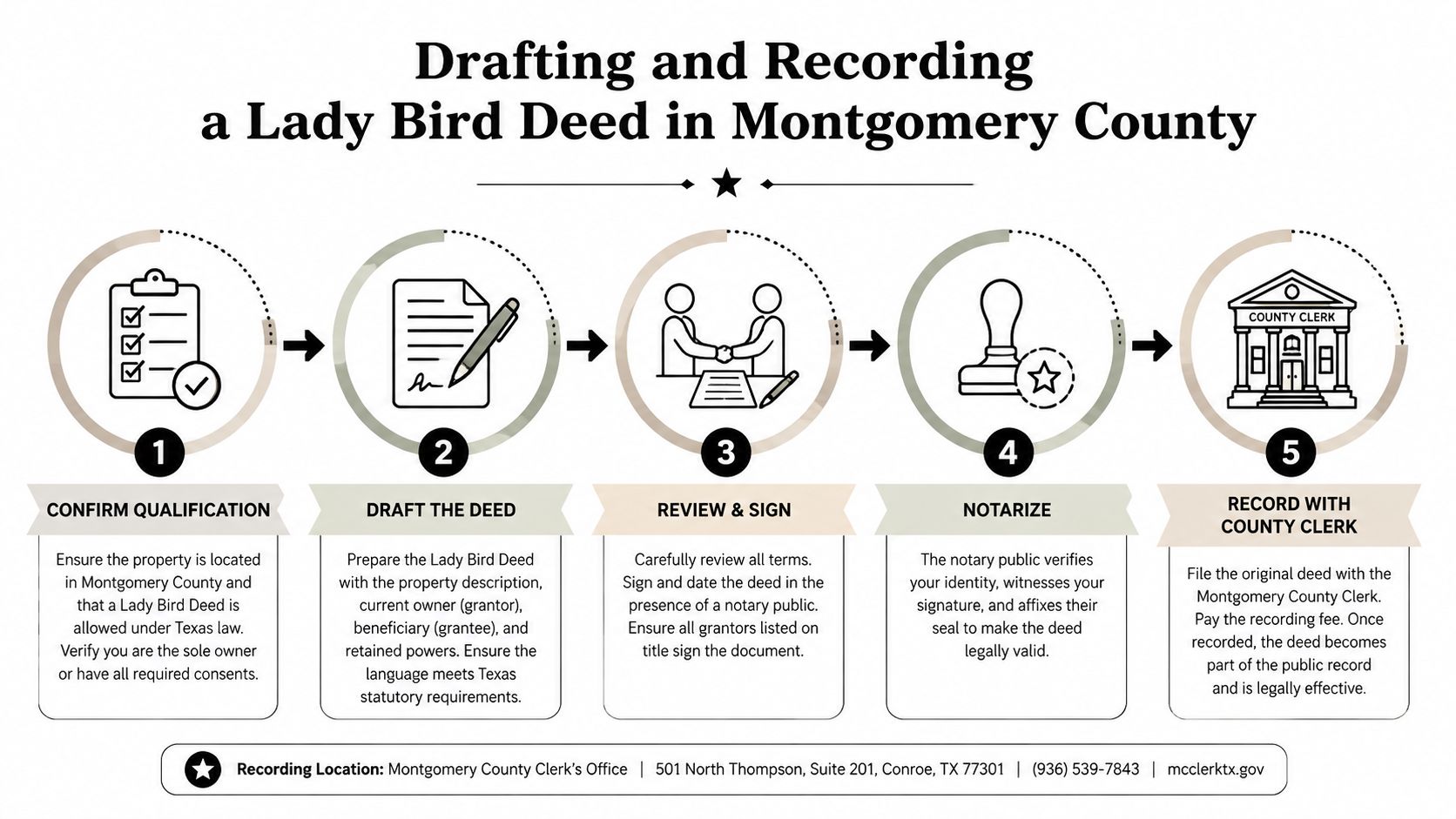
A Lady Bird deed is only useful if the document accurately identifies the owner, property, retained powers, and beneficiaries, then becomes part of the county's real property records. Start with the current deed, not memory or a tax statement. The latest recorded instrument shows how title is vested and supplies the legal description needed for the new document.
Confirm the facts before drafting
Ask these questions first:
- Who owns the property now? Confirm every name on the latest deed of record.
- What is the marital status? Community-property and separate-property issues can change who must sign and how the transfer should be structured.
- Is the home a homestead or primary residence? The deed's effect on homestead rights and tax treatment requires individual review.
- Is there a mortgage? Gather the loan documents and ask whether the lender has notice or consent requirements.
- Who should receive the property? List each beneficiary's full legal name and consider what should happen if a beneficiary dies first.
The drafting attorney should use proper granting and habendum language, reserve the power to sell, mortgage, revoke, or otherwise control the property, and identify the remainder beneficiaries clearly. The grantor must be competent and sign voluntarily. Supporting materials may include the prior deed, mortgage statements, divorce decree, and existing will or trust.
Recording in the county where the home sits
For a home in Panther Creek, Alden Bridge, Sterling Ridge, Creekside, or another Woodlands neighborhood, recording belongs in Montgomery County. The county's South County Annex is in The Woodlands at 1520 Lake Front Circle, The Woodlands, TX 77380. The county clerk's main office is at 210 West Davis, Highway 105, Conroe, TX 77301. Local recording access for southern Montgomery County residents is also described in this Montgomery County deed recording guide.
A homeowner may use the Texas eFile system where eligible or submit the document in person at the Conroe County Clerk's Office or South County Annex. Confirm the current filing-fee schedule and submission requirements before going. After recording, keep the returned deed or certified copy with the property records, estate plan, and other important documents. If you need broader information about the local process, review this Montgomery County probate court process guide.
The same office may appear in unrelated family-law matters. For example, a Child Support Attorney in The Woodlands may handle establishing, modifying, and enforcing child support in Montgomery County. That doesn't change the deed process, but it illustrates why families should keep separate property and family-court documents organized.
Pitfalls That Catch Woodlands Homeowners Off Guard
A Lady Bird deed preserves flexibility, but that flexibility doesn't erase liens, marital-property rights, lender requirements, or tax questions. Homeowners often focus on the promise of avoiding probate and overlook the surrounding documents.
Divorce can change the meaning of the plan
Suppose a homeowner signs a deed naming a spouse or another relative, then divorces before death. The divorce decree may address the home, but the recorded deed may still contain beneficiary language that needs to be changed or revoked. If the former spouse lives outside Texas, the family may face additional title questions about whether the decree addressed the recorded property interest.
The safe approach is to review the deed, divorce decree, and final property division together. Don't assume that a divorce automatically cleans up every recorded instrument.
A mortgage still controls the lender's rights
A Lady Bird deed doesn't eliminate a mortgage. A lender may require notice or consent, and the loan documents may include a due-on-sale clause. Before recording a deed for a home in Alden Bridge or Creekside, the owner should have counsel review the loan terms and determine whether the lender needs to be contacted.
The deed's retained power to mortgage the property is not a promise that a lender must approve every future loan. It's a drafting issue and a lending issue.
Medicaid planning requires careful timing and full disclosure
A Lady Bird deed can be relevant to Medicaid planning because the owner retains control and the future transfer isn't structured like an ordinary completed gift. That doesn't mean the deed guarantees Medicaid eligibility or eliminates every long-term-care issue.
The federal Medicaid look-back period is commonly discussed as 60 months, but the effect of a deed depends on the person's full asset history, the date and terms of the transfer, and current program rules. A recent mortgage payoff, other transfers, or changes in ownership can complicate the analysis. Speak with counsel before recording a deed for a parent who may need Medicaid.
Creditors and tax basis remain separate concerns
The retained power of appointment keeps meaningful control with the grantor. That can also mean the property remains exposed to the grantor's own mortgage obligations, judgment liens, and federal tax liens. A Lady Bird deed isn't a blanket shield against creditors.
The remainder beneficiaries may also face a tax-basis question. If the transfer doesn't place the home in the probate estate, the family should obtain professional advice about whether the beneficiary receives the basis treatment the family expects. A later sale by heirs can produce an unpleasant surprise if everyone assumed the answer without reviewing the facts.
Homestead treatment needs its own review
The deed should be coordinated with the owner's homestead records and marital status. Don't assume that naming a beneficiary automatically doubles or preserves every homestead benefit. The property-tax office, title records, spouse's rights, and deed language must align.
| Pitfall | What Goes Wrong | Local Fix |
|---|---|---|
| Divorce | The recorded beneficiary language may not match the final property division | Review the deed and divorce decree together |
| Mortgage | The lender may raise notice or due-on-sale concerns | Have counsel review the loan documents before recording |
| Medicaid | Transfers and asset history may complicate eligibility or recovery planning | Obtain Medicaid-specific advice before acting |
| Creditor claim | Liens and grantor debts can remain attached to the property | Search title and review creditor exposure |
| Homestead | Deed language may not address all homestead or spouse issues | Coordinate the deed with homestead and marital-property records |
| Tax basis | Beneficiaries may receive different basis treatment than expected | Ask a qualified attorney and tax professional to analyze the transfer |
A Walkthrough Scenario in The Woodlands
A couple in Panther Creek bought their home in 2007 and paid off the mortgage in 2022. They want their adult daughter to receive the property without forcing her through probate, but they also want complete control while they're alive.
Their attorney explains why adding the daughter to the title could create a different problem. Immediate co-ownership might affect future sales, refinancing, creditor issues, and family decision-making. Instead, the attorney reviews an enhanced life estate deed that names the daughter as the remainder beneficiary and reserves the parents' power to sell, mortgage, or revoke the plan.
The couple gathers their current deed, identification, marital information, homestead records, and estate documents. They review the beneficiary language and sign before a notary. Then they record the deed at the Montgomery County South County Annex in The Woodlands.
Years later, one spouse dies. The surviving spouse decides to sell the Panther Creek home to help fund assisted living. Because the deed was drafted with the retained power of sale, the surviving spouse can pursue the sale without treating the daughter as a present co-owner. The outcome is orderly because the deed anticipated the family's real needs.
A careless document could have produced a different result. An unresolved interest involving an estranged sibling's creditor claim might have created a title problem, and an unexamined tax basis issue could have affected the daughter after a sale. The closing-table lesson is simple: recording a deed is not the same as completing a plan. The language and surrounding facts matter just as much.
Your Next Steps and When to Call a Local Attorney
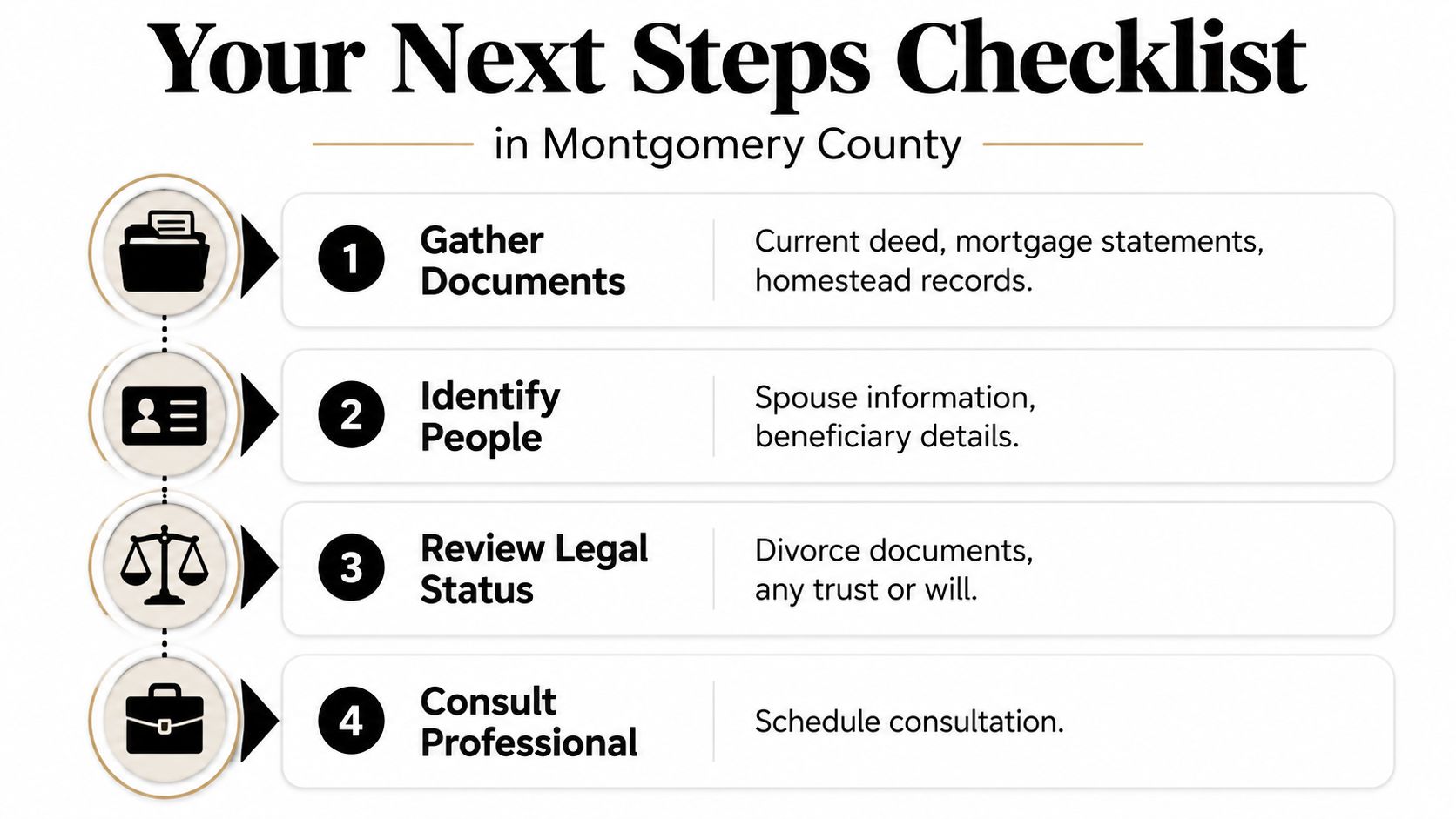
Start with a folder, either paper or digital, containing the documents an attorney will need. Accurate information makes it easier to identify title problems before anyone signs a new instrument.
What to do next
- Gather documents: Collect the current deed, mortgage statements, homestead records, divorce documents, and any trust or will.
- Identify the people involved: Confirm the spouse's information, every beneficiary's full legal name, and what should happen if a beneficiary dies first.
- Confirm ownership: Determine whether the property is community property, separate property, jointly owned, or subject to another recorded interest.
- Check outside requirements: Ask whether a lender or homeowners association has approval or notice requirements.
- Have the plan reviewed: Don't sign a new deed until an attorney has considered ownership, taxes, creditors, Medicaid planning, and the existing estate plan.
- Record correctly: After execution and notarization, record through the Montgomery County Clerk's Office and preserve the returned original or certified copy.
Review the plan after marriage, divorce, death, refinancing, sale, beneficiary disputes, or a change in long-term-care needs. A deed that made sense before a major life event may need to be revoked, replaced, or coordinated with a new will or trust. Families considering broader trust planning can also review these revocable trust forms as part of that conversation.
Call a Texas estate-planning attorney before acting if you're divorced, own the home with a spouse, still have a mortgage, face creditor concerns, may need Medicaid, own the property jointly, or want the deed to work alongside a will or trust. This article is not legal advice, and a consultation is the right place to apply Texas law to your title and family circumstances.
The Law Office of Bryan Fagan helps families in The Woodlands and Montgomery County evaluate estate plans, property transfers, and probate concerns, including whether a Lady Bird deed fits with existing wills or trusts. Visit The Law Office of Bryan Fagan to learn more and schedule a consultation about your home and long-term plan.