
Muniment of title is a Texas probate procedure that can transfer real property to beneficiaries without full estate administration, typically completing in 4–6 weeks when the estate qualifies. For an eligible estate, the court admits the will as a muniment of title and issues an order that can support the transfer and recording of the inherited property.
You may be dealing with this right now. A parent has died, the family wants to sell or refinance a home in The Woodlands, and the deed still shows the parent's name. The title company asks for probate documents before it will insure the transaction. That request can feel like one more problem after an already painful loss, but Texas law provides a focused procedure for situations where the estate doesn't need full administration.
Muniment of title can be the right tool, but only when the will, debts, timing, and property records line up. The hard part often isn't obtaining the order. It's making sure the order and will create a usable title chain in Montgomery County.
What Muniment of Title Means for Woodlands Families
A family inherits a home near Lake Woodlands Drive. Everyone agrees that the property should pass to the named beneficiaries, there's no serious dispute, and the mortgage is the only significant liability. Yet the public deed still identifies the deceased parent as owner. A buyer's title company won't rely on the family's understanding alone. It wants legal authority connecting the decedent to the beneficiaries.
That's where muniment of title fits. Texas Estates Code Chapter 257 allows a court to admit a will as a muniment of title when the court is satisfied that the estate qualifies for this limited procedure. Unlike a traditional administration, the court doesn't appoint an executor or administrator to manage the estate. The order admitting the will supplies authority for custodians, registrars, transfer agents, and others holding estate assets to transfer them without full administration. Texas Estates Code Section 257.001 describes the basic statutory framework.

Why the procedure matters locally
For families in The Woodlands, Conroe, Magnolia, Spring, or nearby Montgomery County communities, the main benefit is focus. If the estate's practical objective is to transfer a house or other real property, opening a full administration may create work that the family doesn't need. A qualifying muniment proceeding can reduce court involvement while still producing an order suitable for recording.
A Texas probate resource directed at The Woodlands states that a qualifying matter may be completed in 4–6 weeks. That timing isn't guaranteed, because missing documents, objections, court scheduling, or title complications can extend the process, but it explains why local families often investigate this option first. The Montgomery County appellate opinion involving Probate Court No. 1 also shows that local courts actively apply Chapter 257 in real disputes.
The procedure is particularly useful when the will clearly identifies the beneficiaries and there's no need to collect assets, resolve creditor claims, operate a business, or litigate competing rights. It isn't a magic deed, and it isn't available just because the family wants a faster answer.
Practical rule: Treat the signed order as the beginning of the title-transfer work, not the end. Recording and title-company follow-up determine whether the property is actually ready for sale or refinance.
Eligibility Requirements Under the Texas Estates Code
For a family in The Woodlands, the key question is not whether a muniment proceeding sounds faster. The question is whether the estate fits the statute and whether the resulting order will support the property's title chain after recording. Texas Estates Code Chapter 257 creates a narrow remedy. The Texas Estates Code provisions governing muniment proceedings must be applied to the facts of the particular estate.
The basic questions the judge must answer
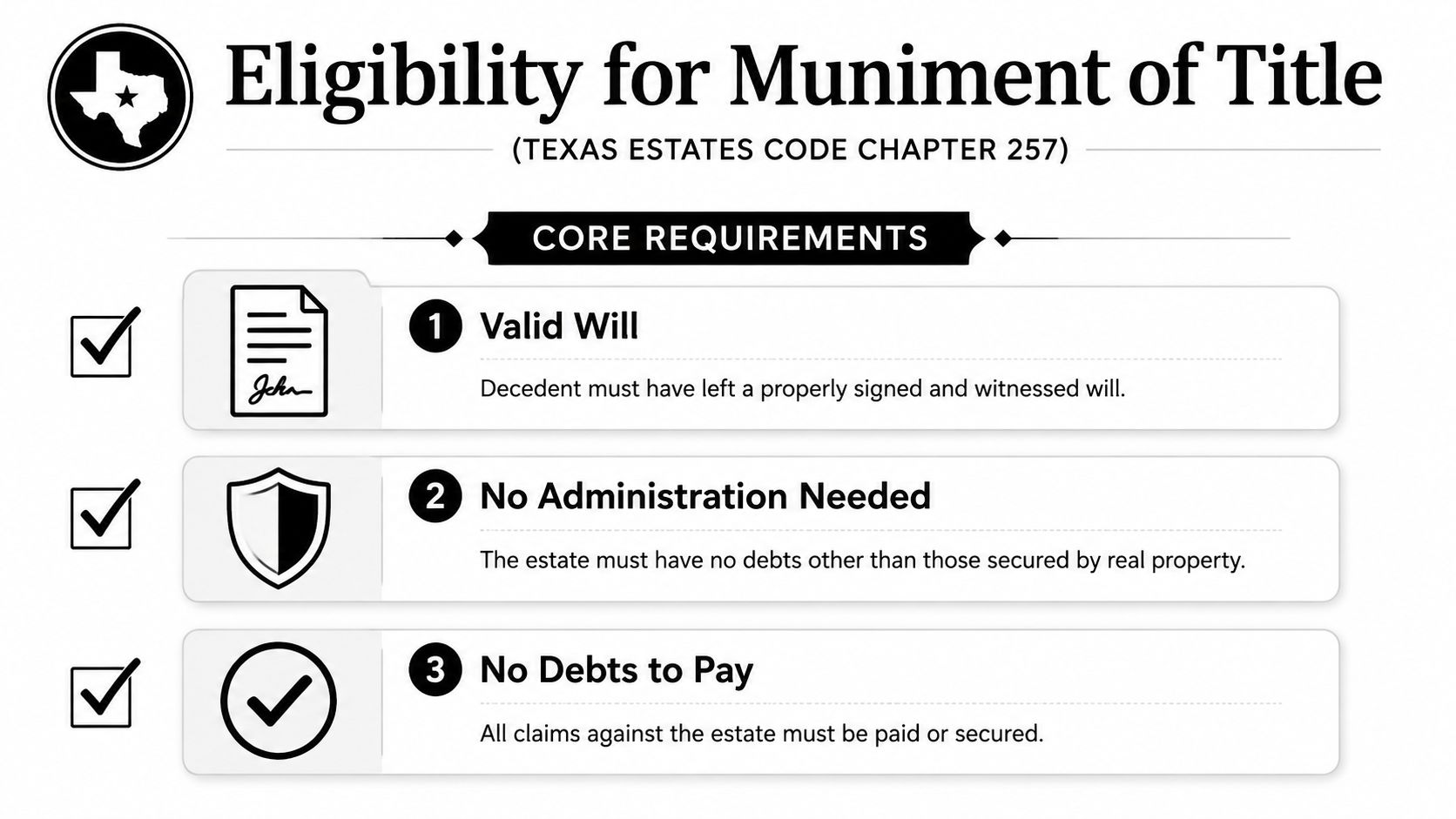
The decedent must have left a will that can be admitted to probate. The will must not have been revoked, and the application must be filed in the proper court with jurisdiction and venue. The applicant must also complete the required citation and notice procedures.
The estate must satisfy the statute's debt limitation. A mortgage or another debt secured by a lien on real estate generally does not disqualify the estate. Unpaid unsecured obligations, including a credit card balance or medical bill, can create a serious problem because administration may be needed to identify, address, or protect creditor claims.
The judge must also find that an executor or administrator is unnecessary. A business interest, disputed ownership, unresolved tax issue, contested will, or complicated asset collection may point toward another probate method. The estate's total value does not decide eligibility by itself. The controlling issue is whether administration is necessary.
Muniment of title generally does not fit an intestate estate, meaning the decedent left no will. The proceeding depends on admitting a valid will as the document directing the transfer. Without one, the family must consider another method.
The order is not a guaranteed shortcut, and it is not available because the family wants a faster answer. In Montgomery County, the post-order title process matters. After the order is recorded, a title company may still request the original will, certified probate documents, proof that notice requirements were met, or evidence connecting the decedent's name to the recorded property description. Those requests do not necessarily mean the order failed. They show why the application, order, and recording package must match the property records.
The four-year deadline
Texas law generally requires a will to be offered for probate within 4 years of the testator's death, unless the applicant proves they were not in default. Texas Estates Code Section 257.054 addresses this limitation and related consequences. Waiting can eliminate the simplest option, particularly when relatives assume an old deed or informal family agreement is enough.
A judge will expect evidence supporting the application's allegations. The file may need the original will, a certified death certificate, information about the decedent's domicile, a property description, the identities and addresses of beneficiaries and interested parties, and evidence concerning debts. A self-proving affidavit can simplify proof of the will. Without one, the case may require additional testimony or witnesses.
Families seeking help with wills, trusts, and estate plans for The Woodlands may consult an Estate Planning Attorney in The Woodlands. Planning before death differs from probate representation afterward, but a properly prepared will can make the later court and title work clearer.
Comparing Muniment of Title to Other Texas Probate Options
Muniment of title is attractive because it avoids the machinery of full administration. That advantage becomes a weakness when the estate has creditor issues, family conflict, or assets that require ongoing management. The right comparison isn't “fast versus slow.” It's whether the chosen procedure can solve every problem the estate presents.
| Probate Method | Typical Cost | Timeline | Court Involvement | Best For |
|---|---|---|---|---|
| Muniment of title | Lower procedural overhead when eligible | Often 4–6 weeks when the estate qualifies | Probate application, notice, hearing, and order | A valid will, clear beneficiaries, and property transfer without needed administration |
| Full independent administration | Varies with the estate's complexity | Depends on assets, claims, and disputes | Court involvement with greater executor authority | Estates needing asset collection, creditor handling, or broader settlement |
| Dependent administration | Varies and can be more involved | Depends on court supervision and estate issues | Ongoing court supervision | Estates requiring structured oversight |
| Small estate affidavit | Depends on statutory eligibility and facts | Can be streamlined when available | Limited court process | Certain intestate estates that meet the applicable requirements |
| Affidavit of heirship | Usually focused on title evidence rather than probate administration | Depends on acceptance by the parties and title professionals | No probate-court order | Establishing heirship when there's no will and the title company accepts the proof |
The table's cost and timing descriptions are qualitative because the facts of each estate control the result. A small estate affidavit for The Woodlands is not interchangeable with muniment of title. Small estate procedures have their own requirements and generally concern intestate estates, while muniment depends on a will.
An affidavit of heirship can help establish family relationships, but it doesn't provide the same probate-court order. Some title companies accept one after the required history and signatures are established. Others may request more evidence, particularly if the family history is complicated or the property is being sold.
Full independent administration makes more sense when the decedent owned a business, held assets in several places, owed disputed debts, or left family members who may contest the will. Dependent administration can be appropriate when court oversight is needed. A Probate Lawyer in The Woodlands, TX may evaluate probate administration and estate settlement issues in Montgomery County, including whether the simpler route is sufficient.
A faster probate path is only better if it leaves the beneficiaries with documents a title company can use.
Filing Steps and Documents for Montgomery County Probate Court
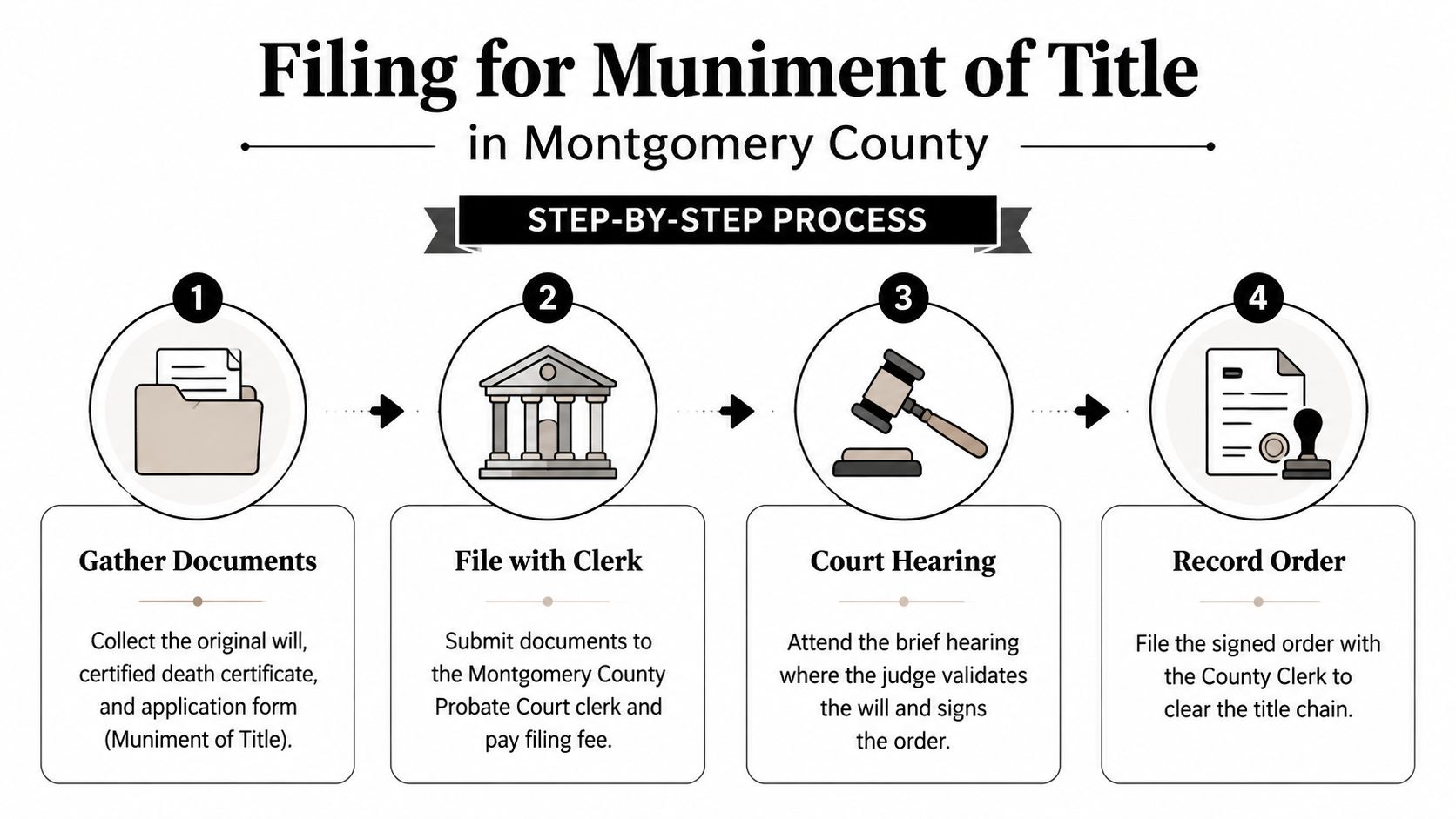
The Montgomery County filing process starts before anyone enters a courtroom. Gather the original will, a certified death certificate, and the property information first. For a Woodlands home, obtain the recorded deed or a preliminary title search so the application and proposed order identify the property accurately.
Build the application around the statute
The Application for Probate of Will as a Muniment of Title should address the facts the court must decide. It typically identifies the decedent, domicile, date of death, the original will, the beneficiaries, the property, and the absence of unpaid debts other than permitted secured liens. It should also explain why full administration isn't needed.
Don't guess about beneficiaries. Identify every person whose rights may be affected and provide the information needed for citation and notice. A missing beneficiary can create an objection, delay the hearing, or leave a title defect that surfaces later.
The applicant should also assemble supporting records, including:
- Original will: The court needs the document offered for probate, not merely an informal copy.
- Certified death certificate: This supports the jurisdictional facts concerning death.
- Property records: A deed history or preliminary title search helps connect the order to the correct legal description.
- Debt information: Collect statements and lien records so the application accurately addresses estate liabilities.
- Self-proving affidavit: If the will includes one, provide it. If it doesn't, determine how the will's execution will be proved.
- Proposed order: A carefully prepared order should identify the will, beneficiaries, and affected property with enough precision for later recording.
File, notice, hearing, and order
The case is filed through the Montgomery County probate court system in Conroe. Filing fees are commonly described as approximately $300–$400, but the exact amount can change and should be confirmed with the clerk before filing. The Montgomery County probate court process can involve local scheduling and procedural requirements that are easy to miss without preparation.
After filing, citation and posting requirements apply. A 10-day waiting requirement generally must pass before the hearing can be scheduled, although the overall calendar depends on the court and the case. The hearing is usually focused. The judge may ask about the will, death, domicile, beneficiaries, debts, and why administration isn't necessary. The applicant or another appropriate witness may need to provide testimony.
A qualifying matter may move from filing to signed order within 4–6 weeks, according to a Woodlands-focused Texas probate resource, but Montgomery County's docket can add delay during busy periods. Bring the proposed order and all required evidence. Don't assume the clerk or judge will draft missing language for you.
The catalog description for Enforcement of Court Orders in The Woodlands concerns divorce decree and custody order provisions in Montgomery County, not probate filings. That distinction matters. A muniment order transfers authority through the probate process, while enforcement remedies address compliance with existing family-law orders.
Recording the Order and Clearing the Title Chain
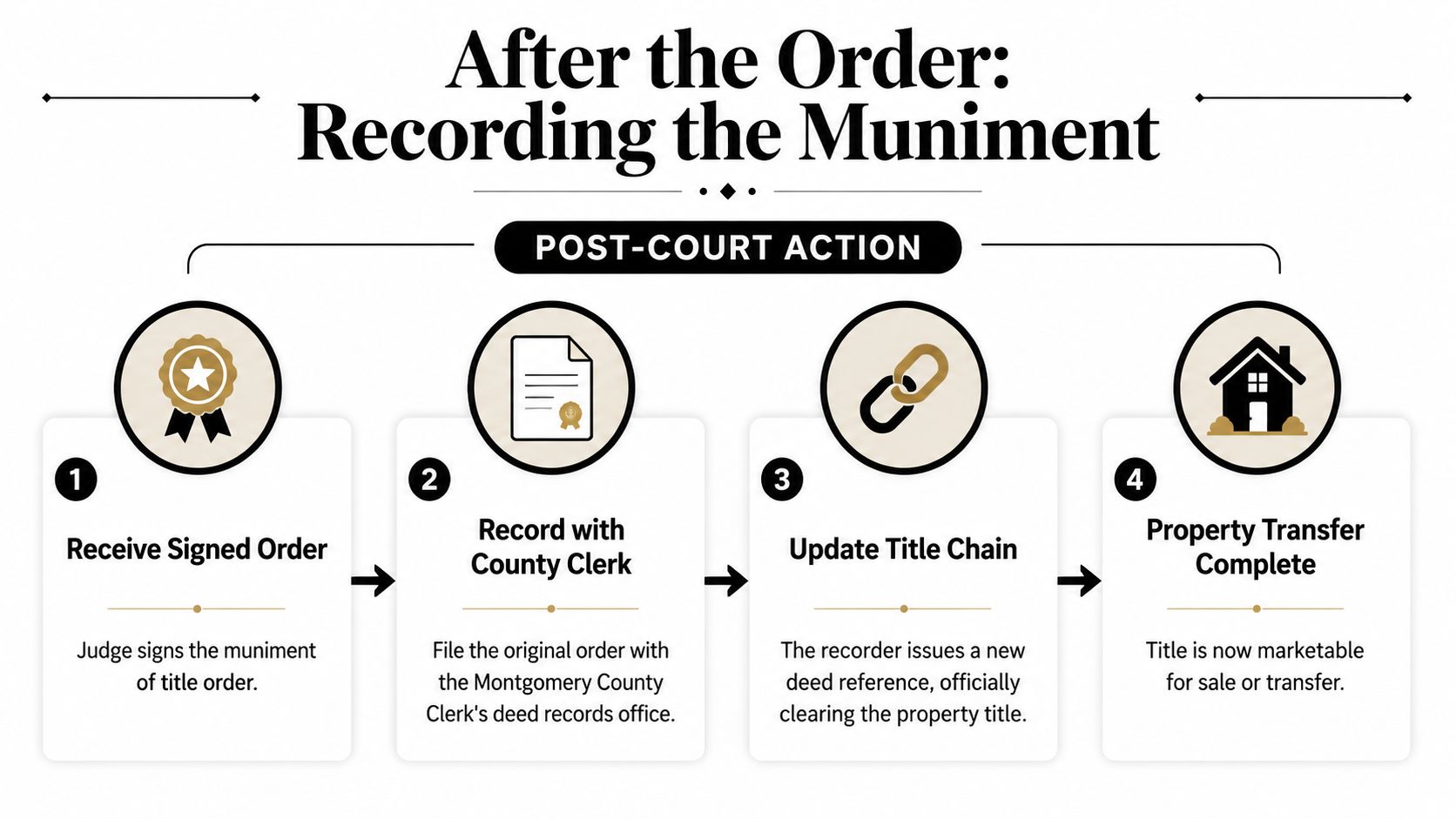
The court order doesn't automatically rewrite the deed records. After the judge signs it, obtain certified copies of the order and the admitted will, then file them with the county clerk where the property is located. For a home in The Woodlands, that generally means recording in Montgomery County property records.
The Texas State Law Library explains that the order and will must be filed with the county clerk where the property is located to help establish the chain of title. Its guide to informal probate methods is useful for understanding why the recording location matters. If the probate case was filed somewhere else, that does not eliminate the need to record in the county where the land sits.
Why title companies ask for more
Recording creates public evidence of the transfer, but title companies still underwrite risk. A company may ask for a certified order, the complete will, proof that notice requirements were satisfied, a title affidavit, or another curative document. It may also ask questions about liens, prior deeds, marital interests, or whether every beneficiary received the interest described in the order.
That request doesn't necessarily mean the probate judge's order was defective. It means the underwriter wants a complete file before insuring a sale or refinance. A muniment proceeding doesn't appoint an executor with letters testamentary, so the title company may look for other documents that establish the same chain of authority.
Record the will with the order whenever appropriate, keep certified copies, and give the title company the complete probate file early. If the underwriter identifies a gap, ask for the request in writing. A title curative affidavit or corrective instrument may resolve a narrow issue, while a larger defect may require additional probate work or another title remedy.
Texas Estates Code Section 257.102 confirms that the order serves as authority for certain custodians, registrars, transfer agents, and other holders of estate assets. It doesn't promise that every private title underwriter will accept an incomplete submission.
Before listing the property: Send the recorded order, recorded will, certified copies, and the legal description to the title company. Let the underwriter identify any curative requirement before a buyer's closing date is at risk.
A transfer-on-death deed is a different planning and transfer tool, not a substitute for repairing a probate title problem after death. Families considering that tool can review information about a Transfer on Death Deed in The Woodlands.
Common Issues and Your Next Steps Checklist
A Woodlands family finished a muniment proceeding and assumed the home could be sold. Two years later, the buyer's title company found that the court order had never been recorded in the property records. The closing stopped while the family collected certified documents and answered the underwriter's demand for more proof. In a serious case, the defect may require a separate title action, adding expense and delay.
The recurring problems are practical. A family may omit a beneficiary, overlook an unsecured credit card balance, delay recording, or assume the will is self-proved without confirming it. Even after a court order is signed, Montgomery County title work can expose gaps in the recorded chain. A title company may still request certified probate documents, the recorded will, a clear legal description, or additional corrective work before insuring a sale or refinance.
What to do next
- Confirm the will: Locate the original and verify that it appears properly signed, witnessed, and self-proved.
- Review the deadline: Confirm the 4-year filing deadline applies to your situation. See the eligibility section above for details on recognized exceptions.
- Review debts: Separate mortgage and other real-property liens from unsecured bills that may require administration.
- Identify everyone affected: List every beneficiary and interested party accurately.
- Trace the property: Obtain the Montgomery County deed history and confirm the legal description.
- Prepare for recording: Plan to record the signed order and will in the county where the property is located.
- Expect title-company questions: Send the recorded order, recorded will, certified copies, and legal description to the underwriter early. Request any additional requirement in writing.
- Call for help early: Consult a Montgomery County probate attorney if the family is blended, the will is contested, debts are disputed, or liens and prior deeds are complicated.
- Schedule a strategy call: The The Law Office of Bryan Fagan can discuss muniment matters and related probate issues involving blended families, contested wills, or complex lien histories.
This is not legal advice. Eligibility depends on the will, debts, timing, notice, property records, and the court's findings in the specific estate.
If you are handling an inherited home in The Woodlands or elsewhere in Montgomery County, schedule a consultation before recording or listing the property. Early review gives your attorney and the title company time to identify defects before they threaten the closing.