 Skip to content
If you're in The Woodlands or elsewhere in Montgomery County, the moment before you call a divorce lawyer often feels the hardest. You may still be living in the same house. You may be trying to keep life normal for the kids. You may also be staring at a kitchen counter covered with bank statements, school papers, and questions you can't neatly organize.
That feeling is normal. It also leads a lot of people to waste their first consultation by showing up with only a general story and no usable records.
Preparation changes that. One published estimate for Texas puts the average divorce cost at $15,600 without children and $23,500 with children, with filing fees reported around $250 to $350, as discussed in Texas divorce cost and process statistics. Those numbers are exactly why a first meeting shouldn't be treated like an informal venting session. It needs to produce strategy.
Your First Step Toward a New Beginning
A common local scenario goes like this. A spouse in Alden Bridge or Sterling Ridge waits weeks before scheduling a meeting because they think they need to be emotionally ready first. By the time they call, they still don't know what accounts exist, whether there are retirement funds in both names, or what the children's weekly routine really looks like on paper.
That approach makes the first meeting harder than it needs to be.
A divorce consultation works best when you treat it as the first organized business meeting of your case. You're not expected to know the law. You are expected to bring the raw material your lawyer needs to evaluate risk, timing, negotiating strength, and next steps.
A prepared client gives an attorney something useful to analyze. An unprepared client gives only a problem to unpack later at higher cost.
In Montgomery County, that practical mindset matters. Judges and court procedures don't stop because a spouse feels overwhelmed. Cases move. Deadlines arrive. Temporary issues about money, the house, and the children often need attention early.
Three things usually make the first consultation productive:
- A basic financial snapshot so property and debt questions can be evaluated.
- A clear list of priorities such as staying in the home, protecting a business interest, or reducing conflict for the children.
- Immediate concern flags including safety issues, hidden accounts, denied visitation, or sudden income changes.
Regarding how to prepare for a divorce consultation in Texas, the short answer is this. Bring facts, not just feelings. Feelings matter, but facts shape what your lawyer can do with them.
Gathering Your Financial and Personal Documents
The time lost chasing records after the first meeting is often underestimated. In Texas, that delay can hurt strategy early. Texas law generally imposes a 60-day waiting period before a divorce can be finalized, and the non-filing spouse typically has 20 days to respond after service, which is why early collection of records matters from the start, as explained in this Texas divorce preparation guide.
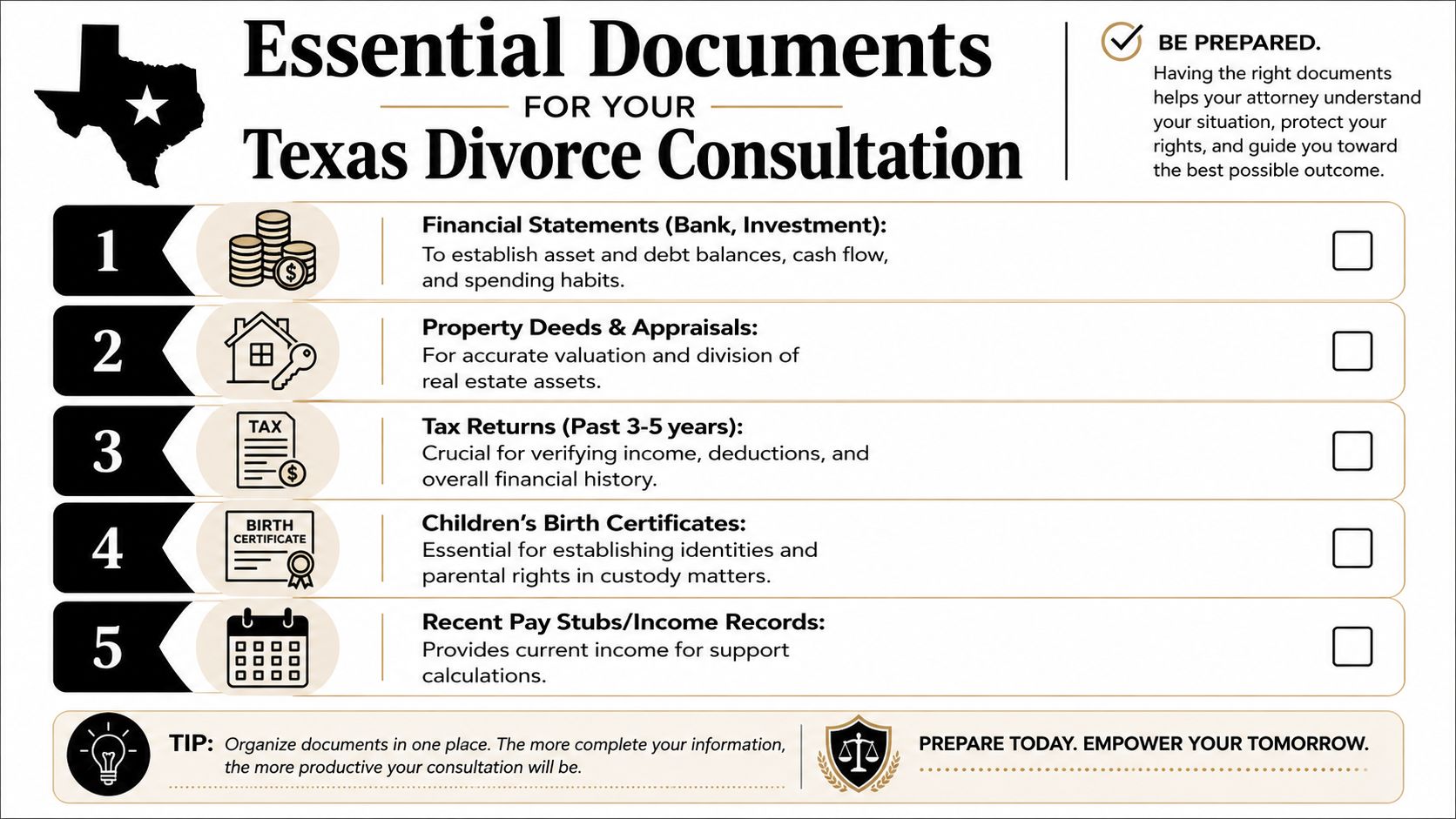
Build the packet before the meeting
Texas is a community property state, and the Texas Family Code governs how courts approach division of marital property in a manner the court considers just and right. That means records aren't busywork. They are the starting point for identifying what exists, what may be separate property, what may be community property, and what still needs to be traced.
A strong first packet usually includes several years of financial records. Practitioner guidance specifically recommends a minimum 5-year financial packet, including tax returns, pay stubs, bank statements, retirement and investment account statements, debt records, property deeds, and any prenup or postnup agreements, as outlined in this Texas divorce checklist.
Practical rule: If a document shows income, ownership, debt, transfers, or account balances, save it.
Here is a simple working table.
| Document Category | Specific Items to Bring |
|---|---|
| Income records | Recent pay stubs, bonus information, self-employment records |
| Tax records | Personal and business tax returns, W-2s, 1099s |
| Bank and cash accounts | Checking, savings, money market statements |
| Retirement and investments | 401(k), IRA, pension, brokerage statements |
| Real property | Deeds, mortgage statements, refinance paperwork, appraisals if available |
| Debts | Credit card statements, personal loans, car notes, student loans |
| Business interests | Ownership records, profit and loss statements, partnership documents |
| Family agreements | Prenuptial agreements, postnuptial agreements, prior court orders |
| Children's records | School calendars, medical information, childcare payment records |
What helps and what doesn't
Some people bring a grocery bag of unopened mail. That's better than nothing, but not by much. What works better is a folder system, digital or paper, with categories clearly labeled.
Good preparation looks like this:
- Group by topic: Put banking together, retirement together, debt together.
- Use complete statements: Bring full monthly statements when possible, not cropped screenshots.
- Mark unknowns: If you suspect an account exists but can't access it, write that down.
- Keep a timeline: Note major events such as separation, job changes, inheritances, home purchases, and large withdrawals.
What doesn't work:
- Selective records: Only bringing documents that support your side usually creates problems later.
- Last-minute downloads: Rushing to collect records in the parking lot usually means important items get missed.
- Memory-based estimates: "I think the account has around…" is not enough for early strategy.
If you expect formal information exchange later, it helps to understand the Texas divorce discovery process. Early organization reduces duplication and makes that stage less expensive and less chaotic.
Protect yourself before you collect records
This is the part many financial checklists miss. If you're worried about coercive control, hidden monitoring, or shared-device access, think about safety before you start downloading sensitive documents.
Texas family-law resources often focus on property and paperwork. They don't always address the practical reality that a spouse may have access to your email, cloud storage, phone account, or location services.
Consider these steps carefully:
- Change account access: Update passwords for email, banking, cloud storage, and your phone account if you can do so safely.
- Review shared devices: If you use a family laptop or tablet, assume your searches and downloads may be visible.
- Check location sharing: Turn off shared location settings if doing so won't escalate risk.
- Create a safe document plan: Store copies somewhere your spouse can't casually access.
- Use secure support when needed: If you need documents notarized but don't want extra in-person exposure, a service like Remote Online Notary can be a practical option depending on the document.
If safety is a concern, don't announce every move. Quiet, careful preparation is usually better than dramatic preparation.
Preparing for Child Custody and Support Discussions
For parents, the consultation usually turns on one question. What is life going to look like for my children?
Under the Texas Family Code, custody issues are handled through conservatorship, possession, and access, with the court focused on the best interest of the child. That legal phrase sounds broad because it is broad. In practice, lawyers need facts that show how your child lives, who handles daily care, and what problems need immediate attention.

A short real-world example helps. Sarah, a mother in Sterling Ridge, comes to her consultation with a simple binder. It includes report cards, a school pickup routine, soccer practice times, pediatrician information, and a calendar showing which parent has handled appointments. That binder gives her attorney a real picture of the child's day-to-day life within minutes.
That's far more useful than saying, "I'm the one who does everything."
Bring the child's life, not just your opinion
The strongest custody preparation is concrete. If you're discussing routine conservatorship and support issues, gather items that show stability and involvement.
Useful materials often include:
- School records: Report cards, attendance notices, teacher communications.
- Medical information: Pediatrician contact details, therapy schedules, medication routines.
- Activity schedules: Sports, tutoring, church, camps, and transportation arrangements.
- Parenting calendars: A simple record of exchanges, overnights, and missed time.
- Child-related expenses: Daycare, medical costs, insurance, extracurricular payments.
For a broader look at court expectations, this parent's guide to your child custody hearing in Montgomery County gives context that many parents find helpful before litigation starts.
If you need urgent orders, bring proof
A routine divorce consultation is different from a crisis consultation. If you need temporary orders for possession, support, or immediate parenting relief, evidence matters more than general frustration.
For parents needing urgent court action, specific proof like screenshots of denied visitation, school calendars, messages about a child's medical needs, or documentation of sudden income changes can be critical, as discussed in questions to ask a divorce lawyer for urgent issues.
If the problem is urgent, bring the proof that shows urgency. Judges don't act on conclusions. They act on evidence.
A few cautions matter here:
- Keep messages complete: Don't bring only the one text that helps you. Bring enough context to understand the exchange.
- Avoid editorializing: A clean timeline is better than a heavily annotated rant.
- Don't coach the child: Your consultation should focus on adult evidence, not pressuring a child to take sides.
Child support discussions also go more smoothly when you bring current income information, health insurance costs, and any unusual child-related expenses. If income recently changed, document when and why.
Key Questions to Ask Your Prospective Attorney
Your first meeting isn't only about telling your story. It's also your chance to evaluate the lawyer. In Montgomery County family cases, local judgment matters. So does candor.

Ask about local fit
A lawyer may know Texas family law and still not be the right fit for your case in The Woodlands or Montgomery County. Ask direct questions that reveal how the attorney thinks, not just what the attorney advertises.
Good local questions include:
- Court familiarity: How often do you handle divorce and custody matters in Montgomery County family courts?
- Judge expectations: What local practices or standing orders should I know about at the outset?
- Case type: Have you handled matters involving business ownership, complex property issues, or urgent temporary orders like mine?
Texas filing rules also matter at the start. To file for divorce in a specific Texas county, at least one spouse must have lived in that county for 90 days, and at least one spouse must meet the state residency requirement, as explained by the Texas State Law Library divorce filing guide. Ask your lawyer to confirm that you can properly file in Montgomery County and whether any county-specific procedures could affect timing.
Ask how the attorney will manage the case
Some questions should test strategy. Others should test communication.
Try questions like these:
- Strategy: Based on what I've told you, does this look more likely to resolve by agreement, mediation, or contested litigation?
- Early priorities: What should I do first, and what should I avoid doing this week?
- Billing: How are calls, emails, drafting, and court appearances billed?
- Communication: Will I mainly work with you, a paralegal, or a team?
A useful consultation leaves you with a realistic path, not a promise of a perfect result.
If you're still comparing counsel, this guide on how to choose a divorce lawyer in The Woodlands can help you frame the decision.
Watch for clear answers
The right attorney for you isn't necessarily the one who sounds the most aggressive. It may be the one who answers hard questions directly, spots the weak points in your case, and tells you what preparation will save time later.
That includes admitting when more records are needed before firm advice can be given. Honest uncertainty is better than confident guessing.
What to Expect During and After the Consultation
Most divorce consultations follow a practical pattern. First, the lawyer gets the basic facts. Then the lawyer asks targeted questions about property, children, safety issues, deadlines, and goals. After that, you should get an initial assessment of likely issues, immediate risks, and what documents or steps come next.
If you're meeting from The Woodlands, Creekside, or another part of Montgomery County, arrive early, bring a written list of concerns, and keep your top priorities short. Three priorities are enough for a first meeting. More than that, and people often lose focus.
The meeting itself
A useful consultation often covers:
- Background facts: Marriage date, children, income sources, property, debts.
- Immediate concerns: Access to money, the home, the children, or personal safety.
- Procedural next steps: Filing, service, temporary orders, disclosures, and court expectations.
- Practical planning: What to gather next and what actions may hurt your position.
If you fear coercive control or digital surveillance, say so early. Most checklists focus on finances and property, but practical safety steps like changing passwords, securing devices, or disabling shared location services before a consultation can be critical, as noted in Texas Law Help family divorce resources.
What happens after
If you decide to hire counsel, the next step is usually a fee agreement and a focused action plan. That may include preparing an Original Petition for Divorce under the Texas Family Code, discussing service, and deciding whether temporary orders are needed for use of the home, parenting schedules, support, or bill payment.
If probate or inheritance issues overlap with the divorce, the Texas Estates Code may also become relevant, especially when separate-property claims or inherited assets are involved.
This article is for informational purposes only. It is not legal advice, and reading it does not create an attorney-client relationship.
Your What to Do Next Checklist
Some people leave a consultation feeling better but still disorganized. Don't let that happen. Use the meeting to create a short action list and start moving.
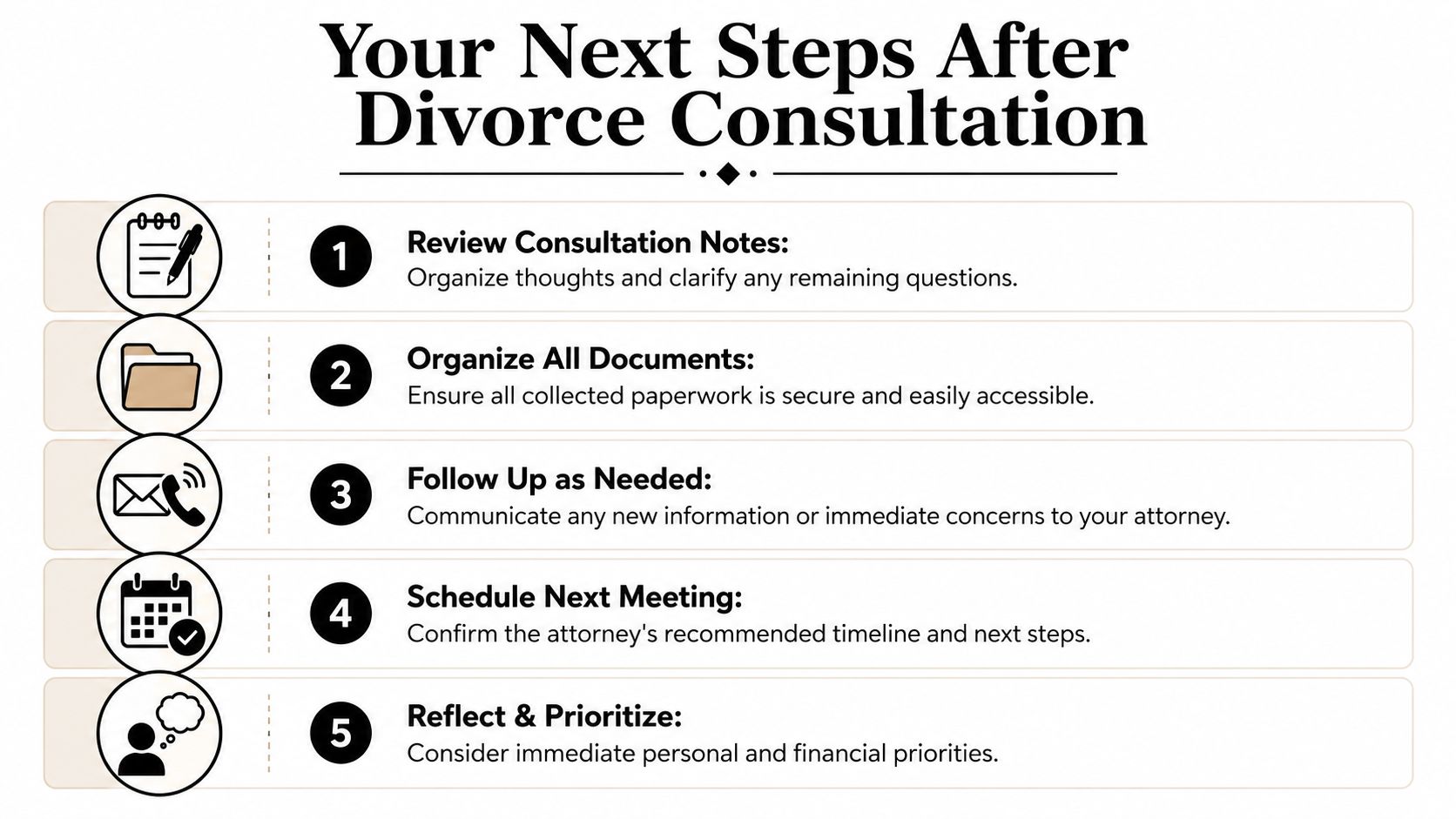
Here is a practical checklist you can use right away:
- Secure your accounts: Update passwords, review shared devices, and protect access to email and financial records.
- Build your file: Gather your financial packet, family agreements, court orders, and child-related records.
- Write down your top three goals: Keep them specific, such as protecting parenting time, understanding the house options, or controlling legal costs.
- List urgent issues separately: Safety concerns, hidden money, denied visitation, or cut-off funds should be easy to spot.
- Prepare your questions: Ask about local filing requirements, likely strategy, communication, and the next step if you hire counsel.
Good preparation won't remove the stress of divorce. It will give that stress a structure. That's a meaningful difference.
If you're in The Woodlands or elsewhere in Montgomery County, and you're ready to take the first step in a more organized way, a consultation can turn uncertainty into a workable plan.
When you're ready, you can schedule a consultation with The Law Office of Bryan Fagan to discuss your situation, your priorities, and the practical next steps for your family.
