 Skip to content
The night before your first divorce hearing in Montgomery County usually doesn't feel legal. It feels personal. You're staring at a folder on the kitchen counter in The Woodlands, rereading texts, wondering what to wear, whether you'll have to speak, and whether the judge will understand what daily life in your house has been like.
That anxiety is normal.
Those searching for what to expect in divorce court in The Woodlands, TX don't really want a textbook summary of divorce law. They want to know what the day will feel like, what the court cares about, and how to avoid making a hard situation worse. That's where practical preparation matters.
A divorce case in Montgomery County is usually less dramatic than people fear, but it is more structured than most expect. Judges are looking for usable facts. Court staff are moving a crowded docket. And the decisions made early, especially at temporary hearings, can shape your schedule, finances, and parenting routine while the case is pending.
This guide is for educational purposes only. It is not legal advice and it does not create an attorney-client relationship. Divorce facts matter, local court practices matter, and your specific situation may call for a different strategy.
Navigating Your Divorce in The Woodlands A First Look
At the start, divorce usually does not feel like a legal case. It feels like a house that has gone tense and quiet. One spouse is sleeping in a different room, the children can tell something has changed, and practical questions start piling up before anyone has a clear plan. Who stays in the home this week. Which bills still get paid. How do school drop-offs work. What happens if one person drains an account or stops helping.
That is a first look at a divorce case in The Woodlands.
In Montgomery County, early court involvement is usually about putting rules in place so daily life does not come apart while the case is pending. The court may need to address possession of the house, parenting time, bill payment, use of vehicles, access to accounts, and contact between the spouses. Clients often come in expecting a final answer on everything. What they usually get first is structure.
That difference matters. It lowers anxiety when you understand what the court is trying to do.
A first hearing is rarely the place for a full history of the marriage. Judges want specific facts they can use. They listen for who has been caring for the children, what the monthly expenses look like, whether anyone is at risk financially, and whether there is a need for immediate boundaries. A calm, organized explanation usually carries more weight than a long account of every betrayal, argument, or insult.
What clients usually worry about before court
The legal issues are only part of the stress. The human part is often what keeps people up the night before.
- Whether you will have to speak: Sometimes you will answer a few questions. Sometimes your lawyer presents most of the evidence. Preparation helps either way.
- Running into your spouse: That may happen in the hallway, courtroom, or waiting area. Expect it so it does not throw you off.
- How you will be perceived: Judges are not grading your marriage. They are trying to make workable decisions based on proof.
- Whether small details matter: They do. A school calendar, a mortgage statement, a pay stub, or a daycare invoice can matter more than a general complaint.
One sentence I give clients often is simple. Tell the judge what affects the children, the bills, the house, and the schedule.
That is the level where these cases are often won or lost early.
What actually helps on day one
The parties who present well in Montgomery County family court are usually the ones who are steady, prepared, and realistic about trade-offs. If you ask for exclusive use of the house, be ready to explain who will pay for it. If you want a certain possession schedule, be ready to explain how it fits school, work, and the children's routines. If support is an issue, bring records. Courts can work with facts.
Practical preparation also means understanding the tone of the day. Dress neatly. Bring a folder, not a stack of loose papers. Turn your phone off. Do not whisper arguments in the hallway where court staff and other families can hear you. If your case involves children, frame your concerns around their routine and stability. That is what the court is listening for.
Divorce court in The Woodlands is really divorce court in Montgomery County. It is formal, busy, and focused on decisions that keep life functioning while the larger case gets sorted out. Once clients understand that, the process usually feels less mysterious and more manageable.
Where Your Case Will Be Heard and Who You Will Meet
For individuals living in The Woodlands, Sterling Ridge, Panther Creek, Alden Bridge, or nearby Montgomery County communities, a divorce case is typically filed in Montgomery County District Court. The filing gatekeeper comes first. Under Texas law, at least one spouse must have lived in Texas for 6 months and in Montgomery County for 90 days before filing, as explained in this Montgomery County divorce process overview.

If you live in The Woodlands, “going to court” usually means going to Conroe, not staying close to home. That matters because you should plan your morning like a courthouse morning, not like a quick office errand.
What the courthouse experience is usually like
Expect a security screening when you enter. Give yourself extra time. Bring only what you need. A neat folder, your identification, and the documents your attorney asked for are usually enough.
Dress like you're attending an important business meeting. You don't need to look expensive. You need to look serious, respectful, and organized.
A few practical habits help:
- Arrive early: Rushing raises stress and causes avoidable mistakes.
- Silence your phone: Court staff notice interruptions immediately.
- Bring paper copies: Don't assume the courtroom is the place to hunt through screenshots.
- Stay measured in the hallway: Judges may not see hallway behavior, but lawyers, staff, and witnesses often do.
Who you will meet in the courtroom
The room feels easier once you know each person's role.
| Person | What they do | What that means for you |
|---|---|---|
| Judge | Makes decisions on disputed issues | Answer clearly and directly if asked |
| Court coordinator | Manages scheduling and settings | This person helps move the docket |
| Bailiff | Maintains order and courtroom procedure | Follow instructions immediately |
| Court reporter | Creates the official record | Speak clearly and avoid talking over others |
| Attorneys | Present evidence and argument | Your lawyer's job is to keep your case focused |
Practical rule: The judge wants usable information, not a running history of the marriage.
What surprises first-time litigants
Many people expect a private, quiet conversation about their family. That isn't what court usually is. It's a working courtroom with other cases, waiting periods, staff movement, and a schedule that may change. You may spend more time waiting than talking.
That doesn't mean your case isn't important. It means the court is managing many important cases at once. The more organized you are, the easier it is for your side to present your position cleanly.
From Filing to Final Decree The Divorce Process Timeline
A divorce case in Montgomery County often feels slow at first, then suddenly urgent. One week you are signing the petition and gathering account statements. The next, you are making decisions about the house, the kids' schedule, and whether a proposed settlement works in real life. Filing starts the court's involvement. It does not put your family on a quick conveyor belt to a final result.
If you need a practical overview of the first step, this guide on filing for divorce in The Woodlands is a helpful starting point.
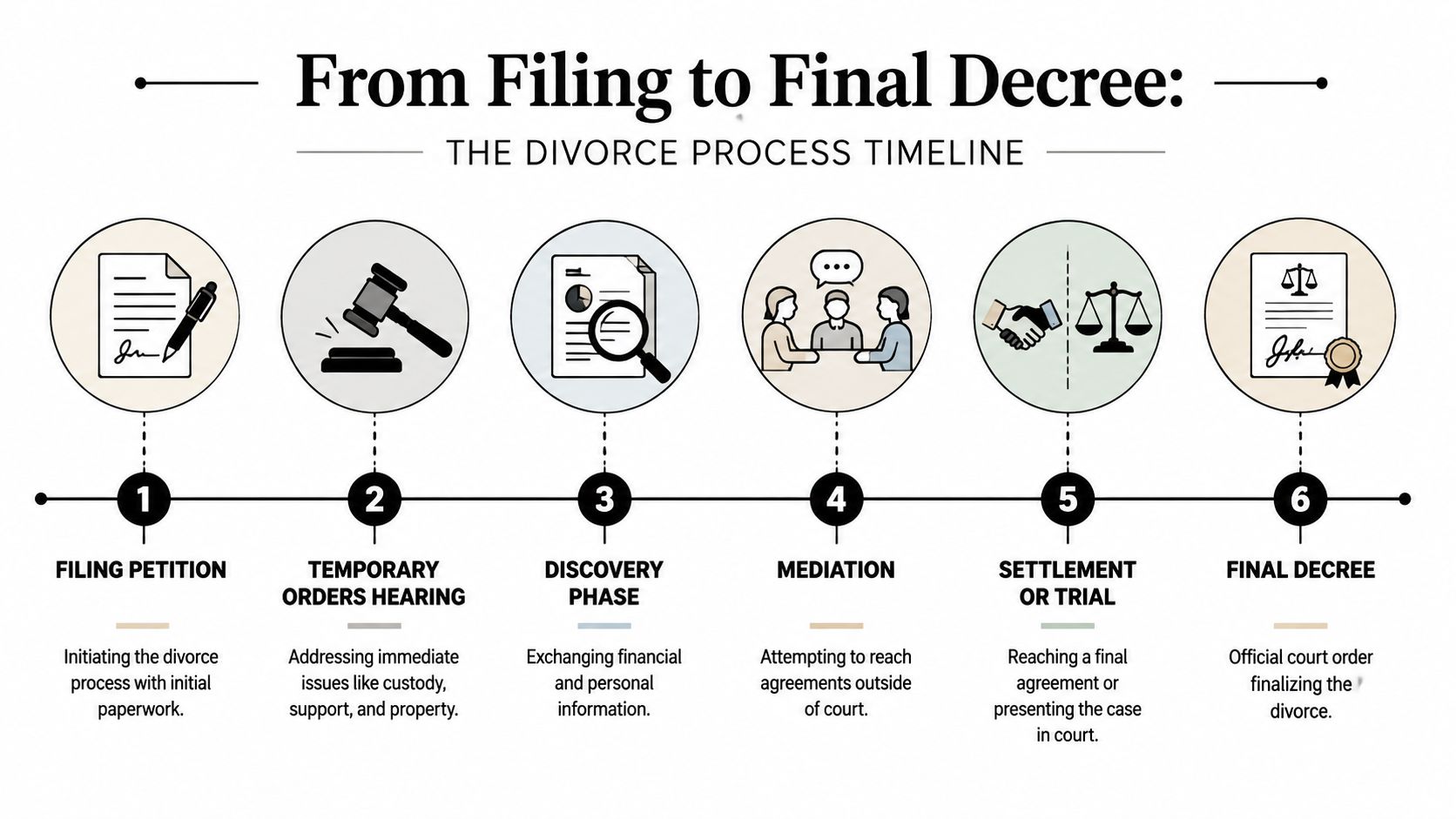
Texas law generally requires a waiting period of at least 60 days after the petition is filed before a divorce can be finalized. In practice, some cases resolve fairly quickly, and others take much longer. The difference usually comes down to conflict level, how organized the parties are, whether temporary issues have to be litigated, and how hard it is to pin down accurate financial information.
Stage one through stage three
The first part of the case is about getting the file opened, bringing the other spouse into the case properly, and putting short-term structure in place.
Filing the petition
One spouse files the original petition for divorce in the correct court. That pleading opens the case and identifies the broad subjects the court may need to address, such as children, property, support, or temporary use of the home.Service or waiver
The other spouse must receive formal notice of the case unless a valid waiver is signed. Service can feel confrontational, but legally it is just the mechanism that gives the court authority to move forward with both parties in the case.Waiting period and early action
The statutory waiting period runs while the case begins to take shape. During that time, lawyers often address immediate problems first. Who is paying which bills, who stays in the house, and what schedule the children follow usually matter more in the opening weeks than the final wording of the decree.
The middle of the case
It's here that the case gets expensive or productive. Sometimes both.
Temporary orders
Temporary orders create rules for daily life while the divorce is pending. In Montgomery County, those rules often cover possession of the house, car use, debt payment, temporary support, and parenting schedules. If the temporary plan is realistic, the case usually becomes easier to settle. If the temporary plan is vague or unworkable, conflict tends to keep resurfacing.
Information exchange
Good decisions require good records. Each side usually needs to produce documents tied to income, debts, accounts, retirement, real property, and sometimes business interests. In parenting disputes, school records, calendars, medical information, and communication history may matter too.
This stage frustrates people because it feels invasive. It is also where weak assumptions get exposed. I often tell clients that a case becomes easier to value once the paper trail catches up with the story.
Negotiation and mediation
Many divorces settle before trial, often after enough information has been exchanged for both sides to assess risk accurately. Mediation is common because it gives the parties more control over the outcome than a courtroom ruling.
There is a real trade-off here. A fast settlement can save money and reduce stress, but speed is not the goal by itself. The better goal is a decree that you can live under six months from now, with clear terms about possession, support, refinancing, sale deadlines, and account division.
The better strategy is usually to press hard on the issues that will still matter after the emotions cool down.
The final stretch
A divorce is final only when the judge signs the final decree after the legal requirements have been met. Even agreed cases usually require a short prove-up hearing. Contested cases may end after mediation, after a final hearing, or after trial, depending on what remains unresolved.
The practical question is not just how long the case will last. It is what needs to happen before a final order is safe to sign.
- Moving quickly works best when both sides are informed and the agreement is detailed.
- Litigating every dispute can increase cost and delay without improving the final result.
- Careful settlement work often produces clearer orders than rushed compromise or broad courtroom requests.
That timeline is not just procedural. It is the period in which finances are documented, parenting arrangements are tested, and settlement positions become more realistic. Clients are often relieved once they understand that delay is not always drift. Sometimes it is the time needed to get the facts straight and avoid signing a decree that creates new problems after the case is over.
Your First Day in Court The Temporary Orders Hearing
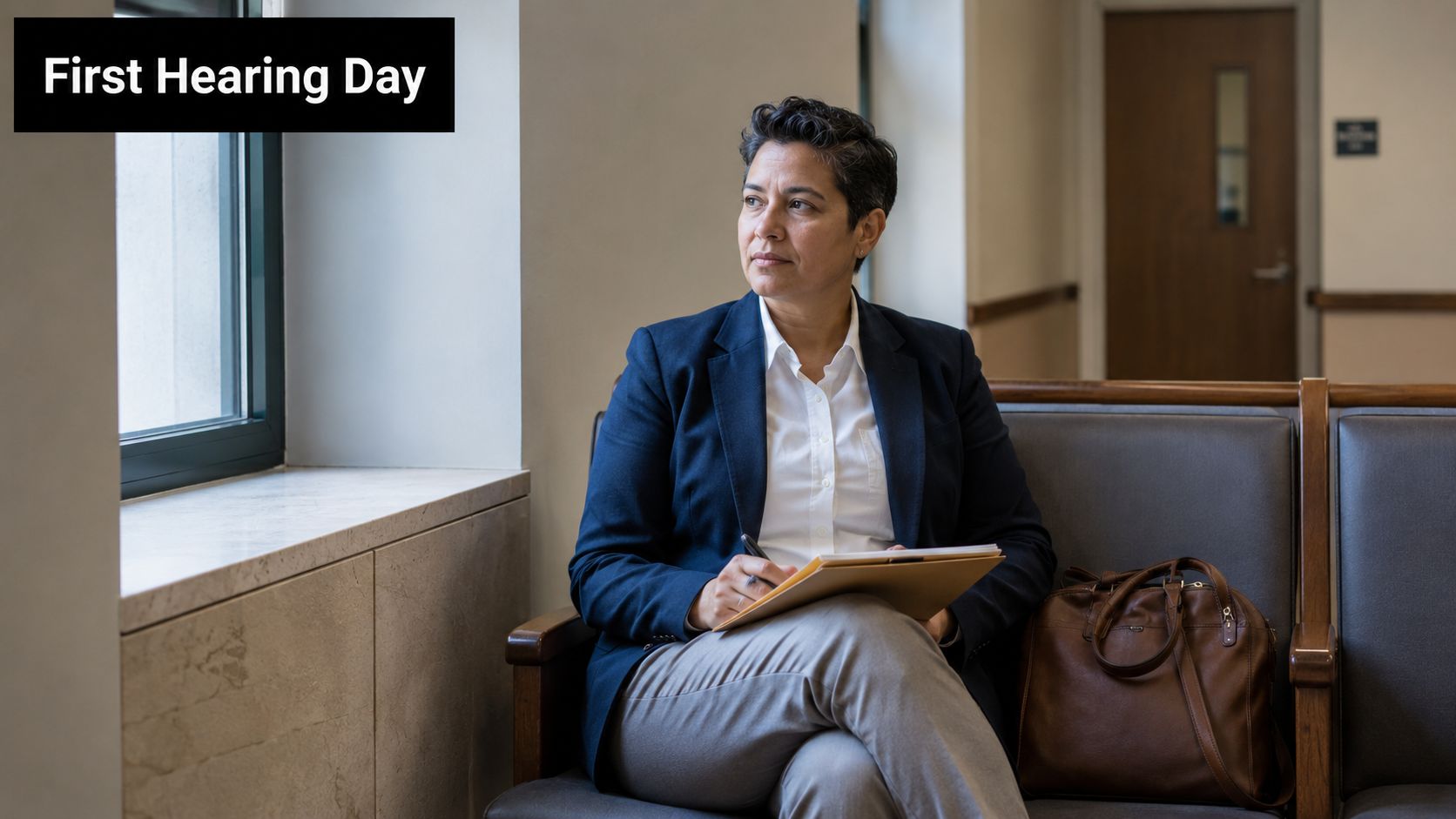
For many families in The Woodlands, the temporary orders hearing is the first moment the case feels concrete. This hearing often addresses who stays in the home, how bills get paid, where the children will be, and what day-to-day structure will apply while the divorce is pending.
If you want a more detailed look at how these hearings work locally, this page on a temporary orders hearing in a Montgomery County divorce is a useful companion.
What the morning usually feels like
You arrive, go through security, find the courtroom, and wait. There may be several other families there for different matters. Your lawyer may speak with opposing counsel in the hallway before the case is called. Sometimes issues narrow before anyone steps in front of the judge.
That waiting period can be hard. Use it well. Review your notes. Stay off social media. Don't start a hallway argument with your spouse. Nothing good comes from trying to win the case in the corridor.
A short local scenario
A parent from Creekside comes into court worried that the judge will want to hear every unfair thing that happened during the marriage. But the urgent issue that day is temporary parenting time and bill payment. The parent who does best is not the one who talks longest. It's the one who can calmly explain the children's school routine, who has handled medical appointments, what the work schedule looks like, and what arrangement would be stable for the next phase of the case.
That's typical.
At a temporary hearing, the court usually needs focused facts tied to immediate decisions. Broad complaints about character often land poorly unless they connect directly to parenting, finances, or safety.
What judges usually want to hear
Judges tend to respond best to testimony that is calm, specific, and grounded in documents.
What works:
- Concrete schedules: School drop-off, pickup, extracurriculars, bedtime routine.
- Clean financial proof: Pay records, account statements, mortgage statements, tax returns.
- Measured testimony: Short answers, direct answers, no speeches.
- Child-focused reasoning: Why a proposed arrangement serves stability.
What doesn't work:
- Interrupting: It signals poor control.
- Overstating: If every issue is described as catastrophic, credibility drops.
- Bringing up every old grievance: The court usually needs current, relevant facts.
- Guessing: If you don't know, say you don't know.
Later in the process, many clients find it helpful to watch a basic courtroom explainer so the setting feels less foreign. This overview can help with that mental preparation.
How to address the judge and carry yourself
Use “Your Honor.” Stand when directed. Don't talk while someone else is speaking. If your lawyer objects, stop talking and wait.
Speak to the judge like a professional speaking to a decision-maker. Calm wins more ground than outrage.
A temporary orders hearing is not the final chapter. But it can set the tone for the rest of the case, which is why careful preparation matters so much.
Property Support and Custody The Heart of the Matter
Most divorce cases in Montgomery County eventually come down to three subjects. Property, children, and support. The legal labels matter, but the practical question is simpler: how will the court structure your life after separation?
Property division in a community property state
Texas follows community property rules. That means most property acquired during the marriage is generally part of the marital estate and subject to a just and right division, rather than automatically being treated as separately owned by default. For a local overview tied to divorce disputes involving homes, accounts, and debts, this page on property division in a The Woodlands divorce is a useful resource.
In plain terms, people often assume title controls everything. It doesn't. A house, retirement funds, or savings accumulated during marriage may be part of the community estate even if one spouse feels more connected to it. The argument that usually matters is not “I care about this more.” It's “Here is how this asset should be classified, valued, and divided.”
Relevant law often starts with the Texas Family Code sections on community property and division of the estate. Those provisions are what anchor the court's approach.
Custody means best interest, not best performance in court
When children are involved, Texas courts focus on the best interest of the child. The local divorce overview from Hannah Law notes that judges consider factors such as parental stability, the child's needs, and evidence of the primary caregiver's role.
That has a practical consequence. A parent usually helps their case more by showing consistency than by attacking the other parent's personality.
Helpful evidence often includes:
- Daily involvement: School communication, doctor visits, activity schedules.
- Stability: Housing, work routine, and ability to meet the child's needs.
- Cooperation: A willingness to support a workable parenting structure.
- Documentation: Records beat general accusations almost every time.
Support issues are usually document-driven
Support disputes often feel emotional because money and fairness are tied together. But in court, support issues are usually built from paperwork, not feelings. Income records, tax returns, recurring expenses, and proof of who is paying what carry most of the weight.
If someone is asking the court for temporary financial relief, they should expect to show why it is needed and what the present financial picture looks like. Vague claims that “I can't manage” are weak without records.
A good rule in all three areas is simple. Bring proof. Organize it. Make it easy for the court to trust what you're saying.
Your Essential Divorce Court Paperwork Checklist
The easiest way to lower anxiety before court is to replace guesswork with a document stack. In divorce court, the strongest presentation is often the best-organized one.

What to gather before a hearing
Financial records
Bring the documents that show income and cash flow.
- Pay records: These help show current earnings.
- Tax returns: Useful for a broader financial picture.
- Bank statements: These show deposits, spending, and account patterns.
Property and debt records
Bring the papers that identify what exists and what is owed.
- Mortgage statements and deeds: Important if the home is in dispute.
- Vehicle loan information: Helpful when cars and debt are being assigned.
- Retirement and investment statements: These often matter in division discussions.
Child-related records
When parenting is disputed, practical records matter.
- School information: Attendance, schedules, and contact history can matter.
- Medical information: Appointment history and insurance details may become relevant.
- Childcare expense records: These help show recurring costs and routine needs.
How to organize the file
Don't walk into court with a grocery bag of paper.
Use a folder or binder with sections. Put the most recent documents on top. If a text message matters, print it and label why it matters. If a calendar matters, make sure it's readable. If your lawyer asked for something, bring it in hard copy.
A judge can't rely on a document nobody can find.
The strongest file is not the thickest one. It's the one that answers the question in front of the court.
What to Do Next Your Action Plan
A lot of clients reach this stage after a sleepless night. They have read too much online, heard three different stories from friends, and now want to know what to do before one bad decision follows them into court. The answer is simple. Get steady, get organized, and stop doing anything that makes you look careless, angry, or impulsive in front of a Montgomery County judge.
Your next steps should make your case easier to explain. Judges usually respond well to parties who are prepared, respectful, and focused on practical problems such as parenting schedules, bill payment, access to the house, and short-term stability.
Your next-step checklist
- Confirm that you can file here: Residency rules matter. Filing in the wrong county wastes time and money.
- Set up one working file: Keep income records, tax returns, bank statements, debt information, and child-related records in one place you can reach quickly.
- Write a clear fact timeline: Include dates of separation, who is living where, the current parenting routine, and any pressing money issues.
- Prepare for a real courthouse morning: Pick conservative clothes, allow time for parking and security, silence your phone, and expect to wait.
- Stop posting about the case: Social media arguments, jokes, and indirect comments often become exhibits.
- Protect the children's routine: Keep school, exchanges, medical appointments, and bedtime as steady as possible.
- Use a reliable system for records and communication: Sloppy document handling causes avoidable problems. For firms and legal teams managing case files and client communication, tools like cloud based law firm software can support secure organization and access.
The goal is not perfection. The goal is credibility.
That usually means avoiding common mistakes. Do not clean out accounts without legal advice. Do not withhold the children to gain bargaining power. Do not show up to court ready to give a speech about every wrong in the marriage if the hearing is about temporary possession, support, or who pays which bill. In Montgomery County courtrooms, the judge often wants the shortest path to a workable temporary arrangement.
Texas family law comes from the Texas Family Code, but your case will be decided by how well the facts are presented in an actual courtroom. Clear records matter. Reasonable conduct matters. So does your tone.
One practical option is to speak with The Law Office of Bryan Fagan, which handles divorce and family law matters in The Woodlands and Montgomery County. A consultation can help you size up the likely pressure points before a hearing, instead of reacting to them at the last minute.
This article is not legal advice. It is a practical overview of what divorce court is usually like in The Woodlands and Montgomery County.
If you need a clearer plan for an upcoming divorce hearing, The Law Office of Bryan Fagan offers consultations for families in The Woodlands and Montgomery County. A focused meeting can help you understand what issues are likely to matter, what documents to bring, and how to prepare for court with less uncertainty.
