 Skip to content
A lot of parents in The Woodlands end up in the same hard spot. Your income drops, your bills don't, and the child support amount in your court order still expects the old version of your finances. You want to keep supporting your child, but you also know you can't keep paying an amount that no longer matches reality.
That pressure gets worse when people try to solve it informally. One text exchange with the other parent can feel easier than filing in court. In Montgomery County, that shortcut is usually the mistake that creates the next problem.
Regarding how to lower child support payments Texas legally, the short answer is simple. You need a court-approved modification. Texas courts won't treat a private agreement, partial payment plan, or temporary understanding as enough.
Your Guide to Modifying Child Support in The Woodlands
In this area, income shifts are common. A parent in The Woodlands may be paid on salary, commissions, bonuses, contract work, or a small business draw. When that income changes, the child support order doesn't automatically adjust with it.
That's where Texas Family Code Chapter 156 matters. It gives parents a legal route to ask the court to change an existing order. The process is real, but it isn't automatic, and it isn't based on what feels fair in the moment. The judge wants a legal basis, reliable paperwork, and a clear reason the current amount no longer fits.
What parents usually get wrong first
Individuals typically don't miss the legal issue. They miss the timing issue.
By the time they call a lawyer, they've often already reduced payments because they lost work, had hours cut, or took a hit in business income. In their mind, the reason is obvious. In court, the existing order still controls until a judge signs a new one.
Practical rule: If your income changed, treat that as a filing problem, not just a budgeting problem.
In Montgomery County cases, the parents who protect themselves best usually act early. They gather income records fast, review the current order carefully, and file before the gap between what they owe and what they can pay turns into an arrears problem.
What this looks like close to home
A parent in Panther Creek loses a position in the energy sector. Another in Creekside sees commission income fall off. A parent in Alden Bridge starts supporting a new child in a second household. Different facts, same question. Can the current order be changed legally?
Sometimes yes. But only if the case fits the standards in the Texas Family Code and the parent can prove it with documents the court can trust.
That distinction matters. A believable story helps. Evidence wins.
Do You Have Legal Grounds for a Child Support Modification
You can't lower child support because the payment feels too high. A Texas court needs legal grounds. Under the Texas Family Code, the most common path is showing a material and substantial change affecting the child or a person under the order.
That phrase sounds broad because it is. But courts still look for real, documented change, not frustration or preference.
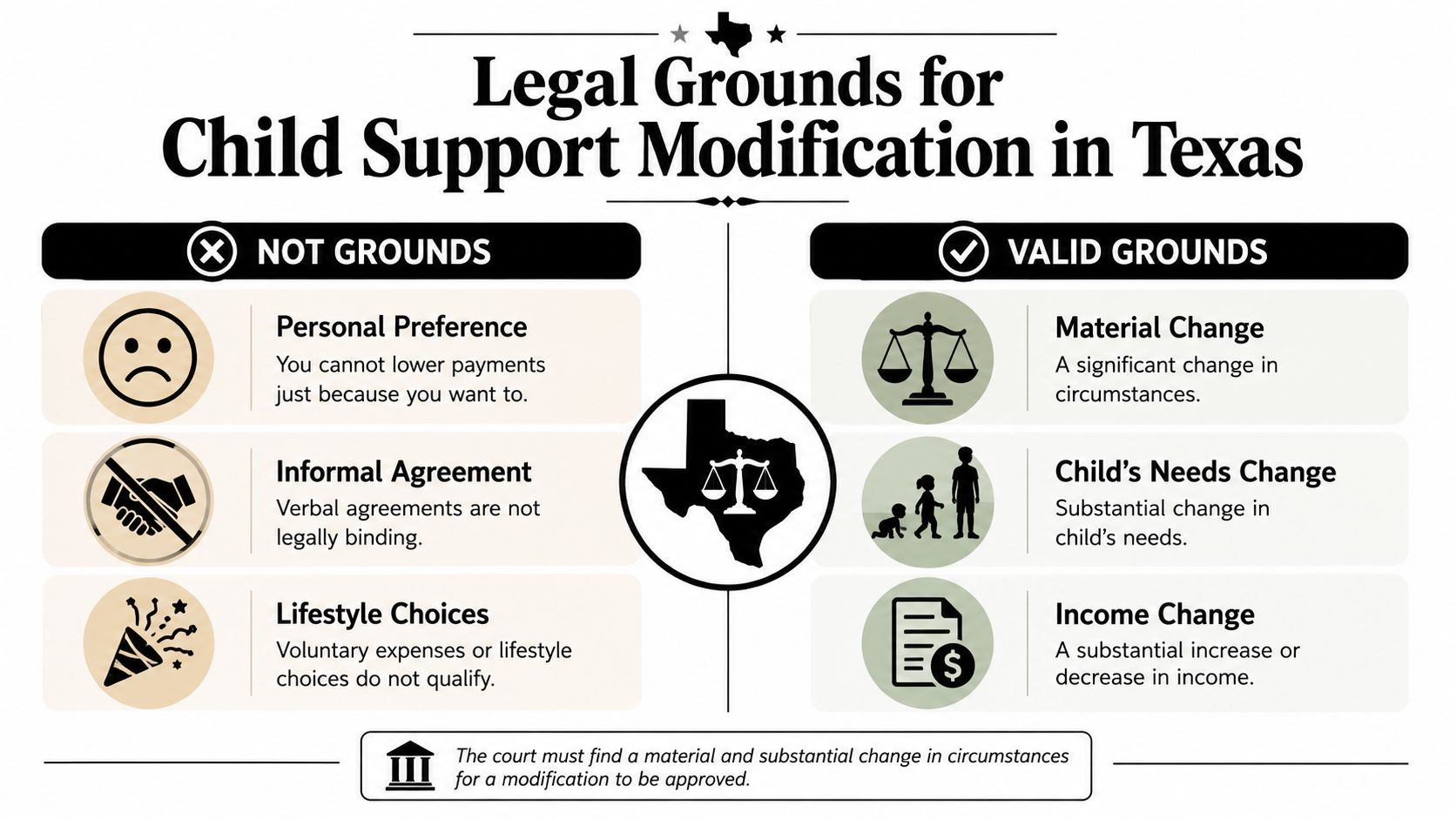
Grounds that often support a modification request
Texas courts commonly treat several life events as potential grounds for modification. The key is proof. As explained in this discussion of modifying child support after an unexpected income drop in Texas, courts commonly recognize involuntary income loss, responsibility for a new child, changes in custody, medical needs, or incarceration as possible grounds, but the parent asking for relief must support the request with documentation. The same source also makes clear that you can't reduce payments on your own after an income drop because the current order remains enforceable until a judge changes it.
In practice, that usually means records like these:
- Employment records: termination notice, layoff paperwork, reduced-hours notice, or compensation change notice
- Income proof: recent pay stubs, tax returns, bank records, or business records if you're self-employed
- Child-related records: insurance documents, school records, or proof of a custody change
- Household changes: proof that you've become legally responsible for another child
Grounds that usually don't work well
Some facts sound important to a parent but don't persuade a judge.
| Situation | Why it usually fails |
|---|---|
| You want a lower payment | Personal preference isn't a legal basis |
| You voluntarily left a better-paying job | The court may view the reduced income as self-created |
| You and the other parent made a side deal | Informal agreements don't change the order |
| Your finances are tight but undocumented | Courts need records, not estimates |
The judge isn't deciding whether your budget feels strained. The judge is deciding whether the legal standard for modification has been proved.
A Montgomery County reality check
Local judges see unsupported modification requests all the time. If you show up in Conroe with rough numbers, missing tax returns, or no explanation for a drop in income, the court may doubt whether the change is substantial, ongoing, or involuntary.
If your change is real, act like it. Build the paper trail first.
How Texas Calculates a New Child Support Amount
Once there's a valid basis to modify, the next question is amount. Texas uses guideline percentages tied to the paying parent's net monthly income. Those percentages matter because they create the starting point for most support calculations.
Under Texas child support modification guidance, the baseline percentages are 20% of net monthly income for one child, 25% for two, 30% for three, 35% for four, 40% for five, and at least 40% for six or more children. The same guidance explains the three-year review rule. If the order is at least 3 years old, and the new guideline amount would differ from the current order by at least 20% or $100 per month, a court may modify the support order.
The guideline percentages at a glance
| Number of children | Guideline share of net monthly income |
|---|---|
| 1 child | 20% |
| 2 children | 25% |
| 3 children | 30% |
| 4 children | 35% |
| 5 children | 40% |
| 6 or more | At least 40% |
If you want a fuller breakdown of how courts in this area apply the formula, this overview of child support guidelines in Montgomery County is a useful starting point.
Why the three-year rule matters
This is one of the most overlooked parts of the law.
Some parents think they must prove a dramatic hardship every time. Not always. If the order is old enough and the recalculated amount is far enough from the current one, the court may have a path to modification under that benchmark.
That doesn't mean the process is casual. It means the focus can shift from proving a major life event to proving the updated numbers correctly.
Takeaway: A strong modification case is often less about argument and more about accurate math backed by complete income records.
What works better than guessing
Parents often estimate income loosely, especially if they're self-employed or paid by commission. That's risky. In a modification case, the court wants credible records and a clean explanation of what changed.
For salaried employees, that may be straightforward. For contractors, small business owners, and sales professionals in The Woodlands, it usually means organizing deposits, tax returns, payroll records, and any evidence showing the difference between temporary fluctuation and a real income drop.
Careful preparation matters. A weak calculation invites skepticism. A documented one gives the court something concrete to work with under the Family Code.
Filing a Modification Suit in Montgomery County Courts
A child support change becomes legal only when a judge signs a new order. Not when the other parent agrees by text. Not when your payroll changes. Not when withholding looks wrong. The signed order is what counts.
For many families in Montgomery County, the process starts with filing a Petition to Modify the Parent-Child Relationship in the court that has continuing jurisdiction over the case.
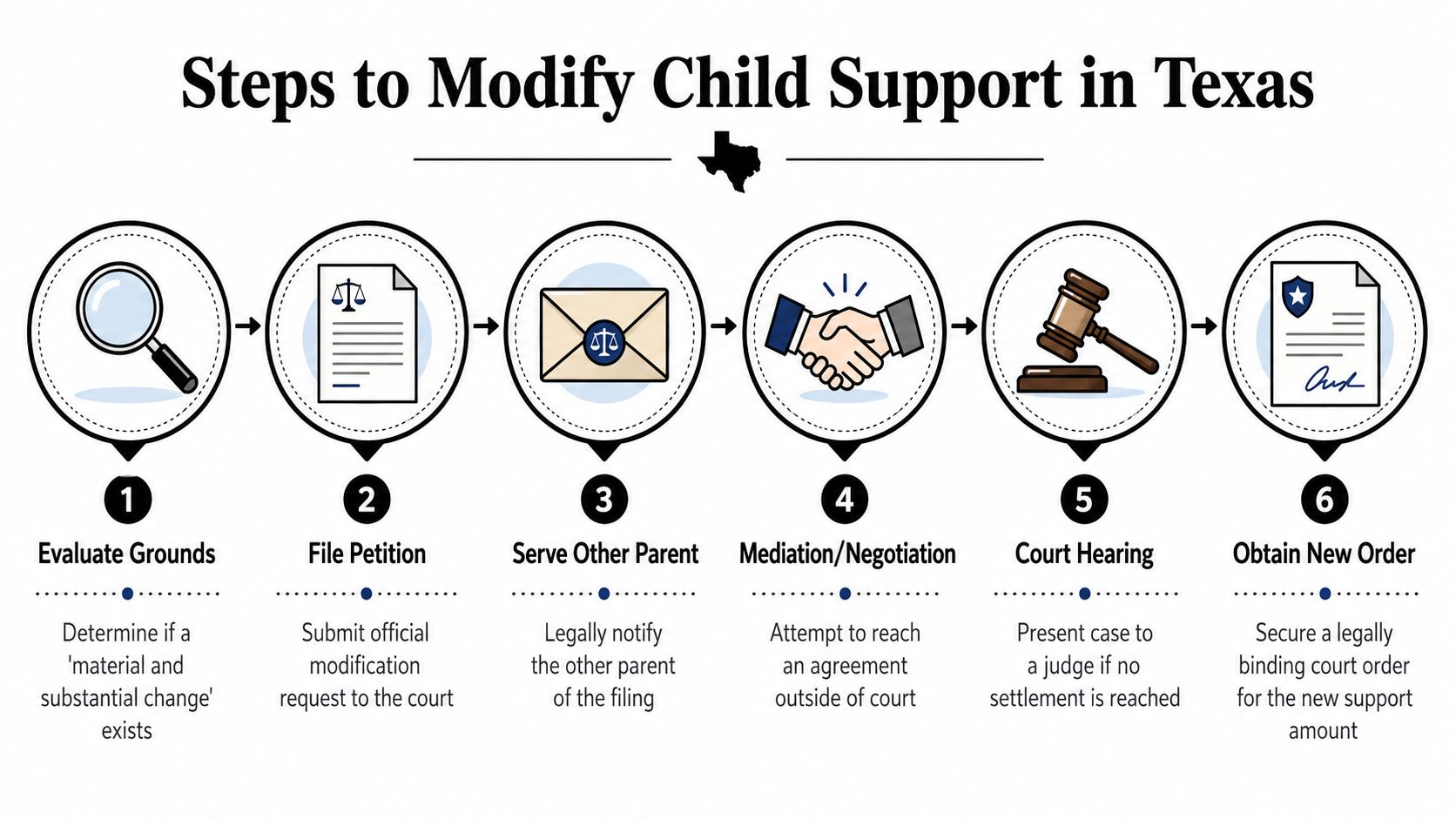
The filing sequence that usually makes sense
The paperwork and scheduling details vary by court, but the usual progression looks like this:
Review the current order
Confirm which court signed it, what it requires, and whether support, medical support, or withholding terms also need to be updated.Prepare the modification petition
The petition should identify the parties, children, existing order, and the legal basis for the requested change under the Texas Family Code.File and serve the other parent
Filing starts the case. Service gives the other side legal notice and starts the response timeline.Exchange financial records
Many cases are won or lost in this step. Missing records create delay and distrust.Negotiate or mediate if possible
Many courts expect a serious effort to resolve the case before final hearing.Present the case for signatures or hearing
If both sides agree, an agreed order may be submitted. If not, the judge decides.
A practical primer on what to expect at a child support hearing in Montgomery County, Texas can help you understand the local court setting before you file.
A short video can also help if you're trying to understand the process visually:
The documents that tend to matter most
Texas Law Help explains that if the order is at least 3 years old and the new guideline amount differs by at least 20% or $100 per month, a court can modify the order, and it notes that the strongest evidence package mirrors what the Office of the Attorney General requests. That includes the case number, county of order, employer and wage data, and proof such as pay stubs, W-2s, and tax returns. It also states that only a signed court order changes the legal obligation. You can review that guidance in Texas Law Help's article on changing a child support order.
For Montgomery County cases, I usually tell parents to think in folders:
- Court folder: signed decree or prior order, cause number, county, and withholding paperwork
- Income folder: pay stubs, W-2s, tax returns, profit-and-loss records, or employer statements
- Change folder: layoff notice, reduced-hours notice, medical records, insurance documents, or school records
- Communication folder: messages with the other parent, but only as background, not as a substitute for the formal process
What local courts tend to expect
Judges in this area generally respond well to organized, straightforward presentations. They don't want drama. They want reliable numbers and a clean explanation.
If you're handling the case yourself, stay disciplined. If you need representation, one option is to consult a local family law office that regularly handles support modifications in Montgomery County, including firms such as The Law Office of Bryan Fagan, where the work typically involves filing modification suits, preparing financial evidence, and appearing in family court on support disputes.
A Parent's Story and Common Modification Mistakes
A father in Alden Bridge loses his job. He and the child's mother talk it through and agree he'll pay less for a while. He keeps making partial payments because that's what he can manage, and he assumes the agreement will protect him.
Months later, the relationship worsens. The mother asks the court to enforce the original order. The father learns the hard way that their private agreement didn't change the legal obligation, and the unpaid difference is still being treated as owed.

That story is common because it feels reasonable at the time. It also creates the exact problem Texas procedure is designed to avoid.
According to Texas Law Help's guidance on stopping child support withholding, only a court order changes the legal obligation, arrears keep accruing until modification is signed, a formal petition is required, and unilateral reduction can create arrears and enforcement exposure. The same guidance points to the safer sequence: keep paying the old amount, file quickly, and document the income change.
Mistakes that create the most damage
Relying on a verbal agreement
This is the biggest one. Even if both parents mean well, the court enforces orders, not side deals.Waiting too long to file
Delay makes everything harder. The financial pressure grows, the records get messier, and the arrearage issue can get larger.Showing up with incomplete records
Courts expect proof. If you're self-employed, that means getting your books in order before the hearing, not during it.Treating a temporary dip like a permanent change
If your income swings month to month, your evidence has to explain whether the change is ongoing or short-lived.
A practical way to steady the process
Parents under support pressure are often juggling work, school pickups, deadlines, and document gathering at the same time. If you're trying to get organized while keeping family life moving, resources on mastering time management as a parent can help you create enough structure to respond quickly and avoid missing court-related tasks.
Waiting for things to "settle down" is usually what turns a manageable modification issue into an enforcement problem.
The mistake pattern is usually the same. The parent assumes the court will understand later. The court expects the parent to have filed earlier.
What to Do Next Checklist and Getting Legal Help
If your income has dropped or your family situation has changed, don't guess your way through it. Get organized and act promptly.
What to do next
Assess the change
Ask whether the change is substantial, real, and something you can prove with paperwork.Pull your current order
Find the signed divorce decree or SAPCR order that sets your present child support terms.Gather your records
Collect tax returns, recent pay information, and documents showing what changed.Keep paying as consistently as you can
Don't assume a private understanding protects you. Keep records of every payment you make.Get local guidance before the hearing date sneaks up
A consultation with a child support lawyer in The Woodlands can help you evaluate grounds, paperwork, and local court procedure in Montgomery County.
Final practical point
Texas Family Code modification cases are often won by preparation, not by emotion. If you're serious about finding how to lower child support payments Texas legally, focus on timing, documentation, and filing the right request in the right court.
Important disclaimer: This article provides general information only and is not legal advice. Family law outcomes depend on the facts of your case, your existing orders, and the court handling the matter.
If you live in The Woodlands, Conroe, Magnolia, Spring, or another nearby Montgomery County community, it often helps to talk through the facts before you file or before arrears become a larger problem.
If you need help evaluating a support modification in Montgomery County, you can schedule a consultation with The Law Office of Bryan Fagan to discuss your current order, your income change, and the procedural steps required to seek relief legally.
