 Skip to content
If you're in The Woodlands or anywhere in Montgomery County, you may already know the feeling. The order made sense a few years ago. Now your child is older, school costs are different, medical expenses have changed, and the support amount doesn't stretch the way it used to.
A lot of parents assume the court will somehow adjust child support once the facts are obvious. It won't. In Texas, support usually changes only when someone asks for a modification and proves why the order should be updated.
This article gives general information about how to increase child support in Texas for families in places like The Woodlands, Conroe, Magnolia, and Spring. It is not legal advice, and it isn't a substitute for getting advice about your specific facts from a Texas family law attorney.
Is It Time for a Child Support Increase
In Montgomery County, this question usually starts with day-to-day pressure, not legal theory. The child needs braces. Insurance changed. One parent's income looks very different than it did when the order was signed. Or the child costs more to raise now than when the case first ended.
That's often the point where a parent starts searching for how to increase child support Texas and realizes something frustrating. Knowing an increase is justified and getting a new court order are two different things.
Common signs the current order may be outdated
Some situations come up again and again:
- Income has changed: The paying parent now earns more, or their compensation structure has improved.
- The child's needs are higher: Medical care, therapy, tutoring, school-related costs, or insurance expenses have increased.
- Possession has shifted: The actual parenting schedule no longer matches what the old order assumed.
- The order is older: If enough time has passed, the current amount may no longer line up with guideline support.
If you want a grounding in how courts approach support generally in this county, it helps to review these child support guidelines in Montgomery County.
Practical rule: If the current amount feels obviously behind real life, don't rely on that feeling alone. Start testing whether the facts fit a legal basis for modification.
What doesn't work
Parents lose time when they rely on approaches that feel reasonable but don't change anything legally.
Those usually include verbal agreements, informal text-message arrangements, or waiting for the other parent to "do the right thing." Even a sincere agreement between parents does not replace a signed court order.
Texas family courts look at formal proof and formal procedure. The good news is that there is a path forward. The hard part is that you have to use it.
The Legal Grounds for a Child Support Modification
A parent in Montgomery County can know the current support amount is too low and still lose if the case is filed on the wrong theory or supported with weak proof. The court does not modify child support because prices went up or because the old number feels unfair. The court modifies support when the request fits the Texas Family Code and the evidence shows why the order should change.
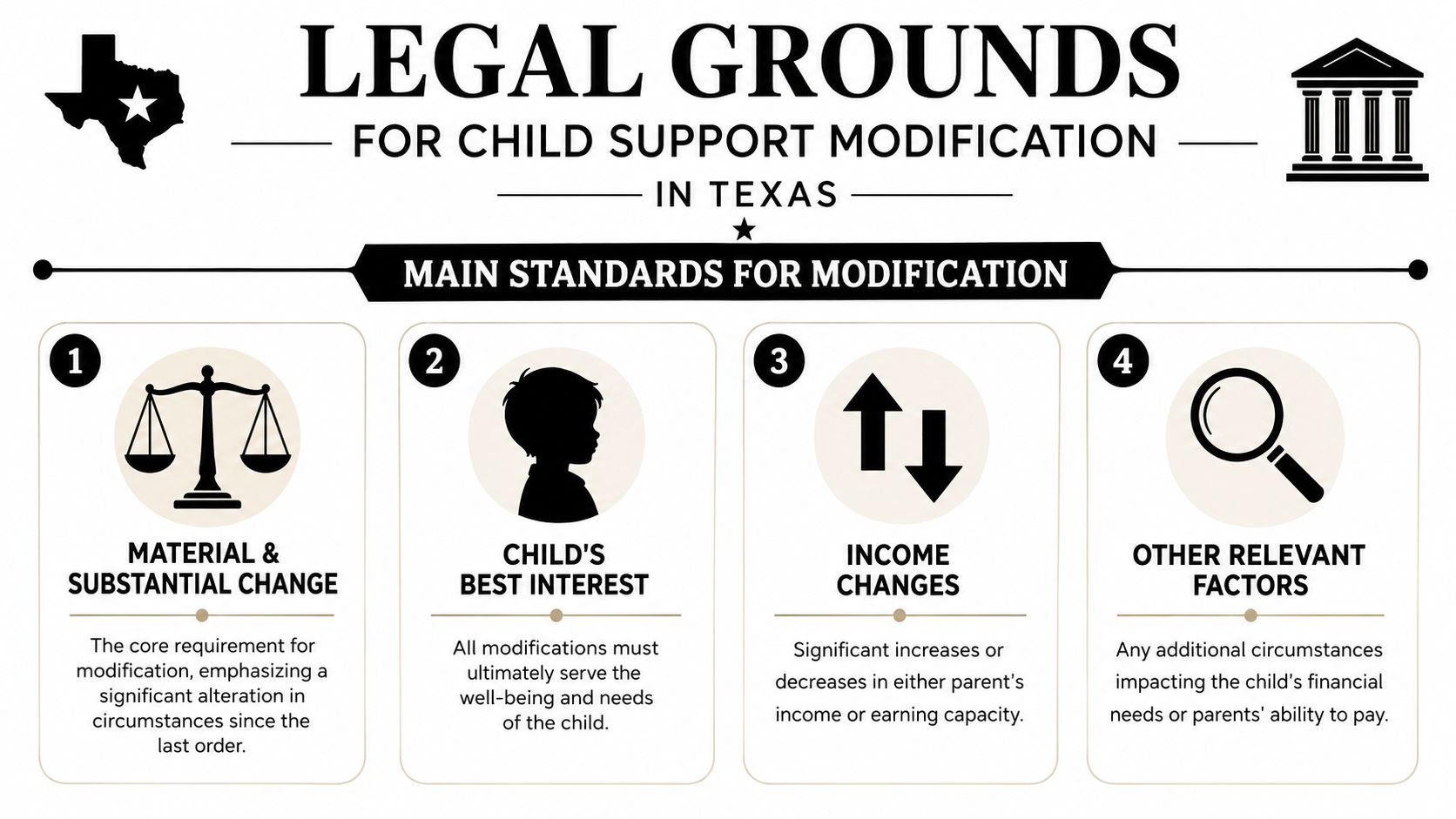
Material and substantial change
The most common legal basis is a material and substantial change in circumstances since the last child support order. That usually means a real change affecting the child, the paying parent, or the parent receiving support. The issue is not whether life looks different in a general sense. The issue is whether the change is large enough, and provable enough, to justify a new order under Texas Family Code Section 156.401.
In practice, I look for changes such as higher income for the obligor, a different possession schedule than the one the old order assumed, increased health insurance costs, or new needs for the child such as medical treatment, counseling, therapy, or educational support. Some changes are straightforward. Others sound significant to a parent but do not move the legal needle unless the records back them up.
That proof problem is where many cases stall. A judge in Montgomery County is not going to increase support because one parent is sure the other got a raise. The court expects pay records, tax documents, insurance costs, and a clear comparison between the facts at the time of the last order and the facts now.
The three-year review rule
Texas also gives parents another route to modification. According to Texas Law Help on changing a child support order, the court may modify support if the current order is at least 3 years old and the monthly amount that would be awarded under the guidelines differs by either 20% or $100 from the existing order.
This rule helps in cases where there has not been one dramatic event, but the numbers no longer match what the guidelines call for. It can be a cleaner path. It is not automatic.
A lot of parents hear "three years" and assume that means the court will update support on request. That is not how it works. The order has to be old enough, and the recalculated guideline amount has to differ enough to meet the legal threshold.
Why timing matters, especially with the 2025 cap increase
Higher-income cases deserve special attention because timing can affect strategy. Texas is scheduled to raise the monthly net-resources cap on September 1, 2025. That change may increase guideline support in cases where the paying parent earns above the current cap.
The mistake I see is waiting and assuming the old order will adjust on its own after that date. It will not. A court order stays in place until a new order replaces it. If no modification is filed and granted, the current amount usually keeps going, even if the law changes in a way that could support a higher number.
That is the practical gap in these cases. Knowing more support should be paid is not the same as having an enforceable order for more support. In Montgomery County, results usually turn on timing, proof, and whether the case is framed correctly from the start.
What the court is actually deciding
Under Chapter 154 of the Texas Family Code, the judge starts with the guideline framework and then looks at whether the requested change is legally supported. In plain terms, the court is asking:
- Has there been a legally significant change since the last order
- Can that change be proven with reliable documents
- Does the new amount fit the guideline calculation, or is there a supported reason to depart from it
- Does the requested modification serve the child's best interest
That last question stays in every child support case. The court is not there to reward one parent or punish the other. The court is deciding what amount should be ordered now, based on the law and the facts that can be proven.
Gathering Your Financial Ammo for a Montgomery County Court
Most child support increase cases are won or lost before the hearing starts. They turn on paperwork. Not drama, not assumptions, not what one parent "knows" the other is making.
If you're trying to increase support in Montgomery County, your job is to assemble a clean financial story. The court needs to see both income capacity and child-cost changes in a way that can be verified.
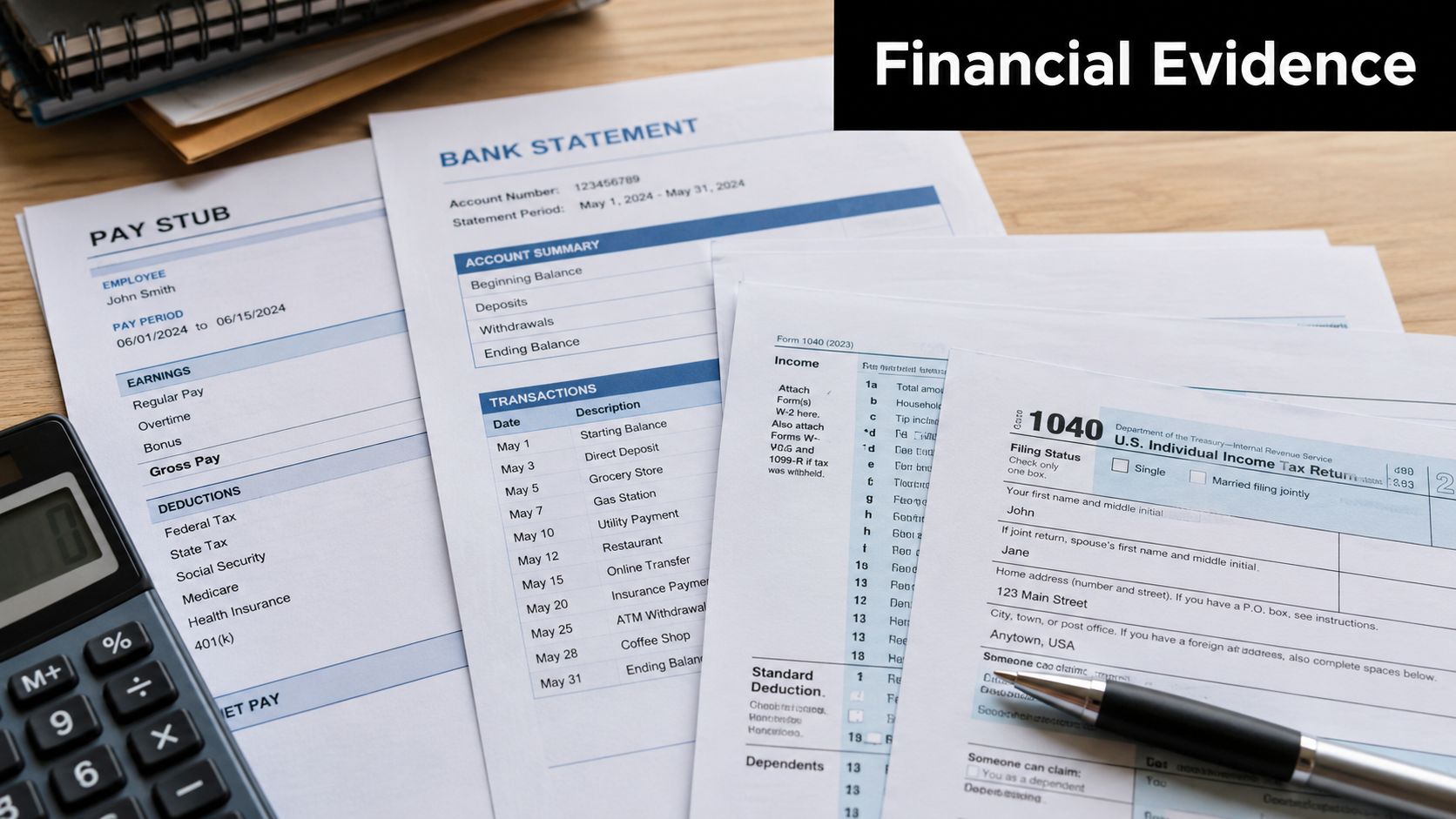
Start with the core income documents
The strongest document package usually includes the records identified in this overview of Texas child support modification evidence: recent pay stubs, tax returns, employer verification, proof of health insurance premiums, medical expense records, and possession/custody evidence.
Here is why each one matters:
- Recent pay stubs: These show current earnings better than an old tax return does, especially if income recently increased.
- Tax returns: These help identify broader income patterns, including self-employment or variable income.
- Employer verification: This can confirm position, compensation, and sometimes changes in employment status.
- Health insurance proof: If premiums affecting the child changed, the court needs the actual numbers and coverage details.
- Medical records and bills: If the child now has higher medical needs, the paperwork has to show the need and the cost.
- Possession evidence: Calendars, school records, and communications may help show that the actual parenting arrangement has changed.
Don't overlook the child's side of the case
Some parents focus only on the other parent's income. That's a mistake. In many upward modification cases, the strongest presentation combines increased earning capacity with increased child-related costs.
Useful records often include:
- School-related expenses: Enrollment documents, activity fees, tutoring invoices, and supply costs.
- Medical and therapy costs: Statements, invoices, and insurance explanations of benefits.
- Insurance changes: Documentation showing new or increased premiums tied to the child.
- Custody and schedule proof: Logs, emails, school pickup records, or other materials showing a change in possession.
The parent who walks into court with organized records usually has a much better chance than the parent who walks in with a list of complaints.
What works in Montgomery County
Judges want specifics. If you're saying the other parent earns more, bring records that support that. If you're saying your child now needs additional support, show the invoices, insurance paperwork, and school documents.
A practical approach is to build one file with sections:
- Current order and date signed
- Proof of the paying parent's current income
- Proof of the child's current expenses
- Proof of insurance and medical costs
- Proof of any possession change
That organization matters more than people think. A clear presentation saves time and reduces confusion.
What usually weakens a case
A few things regularly hurt otherwise valid claims:
- Old documents: If the records are stale, the court may decide they don't reflect current reality.
- Unverified income claims: Social media, rumor, and guesswork rarely carry much weight by themselves.
- Bundled household spending: Courts need child-related facts, not just a general statement that everything costs more.
- Disorganized files: If the judge has to hunt for the point, your argument loses force.
If you're serious about increasing support, treat document gathering like trial prep from day one.
Calculating the New Guideline Child Support Amount
A parent in Montgomery County often gets to this point with a simple question: if the other parent is making more money now, what should support be today, not three years ago when the order was signed?
Texas starts with guideline child support. The court looks at the paying parent's net resources and applies a percentage based on how many children are before the court under Texas Family Code Chapter 154. In many modification cases, that math sets the baseline for settlement talks and for what the judge expects to see at hearing.
The standard percentages
The usual guideline percentages are:
| Number of Children | Guideline Percentage |
|---|---|
| 1 | 20% |
| 2 | 25% |
| 3 | 30% |
| 4 | 35% |
| 5 or more | 40% |
Those percentages sound straightforward. The dispute is usually not the percentage. The dispute is the income number the court should use, what counts as net resources, and whether the case involves enough income for the statutory cap to matter.
If you want a realistic picture of how those issues come up locally, review what a child support hearing in Montgomery County, Texas usually looks like before you walk into court.
The cap change that can affect higher-income cases
Higher-income cases require an extra layer of analysis because guideline support does not apply without limit. For years, the guideline cap has kept some support amounts lower than parents expected, even when the paying parent clearly earned far more.
That cap is scheduled to increase on September 1, 2025, as noted earlier in this article. For some families in The Woodlands, Creekside, Magnolia, and other parts of Montgomery County, that change may materially affect the guideline number.
Here is the practical gap I see in real cases. Parents hear that the cap is going up and assume support will rise on its own. It will not. The old amount stays in place until a new order is signed. If no one files and proves up the modification, nothing changes.
A simple before-and-after example
The guideline math helps show why timing matters.
- One child: At the old cap, guideline support could be about $1,840 per month. At the new cap, it could be about $2,340 per month.
- Five children: At the old cap, guideline support could be about $3,680 per month. At the new cap, it could be about $4,680 per month.
Those are illustrations, not guarantees. Actual support depends on the paying parent's net resources, the number of children before the court, health insurance responsibility, and whether the facts justify a result above or below guideline.
Where parents miscalculate
A lot of modification requests lose steam here because the parent does rough math from gross pay and assumes that is enough. It usually is not.
Net resources are not the same as salary. Overtime, bonuses, commissions, self-employment income, rental income, and certain employment perks may all matter. Some deductions count. Others do not. If the paying parent owns a business or has irregular income, the paper calculation can get messy fast.
That is why two parents can look at the same paycheck and come to very different support numbers.
Real-world trade-offs
Timing matters. So does expectation management.
If the paying parent's income is below the cap, the 2025 increase may have little or no effect on your case. If the current order already tracks guideline support pretty closely, the increase may be modest. If the paying parent's income has climbed well above the current cap, waiting for the new cap might produce a larger guideline figure, but waiting also means more months under an order that no longer fits the facts.
That is the decision point many parents miss. Knowing support should increase is only the starting point. Getting from that instinct to a signed Montgomery County order takes proof, timing, and a calculation the court can trust.
Navigating the Modification Process Step by Step
The process is usually less mysterious once you break it into parts. In Texas, support increases are generally pursued through a formal modification petition. The practical workflow is described in this overview of how to modify child support in Texas: verify the current order, collect income and expense proof, file in the court that issued the original order, and present evidence showing why the guideline calculation should be higher.
In Montgomery County, that often means returning to the same court that signed the original order.
A quick visual helps many parents see the path:

Step one through step three
The first phase is mostly paperwork and positioning.
Review the current order
Read the exact language. Check the date signed, the amount ordered, who carries insurance, and whether there are any unusual terms.File the modification case
The usual pleading is a petition to modify the parent-child relationship. Under Texas Family Code Section 156.401, the filing has to allege a legal basis for changing support.Serve the other parent
The other parent has to receive formal notice. If service isn't handled correctly, the case can stall before it really starts.
If you want a local overview of what this kind of case involves, this page on modifying child support in The Woodlands is a useful starting point.
Step four and step five
Once the case is on file, the facts have to be developed.
The parties may exchange financial information. In some cases that happens informally. In contested cases, it may involve formal discovery. Either way, the goal is the same: reliable proof of current income, insurance costs, and facts affecting support.
Many Montgomery County cases also move through negotiation or mediation before a final hearing. That's often a good thing. A reasonable settlement can save time, expense, and stress, but only if the numbers are grounded in actual records.
Here's a video that gives additional general context on the process:
A short Montgomery County-style scenario
Sarah lives in Sterling Ridge. Her divorce order was entered years ago. Since then, her ex-husband's compensation has changed substantially, and their child now has recurring medical costs and school expenses that weren't part of the original picture.
She doesn't start by accusing him of hiding money. She starts by collecting the old order, recent financial records she already has, insurance information, and records showing what the child now needs. Her attorney files a modification in the same court that issued the original order. After service, the case moves into information exchange. The income records confirm that the support picture is very different now than when the order was signed.
The case doesn't end in a dramatic trial. It resolves in mediation after both sides see the numbers and the legal risk clearly. That outcome is common. Strong preparation often drives settlement.
What helps, and what gets in the way
A few practical points matter in almost every case:
- Help your lawyer with organization: A clean set of records lowers cost and sharpens the argument.
- Keep paying attention to deadlines: Missed settings and incomplete disclosures can slow the case down.
- Don't rely on private side deals: Until a judge signs a new order, the old one still controls.
- Stay focused on provable facts: Emotion is understandable. Evidence is what moves the case.
One option some parents consider is asking the Office of the Attorney General to review support. Another is hiring private counsel for a more specific strategy, especially in contested or higher-income cases. The Law Office of Bryan Fagan handles child support modification matters in The Woodlands and Montgomery County, including cases involving guideline disputes and requests tied to changed financial circumstances.
Your Action Plan What to Do Next
The hardest part for many parents isn't deciding that support should go up. It's taking the first concrete step. Delay is expensive in child support cases because nothing changes until a new order is signed.
If you're weighing how to increase child support Texas, focus on actions you can control now.
What to do next checklist
- Pull your current order: Check the date, the support amount, and the court that issued it.
- Collect income proof: Gather what you have and identify what still needs to be requested or obtained.
- Document child-related costs: Keep medical records, insurance statements, school records, and expense support in one place.
- Compare the old facts to the current facts: Look for a material and substantial change or a strong review issue based on the age of the order.
- Think about timing: If the case may be affected by the upcoming cap change, strategy matters.
- Get legal guidance before filing: Filing first and figuring out the theory later usually creates avoidable problems.
Choosing the right path
Some parents go through the Texas Attorney General's process. That can be useful in straightforward situations.
Others need more direct representation. That's often true when income is disputed, the paying parent is self-employed, the family has higher income, or the support issue is tied to broader custody and enforcement problems. In those cases, local court knowledge matters.
A good modification case is built, not improvised. The parents who do best usually act before the pressure becomes unmanageable.
One practical side issue people miss
Child support and taxes are different topics, but they often get confused in the same conversation. If you're trying to understand how support is treated for tax purposes, this explanation of child support tax rules can help clear up a common area of confusion.
This article is not legal advice. Your facts, your court, and your existing order all matter. If you live in The Woodlands, Conroe, Magnolia, Spring, or elsewhere in Montgomery County and you're considering a child support increase, a consultation can help you figure out whether you have a strong modification case and what to do first.
If you want case-specific guidance, you can schedule a consultation with The Law Office of Bryan Fagan to review your current order, the available financial proof, and the most practical path toward a child support modification in Montgomery County.
